1982 Edition
CIA World Factbook 1982 (Wikisource)
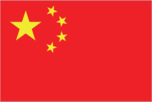
Geography
Coastline
14,500 km
Land boundaries
24,000 km WATER
Limits of territorial waters (claimed)
12 nm
People and Society
Ethnic divisions
94% Han Chinese; 6% Chuang, Uighur, Hui, Yi, Tibetan, Miao, Manchu, Mongol, Pu-I, Korean, and numerous lesser nationalities
Labor force
est. 400 million (mid-1979); 75% agriculture, 25% other; shortage of skilled labor (managerial, technical, mechanics, etc.); surplus of unskilled labor
Language
Chinese (Mandarin mainly; also Cantonese, Wu, Fukienese, Amoy, Hsiang, Kan, Hakka dialects), and minority languages (see ethnic divisions above)
Literacy
at least 25%
Nationality
noun—Chinese (sing., pl.); adjective—Chinese
Population
1,055,304,000 (July 1982), average annual growth rate 1.3%
Religion
most people, even before 1949, have been pragmatic and eclectic, not seriously religious; most important elements of religion are Confucianism, Taoism, Buddhism, ancestor worship; about 2%-3% Muslim, 1% Christian
Government
Branches
before 1966 control was exercised by Chinese Communist Party, through State Council, which supervised more than 60 ministries, commissions, bureaus, etc., all technically under the Standing Committee of the National People's Congress; this system broke down under Cultural Revolution pressures but has been largely restored
Capital
Beijing (Peking)
Communists
about 39 million party members in 1981
Elections
elections held for People's Congress representatives at county level Political parties and leaders: Chinese Communist Party (CCP), headed by Hu Yaobang; Hu is Chairman of Central Committee and was elected at the party's 6th plenum in June 1981; Central Committee was formed at the 11th Party Congress, held in August 1977
Government leader
Premier of State Council ZHAO Ziyang; head of state, Chairman of NPC Standing Committee, YE Jianying; government subordinate to Central Committee of CCP
Legal system
before 1966, a complex amalgam of custom and statute, largely criminal; little ostensible development of uniform code of administrative and civil law; highest judicial organ is Supreme People's Court, which reviews lower court decisions; laws and legal procedure subordinate to priorities of party policy; whole system largely suspended during Cultural Revolution but has been revived as part of the current regime's efforts to rationalize the state and to reintroduce socialist legality; regime has attempted to write civil and Communist codes; new legal codes in effect 1 January 1980
Member of
FAO, IAEA, IBRD, ICAO, IDA, IFAD, IFC, IHO, ILO, IMCO, IMF, ITU, Red Cross, UN, UNESCO, UPU, WHO, WIPO, WMO, other international bodies
National holiday
National Day, 1 October
Official name
People's Republic of China
Other political or pressure groups
the People's Liberation Army (PLA) remains a major force, although many military officers who acquired a wide range of civil political-administrative duties during the Cultural Revolution have been either returned to primarily military positions or removed; many veteran civilian officials, in eclipse since the Cultural Revolution, have been reinstated; mass organizations, such as the trade unions and the youth league, have been rebuilt
Political subdivisions
21 provinces, 3 centrally governed municipalities, and 5 autonomous regions
Suffrage
universal over age 18
Type
Communist state; real authority lies with Communist Party's Political Bureau; the National People's Congress, in theory the highest organ of government, usually ratifies the party's programs; the State Council actually directs the government
Economy
Agriculture
main crops—rice, corn, wheat, miscellaneous grains, oilseed, cotton; agriculture mainly subsistence; grain imports 13.7 million metric tons in 1980 Major industries: iron and steel, coal, machine building, armaments, textiles, petroleum
Crude steel
34.48 million metric tons produced, 30 kg per capita (1979)
Electric power
66,000,000 kW capacity (1980); 301.0 billion kWh produced (1980), 290 kWh per capita
Exports
$13.8 billion (f.o.b., 1979); agricultural products, oil, minerals and metals, manufactured goods
Fiscal year
calendar year
GNP
$552 billion (1980), $538 per capita
Imports
$14.5 billion (c.i.f., 1979); grain, chemical fertilizer, steel, industrial raw materials, machinery and equipment
Major trade partners
Japan, Hong Kong, US, West Germany, Romania, Australia, Canada, UK, France, USSR (1979)
Monetary conversion rate
as of 9 September 1980, about 1.46 yuan=US$1 (arbitrarily established)
Shortages
complex machinery and equipment, highly skilled scientists and technicians, electricity
Communications
Airfields
372 total; 270 with permanent-surface runways; 10 with runways 3,500 m and over; 66 with runways 2,500 to 3,499 m; 230 with runways 1,200 to 2,499 m; 62 with runways less than 1,200 m; 2 seaplane stations; 4 airfields under construction
Highways
about 890,000 km all types roads; almost half (about 350,000 km) unimproved natural earth roads and tracks; about 280,000 km improved earth roads about 2- to 5-meters wide and in poor to fair condition; remainder (about 260,000 km) includes majority of principal roads
Inland waterways
169,000 km; 40,200 km navigable by modern motorized craft
Ports
21 major, approximately 180 minor
Railroads
networks total about 52,500 route km common-carrier lines; about 600 km meter gauge (1.00 m); rest standard gauge (1.435 m); all single track except 9,345 km double track on standard gauge lines; approximately 1,520 km electrified; about 10,000 km industrial lines (gauges range from 0.762 to 1.435 m)
Military and Security
Military manpower
males 15-49, 274,548,000; 153,482,000 fit for military service; 11,372,000 reach military age (18) annually