2011 Edition
CIA World Factbook 2011 Archive (HTML)
Introduction
Background
Prior to the arrival of the Spanish in the 16th century, the Inca ruled northern Chile while the indigenous Mapuche inhabited central and southern Chile. Although Chile declared its independence in 1810, decisive victory over the Spanish was not achieved until 1818. In the War of the Pacific (1879-83), Chile defeated Peru and Bolivia and won its present northern regions. It was not until the 1880s that the Mapuche Indians were completely subjugated. After a series of elected governments, the three-year-old Marxist government of Salvador ALLENDE was overthrown in 1973 by a military coup led by Augusto PINOCHET, who ruled until a freely elected president was installed in 1990. Sound economic policies, maintained consistently since the 1980s, have contributed to steady growth, reduced poverty rates by over half, and have helped secure the country's commitment to democratic and representative government. Chile has increasingly assumed regional and international leadership roles befitting its status as a stable, democratic nation.
Geography
Area
- 756,102 sq km 743,812 sq km 12,290 sq km includes Easter Island (Isla de Pascua) and Isla Sala y Gomez
- total
- 756,102 sq km
- water
- 12,290 sq km
Area - comparative
slightly smaller than twice the size of Montana
Climate
temperate; desert in north; Mediterranean in central region; cool and damp in south
Coastline
6,435 km
Elevation extremes
- Pacific Ocean 0 m Nevado Ojos del Salado 6,880 m
- highest point
- Nevado Ojos del Salado 6,880 m
- lowest point
- Pacific Ocean 0 m
Environment - current issues
widespread deforestation and mining threaten natural resources; air pollution from industrial and vehicle emissions; water pollution from raw sewage
Environment - international agreements
- Antarctic-Environmental Protocol, Antarctic-Marine Living Resources, Antarctic Seals, Antarctic Treaty, Biodiversity, Climate Change, Climate Change-Kyoto Protocol, Desertification, Endangered Species, Environmental Modification, Hazardous Wastes, Law of the Sea, Marine Dumping, Ozone Layer Protection, Ship Pollution, Wetlands, Whaling none of the selected agreements
- party to
- Antarctic-Environmental Protocol, Antarctic-Marine Living Resources, Antarctic Seals, Antarctic Treaty, Biodiversity, Climate Change, Climate Change-Kyoto Protocol, Desertification, Endangered Species, Environmental Modification, Hazardous Wastes, Law of the Sea, Marine Dumping, Ozone Layer Protection, Ship Pollution, Wetlands, Whaling
- signed, but not ratified
- none of the selected agreements
Freshwater withdrawal (domestic/industrial/agricultural)
- 12.55 cu km/yr (11%/25%/64%) 770 cu m/yr (2000)
- per capita
- 770 cu m/yr (2000)
- total
- 12.55 cu km/yr (11%/25%/64%)
Geographic coordinates
30 00 S, 71 00 W
Geography - note
strategic location relative to sea lanes between Atlantic and Pacific Oceans (Strait of Magellan, Beagle Channel, Drake Passage); Atacama Desert is one of world's driest regions; the crater lake of Ojos del Salado is the worlds highest lake (at 6,390m)
Irrigated land
19,000 sq km (2008)
Land boundaries
- 6,339 km Argentina 5,308 km, Bolivia 860 km, Peru 171 km
- border countries
- Argentina 5,308 km, Bolivia 860 km, Peru 171 km
- total
- 6,339 km
Land use
- 2.62% 0.43% 96.95% (2005)
- arable land
- 2.62%
- other
- 96.95% (2005)
- permanent crops
- 0.43%
Location
Southern South America, bordering the South Pacific Ocean, between Argentina and Peru
Map references
South America
Maritime claims
- 12 nm 24 nm 200 nm 200/350 nm
- contiguous zone
- 24 nm
- continental shelf
- 200/350 nm
- exclusive economic zone
- 200 nm
- territorial sea
- 12 nm
Natural hazards
- severe earthquakes; active volcanism; tsunamis Chile experiences significant volcanic activity due to the more than three-dozen active volcanoes situated within the Andes Mountains; Lascar (elev. 5,592 m), which last erupted in 2007, is the most active volcano in the northern Chilean Andes; Llaima (elev. 3,125 m) in central Chile, which last erupted in 2009, is another of the country's most active; Chaiten's 2008 eruption forced major evacuations; other notable historically active volcanoes include Cerro Hudson, Copahue, Guallatiri, Llullaillaco, Nevados de Chillan, Puyehue, San Pedro, and Villarrica
- volcanism
- Chile experiences significant volcanic activity due to the more than three-dozen active volcanoes situated within the Andes Mountains; Lascar (elev. 5,592 m), which last erupted in 2007, is the most active volcano in the northern Chilean Andes; Llaima (elev. 3,125 m) in central Chile, which last erupted in 2009, is another of the country's most active; Chaiten's 2008 eruption forced major evacuations; other notable historically active volcanoes include Cerro Hudson, Copahue, Guallatiri, Llullaillaco, Nevados de Chillan, Puyehue, San Pedro, and Villarrica
Natural resources
copper, timber, iron ore, nitrates, precious metals, molybdenum, hydropower
Terrain
low coastal mountains; fertile central valley; rugged Andes in east
Total renewable water resources
922 cu km (2000)
People and Society
Age structure
- 22.3% (male 1,928,210/female 1,840,839) 68.1% (male 5,751,091/female 5,744,014) 9.6% (male 680,450/female 944,156) (2011 est.)
- 0-14 years
- 22.3% (male 1,928,210/female 1,840,839)
- 15-64 years
- 68.1% (male 5,751,091/female 5,744,014)
- 65 years and over
- 9.6% (male 680,450/female 944,156) (2011 est.)
Birth rate
14.33 births/1,000 population (2011 est.)
Children under the age of 5 years underweight
0.5% (2008)
Death rate
5.97 deaths/1,000 population (July 2011 est.)
Drinking water source
- urban: 99% of population rural: 75% of population total: 96% of population urban: 1% of population rural: 25% of population total: 4% of population (2008)
- rural
- 25% of population
- total
- 4% of population (2008)
- urban
- 1% of population
Education expenditures
4% of GDP (2008)
Ethnic groups
white and white-Amerindian 95.4%, Mapuche 4%, other indigenous groups 0.6% (2002 census)
Health expenditures
8.2% of GDP (2009)
HIV/AIDS - adult prevalence rate
0.4% (2009 est.)
HIV/AIDS - deaths
NA
HIV/AIDS - people living with HIV/AIDS
40,000 (2009 est.)
Hospital bed density
2.1 beds/1,000 population (2009)
Infant mortality rate
- 7.34 deaths/1,000 live births 8.1 deaths/1,000 live births 6.55 deaths/1,000 live births (2011 est.)
- female
- 6.55 deaths/1,000 live births (2011 est.)
- total
- 7.34 deaths/1,000 live births
Languages
Spanish (official), Mapudungun, German, English
Life expectancy at birth
- 77.7 years 74.44 years 81.13 years (2011 est.)
- female
- 81.13 years (2011 est.)
- total population
- 77.7 years
Literacy
- age 15 and over can read and write 95.7% 95.8% 95.6% (2002 census)
- definition
- age 15 and over can read and write
- female
- 95.6% (2002 census)
- male
- 95.8%
- total population
- 95.7%
Major cities - population
SANTIAGO (capital) 5.883 million; Valparaiso 865,000 (2009)
Maternal mortality rate
26 deaths/100,000 live births (2008)
Median age
- 32.1 years 31.1 years 33.1 years (2011 est.)
- female
- 33.1 years (2011 est.)
- male
- 31.1 years
- total
- 32.1 years
Nationality
- Chilean(s) Chilean
- adjective
- Chilean
- noun
- Chilean(s)
Net migration rate
0 migrant(s)/1,000 population (2011 est.)
Obesity - adult prevalence rate
21.9% (2003)
Physicians density
1.09 physicians/1,000 population (2003)
Population
16,888,760 (July 2011 est.)
Population growth rate
0.836% (2011 est.)
Religions
Roman Catholic 70%, Evangelical 15.1%, Jehovah's Witnesses 1.1%, other Christian 1%, other 4.6%, none 8.3% (2002 census)
Sanitation facility access
- urban: 98% of population rural: 83% of population total: 96% of population urban: 2% of population rural: 17% of population total: 4% of population (2008)
- rural
- 17% of population
- total
- 4% of population (2008)
- urban
- 2% of population
School life expectancy (primary to tertiary education)
- 15 years 15 years 15 years (2008)
- female
- 15 years (2008)
- male
- 15 years
- total
- 15 years
Sex ratio
- 1.05 male(s)/female 1.05 male(s)/female 1 male(s)/female 0.72 male(s)/female 0.98 male(s)/female (2011 est.)
- 15-64 years
- 1 male(s)/female
- 65 years and over
- 0.72 male(s)/female
- at birth
- 1.05 male(s)/female
- total population
- 0.98 male(s)/female (2011 est.)
- under 15 years
- 1.05 male(s)/female
Total fertility rate
1.88 children born/woman (2011 est.)
Unemployment, youth ages 15-24
- 22.6% 21.5% 24.4% (2009)
- female
- 24.4% (2009)
- total
- 22.6%
Urbanization
- 89% of total population (2010) 1.1% annual rate of change (2010-15 est.)
- rate of urbanization
- 1.1% annual rate of change (2010-15 est.)
- urban population
- 89% of total population (2010)
Government
Administrative divisions
15 regions (regiones, singular - region); Aisen del General Carlos Ibanez del Campo, Antofagasta, Araucania, Arica y Parinacota, Atacama, Biobio, Coquimbo, Libertador General Bernardo O'Higgins, Los Lagos, Los Rios, Magallanes y de la Antartica Chilena, Maule, Region Metropolitana (Santiago), Tarapaca, Valparaiso the US does not recognize claims to Antarctica
Capital
- Santiago 33 27 S, 70 40 W UTC-4 (1 hour ahead of Washington, DC during Standard Time) +1hr, begins third Sunday in August; ends second Sunday in May; note - the end of DST was delayed until 8 May 2011 due to the ongoing energy crisis Valparaiso is the seat of the national legislature
- daylight saving time
- +1hr, begins third Sunday in August; ends second Sunday in May; note - the end of DST was delayed until 8 May 2011 due to the ongoing energy crisis
- geographic coordinates
- 33 27 S, 70 40 W
- name
- Santiago
- time difference
- UTC-4 (1 hour ahead of Washington, DC during Standard Time)
Constitution
11 September 1980, effective 11 March 1981; amended several times
Country name
- Republic of Chile Chile Republica de Chile Chile
- conventional long form
- Republic of Chile
- conventional short form
- Chile
- local long form
- Republica de Chile
- local short form
- Chile
Diplomatic representation from the US
- Ambassador Alejandro D. WOLFF Avenida Andres Bello 2800, Las Condes, Santiago APO AA 34033 [56] (2) 330-3000 [56] (2) 330-3710, 330-3160
- chief of mission
- Ambassador Alejandro D. WOLFF
- embassy
- Avenida Andres Bello 2800, Las Condes, Santiago
- FAX
- [56] (2) 330-3710, 330-3160
- mailing address
- APO AA 34033
- telephone
- [56] (2) 330-3000
Diplomatic representation in the US
- Ambassador Arturo FERMANDOIS Vohringer 1732 Massachusetts Avenue NW, Washington, DC 20036 [1] (202) 785-1746 [1] (202) 887-5579 Chicago, Houston, Los Angeles, Miami, New York, Philadelphia, San Francisco, San Juan (Puerto Rico)
- chancery
- 1732 Massachusetts Avenue NW, Washington, DC 20036
- chief of mission
- Ambassador Arturo FERMANDOIS Vohringer
- consulate(s) general
- Chicago, Houston, Los Angeles, Miami, New York, Philadelphia, San Francisco, San Juan (Puerto Rico)
- FAX
- [1] (202) 887-5579
- telephone
- [1] (202) 785-1746
Executive branch
- President Sebastian PINERA Echenique (since 11 March 2010); note - the president is both the chief of state and head of government President Sebastian PINERA Echenique (since 11 March 2010) Cabinet appointed by the president president elected by popular vote for a single four-year term; election last held on 13 December 2009 with runoff election held on 17 January 2010 (next to be held in December 2013) Sebastian PINERA Echenique elected president; percent of vote - Sebastian PINERA Echenique 51.6%; Eduardo FREI 48.4%
- cabinet
- Cabinet appointed by the president
- chief of state
- President Sebastian PINERA Echenique (since 11 March 2010); note - the president is both the chief of state and head of government
- election results
- Sebastian PINERA Echenique elected president; percent of vote - Sebastian PINERA Echenique 51.6%; Eduardo FREI 48.4%
- elections
- president elected by popular vote for a single four-year term; election last held on 13 December 2009 with runoff election held on 17 January 2010 (next to be held in December 2013)
- head of government
- President Sebastian PINERA Echenique (since 11 March 2010)
Flag description
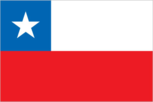
two equal horizontal bands of white (top) and red; a blue square the same height as the white band at the hoist-side end of the white band; the square bears a white five-pointed star in the center representing a guide to progress and honor; blue symbolizes the sky, white is for the snow-covered Andes, and red represents the blood spilled to achieve independence design was influenced by the US flag
Government type
republic
Independence
18 September 1810 (from Spain)
International law organization participation
has not submitted an ICJ jurisdiction declaration; accepts ICCt jurisdiction
International organization participation
APEC, BIS, CAN (associate), CD, FAO, G-15, G-77, IADB, IAEA, IBRD, ICAO, ICC, ICRM, IDA, IFAD, IFC, IFRCS, IHO, ILO, IMF, IMO, IMSO, Interpol, IOC, IOM, IPU, ISO, ITSO, ITU, ITUC, LAES, LAIA, Mercosur (associate), MIGA, MINUSTAH, NAM, OAS, OECD, OPANAL, OPCW, PCA, RG, SICA (observer), UN, UNASUR, UNCTAD, UNESCO, UNFICYP, UNHCR, UNIDO, Union Latina, UNMOGIP, UNTSO, UNWTO, UPU, WCO, WFTU, WHO, WIPO, WMO, WTO
Judicial branch
Supreme Court or Corte Suprema (judges are appointed by the president and ratified by the Senate from lists of candidates provided by the court itself; the president of the Supreme Court is elected every three years by the 20-member court); Constitutional Tribunal (eight-members - two each from the Senate, Chamber of Deputies, Supreme Court, and National Security Council - review the constitutionality of laws approved by Congress)
Legal system
civil law system influenced by several West European civil legal systems; judicial review of legislative acts in the Supreme Court
Legislative branch
- bicameral National Congress or Congreso Nacional consists of the Senate or Senado (38 seats; members elected by popular vote to serve eight-year terms; one-half elected every four years) and the Chamber of Deputies or Camara de Diputados (120 seats; members are elected by popular vote to serve four-year terms) Senate - last held on 13 December 2009 (next to be held in December 2013); Chamber of Deputies - last held on 13 December 2009 (next to be held in December 2013) Senate - percent of vote by party - NA; seats by party - CPD 9 (PDC 4, PPD 3, PS 2), APC 9 (RN 6, UDI 3); Chamber of Deputies - percent of vote by party - NA; seats by party - APC 58 (UDI 37, RN 18, other 3), CPD 57 (PDC 19, PPD 18, PS 11, PRSD 5, PC 3, other 1), PRI 3, independent 2
- election results
- Senate - percent of vote by party - NA; seats by party - CPD 9 (PDC 4, PPD 3, PS 2), APC 9 (RN 6, UDI 3); Chamber of Deputies - percent of vote by party - NA; seats by party - APC 58 (UDI 37, RN 18, other 3), CPD 57 (PDC 19, PPD 18, PS 11, PRSD 5, PC 3, other 1), PRI 3, independent 2
- elections
- Senate - last held on 13 December 2009 (next to be held in December 2013); Chamber of Deputies - last held on 13 December 2009 (next to be held in December 2013)
National anthem
- "Himno Nacional de Chile" (National Anthem of Chile) Eusebio LILLO Robles and Bernardo DE VERA y Pintado/Ramon CARNICER y Battle music adopted 1828, original lyrics adopted 1818, adapted lyrics adopted 1847; under Augusto PINOCHET"s military rule, a verse glorifying the army was added; however, as a protest, some citizens refused to sing this verse; it was removed when democracy was restored in 1990
- lyrics/music
- Eusebio LILLO Robles and Bernardo DE VERA y Pintado/Ramon CARNICER y Battle
- name
- "Himno Nacional de Chile" (National Anthem of Chile)
National holiday
Independence Day, 18 September (1810)
National symbol(s)
huemul (mountain deer); Andean condor
Political parties and leaders
Broad Social Movement or MAS; Clean Chile Vote Happy or CLVF (including Broad Social Movement, Country Force, and Regionalist Party of Independents or PRI); Coalition for Change or CC (formerly known as the Alliance for Chile (Alianza) or APC) (including National Renewal or RN [Carlos LARRAIN Pena], Independent Democratic Union or UDI [Juan Antonio COLOMA Correa], and Chile First [Vlado MIROSEVIC]); Coalition of Parties for Democracy (Concertacion) or CPD (including Christian Democratic Party or PDC [Ignacio WALKER], Party for Democracy or PPD [Carolina TOHA Morales], Radical Social Democratic Party or PRSD [Jose Antonio GOMEZ Urrutia], and Socialist Party or PS [Osvaldo ANDRADE]); Partido Ecologista del Sur; Together We Can Do More (including Communist Party or PC [Guillermo TEILLIER del Valle], and Humanist Party or PH [Danilo MONTEVERDE])
Political pressure groups and leaders
- Roman Catholic Church, particularly conservative groups such as Opus Dei; United Labor Central or CUT includes trade unionists from the country's five largest labor confederations revitalized university student federations at all major universities
- other
- revitalized university student federations at all major universities
Suffrage
18 years of age; universal and compulsory
Economy
Agriculture - products
grapes, apples, pears, onions, wheat, corn, oats, peaches, garlic, asparagus, beans; beef, poultry, wool; fish; timber
Budget
- $45.65 billion $46.26 billion (2010 est.)
- expenditures
- $46.26 billion (2010 est.)
- revenues
- $45.65 billion
Budget surplus (+) or deficit (-)
-0.3% of GDP (2010 est.)
Central bank discount rate
3.12% (31 December 2010 est.) 0.5% (31 December 2009 est.)
Commercial bank prime lending rate
4.753% (31 December 2010 est.) 7.25% (31 December 2009 est.)
Current account balance
$3.802 billion (2010 est.) $2.57 billion (2009 est.)
Debt - external
$96.57 billion (30 June 2011 est.) $84.03 billion (31 December 2010 est.)
Distribution of family income - Gini index
52.1 (2009) 57.1 (2000)
Economy - overview
Chile has a market-oriented economy characterized by a high level of foreign trade and a reputation for strong financial institutions and sound policy that have given it the strongest sovereign bond rating in South America. Exports account for more than one-fourth of GDP, with commodities making up some three-quarters of total exports. Copper alone provides one-third of government revenue. During the early 1990s, Chile's reputation as a role model for economic reform was strengthened when the democratic government of Patricio AYLWIN - which took over from the military in 1990 - deepened the economic reform initiated by the military government. Since 1999, growth has averaged 4% per year. Chile deepened its longstanding commitment to trade liberalization with the signing of a free trade agreement with the US, which took effect on 1 January 2004. Chile claims to have more bilateral or regional trade agreements than any other country. It has 57 such agreements (not all of them full free trade agreements), including with the European Union, Mercosur, China, India, South Korea, and Mexico. Over the past seven years, foreign direct investment inflows have quadrupled to some $15 billion in 2010, but FDI had dropped to about $7 billion in 2009 in the face of diminished investment throughout the world. The Chilean government conducts a rule-based countercyclical fiscal policy, accumulating surpluses in sovereign wealth funds during periods of high copper prices and economic growth, and allowing deficit spending only during periods of low copper prices and growth. As of September 2008, those sovereign wealth funds - kept mostly outside the country and separate from Central Bank reserves - amounted to more than $20 billion. Chile used $4 billion from this fund to finance a fiscal stimulus package to fend off recession. In December 2009, the OECD invited Chile to become a full member, after a two year period of compliance with organization mandates, and in May 2010 Chile signed the OECD Convention, becoming the first South American country to join the OECD. The economy started to show signs of a rebound in the fourth quarter of 2009, and GDP grew more than 5% in 2010. Chile achieved this growth despite the magnitude 8.8 earthquake that struck Chile in February 2010, which was one of the top ten strongest earthquakes on record. The earthquake and subsequent tsunamis it generated caused considerable damage near the epicenter, located about 70 miles from Concepcion - and about 200 miles southwest of Santiago. The Chilean Ministry of Finance estimates the total immediate losses were close to 17% of GDP.
Electricity - consumption
56.35 billion kWh (2008 est.)
Electricity - exports
0 kWh (2009 est.)
Electricity - imports
818 million kWh (2009 est.)
Electricity - production
60.28 billion kWh (2008 est.)
Exchange rates
Chilean pesos (CLP) per US dollar - 525.34 (2010) 560.86 (2009) 509.02 (2008) 526.25 (2007) 530.29 (2006)
Exports
$71.03 billion (2010 est.) $54 billion (2009 est.)
Exports - commodities
copper, fruit, fish products, paper and pulp, chemicals, wine
Exports - partners
China 23.8%, Japan 10.2%, US 10%, Brazil 6%, South Korea 5.9% (2010)
GDP - composition by sector
- 5.1% 41.8% 53.1% (2010 est.)
- agriculture
- 5.1%
- industry
- 41.8%
- services
- 53.1% (2010 est.)
GDP - per capita (PPP)
$15,400 (2010 est.) $14,800 (2009 est.) $15,100 (2008 est.) data are in 2010 US dollars
GDP - real growth rate
5.3% (2010 est.) -1.7% (2009 est.) 3.7% (2008 est.)
GDP (official exchange rate)
$203.3 billion (2010 est.)
GDP (purchasing power parity)
$257.9 billion (2010 est.) $245 billion (2009 est.) $249.2 billion (2008 est.) data are in 2010 US dollars
Household income or consumption by percentage share
- 1.5% 42.5% (2009)
- highest 10%
- 42.5% (2009)
- lowest 10%
- 1.5%
Imports
$55.17 billion (2010 est.) $39.89 billion (2009 est.)
Imports - commodities
petroleum and petroleum products, chemicals, electrical and telecommunications equipment, industrial machinery, vehicles, natural gas
Imports - partners
US 17%, China 13.6%, Argentina 8.5%, Brazil 7.9%, South Korea 5.8%, Japan 5%, Germany 4% (2010)
Industrial production growth rate
-0.4% (2010 est.)
Industries
copper, lithium, other minerals, foodstuffs, fish processing, iron and steel, wood and wood products, transport equipment, cement, textiles
Inflation rate (consumer prices)
1.4% (2010 est.) 1.5% (2009 est.)
Investment (gross fixed)
20.9% of GDP (2010 est.)
Labor force
7.918 million (2010 est.)
Labor force - by occupation
- 13.2% 23% 63.9% (2005)
- agriculture
- 13.2%
- industry
- 23%
- services
- 63.9% (2005)
Market value of publicly traded shares
$341.6 billion (31 December 2010) $209.5 billion (31 December 2009) $132.4 billion (31 December 2008)
Natural gas - consumption
2.84 billion cu m (2009 est.)
Natural gas - exports
0 cu m (2009 est.)
Natural gas - imports
1.49 billion cu m (2009 est.)
Natural gas - production
1.35 billion cu m (2009 est.)
Natural gas - proved reserves
97.97 billion cu m (1 January 2011 est.)
Oil - consumption
302,700 bbl/day (2010 est.)
Oil - exports
52,390 bbl/day (2009 est.)
Oil - imports
305,100 bbl/day (2009 est.)
Oil - production
10,640 bbl/day (2010 est.)
Oil - proved reserves
150 million bbl (1 January 2011 est.)
Population below poverty line
11.5% (2009)
Public debt
9.2% of GDP (2010 est.) 6.2% of GDP (2009 est.)
Reserves of foreign exchange and gold
$27.83 billion (31 December 2010 est.) $25.29 billion (31 December 2009 est.)
Stock of broad money
$190.5 billion (31 December 2010 est.) $160.3 billion (31 December 2009 est.)
Stock of direct foreign investment - abroad
$49.69 billion (31 December 2010 est.) $41.2 billion (31 December 2009 est.)
Stock of direct foreign investment - at home
$137.4 billion (31 December 2010 est.) $121.6 billion (31 December 2009 est.)
Stock of domestic credit
$160.7 billion (31 December 2010 est.) $144.7 billion (31 December 2009 est.)
Stock of narrow money
$34.39 billion (31 December 2010 est.) $26.22 billion (31 December 2009 est.)
Taxes and other revenues
22.5% of GDP (2010 est.)
Unemployment rate
7.1% (2010 est.) 9.6% (2009 est.)
Communications
Broadcast media
national and local terrestrial television channels, coupled with extensive cable TV networks; the state-owned Television Nacional de Chile (TVN) network is self-financed through commercial advertising revenues and is not under direct government control; large number of privately-owned TV stations; about 250 radio stations (2007)
Internet country code
.cl
Internet hosts
1.056 million (2010)
Internet users
7.009 million (2009)
Telephone system
- privatization begun in 1988; most advanced telecommunications infrastructure in South America; modern system based on extensive microwave radio relay facilities; domestic satellite system with 3 earth stations number of fixed-line connections have stagnated in recent years as mobile-cellular usage continues to increase, reaching a level of 100 telephones per 100 persons country code - 56; landing points for the Pan American, South America-1, and South American Crossing/Latin America Nautilius submarine cables providing links to the US and to Central and South America; satellite earth stations - 2 Intelsat (Atlantic Ocean) (2009)
- domestic
- number of fixed-line connections have stagnated in recent years as mobile-cellular usage continues to increase, reaching a level of 100 telephones per 100 persons
- general assessment
- privatization begun in 1988; most advanced telecommunications infrastructure in South America; modern system based on extensive microwave radio relay facilities; domestic satellite system with 3 earth stations
- international
- country code - 56; landing points for the Pan American, South America-1, and South American Crossing/Latin America Nautilius submarine cables providing links to the US and to Central and South America; satellite earth stations - 2 Intelsat (Atlantic Ocean) (2009)
Telephones - main lines in use
3.458 million (2010)
Telephones - mobile cellular
19.852 million (2010)
Transportation
Airports
366 (2010)
Airports - with paved runways
- 24 (2010)
- 1,524 to 2,437 m
- 23
- 2,438 to 3,047 m
- 8
- 914 to 1,523 m
- 24
- over 3,047 m
- 5
- total
- 84
- under 914 m
- 24 (2010)
Airports - with unpaved runways
- 217 (2010)
- 1,524 to 2,437 m
- 12
- 2,438 to 3,047 m
- 3
- 914 to 1,523 m
- 50
- total
- 282
- under 914 m
- 217 (2010)
Merchant marine
- bulk carrier 11, cargo 10, chemical tanker 8, container 1, liquefied gas 2, passenger 4, passenger/cargo 3, petroleum tanker 8, roll on/roll off 1 1 (Norway 1) 48 (Argentina 6, Belize 1, Brazil 1, Cyprus 1, Isle of Man 8, Liberia 7, Panama 17, Singapore 7) (2010)
- foreign-owned
- 1 (Norway 1)
- registered in other countries
- 48 (Argentina 6, Belize 1, Brazil 1, Cyprus 1, Isle of Man 8, Liberia 7, Panama 17, Singapore 7) (2010)
- total
- 48
Pipelines
gas 3,064 km; liquid petroleum gas 517 km; oil 895 km; refined products 768 km (2010)
Ports and terminals
Coronel, Huasco, Lirquen, Puerto Ventanas, San Antonio, San Vicente, Valparaiso
Railways
- 7,082 km 3,435 km 1.676-m gauge (850 km electrified) 3,647 km 1.000-m gauge (2010)
- narrow gauge
- 3,647 km 1.000-m gauge (2010)
- total
- 7,082 km
Roadways
- 80,505 km 16,745 km (includes 2,414 km of expressways) 63,760 km (2004)
- total
- 80,505 km
- unpaved
- 63,760 km (2004)
Military and Security
Manpower available for military service
- 4,324,732 4,251,954 (2010 est.)
- females age 16-49
- 4,251,954 (2010 est.)
- males age 16-49
- 4,324,732
Manpower fit for military service
- 3,621,475 3,561,099 (2010 est.)
- females age 16-49
- 3,561,099 (2010 est.)
- males age 16-49
- 3,621,475
Manpower reaching militarily significant age annually
- 141,500 135,709 (2010 est.)
- female
- 135,709 (2010 est.)
- male
- 141,500
Military branches
Army of the Nation, Chilean Navy (Armada de Chile, includes Naval Aviation, Marine Corps, and Maritime Territory and Merchant Marine Directorate (Directemar)), Chilean Air Force (Fuerza Aerea de Chile, FACh), Carabineros Corps (Cuerpo de Carabineros) (2011)
Military expenditures
2.7% of GDP (2006)
Military service age and obligation
18-45 years of age for voluntary male and female military service, although the right to compulsory recruitment is retained; service obligation - 12 months for Army, 22 months for Navy and Air Force (2008)
Transnational Issues
Disputes - international
Chile and Peru rebuff Bolivia's reactivated claim to restore the Atacama corridor, ceded to Chile in 1884, but Chile has offered instead unrestricted but not sovereign maritime access through Chile to Bolivian natural gas; Chile rejects Peru's unilateral legislation to change its latitudinal maritime boundary with Chile to an equidistance line with a southwestern axis favoring Peru, in October 2007, Peru took its maritime complaint with Chile to the ICJ; territorial claim in Antarctica (Chilean Antarctic Territory) partially overlaps Argentine and British claims; the joint boundary commission, established by Chile and Argentina in 2001, has yet to map and demarcate the delimited boundary in the inhospitable Andean Southern Ice Field (Campo de Hielo Sur)
Illicit drugs
transshipment country for cocaine destined for Europe and the region; some money laundering activity, especially through the Iquique Free Trade Zone; imported precursors passed on to Bolivia; domestic cocaine consumption is rising, making Chile a significant consumer of cocaine (2008)