1997 Edition
CIA World Factbook 1997 (Project Gutenberg)
Geography
Area
total : 756,950 sq km land: 748,800 sq km water: 8,150 sq km note: includes Isla de Pascua (Easter Island) and Isla Sala y Gomez
Area - comparative
slightly smaller than twice the size of Montana
Climate
temperate; desert in north; cool and damp in south
Coastline
6,435 km
Elevation extremes
lowest point : Pacific Ocean 0 m highest point: Cerro Aconcagua 6,962 m
Environment - current issues
air pollution from industrial and vehicle emissions; water pollution from raw sewage; deforestation contributing to loss of biodiversity; soil erosion; desertification
Environment - international agreements
party to: Antarctic-Environmental Protocol, Antarctic Treaty, Biodiversity, Climate Change, Endangered Species, Environmental Modification, Hazardous Wastes, Marine Dumping, Nuclear Test Ban, Ozone Layer Protection, Ship Pollution, Wetlands signed, but not ratified: Desertification, Law of the Sea
Geographic coordinates
30 00 S, 71 00 W
Geography - note
strategic location relative to sea lanes between Atlantic and Pacific Oceans (Strait of Magellan, Beagle Channel, Drake Passage); Atacama Desert is one of world's driest regions
Irrigated land
12,650 sq km (1993 est.)
Land boundaries
total : 6,171 km border countries: Argentina 5,150 km, Bolivia 861 km, Peru 160 km
Land use
arable land: 5% permanent crops: 0% permanent pastures: 18% forests and woodland: 22% other : 55% (1993 est.)
Location
Southern South America, bordering the South Atlantic Ocean and South Pacific Ocean, between Argentina and Peru
Map references
South America
Maritime claims
contiguous zone: 24 nm continental shelf: 200 nm exclusive economic zone: 200 nm territorial sea: 12 nm
Natural hazards
severe earthquakes; active volcanism; tsunamis
Natural resources
copper, timber, iron ore, nitrates, precious metals, molybdenum
Terrain
low coastal mountains; fertile central valley; rugged Andes in east
People and Society
Age structure
0-14 years: 28% (male 2,057,633; female 2,031,588) 15-64 years: 65% (male 4,684,158; female 4,734,170) 65 years and over: 7% (male 416,047; female 584,562) (July 1997 est.)
Birth rate
17.53 births/1,000 population (1997 est.)
Death rate
5.68 deaths/1,000 population (1997 est.)
Ethnic groups
white and white-Amerindian 95%, Amerindian 3%, other 2%
Infant mortality rate
13.2 deaths/1,000 live births (1997 est.)
Languages
Spanish
Life expectancy at birth
total population: 74.73 years male: 71.5 years female: 77.95 years (1997 est.)
Literacy
definition : age 15 and over can read and write total population: 95.2% male : 95.4% female: 95% (1995 est.)
Nationality
noun: Chilean(s) adjective: Chilean
Net migration rate
0 migrant(s)/1,000 population (1997 est.)
Population
14,508,158 (July 1997 est.)
Population growth rate
1.18% (1997 est.)
Religions
Roman Catholic 89%, Protestant 11%, Jewish
Sex ratio
at birth: 1 male(s)/female under 15 years: 1.01 male(s)/female 15-64 years : 0.99 male(s)/female 65 years and over: 0.71 male(s)/female total population: 0.97 male(s)/female (1997 est.)
Total fertility rate
2.17 children born/woman (1997 est.)
Government
Administrative divisions
13 regions (regiones, singular - region); Aisen del General Carlos Ibanez del Campo, Antofagasta, Araucania, Atacama, Bio-Bio, Coquimbo, Libertador General Bernardo O'Higgins, Los Lagos, Magallanes y de la Antartica Chilena, Maule, Region Metropolitana, Tarapaca, Valparaiso note: the US does not recognize claims to Antarctica
Constitution
11 September 1980, effective 11 March 1981; amended 30 July 1989
Country name
conventional long form: Republic of Chile conventional short form: Chile local long form: Republica de Chile local short form: Chile
CPD consists mainly of
Christian Democratic Party or PDC [Enrique KRAUSS]; Socialist Party or PS [Camilo ESCALONA]; Party for Democracy or PPD [Sergio BITAR]; Radical Social Democratic Party or PRSD [Anselmo SULE]; Union for the Progress of Chile or UPP consists mainly of three parties: National Renewal or RN [Alberto ESPINA]; Independent Democratic Union or UDI [Jovino NOVOA]; Center Center Union or UCC [Francisco Javier ERRAZURIZ]
Data code
CI
Diplomatic representation from the US
chief of mission: Ambassador Gabriel GUERRA-MONDRAGON embassy: Avenida Andres Bello 2800, Santiago mailing address : APO AA 34033 telephone: [56] (2) 232-2600
Diplomatic representation in the US
chief of mission: Ambassador John BIEHL Del Rios chancery: 1732 Massachusetts Avenue NW, Washington, DC 20036 telephone: [1] (202) 785-1746
Executive branch
chief of state: President Eduardo FREI Ruiz-Tagle (since 11 March 1994); note - the president is both the chief of state and head of
FAX
- [1] (202) 887-5579 consulate(s) general : Boston, Chicago, Houston, Los Angeles, Miami, New York, Philadelphia, San Francisco, and San Juan (Puerto Rico)
- [56] (2) 330-3710
Flag description
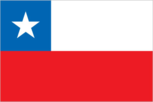
two equal horizontal bands of white (top) and red; there is a blue square the same height as the white band at the hoist-side end of the white band; the square bears a white five-pointed star in the center; design was based on the US flag
Government type
republic
Independence
18 September 1810 (from Spain)
International organization participation
APEC, CCC, ECLAC, FAO, G-11, G-77, IADB, IAEA, IBRD, ICAO, ICC, ICFTU, ICRM, IDA, IFAD, IFC, IFRCS, IHO, ILO, IMF, IMO, Inmarsat, Intelsat, Interpol, IOC, IOM, ISO, ITU, LAES, LAIA, NAM, OAS, OPANAL, PCA, RG, UN, UN Security Council (temporary), UNCTAD, UNESCO, UNIDO, UNITAR, UNMOGIP, UNTSO, UNU, UPU, WCL, WFTU, WHO, WIPO, WMO, WToO, WTrO
Judicial branch
Supreme Court (Corte Suprema), judges are appointed by the president, the president of the Supreme Court is elected by the 17-member court
Legal system
based on Code of 1857 derived from Spanish law and subsequent codes influenced by French and Austrian law; judicial review of legislative acts in the Supreme Court; does not accept compulsory ICJ jurisdiction
Legislative branch
bicameral National Congress or Congreso Nacional consists of the Senate or Senado (46 seats, 38 elected by popular vote; members serve eight-year terms - one half elected every four years) and the Chamber of Deputies or Camara de Diputados (120 seats; members are elected by popular vote to serve four-year terms) elections : Senate - last held 11 December 1993 (next to be held NA December 1997); Chamber of Deputies - last held 11 December 1993 (next to be held NA December 1997) election results: Senate - percent of vote by party - NA; seats by party - Coalition of Parties for Democracy 21 (PDC 13, PS 4, PPD 3, PR 1), Union for the Progress of Chile 15 (RN 11, UDI 3, UCC 1), right-wing independents 2; Chamber of Deputies - percent of vote by party - Coalition of Parties for Democracy 53.95% (PDC 27.16%, PS 12.01%, PPD 11.82%, PR 2.96%), Union for the Progress of Chile 30.57% (RN 15.25%, UDI 12.13%, UCC 3.19%); seats by party - Coalition of Parties for Democracy 70 (PDC 37, PPD 15, PR 2, PS 15, left-wing independent 1), Union for the Progress of Chile 47 (RN 30, UDI 15, UCC 2), right-wing independents 3; note - subsequent to the election, the Radical Party (PR) became the Radical Social Democratic Party (PRSD)
National capital
Santiago
National holiday
Independence Day, 18 September (1810)
Political parties and leaders
Coalition of Parties for Democracy or
Political pressure groups and leaders
revitalized university student federations at all major universities; labor - United Labor Central or CUT includes trade unionists from the country's five largest labor confederations; Roman Catholic Church
Suffrage
18 years of age; universal and compulsory
Economy
Agriculture - products
wheat, corn, grapes, beans, sugar beets, potatoes, fruit; beef, poultry, wool; timber; 1991 fish catch of 6.6 million metric tons
Budget
revenues: $17 billion expenditures: $17 billion, including capital expenditures of $NA (1996 est.)
Currency
1 Chilean peso (Ch$) = 100 centavos
Debt - external
$22.3 billion (1995 est.)
Economic aid
recipient: ODA, $50.3 million (1996 est.)
Economy - overview
Chile has a prosperous, essentially free market economy. Civilian governments - which took over from the military in March 1990 - have continued to reduce the government's role in the economy while shifting the emphasis of public spending toward social programs. Growth in real GDP averaged more than 6.5% in 1991-1996, and inflation is nearing a 40-year low. Chile's currency and foreign reserves also are strong, as sustained foreign capital inflows - driven in part by state privatizations - have more than offset occasional current account deficits and public debt buybacks. President FREI, who took office in March 1994, has placed improving Chile's education system and developing foreign export markets at the top of his economic agenda. Despite this progress, the Chilean economy remains largely dependent on a few sectors - particularly copper mining, fishing, and forestry. Success in meeting the government's goal of sustained annual economic growth of 5% depends largely on world prices for these commodities, continued foreign investor confidence, and the government's ability to maintain a conservative fiscal stance. In 1996, Chile became an associate member of Mercosur and concluded a Free Trade Agreement with Canada.
Electricity - capacity
5.964 million kW (1995)
Electricity - consumption per capita
1,662 kWh (1995 est.)
Electricity - production
27.908 billion kWh (1995)
Exchange rates
Chilean pesos (Ch$) per US$1 - 423.79 (January 1997), 412.27(1996), 396.78 (1995), 420.08 (1994), 404.35 (1993), 362.59 (1992)
Exports
total value: $15.2 billion (f.o.b., 1996 est.) commodities: copper 37%, other metals and minerals 8.2%, wood products 7.1%, fish and fishmeal 9.8%, fruits 8.4% (1994) partners: EU 25%, US 15%, Asia 34%, Latin America 20% (1995 est.)
Fiscal year
calendar year
GDP
purchasing power parity - $120.6 billion (1996 est.)
GDP - composition by sector
agriculture : 8% industry: 33% services: 59% (1995 est.)
GDP - per capita
purchasing power parity - $8,400 (1996 est.)
GDP - real growth rate
6.5% (1996 est.)
Imports
total value : $16.5 billion (f.o.b., 1996 est.) commodities: capital goods 25.2%, spare parts 24.8%, raw materials 15.4%, petroleum 10%, foodstuffs 5.7% (1994) partners: EU 18%, US 25%, Asia 16%, Latin America 26% (1995 est.)
Industrial production growth rate
4.8% (1995)
Industries
copper, other minerals, foodstuffs, fish processing, iron and steel, wood and wood products, transport equipment, cement, textiles
Inflation rate - consumer price index
6.7% (1996 est.)
Labor force
total: 5.5 million (1996 est.) by occupation: services 38.3% (includes government 12%), industry and commerce 33.8%, agriculture, forestry, and fishing 19.2%, mining 2.3%, construction 6.4% (1990)
Unemployment rate
6.5% (1996 est.)
Communications
Radio broadcast stations
AM 179, FM 614, shortwave 11
Radios
NA
Telephone system
modern system based on extensive microwave radio relay facilities domestic: extensive microwave radio relay links; domestic satellite system with 3 earth stations international: satellite earth stations - 2 Intelsat (Atlantic Ocean)
Telephones
1.5 million (1994 est.)
Television broadcast stations
11
Televisions
2.85 million (1992 est.)
Transportation
Airports
343 (1996 est.)
Airports - with paved runways
total : 259 over 3,047 m: 5 2,438 to 3,047 m : 5 1,524 to 2,437 m: 18 914 to 1,523 m: 17 under 914 m: 214 (1996 est.)
Airports - with unpaved runways
total : 84 2,438 to 3,047 m: 3 1,524 to 2,437 m: 10 914 to 1,523 m: 71 (1996 est.)
Highways
total : 79,750 km paved: 11,006 km unpaved: 68,744 km (1995 est.)
Merchant marine
total: 38 ships (1,000 GRT or over) totaling 520,710 GRT/865,867 DWT ships by type: bulk 11, cargo 8, chemical tanker 4, combination ore/oil 1, container 2, liquefied gas tanker 2, oil tanker 4, passenger 1, roll-on/roll-off cargo 3, vehicle carrier 2 (1996 est.)
Pipelines
crude oil 755 km; petroleum products 785 km; natural gas 320 km
Ports and harbors
Antofagasta, Arica, Chanaral, Coquimbo, Iquique, Puerto Montt, Punta Arenas, San Antonio, San Vicente, Talcahuano, Valparaiso
Railways
total: 6,782 km broad gauge: 3,743 km 1.676-m gauge (1,653 km electrified) narrow gauge: 116 km 1.067-m gauge; 2,923 km 1.000-m gauge (40 km electrified) (1995)
Waterways
725 km
Military and Security
Military branches
Army of the Nation, National Navy (includes Naval Air, Coast Guard, and Marines), Air Force of the Nation, Carabineros of Chile (National Police), Investigations Police
Military expenditures - dollar figure
$2.8 billion (1997); note - includes earnings from CODELCO Company; may exclude costs of pensions and internal security
Military expenditures - percent of GDP
3.5% (1997)
Military manpower - availability
males age 15-49: 3,867,676 (1997 est.)
Military manpower - fit for military service
males : 2,874,235 (1997 est.)
Military manpower - military age
19 years of age
Military manpower - reaching military age annually
males: 125,586 (1997 est.)
Transnational Issues
Disputes - international
short section of the southern boundary with Argentina is indefinite; Bolivia has wanted a sovereign corridor to the South Pacific Ocean since the Atacama area was lost to Chile in 1884; dispute with Bolivia over Rio Lauca water rights; territorial claim in Antarctica (Chilean Antarctic Territory) partially overlaps Argentine and British claims
Illicit drugs
a minor transshipment country for cocaine destined for the US and Europe; booming economy has made it more attractive to traffickers seeking to launder drug profits ______________________________________________________________________ CHINA (also see separate Taiwan entry)