2014 Edition
CIA World Factbook 2014 Archive (HTML)
Introduction
Background
The former French colony of Ubangi-Shari became the Central African Republic upon independence in 1960. After three tumultuous decades of misrule - mostly by military governments - civilian rule was established in 1993 and lasted for one decade. In March, 2003 President Ange-Felix PATASSE was deposed in a military coup led by General Francois BOZIZE, who established a transitional government. Elections held in 2005 affirmed General BOZIZE as president; he was reelected in 2011 in voting widely viewed as flawed. The government still does not fully control the countryside, where pockets of lawlessness persist. The militant group the Lord's Resistance Army continues to destabilize southeastern Central African Republic, and several rebel groups joined together in early December 2012 to launch a series of attacks that left them in control of numerous towns in the northern and central parts of the country. The rebels - who are unhappy with BOZIZE's government - participated in peace talks in early January 2013 which resulted in a coalition government including the rebellion's leadership. In March 2013, the coalition government dissolved, rebels seized the capital, and President BOZIZE fled the country. Rebel leader Michel DJOTODIA assumed the presidency, reappointed Nicolas TIANGAYE as Prime Minister, and established a transitional government on 31 March. On 13 April 2013, the National Transitional Council affirmed DJOTODIA as President.
Geography
Area
- 622,984 sq km 622,984 sq km 0 sq km
- total
- 622,984 sq km
- water
- 0 sq km
Area - comparative
slightly smaller than Texas
Climate
tropical; hot, dry winters; mild to hot, wet summers
Coastline
0 km (landlocked)
Elevation extremes
- Oubangui River 335 m Mont Ngaoui 1,420 m
- highest point
- Mont Ngaoui 1,420 m
- lowest point
- Oubangui River 335 m
Environment - current issues
tap water is not potable; poaching has diminished the country's reputation as one of the last great wildlife refuges; desertification; deforestation
Environment - international agreements
- Biodiversity, Climate Change, Climate Change-Kyoto Protocol, Desertification, Endangered Species, Hazardous Wastes, Ozone Layer Protection, Tropical Timber 94, Wetlands Law of the Sea
- party to
- Biodiversity, Climate Change, Climate Change-Kyoto Protocol, Desertification, Endangered Species, Hazardous Wastes, Ozone Layer Protection, Tropical Timber 94, Wetlands
- signed, but not ratified
- Law of the Sea
Freshwater withdrawal (domestic/industrial/agricultural)
- 0.07 cu km/yr (83%/17%/1%) 17.42 cu m/yr (2005)
- per capita
- 17.42 cu m/yr (2005)
- total
- 0.07 cu km/yr (83%/17%/1%)
Geographic coordinates
7 00 N, 21 00 E
Geography - note
landlocked; almost the precise center of Africa
Irrigated land
1.35 sq km (2003)
Land boundaries
- 5,920 km Cameroon 901 km, Chad 1,556 km, Democratic Republic of the Congo 1,747 km, Republic of the Congo 487 km, South Sudan 1,055 km, Sudan 174 km
- border countries
- Cameroon 901 km, Chad 1,556 km, Democratic Republic of the Congo 1,747 km, Republic of the Congo 487 km, South Sudan 1,055 km, Sudan 174 km
- total
- 5,920 km
Land use
- 2.89% 0.13% 96.98% (2011)
- arable land
- 2.89%
- other
- 96.98% (2011)
- permanent crops
- 0.13%
Location
Central Africa, north of Democratic Republic of the Congo
Map references
Africa
Maritime claims
none (landlocked)
Natural hazards
hot, dry, dusty harmattan winds affect northern areas; floods are common
Natural resources
diamonds, uranium, timber, gold, oil, hydropower
Terrain
vast, flat to rolling, monotonous plateau; scattered hills in northeast and southwest
Total renewable water resources
144.4 cu km (2011)
People and Society
Age structure
- 40.6% (male 1,077,247/female 1,064,660) 20.1% (male 534,257/female 528,822) 31.8% (male 838,484/female 838,858) 3.9% (male 91,696/female 115,600) 3.6% (male 73,914/female 114,421) (2014 est.)
- 0-14 years
- 40.6% (male 1,077,247/female 1,064,660)
- 15-24 years
- 20.1% (male 534,257/female 528,822)
- 25-54 years
- 31.8% (male 838,484/female 838,858)
- 55-64 years
- 3.9% (male 91,696/female 115,600)
- 65 years and over
- 3.6% (male 73,914/female 114,421) (2014 est.)
Birth rate
35.45 births/1,000 population (2014 est.)
Child labor - children ages 5-14
- 532,518 47 % (2006 est.)
- percentage
- 47 % (2006 est.)
- total number
- 532,518
Children under the age of 5 years underweight
28% (2006)
Contraceptive prevalence rate
19% (2006)
Death rate
14.11 deaths/1,000 population (2014 est.)
Dependency ratios
- 76.5 % 69.7 % 6.7 % 14.8 (2014 est.)
- elderly dependency ratio
- 6.7 %
- potential support ratio
- 14.8 (2014 est.)
- total dependency ratio
- 76.5 %
- youth dependency ratio
- 69.7 %
Drinking water source
- urban: 89.6% of population rural: 54.4% of population total: 68.2% of population urban: 10.4% of population rural: 45.6% of population total: 31.8% of population (2012 est.)
- rural
- 45.6% of population
- total
- 31.8% of population (2012 est.)
- urban
- 10.4% of population
Education expenditures
1.2% of GDP (2011)
Ethnic groups
Baya 33%, Banda 27%, Mandjia 13%, Sara 10%, Mboum 7%, M'Baka 4%, Yakoma 4%, other 2%
Health expenditures
3.8% of GDP (2011)
HIV/AIDS - adult prevalence rate
4.7% (2009 est.)
HIV/AIDS - deaths
11,000 (2009 est.)
HIV/AIDS - people living with HIV/AIDS
130,000 (2009 est.)
Hospital bed density
1 beds/1,000 population (2011)
Infant mortality rate
- 92.86 deaths/1,000 live births 100.55 deaths/1,000 live births 84.93 deaths/1,000 live births (2014 est.)
- female
- 84.93 deaths/1,000 live births (2014 est.)
- total
- 92.86 deaths/1,000 live births
Languages
French (official), Sangho (lingua franca and national language), tribal languages
Life expectancy at birth
- 51.35 years 50.06 years 52.67 years (2014 est.)
- female
- 52.67 years (2014 est.)
- total population
- 51.35 years
Literacy
- age 15 and over can read and write 56.6% 69.6% 44.2% (2011 est.)
- definition
- age 15 and over can read and write
- female
- 44.2% (2011 est.)
- male
- 69.6%
- total population
- 56.6%
Major infectious diseases
- very high bacterial and protozoal diarrhea, hepatitis A and E, and typhoid fever malaria and dengue fever meningococcal meningitis schistosomiasis rabies (2013)
- animal contact disease
- rabies (2013)
- degree of risk
- very high
- food or waterborne diseases
- bacterial and protozoal diarrhea, hepatitis A and E, and typhoid fever
- respiratory disease
- meningococcal meningitis
- vectorborne diseases
- malaria and dengue fever
- water contact disease
- schistosomiasis
Major urban areas - population
BANGUI (capital) 740,000 (2011)
Maternal mortality rate
890 deaths/100,000 live births (2010)
Median age
- 19.4 years 19.1 years 19.8 years (2014 est.)
- female
- 19.8 years (2014 est.)
- male
- 19.1 years
- total
- 19.4 years
Nationality
- Central African(s) Central African
- adjective
- Central African
- noun
- Central African(s)
Net migration rate
0 migrant(s)/1,000 population (2014 est.)
Obesity - adult prevalence rate
3.5% (2008)
Physicians density
0.05 physicians/1,000 population (2009)
Population
5,277,959 estimates for this country explicitly take into account the effects of excess mortality due to AIDS; this can result in lower life expectancy, higher infant mortality, higher death rates, lower population growth rates, and changes in the distribution of population by age and sex than would otherwise be expected (July 2014 est.)
Population growth rate
2.13% (2014 est.)
Religions
indigenous beliefs 35%, Protestant 25%, Roman Catholic 25%, Muslim 15% animistic beliefs and practices strongly influence the Christian majority
Sanitation facility access
- urban: 43.6% of population rural: 7.2% of population total: 21.5% of population urban: 56.4% of population rural: 92.8% of population total: 78.5% of population (2012 est.)
- rural
- 92.8% of population
- total
- 78.5% of population (2012 est.)
- urban
- 56.4% of population
School life expectancy (primary to tertiary education)
- 7 years 9 years 6 years (2012)
- female
- 6 years (2012)
- male
- 9 years
- total
- 7 years
Sex ratio
- 1.03 male(s)/female 1.01 male(s)/female 1.01 male(s)/female 1 male(s)/female 0.98 male(s)/female 0.66 male(s)/female 0.98 male(s)/female (2014 est.)
- 0-14 years
- 1.01 male(s)/female
- 15-24 years
- 1.01 male(s)/female
- 25-54 years
- 1 male(s)/female
- 55-64 years
- 0.98 male(s)/female
- 65 years and over
- 0.66 male(s)/female
- at birth
- 1.03 male(s)/female
- total population
- 0.98 male(s)/female (2014 est.)
Total fertility rate
4.46 children born/woman (2014 est.)
Urbanization
- 39.1% of total population (2011) 2.6% annual rate of change (2010-15 est.)
- rate of urbanization
- 2.6% annual rate of change (2010-15 est.)
- urban population
- 39.1% of total population (2011)
Government
Administrative divisions
14 prefectures (prefectures, singular - prefecture), 2 economic prefectures* (prefectures economiques, singular - prefecture economique), and 1 commune**; Bamingui-Bangoran, Bangui**, Basse-Kotto, Haute-Kotto, Haut-Mbomou, Kemo, Lobaye, Mambere-Kadei, Mbomou, Nana-Grebizi*, Nana-Mambere, Ombella-Mpoko, Ouaka, Ouham, Ouham-Pende, Sangha-Mbaere*, Vakaga
Capital
- Bangui 4 22 N, 18 35 E UTC+1 (6 hours ahead of Washington, DC, during Standard Time)
- geographic coordinates
- 4 22 N, 18 35 E
- name
- Bangui
- time difference
- UTC+1 (6 hours ahead of Washington, DC, during Standard Time)
Constitution
several previous; latest ratified by referendum 5 December 2004, effective 27 December 2004; amended 2010; note - the transitional parliament has begun work on a new constitution which should be ready for citizens feedback in early 2015 (2010)
Country name
- Central African Republic none Republique Centrafricaine none Ubangi-Shari, Central African Empire CAR
- abbreviation
- CAR
- conventional long form
- Central African Republic
- conventional short form
- none
- former
- Ubangi-Shari, Central African Empire
- local long form
- Republique Centrafricaine
- local short form
- none
Diplomatic representation from the US
- Ambassador Laurence D. WOHLERS (since September 2010) Avenue David Dacko, Bangui B. P. 924, Bangui [236] 21 61 02 00 [236] 21 61 44 94 the embassy temporarily suspended operations in December, 2012
- chief of mission
- Ambassador Laurence D. WOHLERS (since September 2010)
- embassy
- Avenue David Dacko, Bangui
- FAX
- [236] 21 61 44 94
- mailing address
- B. P. 924, Bangui
- telephone
- [236] 21 61 02 00
Diplomatic representation in the US
- Ambassador Stanislas MOUSSA-KEMBE (since 24 August 2009) 1618 22nd Street NW, Washington, DC 20008 [1] (202) 483-7800 [1] (202) 332-9893
- chancery
- 1618 22nd Street NW, Washington, DC 20008
- chief of mission
- Ambassador Stanislas MOUSSA-KEMBE (since 24 August 2009)
- FAX
- [1] (202) 332-9893
- telephone
- [1] (202) 483-7800
Executive branch
- Interim President Catherine SAMBA-PANZA (since 20 January 2014); elected by the National Transitional Council Interim Prime Minister Andre NZAPAYEKE (since 25 January 2014); note - he replaced Prime Minister Nicolas TIANGAYE who resigned 10 January 2014 Council of Ministers interim president was elected by the National Transitional Council on 20 January 2014; she will be in office until February 2015 at the new general elections in the second round Catherine SAMBA-PANZA was elected; SAMBA-PANZA 75 votes from the National Transitional Council, Desire KOLINGBA 53 votes (129 MPs out of 135 voted) note: rebel forces seized the captial in March 2013, forcing former President BOZIZE to flee the country; Interim President Michel DJOTODIA assumed the presidency, reinstated the prime minister, established a transitional government and was subsequently affirmed as president by the National Transitional Council on 13 Apriil 2013; he resigned soon after because of racial violence in the country and was replced briefly by Interim President Alexandre-Ferdinand NGUENDET
- cabinet
- Council of Ministers
- chief of state
- Interim President Catherine SAMBA-PANZA (since 20 January 2014); elected by the National Transitional Council
- election results
- in the second round Catherine SAMBA-PANZA was elected; SAMBA-PANZA 75 votes from the National Transitional Council, Desire KOLINGBA 53 votes (129 MPs out of 135 voted)
- elections
- interim president was elected by the National Transitional Council on 20 January 2014; she will be in office until February 2015 at the new general elections
- head of government
- Interim Prime Minister Andre NZAPAYEKE (since 25 January 2014); note - he replaced Prime Minister Nicolas TIANGAYE who resigned 10 January 2014
- note
- rebel forces seized the captial in March 2013, forcing former President BOZIZE to flee the country; Interim President Michel DJOTODIA assumed the presidency, reinstated the prime minister, established a transitional government and was subsequently affirmed as president by the National Transitional Council on 13 Apriil 2013; he resigned soon after because of racial violence in the country and was replced briefly by Interim President Alexandre-Ferdinand NGUENDET
Flag description
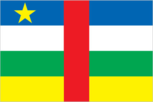
four equal horizontal bands of blue (top), white, green, and yellow with a vertical red band in center; a yellow five-pointed star to the hoist side of the blue band; banner combines the Pan-African and French flag colors; red symbolizes the blood spilled in the struggle for independence, blue represents the sky and freedom, white peace and dignity, green hope and faith, and yellow tolerance; the star represents aspiration towards a vibrant future
Government type
republic
Independence
13 August 1960 (from France)
International law organization participation
has not submitted an ICJ jurisdiction declaration; accepts ICCt jurisdiction
International organization participation
ACP, AfDB, AU, BDEAC, CEMAC, EITI (compliant country), FAO, FZ, G-77, IAEA, IBRD, ICAO, ICRM, IDA, IFAD, IFC, IFRCS, ILO, IMF, Interpol, IOC, IOM, ITSO, ITU, ITUC (NGOs), MIGA, NAM, OIC, OIF, OPCW, UN, UNCTAD, UNESCO, UNIDO, UNWTO, UPU, WCO, WHO, WIPO, WMO, WTO
Judicial branch
- Supreme Court (consists of NA judges); Constitutional Court (consists of 9 judges, at least 3 of which are women) Supreme Court judges appointed by the president; Constitutional Court judge appointments - 2 by the president, 1 by the speaker of the National Assembly, 2 elected by their peers, 2 are advocates elected by their peers, and 2 are law professors elected by their peers; judges serve 7-year non-renewable terms high courts; magistrates' courts
- highest court(s)
- Supreme Court (consists of NA judges); Constitutional Court (consists of 9 judges, at least 3 of which are women)
- judge selection and term of office
- Supreme Court judges appointed by the president; Constitutional Court judge appointments - 2 by the president, 1 by the speaker of the National Assembly, 2 elected by their peers, 2 are advocates elected by their peers, and 2 are law professors elected by their peers; judges serve 7-year non-renewable terms
- subordinate courts
- high courts; magistrates' courts
Legal system
civil law system based on the French model
Legislative branch
- unicameral National Transitional Council to act as the National Assembly or Assemblee Nationale (105 seats; members are elected by popular vote to serve five-year terms) last held on 23 January 2011 and 27 March 2011 (next to be held in February 2015) percent of vote by party - NA; seats by party - NA
- election results
- percent of vote by party - NA; seats by party - NA
- elections
- last held on 23 January 2011 and 27 March 2011 (next to be held in February 2015)
National anthem
- "Le Renaissance" (The Renaissance) Barthelemy BOGANDA/Herbert PEPPER adopted 1960; Barthelemy BOGANDA, who wrote the anthem's lyrics, was the first prime minister of the autonomous French territory
- lyrics/music
- Barthelemy BOGANDA/Herbert PEPPER
- name
- "Le Renaissance" (The Renaissance)
National holiday
Republic Day, 1 December (1958)
National symbol(s)
elephant
Political parties and leaders
Alliance for Democracy and Progress or ADP [Clement BELIBANGA] Central African Democratic Rally or RDC [Louis-Pierre GAMBA] Civic Forum or FC Democratic Forum for Modernity or FODEM [Saturnin NDOMBY] Liberal Democratic Party or PLD Londo Association or LONDO Movement for Democracy and Development or MDD MaMovement for the Liberation of the Central African People or MLPC [Martin ZIGUELE ] National Convergence or KNK [Francois BOZIZE] National Unity Party or PUN New Alliance for Progress or NAP [Jean-Jacques DEMAFOUTH] Patriotic Front for Progress or FPP [Alexandre Philippe GOUMBA] People's Union for the Republic or UPR [Pierre Sammy MAKFOY] Social Democratic Party or PSD [Enoch LAKOUE]
Political pressure groups and leaders
NA
Suffrage
18 years of age; universal
Economy
Agriculture - products
cotton, coffee, tobacco, cassava (manioc, tapioca), yams, millet, corn, bananas; timber
Budget
- $186.2 million $270.7 million (2013 est.)
- expenditures
- $270.7 million (2013 est.)
- revenues
- $186.2 million
Budget surplus (+) or deficit (-)
-4.1% of GDP (2013 est.)
Central bank discount rate
4.25% (31 December 2009) 4.75% (31 December 2008)
Commercial bank prime lending rate
15% (31 December 2013 est.) 15% (31 December 2012 est.)
Current account balance
-$133.8 million (2013 est.) -$197.6 million (2012 est.)
Debt - external
$634.2 million (31 December 2013 est.) $632.7 million (31 December 2012 est.)
Distribution of family income - Gini index
61.3 (1993)
Economy - overview
Subsistence agriculture, together with forestry and mining, remains the backbone of the economy of the Central African Republic (CAR), with about 60% of the population living in outlying areas. The agricultural sector generates more than half of GDP. Timber and diamonds account for most export earnings, followed by cotton. Important constraints to economic development include the CAR's landlocked position, a poor transportation system, a largely unskilled work force, and a legacy of misdirected macroeconomic policies. Factional fighting between the government and its opponents remains a drag on economic revitalization. Since 2009 the IMF has worked closely with the government to institute reforms that have resulted in some improvement in budget transparency, but other problems remain. The government's additional spending in the run-up to the election in 2011 worsened CAR's fiscal situation. Distribution of income is extraordinarily unequal. Grants from France and the international community can only partially meet humanitarian needs. In 2012 the World Bank approved $125 million in funding for transport infrastructure and regional trade, focused on the route between CAR's capital and the port of Douala in Cameroon. After a two year lag in donor support, the IMF's first review of CAR's extended credit facility for 2012-15 praised improvements in revenue collection but warned of weak management of spending.
Exchange rates
Cooperation Financiere en Afrique Centrale francs (XAF) per US dollar - 500.7 (2013 est.) 510.53 (2012 est.) 495.28 (2010) 472.19 (2009) 447.81 (2008)
Exports
$138.9 million (2013 est.) $207.7 million (2012 est.)
Exports - commodities
diamonds, timber, cotton, coffee
Exports - partners
Belgium 31.7%, China 27.9%, Democratic Republic of the Congo 7.8%, Indonesia 5.2%, France 4.5% (2012)
Fiscal year
calendar year
GDP - composition, by end use
- 91.5% 6.1% 8.3% 0% 9.7% -15.6% (2013 est.)
- exports of goods and services
- 9.7%
- government consumption
- 6.1%
- household consumption
- 91.5%
- imports of goods and services
- -15.6%
- investment in fixed capital
- 8.3%
- investment in inventories
- 0%
GDP - composition, by sector of origin
- 56.6% 14.5% 28.9% (2013 est.)
- agriculture
- 56.6%
- industry
- 14.5%
- services
- 28.9% (2013 est.)
GDP - per capita (PPP)
$700 (2013 est.) $900 (2012 est.) $800 (2011 est.) data are in 2013 US dollars
GDP - real growth rate
-14.5% (2013 est.) 4.1% (2012 est.) 3.3% (2011 est.)
GDP (official exchange rate)
$2.05 billion (2013 est.)
GDP (purchasing power parity)
$3.336 billion (2013 est.) $3.902 billion (2012 est.) $3.748 billion (2011 est.) data are in 2013 US dollars
Gross national saving
2.4% of GDP (2013 est.) 3.8% of GDP (2012 est.) 3.7% of GDP (2011 est.)
Household income or consumption by percentage share
- 2.1% 33% (2003)
- highest 10%
- 33% (2003)
- lowest 10%
- 2.1%
Imports
$218.6 million (2013 est.) $333.7 million (2012 est.)
Imports - commodities
food, textiles, petroleum products, machinery, electrical equipment, motor vehicles, chemicals, pharmaceuticals
Imports - partners
Netherlands 20.3%, France 9.7%, Cameroon 9.1%, South Korea 9.1% (2012)
Industrial production growth rate
-11% (2013 est.)
Industries
gold and diamond mining, logging, brewing, sugar refining
Inflation rate (consumer prices)
7% (2013 est.) 5.8% (2012 est.)
Labor force
2.082 million (2011 est.)
Market value of publicly traded shares
$NA
Population below poverty line
NA%
Stock of broad money
$376.4 million (31 December 2013 est.) $421.6 million (31 December 2012 est.)
Stock of domestic credit
$478.7 million (31 December 2013 est.) $507.7 million (31 December 2012 est.)
Stock of narrow money
$308.3 million (31 December 2013 est.) $337.7 million (31 December 2012 est.)
Taxes and other revenues
9.1% of GDP (2013 est.)
Unemployment rate
8% (2001 est.) 23% unemployment in the capital, Bangui
Energy
Carbon dioxide emissions from consumption of energy
293,900 Mt (2011 est.)
Crude oil - exports
0 bbl/day (2010 est.)
Crude oil - imports
0 bbl/day (2010 est.)
Crude oil - production
0 bbl/day (2012 est.)
Crude oil - proved reserves
0 bbl (1 January 2013 est.)
Electricity - consumption
148.8 million kWh (2010 est.)
Electricity - exports
0 kWh (2012 est.)
Electricity - from fossil fuels
43.2% of total installed capacity (2010 est.)
Electricity - from hydroelectric plants
56.8% of total installed capacity (2010 est.)
Electricity - from nuclear fuels
0% of total installed capacity (2010 est.)
Electricity - from other renewable sources
0% of total installed capacity (2010 est.)
Electricity - imports
0 kWh (2012 est.)
Electricity - installed generating capacity
44,000 kW (2010 est.)
Electricity - production
160 million kWh (2010 est.)
Natural gas - consumption
0 cu m (2010 est.)
Natural gas - exports
0 cu m (2011 est.)
Natural gas - imports
0 cu m (2011 est.)
Natural gas - production
0 cu m (2011 est.)
Natural gas - proved reserves
0 cu m (1 January 2013 est.)
Refined petroleum products - consumption
3,175 bbl/day (2011 est.)
Refined petroleum products - exports
0 bbl/day (2010 est.)
Refined petroleum products - imports
2,318 bbl/day (2010 est.)
Refined petroleum products - production
0 bbl/day (2010 est.)
Communications
Broadcast media
government-owned network, Radiodiffusion Television Centrafricaine, provides domestic TV broadcasting; licenses for 2 private TV stations are pending; state-owned radio network is supplemented by a small number of privately owned broadcast stations as well as a few community radio stations; transmissions of at least 2 international broadcasters are available (2007)
Internet country code
.cf
Internet hosts
20 (2012)
Internet users
22,600 (2009)
Telephone system
- network consists principally of microwave radio relay and low-capacity, low-powered radiotelephone communication limited telephone service with less than 1 fixed-line connection per 100 persons; spurred by the presence of multiple mobile-cellular service providers, cellular usage is increasing from a low base; most fixed-line and mobile-cellular telephone services are concentrated in Bangui country code - 236; satellite earth station - 1 Intelsat (Atlantic Ocean) (2011)
- domestic
- limited telephone service with less than 1 fixed-line connection per 100 persons; spurred by the presence of multiple mobile-cellular service providers, cellular usage is increasing from a low base; most fixed-line and mobile-cellular telephone services are concentrated in Bangui
- general assessment
- network consists principally of microwave radio relay and low-capacity, low-powered radiotelephone communication
- international
- country code - 236; satellite earth station - 1 Intelsat (Atlantic Ocean) (2011)
Telephones - main lines in use
5,600 (2012)
Telephones - mobile cellular
1.07 million (2012)
Transportation
Airports
39 (2013)
Airports - with paved runways
- 1 (2013)
- 1,524 to 2,437 m
- 1 (2013)
- 2,438 to 3,047 m
- 1
- total
- 2
Airports - with unpaved runways
- 6 (2013)
- 1,524 to 2,437 m
- 11
- 2,438 to 3,047 m
- 1
- 914 to 1,523 m
- 19
- total
- 37
Ports and terminals
- Bangui (Oubangui); Nola (Sangha)
- river port(s)
- Bangui (Oubangui); Nola (Sangha)
Roadways
- 20,278 km (2010)
- total
- 20,278 km (2010)
Waterways
2,800 km (the primary navigable river is the Ubangi, which joins the River Congo; it was the traditional route for the export of products because it connected with the Congo-Ocean railway at Brazzaville; because of the warfare on both sides of the River Congo from 1997, however, routes through Cameroon became preferred by importers and exporters) (2011)
Military and Security
Manpower available for military service
- 1,149,856 1,145,897 (2010 est.)
- females age 16-49
- 1,145,897 (2010 est.)
- males age 16-49
- 1,149,856
Manpower fit for military service
- 655,875 661,308 (2010 est.)
- females age 16-49
- 661,308 (2010 est.)
- males age 16-49
- 655,875
Manpower reaching militarily significant age annually
- 54,843 53,999 (2010 est.)
- female
- 53,999 (2010 est.)
- male
- 54,843
Military branches
- Central African Armed Forces (Forces Armees Centrafricaines, FACA): Ground Forces (includes Military Air Service), General Directorate of Gendarmerie Inspection (DGIG), National Police (2011)
- Central African Armed Forces (Forces Armees Centrafricaines, FACA)
- Ground Forces (includes Military Air Service), General Directorate of Gendarmerie Inspection (DGIG), National Police (2011)
Military service age and obligation
18 years of age for selective military service; 2-year conscript service obligation (2012)
Transnational Issues
Disputes - international
periodic skirmishes over water and grazing rights among related pastoral populations along the border with southern Sudan persist
Refugees and internally displaced persons
- 10,992 (Democratic Republic of the Congo) (2013) 551,600 (clashes between army and rebel groups since 2005; tensions between ethnic groups) (2014)
- IDPs
- 551,600 (clashes between army and rebel groups since 2005; tensions between ethnic groups) (2014)
- refugees (country of origin)
- 10,992 (Democratic Republic of the Congo) (2013)
Trafficking in persons
- Central African Republic (CAR) is a source and destination country for children subjected to forced labor and sex trafficking and possibly women subjected to forced prostitution; most victims appear to be CAR citizens exploited within the country, and that a smaller number are transported back and forth between the CAR and Cameroon, Chad, Nigeria, Republic of the Congo, Democratic Republic of the Congo, Sudan, and South Sudan; children are forced into domestic servitude, commercial sexual exploitation, agricultural labor, mining, and street vending; armed groups operating in the CAR, including the Lord's Resistance Army, continue to recruit and use children for military activities, while village self-defense units use children as combatants, lookouts, and porters Tier 3 - Central African Republic does not fully comply with the minimum standards for the elimination of trafficking and is not making significant efforts to do so; the government does not investigate or prosecute any suspected cases of human trafficking, including the use of child soldiers; the government also fails to identify, provide protection to, or refer to service providers any trafficking victims; in collaboration with an NGO, the government has convened a working group to develop a national action plan to combat human trafficking (2013)
- current situation
- Central African Republic (CAR) is a source and destination country for children subjected to forced labor and sex trafficking and possibly women subjected to forced prostitution; most victims appear to be CAR citizens exploited within the country, and that a smaller number are transported back and forth between the CAR and Cameroon, Chad, Nigeria, Republic of the Congo, Democratic Republic of the Congo, Sudan, and South Sudan; children are forced into domestic servitude, commercial sexual exploitation, agricultural labor, mining, and street vending; armed groups operating in the CAR, including the Lord's Resistance Army, continue to recruit and use children for military activities, while village self-defense units use children as combatants, lookouts, and porters
- tier rating
- Tier 3 - Central African Republic does not fully comply with the minimum standards for the elimination of trafficking and is not making significant efforts to do so; the government does not investigate or prosecute any suspected cases of human trafficking, including the use of child soldiers; the government also fails to identify, provide protection to, or refer to service providers any trafficking victims; in collaboration with an NGO, the government has convened a working group to develop a national action plan to combat human trafficking (2013)