2007 Edition
CIA World Factbook 2007 (Project Gutenberg)
Introduction
Administrative divisions
14 prefectures (prefectures, singular - prefecture), 2 economic prefectures* (prefectures economiques, singular - prefecture economique), and 1 commune**; Bamingui-Bangoran, Bangui**, Basse-Kotto, Haute-Kotto, Haut-Mbomou, Kemo, Lobaye, Mambere-Kadei, Mbomou, Nana-Grebizi*, Nana-Mambere, Ombella-Mpoko, Ouaka, Ouham, Ouham-Pende, Sangha-Mbaere*, Vakaga
Age structure
0-14 years: 41.9% (male 907,629/female 897,153) 15-64 years: 53.9% (male 1,146,346/female 1,173,268) 65 years and over: 4.2% (male 71,312/female 107,648) (2006 est.)
Agriculture - products
cotton, coffee, tobacco, manioc (tapioca), yams, millet, corn, bananas; timber
Airports
50 (2006)
Airports - with paved runways
- total
- 3 2,438 to 3,047 m: 1 1,524 to 2,437 m: 2 (2006)
Airports - with unpaved runways
- total
- 47 2,438 to 3,047 m: 1 1,524 to 2,437 m: 10 914 to 1,523 m: 23
- under 914 m
- 13 (2006)
Area
- land
- 622,984 sq km
- total
- 622,984 sq km
- water
- 0 sq km
Area - comparative
slightly smaller than Texas
Background
The former French colony of Ubangi-Shari became the Central African Republic upon independence in 1960. After three tumultuous decades of misrule - mostly by military governments - civilian rule was established in 1993 and lasted for one decade. President Ange-Felix PATASSE's civilian government was plagued by unrest, and in March 2003 he was deposed in a military coup led by General Francois BOZIZE, who established a transitional government. Though the government has the tacit support of civil society groups and the main parties, a wide field of candidates contested the municipal, legislative, and presidential elections held in March and May of 2005 in which General BOZIZE was affirmed as president. The government still does not fully control the countryside, where pockets of lawlessness persist. Geography Central African Republic
Birth rate
33.91 births/1,000 population (2006 est.)
Budget
- expenditures
- $NA
- revenues
- $NA
Capital
- geographic coordinates
- 4 22 N, 18 35 E
- name
- Bangui
- time difference
- UTC+1 (6 hours ahead of Washington, DC during Standard Time)
Central African Armed Forces (FACA)
Ground Forces, Military Air Service; General Directorate of Gendarmerie Inspection (DGIG), Republican Guard, National Police (2006)
Climate
tropical; hot, dry winters; mild to hot, wet summers
Coastline
0 km (landlocked)
Constitution
ratified by popular referendum 5 December 2004; effective 27 December 2004
Country name
- abbreviation
- CAR
- conventional long form
- Central African Republic
- conventional short form
- none
- former
- Ubangi-Shari, Central African Empire
- local long form
- Republique Centrafricaine
- local short form
- none
Currency (code)
Communaute Financiere Africaine franc (XAF); note - responsible authority is the Bank of the Central African States
Currency code
XAF
Death rate
18.65 deaths/1,000 population (2006 est.)
Debt - external
$1.06 billion (2002 est.)
Diplomatic representation from the US
- chief of mission
- Ambassador (vacant); Charge d'Affaires James PANOS
- embassy
- Avenue David Dacko, Bangui
- mailing address
- B. P. 924, Bangui
- telephone
- [236] 61 02 00
Diplomatic representation in the US
- chancery
- 1618 22nd Street NW, Washington, DC 20008
- chief of mission
- Ambassador Emmanuel TOUABOY
- telephone
- [1] (202) 483-7800
Disputes - international
about 30,000 refugees fleeing the 2002 civil conflict in the CAR still reside in southern Chad; periodic skirmishes over water and grazing rights among related pastoral populations along the border with southern Sudan persist
Distribution of family income - Gini index
61.3 (1993)
Economic aid - recipient
ODA, $59.8 million; note - traditional budget subsidies from France (2002 est.)
Economy - overview
Subsistence agriculture, together with forestry, remains the backbone of the economy of the Central African Republic (CAR), with more than 70% of the population living in outlying areas. The agricultural sector generates more than half of GDP. Timber has accounted for about 16% of export earnings and the diamond industry, for 40%. Important constraints to economic development include the CAR's landlocked position, a poor transportation system, a largely unskilled work force, and a legacy of misdirected macroeconomic policies. Factional fighting between the government and its opponents remains a drag on economic revitalization. Distribution of income is extraordinarily unequal. Grants from France and the international community can only partially meet humanitarian needs.
Electricity - consumption
101.4 million kWh (2004)
Electricity - exports
0 kWh (2004)
Electricity - imports
0 kWh (2004)
Electricity - production
109 million kWh (2004)
Electricity - production by source
- fossil fuel
- 19.8%
- hydro
- 80.2%
- nuclear
- 0%
- other
- 0% (2001)
Elevation extremes
- highest point
- Mont Ngaoui 1,420 m
- lowest point
- Oubangui River 335 m
Environment - current issues
tap water is not potable; poaching has diminished the country's reputation as one of the last great wildlife refuges; desertification; deforestation
Environment - international agreements
- party to
- Biodiversity, Climate Change, Desertification, Endangered Species, Hazardous Wastes, Ozone Layer Protection, Tropical Timber 94, Wetlands
- signed, but not ratified
- Law of the Sea
Ethnic groups
Baya 33%, Banda 27%, Mandjia 13%, Sara 10%, Mboum 7%, M'Baka 4%, Yakoma 4%, other 2%
Exchange rates
Communaute Financiere Africaine francs (XAF) per US dollar - 527.47 (2005), 528.29 (2004), 581.2 (2003), 696.99 (2002)
Executive branch
- cabinet
- Council of Ministers
- chief of state
- President Francois BOZIZE (since 15 March 2003 coup)
- election results
- Francois BOZIZE elected president; percent of second round balloting - Francois BOZIZE (KNK) 64.6%, Martin ZIGUELE (MLPC) 35.4%
- elections
- under the new constitution, the president elected to a five-year term (eligible for a second term); elections last held 13 March and 8 May 2005 (next to be held in 2010); prime minister appointed by the political party with a parliamentary majority
- head of government
- Prime Minister Elie DOTE (since 13 June 2005); note - Celestin GAOMBALET resigned 11 June 2005
Exports
$131 million f.o.b. (2004 est.)
Exports - commodities
diamonds, timber, cotton, coffee, tobacco
Exports - partners
Belgium 34.9%, France 9.6%, Spain 8.7%, Italy 8.1%, China 7.1%, Indonesia 6.3%, Democratic Republic of the Congo 4.7%, US 4.5%, Turkey 4.5% (2005)
FAX
- [1] (202) 332-9893
- [236] 61 44 94
- note
- the embassy is currently operating with a minimal staff
Fiscal year
calendar year Communications Central African Republic
Flag description
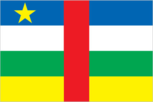
four equal horizontal bands of blue (top), white, green, and yellow with a vertical red band in center; there is a yellow five-pointed star on the hoist side of the blue band Economy Central African Republic
GDP - composition by sector
- agriculture
- 55%
- industry
- 20%
- services
- 25% (2001 est.)
GDP - per capita (PPP)
$1,100 (2006 est.)
GDP - real growth rate
3% (2006 est.)
GDP (official exchange rate)
$1.542 billion (2006 est.)
GDP (purchasing power parity)
$4.913 billion (2006 est.)
Geographic coordinates
7 00 N, 21 00 E
Geography - note
landlocked; almost the precise center of Africa People Central African Republic
Government type
republic
HIV/AIDS - adult prevalence rate
13.5% (2003 est.)
HIV/AIDS - deaths
23,000 (2003 est.)
HIV/AIDS - people living with HIV/AIDS
260,000 (2003 est.)
Household income or consumption by percentage share
- highest 10%
- 47.7% (1993)
- lowest 10%
- 0.7%
IDPs
150,000 (ongoing unrest following coup in 2003) (2006)
Imports
$203 million f.o.b. (2004 est.)
Imports - commodities
food, textiles, petroleum products, machinery, electrical equipment, motor vehicles, chemicals, pharmaceuticals
Imports - partners
France 16.6%, Netherlands 10.3%, Cameroon 9.7%, US 7.3% (2005)
Independence
13 August 1960 (from France)
Industrial production growth rate
3% (2002)
Industries
gold and diamond mining, logging, brewing, textiles, footwear, assembly of bicycles and motorcycles
Infant mortality rate
- female
- 78.61 deaths/1,000 live births (2006 est.)
- male
- 92.44 deaths/1,000 live births
- total
- 85.63 deaths/1,000 live births
Inflation rate (consumer prices)
3.6% (2001 est.)
International organization participation
ACCT, ACP, AfDB, AU, BDEAC, CEMAC, FAO, FZ, G-77, IAEA, IBRD, ICAO, ICCt, ICRM, IDA, IFAD, IFC, IFRCS, ILO, IMF, Interpol, IOC, ITU, ITUC, MIGA, NAM, OIC (observer), OIF, OPCW, OPCW (signatory), UN, UNCTAD, UNESCO, UNIDO, UNWTO, UPU, WCL, WCO, WHO, WIPO, WMO, WTO
Internet country code
.cf
Internet hosts
10 (2006)
Internet Service Providers (ISPs)
1 (2002)
Internet users
9,000 (2005) Transportation Central African Republic
Irrigated land
20 sq km (2003)
Judicial branch
Supreme Court or Cour Supreme; Constitutional Court (3 judges appointed by the president, 3 by the president of the National Assembly, and 3 by fellow judges); Court of Appeal; Criminal Courts; Inferior Courts
Labor force
NA
Land boundaries
- border countries
- Cameroon 797 km, Chad 1,197 km, Democratic Republic of the Congo 1,577 km, Republic of the Congo 467 km, Sudan 1,165 km
- total
- 5,203 km
Land use
- arable land
- 3.1%
- other
- 96.75% (2005)
- permanent crops
- 0.15%
Languages
French (official), Sangho (lingua franca and national language), tribal languages
Legal system
based on French law
Legislative branch
- unicameral National Assembly or Assemblee Nationale (109 seats; members are elected by popular vote to serve five-year terms)
- election results
- percent of vote by party - MLPC 43%, RDC 18%, MDD 9%, FPP 6%, PSD 5%, ADP 4%, PUN 3%, FODEM 2%, PLD 2%, UPR 1%, FC 1%, independents 6%; seats by party - MLPC 47, RDC 20, MDD 8, FPP 7, PSD 6, ADP 5, PUN 3, FODEM 2, PLD 2, UPR 1, FC 1, independents 7
- elections
- last held 13 March 2005 and 8 May 2005 (next to be held NA 2010)
Life expectancy at birth
- female
- 43.62 years (2006 est.)
- male
- 43.46 years
- total population
- 43.54 years
Literacy
- definition
- age 15 and over can read and write
- female
- 39.9% (2003 est.) Government Central African Republic
- male
- 63.3%
- total population
- 51%
Location
Central Africa, north of Democratic Republic of the Congo
Major infectious diseases
- degree of risk
- very high
- food or waterborne diseases
- bacterial diarrhea, hepatitis A, and typhoid fever
- respiratory disease
- meningococcal meningitis (2007)
- vectorborne disease
- malaria
Manpower available for military service
- females age 18-49
- 835,426 (2005 est.)
- males age 18-49
- 853,760
Manpower fit for military service
- females age 18-49
- 383,056 (2005 est.)
- males age 18-49
- 416,091
Map references
Africa
Maritime claims
none (landlocked)
Median age
- female
- 18.8 years (2006 est.)
- male
- 18 years
- total
- 18.4 years
Military expenditures - dollar figure
$16.37 million (2005 est.)
Military expenditures - percent of GDP
1% (2005 est.) Transnational Issues Central African Republic
Military service age and obligation
18 years of age for voluntary and compulsory military service; conscript service obligation is two years (2005)
National holiday
Republic Day, 1 December (1958)
Nationality
- adjective
- Central African
- noun
- Central African(s)
Natural gas - consumption
0 cu m (2004 est.)
Natural gas - production
0 cu m (2004 est.)
Natural hazards
hot, dry, dusty harmattan winds affect northern areas; floods are common
Natural resources
diamonds, uranium, timber, gold, oil, hydropower
Net migration rate
0 migrant(s)/1,000 population (2006 est.)
Oil - consumption
2,420 bbl/day (2004 est.)
Oil - exports
NA bbl/day
Oil - imports
NA bbl/day
Oil - production
0 bbl/day (2004)
Political parties and leaders
Alliance for Democracy and Progress or ADP [Jacques MBOLIEDAS]; Central African Democratic Assembly or RDC [Andre KOLINGBA]; Civic Forum or FC [Gen. Timothee MALENDOMA]; Democratic Forum for Modernity or FODEM [Charles MASSI]; Liberal Democratic Party or PLD [Nestor KOMBO-NAGUEMON]; Movement for Democracy and Development or MDD [David DACKO]; Movement for the Liberation of the Central African People or MLPC [Ange-Felix PATASSE] (the party of deposed president); National Convergence or KNK; Patriotic Front for Progress or FPP [Abel GOUMBA]; People's Union for the Republic or UPR [Pierre Sammy MAKFOY]; National Unity Party or PUN [Jean-Paul NGOUPANDE]; Social Democratic Party or PSD [Enoch LAKOUE]
Political pressure groups and leaders
NA
Population
- 4,303,356
- note
- estimates for this country explicitly take into account the effects of excess mortality due to AIDS; this can result in lower life expectancy, higher infant mortality and death rates, lower population and growth rates, and changes in the distribution of population by age and sex than would otherwise be expected (July 2006 est.)
Population below poverty line
NA%
Population growth rate
1.53% (2006 est.)
Ports and terminals
Bangui, Nola, Salo, Nzinga Military Central African Republic
Radio broadcast stations
AM 1, FM 5, shortwave 1 (2002)
Radios
283,000 (1997)
Refugees and internally displaced persons
- refugees (country of origin)
- 19,960 (Sudan) 3,325 (Democratic Republic of the Congo); note - UNHCR resumed repatriation of Southern Sudanese refugees in 2006
Religions
- indigenous beliefs 35%, Protestant 25%, Roman Catholic 25%, Muslim 15%
- note
- animistic beliefs and practices strongly influence the Christian majority
Roadways
- total
- 23,810 km (1999)
Sex ratio
- at birth
- 1.03 male(s)/female
- total population
- 0.98 male(s)/female (2006 est.)
- under 15 years
- 1.01 male(s)/female 15-64 years: 0.98 male(s)/female 65 years and over: 0.66 male(s)/female
Suffrage
21 years of age; universal
Telephone system
- domestic
- network consists principally of microwave radio relay and low-capacity, low-powered radiotelephone communication
- general assessment
- fair system
- international
- country code - 236; satellite earth station - 1 Intelsat (Atlantic Ocean)
Telephones - main lines in use
10,000 (2004)
Telephones - mobile cellular
60,000 (2004)
Television broadcast stations
1 (2001)
Televisions
18,000 (1997)
Terrain
vast, flat to rolling, monotonous plateau; scattered hills in northeast and southwest
Total fertility rate
4.41 children born/woman (2006 est.)
Trafficking in persons
- current situation
- Central African Republic is a source and destination country for children trafficked for domestic servitude, sexual exploitation, and forced labor in shops and commercial labor activities; while the majority of child victims are trafficked within the country, some are also trafficked to and from Cameroon and Nigeria
- tier rating
- Tier 2 Watch List - the Central African Republic failed to provide evidence of increasing efforts to combat trafficking in persons during 2005, specifically its inadequate law enforcement response to trafficking crimes This page was last updated on 8 February, 2007
Unemployment rate
8% (23% for Bangui) (2001 est.)
Waterways
2,800 km (primarily on the Oubangui and Sangha rivers) (2005)