1996 Edition
CIA World Factbook 1996 (Project Gutenberg)
Introduction
Description
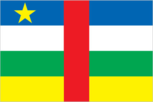
four equal horizontal bands of blue (top), white, green, and yellow with a vertical red band in center; there is a yellow five-pointed star on the hoist side of the blue band
Location
7 00 N, 21 00 E -- Central Africa, north of Zaire Flag ----
Geography
Area
- comparative area
- slightly smaller than Texas
- land area
- 622,980 sq km
- total area
- 622,980 sq km
Climate
tropical; hot, dry winters; mild to hot, wet summers
Coastline
0 km (landlocked)
Environment
- current issues
- tap water is not potable; poaching has diminished reputation as one of last great wildlife refuges; desertification
- international agreements
- party to - Biodiversity, Climate Change, Endangered Species, Nuclear Test Ban, Ozone Layer Protection; signed, but not ratified - Desertification, Law of the Sea
- natural hazards
- hot, dry, dusty harmattan winds affect northern areas; floods are common
Geographic coordinates
7 00 N, 21 00 E
Geographic note
landlocked; almost the precise center of Africa
International disputes
none
Irrigated land
NA sq km
Land boundaries
- border countries
- Cameroon 797 km, Chad 1,197 km, Congo 467 km, Sudan 1,165 km, Zaire 1,577 km
- total
- 5,203 km
Land use
- arable land
- 3%
- forest and woodland
- 64%
- meadows and pastures
- 5%
- other
- 28%
- permanent crops
- 0%
Location
Central Africa, north of Zaire
Map references
Africa
Maritime claims
none (landlocked)
Natural resources
diamonds, uranium, timber, gold, oil
Terrain
- vast, flat to rolling, monotonous plateau; scattered hills in northeast and southwest
- highest point
- Mount Gaou 1,420 m
- lowest point
- Oubangui River 335 m
People and Society
Age structure
0-14 years: 44% (male 724,914; female 718,423) 15-64 years: 52% (male 839,118; female 877,069) 65 years and over: 4% (male 53,418; female 61,484) (July 1996 est.)
Birth rate
39.97 births/1,000 population (1996 est.)
Death rate
17.64 deaths/1,000 population (1996 est.)
Ethnic divisions
Baya 34%, Banda 27%, Sara 10%, Mandjia 21%, Mboum 4%, M'Baka 4%, Europeans 6,500 (including 3,600 French)
Infant mortality rate
111.7 deaths/1,000 live births (1996 est.)
Languages
French (official), Sangho (lingua franca and national language), Arabic, Hunsa, Swahili
Life expectancy at birth
- female
- 46.71 years (1996 est.)
- male
- 45.03 years
- total population
- 45.86 years
Literacy
- age 15 and over can read and write (1995 est.)
- female
- 52.4%
- male
- 68.5%
- total population
- 60%
Nationality
- adjective
- Central African
- noun
- Central African(s)
Net migration rate
-1.53 migrant(s)/1,000 population (1996 est.)
Population
3,274,426 (July 1996 est.)
Population growth rate
2.08% (1996 est.)
Religions
- indigenous beliefs 24%, Protestant 25%, Roman Catholic 25%, Muslim 15%, other 11%
- note
- animistic beliefs and practices strongly influence the Christian majority
Sex ratio
- all ages
- 0.98 male(s)/female (1996 est.)
- at birth
- 1.03 male(s)/female
- under 15 years
- 1.01 male(s)/female 15-64 years: 0.96 male(s)/female 65 years and over: 0.87 male(s)/female
Total fertility rate
5.41 children born/woman (1996 est.)
Government
Administrative divisions
14 prefectures (prefectures, singular - prefecture), 2 economic prefectures* (prefectures economiques, singular - prefecture economique), and 1 commune**; Bamingui-Bangoran, Bangui**, Basse-Kotto, Gribingui*, Haute-Kotto, Haute-Sangha, Haut-Mbomou, Kemo-Gribingui, Lobaye, Mbomou, Nana-Mambere, Ombella-Mpoko, Ouaka, Ouham, Ouham-Pende, Sangha*, Vakaga
Capital
Bangui
Constitution
passed by referendum 29 December 1994; adopted 7 January 1995
Data code
CT
Diplomatic representation in US
- chancery
- 1618 22nd Street NW, Washington, DC 20008
- chief of mission
- Ambassador Henri KOBA
- telephone
- [1] (202) 483-7800, 7801
Executive branch
- cabinet
- Council of Ministers; appointed by the president
- chief of state
- President Ange PATASSE (since 22 October 1993) elected for a five-year term by universal suffrage; election last held 19 September 1993 (next to be held NA 1998); results - PATASSE received 52.45% of the votes and Abel GOUMBA received 45.62%
- head of government
- Prime Minister Jean-Paul NGOUPANDE (since 6 June 1996); appointed by the president
FAX
- [1] (202) 332-9893
- [236] 61 44 94
Flag
four equal horizontal bands of blue (top), white, green, and yellow with a vertical red band in center; there is a yellow five-pointed star on the hoist side of the blue band
Independence
13 August 1960 (from France)
International organization participation
ACCT, ACP, AfDB, BDEAC, CCC, CEEAC, ECA, FAO, FZ, G-77, IBRD, ICAO, ICRM, IDA, IFAD, IFC, IFRCS, ILO, IMF, Intelsat, Interpol, IOC, ITU, NAM, OAU, UDEAC, UN, UNCTAD, UNESCO, UNIDO, UPU, WCL, WHO, WIPO, WMO, WTrO
Judicial branch
Supreme Court (Cour Supreme), judges appointed by the president; Constitutional Court, judges appointed by the president
Legal system
based on French law
Legislative branch
unicameral
Name of country
- abbreviation
- CAR
- conventional long form
- Central African Republic
- conventional short form
- none
- former
- Central African Empire
- local long form
- Republique Centrafricaine
- local short form
- none
National Assembly (Assemblee Nationale)
- elections last held 19 September 1993 (next to be held NA); results - percent of vote by party NA; seats - (85 total) MLPC 33, RDC 14, PLD 7, ADP 6, PSD 3, others 22
- note
- the National Assembly is advised by the Economic and Regional Council (Conseil Economique et Regional); when they sit together they are called the Congress (Congres)
National holiday
National Day, 1 December (1958) (proclamation of the republic)
Political parties and leaders
Alliance for Democracy and Progress (ADP), Tchapka BREDE; Central African Democratic Assembly (RDC), Andre KOLINGBA; Civic Forum (FC), Gen. Timothee MALENDOMA; Liberal Democratic Party (PLD), Nestor KOMBO-NAGUEMON; Movement for the Liberation of the Central African People (MLPC), the party of the president, Ange Felix PATASSE; Movement for Democracy and Development (MDD), David DACKO; Marginal Movement for Democracy, Renaissance and Evolution (MDREC), Joseph BENDOUNGA; Patriotic Front for Progress (FFP), Abel GOUMBA; Social Democratic Party (PSD), Enoch Derant LAKOUE
Suffrage
21 years of age; universal
Type of government
republic;
US diplomatic representation
- chief of mission
- Ambassador Mosina H. JORDAN
- embassy
- Avenue David Dacko, Bangui
- mailing address
- B. P. 924, Bangui
- telephone
- [236] 61 02 00, 61 25 78, 61 02 10
Economy
Agriculture
cotton, coffee, tobacco, manioc (tapioca), yams, millet, corn, bananas; timber
Budget
- expenditures
- $NA, including capital expenditures of $NA
- revenues
- $NA
Currency
1 Communaute Financiere Africaine franc (CFAF) = 100 centimes
Economic aid
- recipient
- ODA, $NA
Economic overview
Subsistence agriculture, together with forestry, remains the backbone of the economy of the Central African Republic (CAR), with more than 70% of the population living in outlying areas. The agricultural sector generates half of GDP. Timber has accounted for about 13% of export earnings and the diamond industry for nearly 80%. Important constraints to economic development include the CAR's landlocked position, a poor transportation system, a largely unskilled work force, and a legacy of misdirected macroeconomic policies. A major plus is the large forest reserves, which the government is moving to protect from overexploitation. The 50% devaluation of the currencies of 14 Francophone African nations on 12 January 1994 had mixed effects on the CAR's economy. While diamond, timber, coffee, and cotton exports increased - leading GDP to increase by 5.5% - inflation rose to 45%, fueled by the rising prices of imports on which the economy depends; inflation dropped back rapidly in 1995. The CAR's poor resource base and primitive infrastructure will keep it dependent on multilateral donors and France for the foreseeable future.
Electricity
- capacity
- 40,000 kW
- consumption per capita
- 29 kWh (1993)
- production
- 100 million kWh
Exchange rates
- CFA francs (CFAF) per US$1 - 500.56 (January 1996), 499.15 (1995), 555.20 (1994), 283.16 (1993), 264.69 (1992), 282.11 (1991)
- note
- beginning 12 January 1994, the CFA franc was devalued to CFAF 100 per French franc from CFAF 50 at which it had been fixed since 1948
Exports
- $154 million (f.o.b., 1994 est.)
- commodities
- diamonds, timber, cotton, coffee, tobacco
- partners
- France, Belgium, Italy, Japan, US, Spain, Iran
External debt
$904.3 million (1993 est.)
Fiscal year
calendar year
GDP
purchasing power parity - $2.5 billion (1995 est.)
GDP composition by sector
- agriculture
- 50%
- industry
- 14%
- services
- 36% (1993)
GDP per capita
$800 (1995 est.)
GDP real growth rate
4.1% (1995 est.)
Imports
- $215 million (f.o.b., 1994 est.)
- commodities
- food, textiles, petroleum products, machinery, electrical equipment, motor vehicles, chemicals, pharmaceuticals, consumer goods, industrial products
- partners
- France, other EC countries, Japan, Algeria, Cameroon, Namibia
Industrial production growth rate
NA%
Industries
diamond mining, sawmills, breweries, textiles, footwear, assembly of bicycles and motorcycles
Inflation rate (consumer prices)
45% (1994 est.)
Labor force
- 775,413 (1986 est.)
- by occupation
- agriculture 85%, commerce and services 9%, industry 3%, government 3%
- note
- about 64,000 salaried workers (1985)
Unemployment rate
NA%
Communications
Branches
Central African Army (includes Republican Guard), Air Force, National Gendarmerie, Police Force
Defense expenditures
exchange rate conversion - $30 million, 2.3% of GDP (1994)
Manpower availability
- males age 15-49
- 737,330
- males fit for military service
- 384,134 (1996 est.)
Radio broadcast stations
AM 1, FM 1, shortwave 0
Radios
NA
Telephone system
- fair system
- domestic
- network consists principally of microwave radio relay and low-capacity, low-powered radiotelephone communication
- international
- satellite earth station - 1 Intelsat (Atlantic Ocean)
Telephones
16,867 (1992 est.)
Television broadcast stations
1 (1987 est.)
Televisions
7,500 (1993 est.) Defense
Transportation
Airports
- total
- 48
- with paved runways 1 524 to 2 437 m
- 2
- with paved runways 2 438 to 3 047 m
- 1
- with paved runways under 914 m
- 11
- with unpaved runways 1 524 to 2 437 m
- 9
- with unpaved runways 2 438 to 3 047 m
- 1
- with unpaved runways 914 to 1 523 m
- 24 (1995 est.)
Highways
- paved
- 427 km
- total
- 23,738 km
- unpaved
- 23,311 km (1991 est.)
Ports
Bangui, Nola
Railways
0 km
Waterways
800 km; traditional trade carried on by means of shallow-draft dugouts; Oubangui is the most important river