1992 Edition
CIA World Factbook 1992 (Project Gutenberg)
Geography
Climate
tropical; hot, dry winters; mild to hot, wet summers
Coastline
none - landlocked
Comparative area
slightly smaller than Texas
Disputes
none
Environment
hot, dry, dusty harmattan winds affect northern areas; poaching has diminished reputation as one of last great wildlife refuges; desertification
Land area
622,980 km2
Land boundaries
5,203 km; Cameroon 797 km, Chad 1,197 km, Congo 467 km, Sudan 1,165 km, Zaire 1,577 km
Land use
arable land 3%; permanent crops NEGL%; meadows and pastures 5%; forest and woodland 64%; other 28%
Maritime claims
none - landlocked
Natural resources
diamonds, uranium, timber, gold, oil
Note
landlocked; almost the precise center of Africa
Terrain
vast, flat to rolling, monotonous plateau; scattered hills in northeast and southwest
Total area
622,980 km2
People and Society
Birth rate
43 births/1,000 population (1992)
Death rate
18 deaths/1,000 population (1992)
Ethnic divisions
about 80 ethnic groups, the majority of which have related ethnic and linguistic characteristics; Baya 34%, Banda 27%, Sara 10%, Mandjia 21%, Mboum 4%, M'Baka 4%; 6,500 Europeans, of whom 3,600 are French
Infant mortality rate
135 deaths/1,000 live births (1992)
Labor force
775,413 (1986 est.); agriculture 85%, commerce and services 9%, industry 3%, government 3%; about 64,000 salaried workers; 55% of population of working age (1985)
Languages
French (official); Sangho (lingua franca and national language); Arabic, Hunsa, Swahili
Life expectancy at birth
46 years male, 49 years female (1992)
Literacy
27% (male 33%, female 15%) age 15 and over can read and write (1990 est.)
Nationality
noun - Central African(s); adjective - Central African
Net migration rate
0 migrants/1,000 population (1992)
Organized labor
1% of labor force
Population
3,029,080 (July 1992), growth rate 2.6% (1992)
Religions
indigenous beliefs 24%, Protestant 25%, Roman Catholic 25%, Muslim 15%, other 11%; animistic beliefs and practices strongly influence the Christian majority
Total fertility rate
5.5 children born/woman (1992)
Government
Administrative divisions
14 prefectures (prefectures, singular - prefecture), 2 economic prefectures* (prefectures economiques, singular - prefecture economique), and 1 commune**; Bamingui-Bangoran, Bangui** Basse-Kotto, Gribingui*, Haute-Kotto, Haute-Sangha, Haut-Mbomou, Kemo-Gribingui, Lobaye, Mbomou, Nana-Mambere, Ombella-Mpoko, Ouaka, Ouham, Ouham-Pende, Sangha*, Vakaga
Capital
Bangui
Chief of State
: President Andre-Dieudonne KOLINGBA (since 1 September 1981)
Communists
small number of Communist sympathizers
Constitution
21 November 1986
Diplomatic representation
Ambassador Jean-Pierre SOHAHONG-KOMBET; Chancery at 1618 22nd Street NW, Washington, DC 20008; telephone (202) 483-7800 or 7801 US: Ambassador Daniel H. SIMPSON; Embassy at Avenue du President David Dacko, Bangui (mailing address is B. P. 924, Bangui); telephone 61-02-00, 61-25-78, or 61-43-33; FAX [190] (236) 61-44-94
Executive branch
president, prime minister, Council of Ministers (cabinet)
Flag
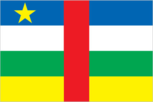
four equal horizontal bands of blue (top), white, green, and yellow with a vertical red band in center; there is a yellow five-pointed star on the hoist side of the blue band
Head of Government
: Prime Minister Edouard FRANCK (since 15 March 1991)
Independence
13 August 1960 (from France; formerly Central African Empire)
Judicial branch
Supreme Court (Cour Supreme)
Legal system
based on French law
Legislative branch
unicameral National Assembly (Assemblee Nationale) advised by the Economic and Regional Council (Conseil Economique et Regional); when they sit together this is known as the Congress (Congres)
Long-form name
Central African Republic (no short-form name); abbreviated CAR
Member of
ACCT, ACP, AfDB, BDEAC, CCC, CEEAC, ECA, FAO, FZ, G-77, GATT, IBRD, ICAO, ICFTU, IDA, IFAD, ILO, IMF, INTELSAT, INTERPOL, IOC, ITU, LORCS, NAM, OAU, UDEAC, UN, UNCTAD, UNESCO, UNIDO, UPU, WCL, WHO, WIPO, WMO
National Assembly
last held 31 July 1987 (next to be held by end of 1992); results - RDC is the only party; seats - (52 total) RDC 52
National holiday
National Day (proclamation of the republic), 1 December (1958)
Political parties and leaders
Centrafrican Democratic Rally Party (RDC), Andre-Dieudonne KOLINGBA; note - as part of political reforms leading to a democratic system announced in April 1991, 18 opposition parties have been legalized
President
last held 21 November 1986 (next to be held by end of 1992); results - President KOLINGBA was reelected without opposition
Suffrage
universal at age 21
Type
republic, one-party presidential regime since 1986
Economy
Agriculture
accounts for 40% of GDP; self-sufficient in food production except for grain; commercial crops - cotton, coffee, tobacco, timber; food crops - manioc, yams, millet, corn, bananas
Budget
revenues $121 million; expenditures $193 million, including capital expenditures of $NA million (1991 est.)
Currency
Communaute Financiere Africaine franc (plural - francs); 1 CFA franc (CFAF) = 100 centimes
Economic aid
US commitments, including Ex-Im (FY70-89), $49 million; Western (non-US) countries, ODA and OOF bilateral commitments (1970-89), $1.5 billion; OPEC bilateral aid (1979-89), $6 million; Communist countries (1970-89), $38 million
Electricity
40,000 kW capacity; 95 million kWh produced, 30 kWh per capita (1991)
Exchange rates
Communaute Financiere Africaine francs (CFAF) per US$1 - 269.01 (January 1992), 282.11 (1991), 272.26 (1990), 319.01 (1989), 297.85 (1988), 300.54 (1987)
Exports
$151.3 million (1990 est.) commodities: diamonds, cotton, coffee, timber, tobacco partners: France, Belgium, Italy, Japan, US
External debt
$700 million (1990 est.)
Fiscal year
calendar year
GDP
exchange rate conversion - $1.3 billion, per capita $440; real growth rate - 3.0% (1990 est.)
Imports
$214.5 million (1990 est.) commodities: food, textiles, petroleum products, machinery, electrical equipment, motor vehicles, chemicals, pharmaceuticals, consumer goods, industrial products partners: France, other EC countries, Japan, Algeria, Yugoslavia
Industrial production
0.8% (1988); accounts for 12% of GDP
Industries
diamond mining, sawmills, breweries, textiles, footwear, assembly of bicycles and motorcycles
Inflation rate (consumer prices)
-3.0% (1990 est.)
Overview
Subsistence agriculture, including forestry, is the backbone of the CAR economy, with more than 70% of the population living in the countryside. In 1988 the agricultural sector generated about 40% of GDP. Agricultural products accounted for about 60% of export earnings and the diamond industry for 30%. The country's 1991 budget deficit was US $70 million and in 1992 is expected to be about the same. Important constraints to economic development include the CAR's landlocked position, a poor transportation system, and a weak human resource base. Multilateral and bilateral development assistance, particularly from France, plays a major role in providing capital for new investment.
Unemployment rate
30% in Bangui (1988 est.)
Communications
Airports
66 total, 52 usable; 4 with permanent-surface runways; none with runways over 3,659 m; 2 with runways 2,440-3,659 m; 22 with runways 1,220-2,439 m
Civil air
2 major transport aircraft
Highways
22,000 km total; 458 km bituminous, 10,542 km improved earth, 11,000 unimproved earth
Inland waterways
800 km; traditional trade carried on by means of shallow-draft dugouts; Oubangui is the most important river
Telecommunications
fair system; network relies primarily on radio relay links, with low-capacity, low-powered radiocommunication also used; broadcast stations - 1 AM, 1 FM, 1 TV; 1 Atlantic Ocean INTELSAT earth station
Military and Security
Branches
Central African Army (including Republican Guard), Air Force, National Gendarmerie, Police Force
Defense expenditures
exchange rate conversion - $23 million, 1.8% of GDP (1989 est.)
Manpower availability
males 15-49, 677,889; 354,489 fit for military service