1991 Edition
CIA World Factbook 1991 (Project Gutenberg)
Geography
Climate
tropical; hot, dry winters; mild to hot, wet summers
Coastline
none--landlocked
Comparative area
slightly smaller than Texas
Environment
hot, dry, dusty harmattan winds affect northern areas; poaching has diminished reputation as one of last great wildlife refuges; desertification
Land boundaries
5,203 km total; Cameroon 797 km, Chad 1,197 km, Congo 467 km, Sudan 1,165 km, Zaire 1,577 km
Land use
arable land 3%; permanent crops NEGL%; meadows and pastures 5%; forest and woodland 64%; other 28%
Maritime claims
none--landlocked
Natural resources
diamonds, uranium, timber, gold, oil
Note
landlocked; almost the precise center of Africa
Terrain
vast, flat to rolling, monotonous plateau; scattered hills in northeast and southwest
Total area
622,980 km2; land area: 622,980 km2
People and Society
Birth rate
44 births/1,000 population (1991)
Death rate
18 deaths/1,000 population (1991)
Ethnic divisions
about 80 ethnic groups, the majority of which have related ethnic and linguistic characteristics; Baya 34%, Banda 27%, Sara 10%, Mandjia 21%, Mboum 4%, M'Baka 4%; 6,500 Europeans, of whom 3,600 are French
Infant mortality rate
138 deaths/1,000 live births (1991)
Labor force
775,413 (1986 est.); agriculture 85%, commerce and services 9%, industry 3%, government 3%; about 64,000 salaried workers; 55% of population of working age (1985)
Language
French (official); Sangho (lingua franca and national language); Arabic, Hunsa, Swahili
Life expectancy at birth
45 years male, 49 years female (1991)
Literacy
27% (male 33%, female 15%) age 15 and over can read and write (1990 est.)
Nationality
noun--Central African(s); adjective--Central African
Net migration rate
0 migrants/1,000 population (1991)
Organized labor
1% of labor force
Population
2,952,382 (July 1991), growth rate 2.6% (1991)
Religion
indigenous beliefs 24%, Protestant 25%, Roman Catholic 25%, Muslim 15%, other 11%; animistic beliefs and practices strongly influence the Christian majority
Total fertility rate
5.6 children born/woman (1991)
Government
Administrative divisions
14 prefectures (prefectures, singular--prefecture) and 2 economic prefectures* (prefectures economiques, singular--prefecture economique); Bamingui-Bangoran, Basse-Kotto, Gribingui*, Haute-Kotto, Haute-Sangha, Haut-Mbomou, Kemo-Gribingui, Lobaye, Mbomou, Nana-Mambere, Ombella-Mpoko, Ouaka, Ouham, Ouham-Pende, Sangha*, Vakaga; note--there may be a new autonomous commune of Bangui
Capital
Bangui
Communists
small number of Communist sympathizers
Constitution
21 November 1986
Diplomatic representation
Ambassador Jean-Pierre SOHAHONG-KOMBET; Chancery at 1618 22nd Street NW, Washington DC 20008; telephone (202) 483-7800 or 7801; US--Ambassador Daniel H. SIMPSON; Embassy at Avenue du President David Dacko, Bangui (mailing address is B. P. 924, Bangui); telephone 61-02-00 or 61-25-78, 61-43-33
Elections
President--last held 21 November 1986 (next to be held November 1993); results--President KOLINGBA was reelected without opposition; National Assembly--last held 31 July 1987 (next to be held July 1992); results--RDC is the only party; seats--(52 total) RDC 52
Executive branch
president, Council of Ministers (cabinet)
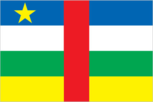
Flag
four equal horizontal bands of blue (top), white, green, and yellow with a vertical red band in center; there is a yellow five-pointed star on the hoist side of the blue band
Independence
13 August 1960 (from France; formerly Central African Empire)
Judicial branch
Supreme Court (Cour Supreme)
Leaders
Chief of State and Head of Government--President Andre-Dieudonne KOLINGBA (since 1 September 1981)
Legal system
based on French law
Legislative branch
unicameral National Assembly (Assemblee Nationale) advised by the Economic and Regional Council (Conseil Economique et Regional); when they sit together this is known as the Congress (Congres)
Long-form name
Central African Republic (no short-form name); abbreviated CAR
Member of
ACCT, ACP, AfDB, BDEAC, CCC, CEEAC, ECA, FAO, FZ, G-77, GATT, IBRD, ICAO, ICFTU, IDA, IFAD, ILO, IMF, INTELSAT, INTERPOL, IOC, ITU, LORCS, NAM, OAU, UDEAC, UN, UNCTAD, UNESCO, UNIDO, UPU, WCL, WHO, WIPO, WMO
National holiday
National Day (proclamation of the republic), 1 December (1958)
Political parties and leaders
only party--Centrafrican Democrtic Rally Party (RDC), Andre-Dieudonne KOLINGBA
Suffrage
universal at age 21
Type
republic, one-party presidential regime since 1986
Economy
Agriculture
accounts for 40% of GDP; self-sufficient in food production except for grain; commercial crops--cotton, coffee, tobacco, timber; food crops--manioc, yams, millet, corn, bananas
Budget
revenues $132 million; current expenditures $305 million, including capital expenditures of $NA million (1989 est.)
Currency
Communaute Financiere Africaine franc (plural--francs); 1 CFA franc (CFAF) = 100 centimes
Economic aid
US commitments, including Ex-Im (FY70-89), $49 million; Western (non-US) countries, ODA and OOF bilateral commitments (1970-88), $1.4 billion; OPEC bilateral aid (1979-89), $6 million; Communist countries (1970-88), $38 million
Electricity
35,000 kW capacity; 84 million kWh produced, 30 kWh per capita (1989)
Exchange rates
Communaute Financiere Africaine francs (CFAF) per US$1--256.54 (January 1991), 272.26 (1990), 319.01 (1989), 297.85 (1988), 300.54 (1987), 346.30 (1986), 449.26 (1985)
Exports
$148 million (f.o.b., 1989 est.); commodities--diamonds, cotton, coffee, timber, tobacco; partners--France, Belgium, Italy, Japan, US
External debt
$671 million (December 1989)
Fiscal year
calendar year
GDP
$1.3 billion, per capita $440; real growth rate 2.0% (1990 est.)
Imports
$239 million (c.i.f., 1989 est.); commodities--food, textiles, petroleum products, machinery, electrical equipment, motor vehicles, chemicals, pharmaceuticals, consumer goods, industrial products; partners--France, other EC, Japan, Algeria, Yugoslavia
Industrial production
0.8% (1988); accounts for 12% of GDP
Industries
diamond mining, sawmills, breweries, textiles, footwear, assembly of bicycles and motorcycles
Inflation rate (consumer prices)
- 4.2% (1988 est.)
Overview
The Central African Republic (CAR) had a per capita income of roughly $440 in 1990. Subsistence agriculture, including forestry, is the backbone of the economy, with over 70% of the population living in the countryside. In 1988 the agricultural sector generated about 40% of GDP. Agricultural products accounted for about 60% of export earnings and the diamond industry for 30%. Important constraints to economic development include the CAR's landlocked position, a poor transportation infrastructure, and a weak human resource base. Multilateral and bilateral development assistance plays a major role in providing capital for new investment.
Unemployment rate
30% in Bangui (1988 est.)
Communications
Airports
66 total, 49 usable; 4 with permanent-surface runways; none with runways over 3,659 m; 2 with runways 2,440-3,659 m; 22 with runways 1,220-2,439 m
Civil air
2 major transport aircraft
Highways
22,000 km total; 458 km bituminous, 10,542 km improved earth, 11,000 unimproved earth
Inland waterways
800 km; traditional trade carried on by means of shallow-draft dugouts; Oubangui is the most important river
Telecommunications
fair system; network relies primarily on radio relay links, with low-capacity, low-powered radiocommunication also used; 6,000 telephones; stations--1 AM, 1 FM, 1 TV; 1 Atlantic Ocean INTELSAT earth station
Military and Security
Branches
Central African Armed Forces, Air Force, National Gendarmerie, Police Force
Defense expenditures
$23 million, 1.8% of GDP (1989 est.) _%_
Manpower availability
males 15-49, 659,802; 345,049 fit for military service