1989 Edition
CIA World Factbook 1989 (Internet Archive)
Geography
Climate
- tropical; hot, dry winters; mild to hot, wet summers
- tropical in south, desert in north
Coastline
- none — landlocked
- none — landlocked
Comparative area
- slightly smaller than Texas
- slightly more than three times the size of California
Disputes
Libya claims and occupies a small portion of the Aozou Strip in far north; exact locations of the Chad-NigerNigeria and Cameroon-Chad-Nigeria tripoints in Lake Chad have not been determined— since the boundary has not been demarcated, border incidents have resulted
Environment
- hot, dry, dusty harmattan winds affect northern areas; poaching has diminished reputation as one of last great wildlife refuges; desertification
- hot, dry, dusty harmattan winds occur in north; drought and desertification adversely affecting south; subject to plagues of locusts
Land boundaries
- 5,203 km total; Cameroon 797 km, Chad 1,197 km, Congo 467 km, Sudan 1,165 km, Zaire 1,577 km
- 5,968 km total; Cameroon 1,094 km, Central African Republic 1,197 km, Libya 1,055 km, Niger 1,175 km, Nigeria 87 km, Sudan 1,360 km
Land use
- 3% arable land; NEGL% permanent crops; 5% meadows and pastures; 64% forest and woodland; 28% other
- 2% arable land; NEGL% permanent crops; 36% meadows and pastures; 11% forest and woodland; 51% other; includes NEGL% irrigated
Maritime claims
- none — landlocked
- none — landlocked
Natural resources
- diamonds, uranium, timber, gold, oil
- small quantities of crude oil (unexploited but exploration beginning), uranium, natron, kaolin, fish (Lake Chad)
Note
- landlocked; almost the precise center of Africa
- landlocked; Lake Chad is the most significant water body in the Sahel
Terrain
- vast, flat to rolling, monotonous plateau; scattered hills in northeast and southwest
- broad, arid plains in center, desert in north, mountains in northwest, lowlands in south
Total area
- 622,980 km2; land area: 622,980 km2
- 1,284,000 km2; land area: 1,259,200 km2
People and Society
Birth rate
- 44 births/ 1 ,000 population (1990)
- 42 births/ 1,000 population (1990)
Death rate
- 18 deaths/ 1,000 population (1990)
- 22 deaths/ 1,000 population (1990)
Ethnic divisions
- about 80 ethnic groups, the majority of which have related ethnic and linguistic characteristics; 34% Baya, 27% Banda, 10% Sara, 21% Mandjia, 4% Mboum, 4% M'Baka; 6,500 Europeans, of whom 3,600 are French
- some 200 distinct ethnic groups, most of whom are Muslims (Arabs, Toubou, Fulbe, Kotoko, Hausa, Kanembou, Baguirmi, Boulala, and Maba) in the north and center and non-Muslims (Sara, Ngambaye, Mbaye, Goulaye, Moudang, Moussei, Massa) in the south; some 150,000 nonindigenous, of whom 1,000 are French
Infant mortality rate
- 141 deaths/ 1,000 live births (1990)
- 136 deaths/ 1,000 live births (1990)
Labor force
- 775,413 (1986 est.); 85% agriculture, 9% commerce and services, 3% industry, 3% government; about 64,000 salaried workers; 55% of population of working age (1985)
- NA; 85% agriculture (engaged in unpaid subsistence farming, herding, and fishing)
Language
- French (official); Sangho (lingua franca and national language); Arabic, Hunsa, Swahili
- French and Arabic (official); Sara and Sango in south; mere than 100 different languages and dialects are spoken
Life expectancy at birth
- 45 years male, 48 years female (1990)
- 38 years male, 40 years female (1990)
Literacy
- 40.2%
- 25.3%
Nationality
- noun — Central African(s); adjective — Central African Central African Republic (continued)
- noun — Chadian(s); adjective — Chadian
Net migration rate
- 0 migrants/ 1 ,000 population (1990)
- NEGL migrants/ 1,000 population (1990)
Organized labor
- 1 % of labor force
- about 20% of wage labor force
Population
- 2,877,365 (July 1990), growth rate 2.6% (1990)
- 5,017,431 (July 1990), growth rate 2.1% (1990)
Religion
- 24% indigenous beliefs, 25% Protestant, 25% Roman Catholic, 15% Muslim, 1 1% other; animistic beliefs and practices strongly influence the Christian majority
- 44% Muslim, 33% Christian, 23% indigenous beliefs, animism
Total fertility rate
- 5.6 children born/ woman (1990)
- 5.3 children born/ woman (1990)
Government
Administrative divisions
- 14 prefectures (prefectures, singular — prefecture) and 2 economic prefectures* (prefectures economiques, singular — prefecture economique); Bamingui-Bangoran, Basse-Kotto, Gribingui*, Haute-Kotto, Haute-Sangha, Haut-Mbomou, Kemo-Gribingui, Lobaye, Mbomou, Nana-Mambere, Ombella-Mpoko, Ouaka, Ouham, OuhamPende, Sangha*, Vakaga; note — there may be a new autonomous commune of Bangui
- 14 prefectures (prefectures, singular — prefecture); Batha, Biltine, Borkou-Ennedi-Tibesti, ChariBaguirmi, Guera, Kanem, Lac, Logone Occidental, Logone Oriental, Mayo-Kebbi, Moyen-Chari, Ouaddai', Salamat, Tandjile
Capital
- Bangui
- N'Djamena
Communists
- small number of Communist sympathizers
- no front organizations or underground party; probably a few Communists and some sympathizers
Constitution
- 21 November 1986
- 22 December 1989
Diplomatic representation
- Ambassador Jean-Pierre SOHAHONG-KOMBET; Chancery at 1618 22nd Street NW, Washington DC 20008; telephone (202) 483-7800 or 7801; US— Ambassador Daniel H. SIMPSON; Embassy at Avenue du President David Dacko, Bangui (mailing address is B. P. 924, Bangui); telephone 61-02-00 or 61-25-78, 61-43-33
- Ambassador Mahamat Ali ADOUM; Chancery at 2002 R Steet NW, Washington DC 20009; telephone (202) 462-4009; US— Ambassador (vacant); Charge d'Affaires, Julius WALKER; Embassy at Avenue Felix Eboue, N'Djamena (mailing address is B. P. 413, N'Djamena); telephone [235] (51) 32-69 or 35-13, 28-62, 23-29, 32-29, 30-94, 28-47
Elections
- President — last held 21 November 1986 (next to be held November 1993); results — President Kolingba was reelected without opposition; National Assembly — last held 3 1 July 1987 (next to be held July 1992); results— RDC is the only party; seats — (total) RDC
- President — last held 10 December 1989 (next to be held December 1996); results — President Habre was reelected without opposition
Executive branch
- president, Council of Ministers (cabinet)
- president, Council of Ministers (cabinet)
Flag
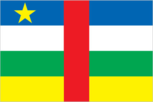
- four equal horizontal bands of blue (top), white, green, and yellow with a vertical red band in center; there is a yellow five-pointed star on the hoist side of the blue band
- three equal vertical bands of blue (hoist side), yellow, and red; similar to the flag of Andorra which has a national coat of arms featuring a quartered shield centered in the yellow band; also similar to the flag of Romania which has a national coat of arms featuring a mountain landscape centered in the yellow band; design was based on the flag of France
Independence
- 1 3 August 1 960 (from France; formerly Central African Empire)
- 1 1 August 1 960 (from France)
Judicial branch
- Supreme Court (Cour Supreme)
- Court of Appeal
Leaders
- Chief of State and Head of Government— President Andre-Dieudonne KOLINGBA (since 1 September 1981) Political parties and leaders: only party — Centrafrican Democrtic Rally Party (RDC), Andre-Dieudonne Kolingba
- Chief of State and Head of Government— President Hissein HABRE (since 19 June 1982) Political parties and leaders: National Union for Independence and Revolution (UNIR) established June 1984 with Habre as President; numerous dissident groups Chad (continued) (most significant opponents have returned to the government since mid1986)
Legal system
- based on French law
- based on French civil law system and Chadian customary law; has not accepted compulsory ICJ jurisdiction
Legislative branch
- bicameral Congress consists of an upper house or Economic and Regional Council (Conseil Economique et Regional) and a lower house or National Assembly (Assemblee Nationale)
- unicameral National Consultative Council (Conseil National Consultatif)
Long-form name
- Central African Republic (no short-form name); abbreviated CAR
- Republic of Chad
Member of
- ACP, AfDB, CCC, Conference of East and Central African States, EAMA, ECA, FAO, G-77, GATT, IBRD, ICAO, ICO, IDA, IFAD, ILO, IMF, INTELSAT, INTERPOL, ITU, NAM, OAU, OCAM, UDEAC, UN, UNESCO, UPU, WHO, WIPO, WMO
- ACP, AfDB, CEAO, Conference of East and Central African States, EAMA, ECA, EC (associate), FAO, G-77, GATT, IBRD, ICAC, ICAO, IDA, IDB— Islamic Development Bank, IFAD, ILO, IMF, INTELSAT, INTERPOL, ITU, Lake Chad Basin Commission, NAM, OAU, OCAM, QIC, UN, UNESCO, UPU, WHO, WIPO, WMO
National holiday
- National Day (proclamation of the republic), 1 December (1958)
- National Day (founding of the Third Republic), 7 June (1982)
Other political or pressure groups
NA
Suffrage
- universal at age 21
- universal at age NA
Type
- republic, one-party presidential regime since 1986
- republic
Economy
Agriculture
- minor production of vegetables, fruit, livestock; turtle farming
- accounts for 40% of GDP; self-sufficient in food production except for grain; commercial crops — cotton, coffee, tobacco, timber; food crops — manioc, yams, millet, corn, bananas
- accounts for 45% of GDP; largely subsistence farming; cotton most important cash crop; food crops include sorghum, millet, peanuts, rice, potatoes, manioc; livestock — cattle, sheep, goats, camels; self-sufficient in food in years of adequate rainfall
Aid
- US commitments, including Ex-Im (FY70-87), $26.7 million; Western (nonUS) countries, ODA and OOF bilateral commitments (1970-87), $32.2 million
- US commitments, including Ex-Im (FY70-88), $44 million; Western (non-US) countries, ODA and OOF bilateral commitments (1970-87), $1.3 billion; OPEC bilateral aid (1979-89), $6 million; Communist countries (1970-88), $38 million
- US commitments, including Ex-Im (FY70-88), $178 million; Western (nonUS) countries, ODA and OOF bilateral commitments (1970-87), $1.2 billion; OPEC bilateral aid (1979-89), $28 million; Communist countries (1970-88), $71 million
Budget
- revenues $46.2 million; expenditures $47.0 million, including capital expenditures of $9.1 million (1986)
- revenues $132 million; current expenditures $305 million, including capital expenditures of $NA million (1989 est.)
- revenues $61 million; expenditures $85 million, including capital expenditures of NA(1988est.)
Currency
- Caymanian dollar (plural — dollars); 1 Caymanian dollar (CI$) = 100 cents
- Communaute Financiere Africaine franc (plural — francs); 1 CFA franc (CFAF) = 100 centimes
- Communaute Financiere Africaine franc (plural — francs); 1 CFA franc (CFAF) = 100 centimes
Electricity
- 59,000 kW capacity; 213 million kWh produced, 8,960 kWh per capita (1989)
- 35,000 kW capacity; 84 million kWh produced, 30 kWh per capita (1989)
- 38,000 kW capacity; 70 million kWh produced, 14 kWh per capita (1989)
Exchange rates
- Caymanian dollars (CIS) per US$1— 0.835 (fixed rate)
- Communaute Financiere Africaine francs (CFAF) per US$1— 287.99 (January 1990), 319.01 (1989), 297.85 (1988), 300.54 (1987), 346.30 (1986), 449.26(1985) Fiscal yean calendar year
- Communaute Financiere Africaine francs (CFAF) per US$1 — 287.99 (January 1990), 319.01 (1989), 297.85 (1988), 300.54 (1987), 346.30 (1986), 449.26(1985)
Exports
- $2.2 million (f.o.b., 1986 est.); commodities — turtle products, manufactured consumer goods; partners — mostly US
- $138 million (f.o.b., 1988 est.); commodities — diamonds, cotton, coffee, timber, tobacco; partners — France, Belgium, Italy, Japan, US
- $432 million (f.o.b., 1988); commodities— cotton 43%, cattle 35%, textiles 5%, fish; partners — France, Nigeria, Cameroon
External debt
- $15 million (1986)
- $660 million (December 1989)
- $360 million (December 1989)
Fiscal year
- 1 April-31 March
- calendar year
GDP
- $238 million, per capita $10,000 (1989 est.); real growth rate 12% (1987 est.)
- $1.27 billion, per capita $453; real growth rate 2.0% (1988 est.)
- $902 million, per capita $190; real growth rate 7.0% (1988)
Imports
- $134 million (c.i.f., 1986 est.); commodities — foodstuffs, manufactured goods; partners — US, Trinidad and Tobago, UK, Netherlands Antilles, Japan
- $285 million (c.i.f., 1988 est.); commodities — food, textiles, petroleum products, machinery, electrical equipment, motor vehicles, chemicals, pharmaceuticals, consumer goods, industrial products; partners — France, other EC, Japan, Algeria, Yugoslavia
- $214 million (c.i.f., 1988); commodities— machinery and transportation equipment 39%, industrial goods 20%, petroleum products 13%, foodstuffs 9%; partners — US, France
Industrial production
- growth rate NA%
- 1.9% (1987 est.)
- growth rate —7.0% (1986)
Industries
- tourism, banking, insurance and finance, real estate and construction
- sawmills, breweries, diamond mining, textiles, footwear, assembly of bicycles and motorcycles
- cotton textile mills, slaughterhouses, brewery, natron (sodium carbonate)
Inflation rate (consumer prices)
- 2.4% (1986)
- —4.2% (1988 est.)
- —3.0% (1987)
Overview
- The economy depends heavily on tourism (70% of GDP and 75% of export earnings) and offshore financial services, with the tourist industry aimed at the luxury market and catering mainly to visitors from North America. About 90% of the islands' food and consumer goods needs must be imported. The Caymanians enjoy one of the highest standards of living in the region.
- The Central African Republic (CAR) is one of the poorest countries in Africa, with a per capita income of roughly $450 in 1988. Subsistence agriculture, including forestry, is the backbone of the economy, with over 70% of the population living in the countryside. In 1988 the agricultural sector generated about 40% of GDP, mining and manufacturing 14%, utilities and construction 4%, and services 41%. Agricultural products accounted for about 60% of export earnings and the diamond industry for 30%. Important constraints to economic development include the CAR's landlocked position, a poor transportation infrastructure, and a weak human resource base. Multilateral and bilateral development assistance plays a major role in providing capital for new investment.
- The climate, geographic location, and lack of infrastructure and natural resources potential make Chad one of the most underdeveloped countries in the world. Its economy is slowly recovering from the ravaging effects of prolonged civil war, conflict with Libya, drought, and food shortages. In 1986 real GDP returned to its 1977 level, with cotton, the major cash crop, accounting for 43% of exports. Over 80% of the work force is employed in subsistence farming and fishing. Industry is based almost entirely on the processing of agricultural products, including cotton, sugarcane, and cattle. Chad is still highly dependent on foreign aid, with its economy in trouble and many regions suffering from shortages.
Unemployment rate
- NA%
- 30% in Bangui (1988 est.)
- NA
Communications
Airports
- 3 total; 3 usable; 2 with permanent-surface runways; none with runways over 2,439 m; 2 with runways 1,220-2,439 m
- 66 total, 49 usable; 4 with permanent-surface runways; none with runways over 3,659 m; 2 with runways 2,440-3,659 m; 22 with runways 1,2202,439 m Chad
- 71 total, 55 usable; 4 with permanent-surface runways; none with runways over 3,659 m; 3 with runways 2,440-3,659 m; 24 with runways 1,2202,439 m
Branches
- Army, Air Force
- Army, Air Force, paramilitary Gendarmerie, Presidential Guard
Civil air
- 2 major transport aircraft
- 3 major transport aircraft
Defense expenditures
- 1.8% of GDP, or $23 million (1989 est.) SeercfionilmapVIl
- 3.5% of GDP (1987)
Highways
- 160 km of main roads
- 22,000 km total; 458 km bituminous, 10,542 km improved earth, 1 1 ,000 unimproved earth
- 31,322 km total; 32 km bituminous; 7,300 km gravel and laterite; remainder unimproved
Inland waterways
2,000 km navigable
Intend waterways
800 km; traditional trade carried on by means of shallow-draft dugouts; Oubangui is the most important river
Merchant marine
32 ships (1,000 CRT or over) totaling 355,055 GRT/576,622 DWT; includes 1 passenger-cargo, 8 cargo, 8 roll-on/roll-off cargo, 4 petroleum, oils, and lubricants (POL) tanker, 1 chemical tanker, 1 specialized tanker, 1 liquefied gas carrier, 8 bulk; note — a flag of convenience registry
Military manpower
- males 15-49, 642,207; 335,863 fit for military service
- males 15-49, 1,163,312; 603,923 fit for military service; 50,255 reach military age (20) annually
Note
defense is the responsibility of the UK 400km Secretions! mtp VII
Ports
George Town, Cayman Brae
Telecommunications
- 35,000 telephones; telephone system uses 1 submarine coaxial cable and 1 Atlantic Ocean INTELSAT earth station to link islands and access international services; stations — 2 AM, 1 FM, no TV Defense Forces
- fair system; network relies primarily on radio relay links, with low-capacity, low-powered radiocommunication also used; 6,000 telephones; stations—I AM, 1 FM, 1 TV; 1 Atlantic Ocean INTELSAT earth station Defense Forces
- fair system of radiocommunication stations for intercity links; 5,000 telephones; stations — 3 AM, 1 FM, limited TV service; many facilities are inoperative; 1 Atlantic Ocean INTELSAT earth station Defense Forces