1983 Edition
CIA World Factbook 1983 (Internet Archive)
Geography
Agriculture
- main crops — corn, beans, manioc, sweet potatoes; barely self-sufficient in food
- commercial — cotton, coffee, peanuts, sesame, wood; main food crops — manioc, corn, peanuts, rice, potatoes
Airfields
- 6 total, 6 usable; 4 with permanentsurface runways; 1 with runways 2,4403,659 m, 4 with runways 1,220-2,439 m
- 54 total, 45 usable; 3 with permanent-surface runways; 1 with runways 2,440-3,659 m, 18 with runways 1,2202,439 m
Branches
- National People's Assembly, 56 members; the official party is the supreme political institution
- People's Revolutionary Armed Forces (FARP); Army, Navy, and Air Force are separate components of FARP
- Gen. AndreDieudonne Kolingba is Chief of State and President of the Military Committee for National Recovery, which replaced the Council of Ministers; no legislature; separate judiciary
- Army, Air Force
Budget
- $17.1 million public revenue, $22.1 million current expenditures (1980 est.)
- (1982) revenues $102 million; current expenditures $111 million; development expenditures $18 million
Capital
- Praia
- Bangui
Civil air
- 2 major transport aircraft
- 3 major transport aircraft
Communists
a few Communists, some sympathizers
Elections
- National Assembly election held December 1980, the first since independence Political parties and leaders: only legal party, African Party for Independence of Cape Verde (PAICV), led by Aristides Pereira, secretary general; PAICV established in January 1981 to replace the former ruling party in both Cape Verde and Guinea Bissau, the African Party for the Independence of Guinea-Bissau and Cape Verde (PAIGC), in protest of the November 1980 coup in Guinea-Bissau
- no scheduled presidential, legislative, or municipal elections Political parties and leaders: political parties were banned in September 1981 Communists.- no Communist party; small number of Communist sympathizers
Electric power
- 8,000 kW capacity (1983); 10 million kWh produced (1983); 35 kWh per capita
- 46,000 kW capacity (1983); 65 million kWh produced (1983), 25 kWh per capita
Ethnic divisions
approximately 80 ethnic groups, the majority of which have related ethnic and linguistic characteristics; 34% Baya, 28% Banda, 10% Sara, 9% Mandjia, 9% Mboum, 7% M'Baka; 6,500 Europeans, of whom 3,600 are French
Exports
- $4.0 million (f.o.b., 1980); fish, bananas, salt, flour
- $111.5 million (f.o.b., 1982); cotton, coffee, diamonds, timber
Fiscal year
- calendar year Communications
- calendar year Communications
Fishing
catch 8,331 metric tons (1979 est); largely undeveloped but provides major source of export earnings
GDP
$658 million (1982 est), $273 per capita, 0.4% real growth
GNP
$142 million (1980 prov.); $473 per capita income(1980); 0.0% growth rate(1978)
Government leader
Gen. Andre-Dieudonne KOLINGBA, Chief of State and President of the Military Committee for National Recovery
Government leaders
Aristides PEREIRA, President; Pedro PIRES, Prime Minister
Highways
21,950 km total; 454 km bituminous, 10,196 km improved earth, 11,300 unimproved earth
Imports
- $64.5 million (c.i.f., 1980); petroleum products, corn, rice, machinery, textiles
- $149.7 million (f.o.b., 1982 est); textiles, petroleum products, machinery, electrical equipment, motor vehicles, chemicals, Pharmaceuticals
Inland waterways
7,080 km; traditional trade carried on by means of shallow-draft dugouts on the extensive system of rivers and streams
Labor force
1,320,000(1983); 88% agriculture, 4% industry and commerce, 4% services, 4% government; approximately 64,000 salaried workers
Land boundaries
4,981 km People
Language
French (official); Sangho, lingua franca and national language
Legal system
- based on constitution
- based on French law; constitution, which was approved in February 1981 referendum, was suspended after September 1981 military takeover; judiciary, Supreme Court, court of appeals, criminal court, and numerous lower courts
Literacy
est. 33%
Major industries
- salt mining
- sawmills, brewery, diamond mining and splitting
Major trade partners
- Portugal, UK, Japan, African neighbors
- exports — France, Belgium, Japan, US; imports — France and other EC countries, Japan, Algeria, Yugoslavia
Member of
- FAO, G-77, GATT (de facto), IBRD, ICAO, IDA, IFAD, ILO.IMF, IMO, INTELSAT, IPU, ITU, NAM, OAU, UN, UNESCO, UPU, WHO, WMO Economy
- AfDB, Conference of East and Central African States, EAMA, EGA, FAO, G-77, GATT, IBRD, ICAO, ICO, IDA, IFAD, ILO, IMF, INTELSAT, INTERPOL, ITU, NAM, OAU, OCAM, UDEAC, UEAC, UN, UNESCO, UPU, WHO, WIPO, WMO Economy
Military budget
- for fiscal year including 31 December 1980, $15 million; about 5% of central government budget Land 626,780 km2; 80%-85% meadow, fallow, vacant arable land, urban, or waste; 10%-15% cultivated; 5% dense forest
- for fiscal year ending 31 December 1983; $12.2 million; about 14.5% of central government budget
Military manpower
- males 15-49, 82,000; 48,000 fit for military service
- males 15-49, 570,000; 295,000 fit for military service
Monetary conversion rate
- 72.644 escudos= US$1 (Feburary 1984)
- 422.25 Communaute Financiere Africaine (CFA) francs=US$l (February 1984)
National holiday
- Independence Day, 5 July
- Independence Day, 13 August; National Day, 1 December
Nationality
noun — Central African(s); adjective — -Central African
Official name
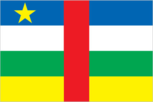
Central African Republic
Organized labor
1 % of labor force
Political subdivisions
- 10 islands
- 14 prefectures, 47 subprefectures
Population
2,585,000 (July 1984), average annual growth rate 2.8%
Ports
1 major (Mindelo), 3 minor
Railroads
none
Religion
25% Protestant, 25% Roman Catholic, 24% indigenous beliefs, 10% Muslim; animistic beliefs and practices strongly influence the Christian majority
Suffrage
- universal over age 15
- universal over age 21
Supply
mainly dependent on France, but has received equipment from Israel, Italy, USSR, FRG, South Korea, and PRC
Telecommunications
- interisland radiorelay system, HF radio to mainland Portugal and Guinea-Bissau, about 1,740 telephones (0.6 per 100 popl.); 2 FM and 2 AM stations; 1 small TV station; 2 coaxial submarine cables; 1 Atlantic Ocean satellite ground station Defense Forces
- facilities are meager; network is composed of low-capacity, low-powered radio-communication stations and radio-relay links; 6,000 telephones (0.2 per 100 popl.); 1 AM station, 1 FM station, and 1 TV station; satellite ground station under construction Defense Forces
Type
republic, under military rule since September 1981