1982 Edition
CIA World Factbook 1982 (Wikisource)
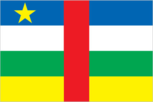
Geography
Area
626,780 km2; 10%-15% cultivated, 5% dense forests, 80%-85% grazing, fallow, vacant arable land, urban, waste
Land boundaries
4,981 km
People and Society
Ethnic divisions
approximately 80 ethnic groups, the majority of which have related ethnic and linguistic characteristics; Banda (32%) and Baya-Mandjia (29%) are largest single groups; 6,500 Europeans, of whom 6,000 are French and majority of the rest Portuguese
Labor force
about half the population economically active, 80% of whom are in agriculture; approximately 64,000 salaried workers
Language
French official; Sangho, lingua franca and national language
Literacy
estimated at 20%
Nationality
noun—Central African(s); adjective—Central African
Organized labor
1% of labor force
Population
2,471,000 (July 1982), average annual growth rate 2.6%
Religion
40% Protestant, 28% Catholic, 24% animist, 8% Muslim; animistic beliefs and practices strongly influence the Christian majority
Government
Capital
Bangui
Communists
no Communist party; small number of Communist sympathizers
Elections
no scheduled presidential, legislative, or municipal elections Political parties and leaders: political parties were banned in September 1981
Government leader
Gen. André-Dieudonné KOLINGBA, Chief of State, President of the Military Committee for National Recovery, Minister of National Defense, and Armed Forces Chief of Staff
Member of
AFDB, Conference of East and Central African States, EAMA, ECA, FAO, G-77, GATT, IBRD, ICAO, ICO, IDA, IFAD, ILO, IMF, ITU, NAM, OAU, OCAM, UDEAC, UN, UNESCO, UPU, WHO, WIPO, WMO
National holiday
4 December Branches: Gen. André-Dieudonné Kolingba is Chief of State and President of the Military Committee for National Recovery, which replaced the Council of Ministers; no legislature; separate judiciary
Official name
Central African Republic
Political subdivisions
14 prefectures, 47 subprefectures Legal system: based on French law; Constitution, which was approved in February 1981 referendum, was suspended after September 1981 military takeover; judiciary, Supreme Court, court of appeals, criminal court, and numerous lower courts
Suffrage
universal over age 21
Type
republic, under military rule since September 1981
Economy
Agriculture
commercial—cotton, coffee, peanuts, sesame, wood; main food crops—manioc, corn, peanuts, rice, potatoes, beef; requires wheat, flour, rice, beef, and sugar imports
Budget
(1980) revenues $95.1 million (est.), current expenditures $131.1 million (est.), development expenditures $4.4 million (est.)
Electric power
44,000 kW capacity (1980); 66 million kWh produced (1980), 28 kWh per capita
Exports
$129.7 million (f.o.b., 1979 est.); cotton, coffee, diamonds, timber
Fiscal year
calendar year
GDP
$535,5 million (1980 est.), $200 per capita, 1% real growth
Imports
$101.6 million (f.o.b., 1979 est.); textiles, petroleum products, machinery and electrical equipment, motor vehicles and equipment, chemicals and pharmaceuticals
Major industries
sawmills, cotton textile mills, brewery, diamond mining and splitting
Major trade partners
France, Yugoslavia, Japan, US
Monetary conversion rate
225.8 Communaute Financiere Africaine (CFA) francs=US$1 (1980)
Communications
Airfields
55 total, 47 usable; 3 with permanent-surface runways; 1 with runways 2,440-3,659 m, 18 with runways 1,220-2,439 m
Civil air
3 major transport aircraft
Highways
21,950 km total; 454 km bituminous, 10,196 km improved earth, 11,300 unimproved earth
Inland waterways
7,080 km; traditional trade carried on by means of shallow-draft dugouts on the extensive system of rivers and streams
Ports
Bangui (river port)
Railroads
none
Telecommunications
facilities are meager; network is composed of low-capacity, low-powered radio-communication stations and radio-relay links; 6,000 telephones (0.2 per 100 popl.); 3 AM stations, 1 FM station, and 1 TV station
Military and Security
Military budget
for fiscal year ending 31 December 1980; $13.5 million; about 10.8% of central government budget
Military manpower
males 15-49, 541,000; 281,000 fit for military service
Supply
mainly dependent on France, but has received equipment from Israel, Italy, USSR, FRG, South Korea, and PRC