2009 Edition
CIA World Factbook 2009 (Project Gutenberg)
Introduction
Background
The uninhabited islands were discovered and colonized by the Portuguese in the 15th century; Cape Verde subsequently became a trading center for African slaves and later an important coaling and resupply stop for whaling and transatlantic shipping. Following independence in 1975, and a tentative interest in unification with Guinea-Bissau, a one-party system was established and maintained until multi-party elections were held in 1990. Cape Verde continues to exhibit one of Africa's most stable democratic governments. Repeated droughts during the second half of the 20th century caused significant hardship and prompted heavy emigration. As a result, Cape Verde's expatriate population is greater than its domestic one. Most Cape Verdeans have both African and Portuguese antecedents.
Geography
Area
total: 4,033 sq km country comparison to the world: 175 land: 4,033 sq km water: 0 sq km
Area - comparative
slightly larger than Rhode Island
Climate
temperate; warm, dry summer; precipitation meager and very erratic
Coastline
965 km
Elevation extremes
lowest point: Atlantic Ocean 0 m highest point: Mt. Fogo 2,829 m (a volcano on Fogo Island)
Environment - current issues
soil erosion; deforestation due to demand for wood used as fuel; water shortages; desertification; environmental damage has threatened several species of birds and reptiles; illegal beach sand extraction; overfishing
Environment - international agreements
party to: Biodiversity, Climate Change, Climate Change-Kyoto Protocol, Desertification, Endangered Species, Environmental Modification, Hazardous Wastes, Law of the Sea, Marine Dumping, Ozone Layer Protection, Ship Pollution, Wetlands signed, but not ratified: none of the selected agreements
Freshwater withdrawal (domestic/industrial/agricultural)
total: 0.02 cu km/yr (7%/2%/91%) per capita: 39 cu m/yr (2000)
Geographic coordinates
16 00 N, 24 00 W
Geography - note
strategic location 500 km from west coast of Africa near major north-south sea routes; important communications station; important sea and air refueling site
Irrigated land
30 sq km (2003)
Land boundaries
0 km
Land use
arable land: 11.41% permanent crops: 0.74% other: 87.85% (2005)
Location
Western Africa, group of islands in the North Atlantic Ocean, west of Senegal
Map references
Africa
Maritime claims
measured from claimed archipelagic baselines territorial sea: 12 nm contiguous zone: 24 nm exclusive economic zone: 200 nm
Natural hazards
prolonged droughts; seasonal harmattan wind produces obscuring dust; volcanically and seismically active
Natural resources
salt, basalt rock, limestone, kaolin, fish, clay, gypsum
Terrain
steep, rugged, rocky, volcanic
Total renewable water resources
0.3 cu km (1990)
People and Society
Age structure
0-14 years: 35.2% (male 76,012/female 74,993) 15-64 years: 58.5% (male 123,376/female 127,653) 65 years and over: 6.4% (male 10,040/female 17,400) (2009 est.)
Birth rate
23.5 births/1,000 population (2009 est.) country comparison to the world: 74
Death rate
6.22 deaths/1,000 population (July 2009 est.) country comparison to the world: 155
Education expenditures
6.3% of GDP (2006) country comparison to the world: 34
Ethnic groups
Creole (mulatto) 71%, African 28%, European 1%
HIV/AIDS - adult prevalence rate
0.035% (2001 est.) country comparison to the world: 167
HIV/AIDS - deaths
225 (as of 2001) country comparison to the world: 103
HIV/AIDS - people living with HIV/AIDS
775 (2001) country comparison to the world: 144
Infant mortality rate
total: 41.35 deaths/1,000 live births country comparison to the world: 63 male: 47.39 deaths/1,000 live births female: 35.12 deaths/1,000 live births (2009 est.)
Languages
Portuguese, Crioulo (a blend of Portuguese and West African words)
Life expectancy at birth
total population: 71.61 years country comparison to the world: 126 male: 68.27 years female: 75.05 years (2009 est.)
Literacy
definition: age 15 and over can read and write total population: 76.6% male: 85.8% female: 69.2% (2003 est.)
Median age
total: 21.1 years male: 20.4 years female: 21.9 years (2009 est.)
Nationality
noun: Cape Verdean(s) adjective: Cape Verdean
Net migration rate
-11.67 migrant(s)/1,000 population (2009 est.) country comparison to the world: 177
Population
429,474 (July 2009 est.) country comparison to the world: 171
Population growth rate
0.561% (2009 est.) country comparison to the world: 149
Religions
Roman Catholic (infused with indigenous beliefs), Protestant (mostly Church of the Nazarene)
School life expectancy (primary to tertiary education)
total: 12 years male: 11 years female: 12 years (2006)
Sex ratio
at birth: 1.03 male(s)/female under 15 years: 1.01 male(s)/female 15-64 years: 0.97 male(s)/female 65 years and over: 0.58 male(s)/female total population: 0.95 male(s)/female (2009 est.)
Total fertility rate
3.07 children born/woman (2009 est.) country comparison to the world: 69
Urbanization
urban population: 60% of total population (2008) rate of urbanization: 3.5% annual rate of change (2005-10 est.)
Government
Administrative divisions
17 municipalities (concelhos, singular - concelho); Boa Vista, Brava, Maio, Mosteiros, Paul, Praia, Porto Novo, Ribeira Grande, Sal, Santa Catarina, Santa Cruz, Sao Domingos, Sao Filipe, Sao Miguel, Sao Nicolau, Sao Vicente, Tarrafal
Capital
name: Praia geographic coordinates: 14 55 N, 23 31 W time difference: UTC-1 (4 hours ahead of Washington, DC during Standard Time)
Constitution
25 September 1992; a major revision on 23 November 1995 substantially increased the powers of the president; a 1999 revision created the position of national ombudsman (Provedor de Justica)
Country name
conventional long form: Republic of Cape Verde conventional short form: Cape Verde local long form: Republica de Cabo Verde local short form: Cabo Verde
Diplomatic representation from the US
chief of mission: Ambassador Marianne M. MYLES embassy: Rua Abilio Macedo n6, Praia mailing address: C. P. 201, Praia telephone: [238] 2-60-89-00
Diplomatic representation in the US
chief of mission: Ambassador Fatima Lima VEIGA chancery: 3415 Massachusetts Avenue NW, Washington, DC 20008 telephone: [1] (202) 965-6820
Executive branch
chief of state: President Pedro Verona Rodriques PIRES (since 22 March 2001) head of government: Prime Minister Jose Maria Pereira NEVES (since 1 February 2001) cabinet: Council of Ministers appointed by the president on the recommendation of the prime minister elections: president elected by popular vote for a five-year term (eligible for a second term); election last held 12 February 2006 (next to be held in February 2011); prime minister nominated by the National Assembly and appointed by the president election results: Pedro PIRES reelected president; percent of vote - Pedro PIRES (PAICV) 51.2%, Carlos VIEGA (MPD) 48.8%
FAX
- [1] (202) 965-1207 consulate(s) general: Boston
- [238] 2-61-13-55
Flag description
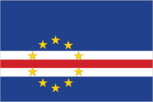
five unequal horizontal bands; the top-most band of blue - equal to one half the width of the flag - is followed by three bands of white, red, and white, each equal to 1/12 of the width, and a bottom stripe of blue equal to one quarter of the flag width; a circle of 10, yellow, five-pointed stars, each representing one of the islands, is centered on the red stripe and positioned 3/8 of the length of the flag from the hoist side
Government type
republic
Independence
5 July 1975 (from Portugal)
International organization participation
ACCT, ACP, AfDB, AU, CPLP, ECOWAS, FAO, G-77, IBRD, ICAO, ICCt (signatory), ICRM, IDA, IFAD, IFC, IFRCS, ILO, IMF, IMO, Interpol, IOC, IOM, IPU, ITSO, ITU, ITUC, MIGA, NAM, OIF, OPCW, UN, UNCTAD, UNESCO, UNIDO, Union Latina, UNWTO, UPU, WCO, WFTU, WHO, WIPO, WMO, WTO
Judicial branch
Supreme Tribunal of Justice or Supremo Tribunal de Justia
Legal system
based on the legal system of Portugal; has not accepted compulsory ICJ jurisdiction
Legislative branch
unicameral National Assembly or Assembleia Nacional (72 seats; members are elected by popular vote to serve five-year terms) elections: last held 22 January 2006 (next to be held in January 2011) election results: percent of vote by party - PAICV 52.3%, MPD 44%, UCID 2.7%; seats by party - PAICV 41, MPD 29, UCID 2
National holiday
Independence Day, 5 July (1975)
Political parties and leaders
African Party for Independence of Cape Verde or PAICV [Jose Maria Pereira NEVES, chairman]; Democratic Christian Party or PDC [Manuel RODRIGUES]; Democratic Renovation Party or PRD [Victor FIDALGO]; Democratic and Independent Cape Verdean Union or UCID [Antonio MONTEIRO]; Movement for Democracy or MPD [Jorge SANTOS]; Party for Democratic Convergence or PCD [Dr. Eurico MONTEIRO]; Party of Work and Solidarity or PTS [Isaias RODRIGUES]; Social Democratic Party or PSD [Joao ALEM]
Political pressure groups and leaders
other: environmentalists; political pressure groups
Suffrage
18 years of age; universal
Economy
Agriculture - products
bananas, corn, beans, sweet potatoes, sugarcane, coffee, peanuts; fish
Budget
revenues: $508 million expenditures: $540.2 million (2008 est.)
Central bank discount rate
7.5% (31 December 2008) country comparison to the world: 50 8.5% (31 December 2007)
Commercial bank prime lending rate
9.99% (31 December 2008) country comparison to the world: 78 10.55% (31 December 2007)
Current account balance
-$259 million (2008 est.) country comparison to the world: 95 -$132.6 million (2007 est.)
Debt - external
$325 million (2002) country comparison to the world: 172
Economy - overview
This island economy suffers from a poor natural resource base, including serious water shortages exacerbated by cycles of long-term drought. The economy is service-oriented, with commerce, transport, tourism, and public services accounting for about three-fourths of GDP. Although nearly 70% of the population lives in rural areas, the share of food production in GDP is low. About 82% of food must be imported. The fishing potential, mostly lobster and tuna, is not fully exploited. Cape Verde annually runs a high trade deficit, financed by foreign aid and remittances from emigrants; remittances supplement GDP by more than 20%. Economic reforms are aimed at developing the private sector and attracting foreign investment to diversify the economy. Future prospects depend heavily on the maintenance of aid flows, the encouragement of tourism, remittances, and the momentum of the government's development program. Cape Verde became a member of the WTO in July 2008.
Electricity - consumption
232.5 million kWh (2007 est.) country comparison to the world: 172
Electricity - exports
0 kWh (2008 est.)
Electricity - imports
0 kWh (2008 est.)
Electricity - production
250 million kWh (2007 est.) country comparison to the world: 171
Exchange rates
Cape Verdean escudos (CVE) per US dollar - 73.84 (2008 est.), 81.235 (2007), 87.946 (2006), 88.67 (2005), 88.808 (2004)
Exports
$105 million (2008 est.) country comparison to the world: 192 $76.5 million (2007 est.)
Exports - commodities
fuel, shoes, garments, fish, hides
Exports - partners
Japan 37.5%, Spain 28.5%, Portugal 17.5%, Morocco 4.8% (2008)
GDP - composition by sector
agriculture: 9.1% industry: 16.6% services: 74.4% (2008 est.)
GDP - per capita (PPP)
$3,800 (2008 est.) country comparison to the world: 157 $3,600 (2007 est.) $3,400 (2006 est.) note: data are in 2008 US dollars
GDP - real growth rate
5.5% (2008 est.) country comparison to the world: 73 6.9% (2007 est.) 10.8% (2006 est.)
GDP (official exchange rate)
$1.744 billion (2008 est.)
GDP (purchasing power parity)
$1.63 billion (2008 est.) country comparison to the world: 190 $1.545 billion (2007 est.) $1.446 billion (2006 est.) note: data are in 2008 US dollars
Household income or consumption by percentage share
lowest 10%: NA% highest 10%: NA%
Imports
$864 million (2008 est.) country comparison to the world: 174 $743.6 million (2007 est.)
Imports - commodities
foodstuffs, industrial products, transport equipment, fuels
Imports - partners
Portugal 40.3%, Netherlands 11.8%, Spain 6.7%, UK 6.5%, Cote d'Ivoire 4.6%, Brazil 4.1% (2008)
Industrial production growth rate
5% (2008 est.) country comparison to the world: 49
Industries
food and beverages, fish processing, shoes and garments, salt mining, ship repair
Inflation rate (consumer prices)
6.8% (2008 est.) country comparison to the world: 113 4.4% (2007 est.)
Investment (gross fixed)
41.6% of GDP (2008 est.) country comparison to the world: 2
Labor force
196,100 (2007) country comparison to the world: 165
Natural gas - consumption
0 cu m (2008 est.) country comparison to the world: 194
Natural gas - exports
0 cu m (2008) country comparison to the world: 64
Natural gas - imports
0 cu m (2008 est.) country comparison to the world: 184
Natural gas - production
0 cu m (2008 est.) country comparison to the world: 193
Natural gas - proved reserves
0 cu m (1 January 2009 est.) country comparison to the world: 191
Oil - consumption
2,000 bbl/day (2008 est.) country comparison to the world: 184
Oil - exports
0 bbl/day (2007 est.) country comparison to the world: 194
Oil - imports
1,619 bbl/day (2007 est.) country comparison to the world: 180
Oil - production
0 bbl/day (2008 est.) country comparison to the world: 195
Oil - proved reserves
0 bbl (1 January 2009 est.) country comparison to the world: 184
Population below poverty line
30% (2000)
Reserves of foreign exchange and gold
$258 million (31 December 2008 est.) country comparison to the world: 143 $281 million (31 December 2007 est.)
Stock of domestic credit
$1.153 billion (31 December 2008) country comparison to the world: 106 $1.049 billion (31 December 2007)
Stock of money
$563.4 million (31 December 2008) country comparison to the world: 92 $574 million (31 December 2007)
Stock of quasi money
$721.3 million (31 December 2008) country comparison to the world: 102 $689 million (31 December 2007)
Unemployment rate
21% (2000 est.) country comparison to the world: 167
Communications
Internet country code
.cv
Internet hosts
24 (2009) country comparison to the world: 214
Internet users
102,800 (2008) country comparison to the world: 153
Radio broadcast stations
AM 0, FM 22 (plus 12 repeaters), shortwave 0 (2001)
Telephone system
general assessment: effective system, extensive modernization from 1996-2000 following partial privatization in 1995 domestic: major service provider is Cabo Verde Telecom (CVT); fiber-optic ring, completed in 2001, links all islands providing Internet access and ISDN services; cellular service introduced in 1998; broadband services launched in 2004 international: country code - 238; landing point for the Atlantis-2 fiber-optic transatlantic telephone cable that provides links to South America, Senegal, and Europe; HF radiotelephone to Senegal and Guinea-Bissau; satellite earth station - 1 Intelsat (Atlantic Ocean) (2007)
Telephones - main lines in use
72,000 (2008) country comparison to the world: 155
Telephones - mobile cellular
277,700 (2008) country comparison to the world: 169
Television broadcast stations
1 (plus 7 repeaters) (2001)
Transportation
Airports
10 (2009) country comparison to the world: 156
Airports - with paved runways
total: 9 over 3,047 m: 1 1,524 to 2,437 m: 3 914 to 1,523 m: 3 under 914 m: 2 (2009)
Airports - with unpaved runways
total: 1 under 914 m: 1 (2009)
Merchant marine
total: 8 country comparison to the world: 125 by type: cargo 2, chemical tanker 1, passenger/cargo 5 foreign-owned: 2 (Spain 1, UK 1) (2008)
Ports and terminals
Porto Grande
Roadways
total: 1,350 km country comparison to the world: 178 paved: 932 km unpaved: 418 km (2000)
Military and Security
Manpower available for military service
males age 16-49: 103,650 females age 16-49: 103,553 (2008 est.)
Manpower fit for military service
males age 16-49: 84,967 females age 16-49: 90,154 (2009 est.)
Manpower reaching militarily significant age annually
male: 5,471 female: 5,349 (2009 est.)
Military expenditures
0.7% of GDP (2005) country comparison to the world: 152
Military service age and obligation
18 years of age (est.) for selective compulsory military service; 14-month conscript service obligation (2006)
People's Revolutionary Armed Forces (FARP)
Army, Coast Guard (includes maritime air wing) (2007)
Transnational Issues
Disputes - international
none
Illicit drugs
used as a transshipment point for Latin American cocaine destined for Western Europe, particularly because of Lusophone links to Brazil, Portugal, and Guinea-Bissau; has taken steps to deter drug money laundering, including a 2002 anti-money laundering reform that criminalizes laundering the proceeds of narcotics trafficking and other crimes and the establishment in 2008 of a Financial Intelligence Unit (2008) page last updated on November 11, 2009