1992 Edition
CIA World Factbook 1992 (Project Gutenberg)
Geography
Climate
temperate; warm, dry, summer; precipitation very erratic
Coastline
965 km
Comparative area
slightly larger than Rhode Island
Disputes
none
Environment
subject to prolonged droughts; harmattan wind can obscure visibility; volcanically and seismically active; deforestation; overgrazing
Exclusive economic zone
200 nm
Land area
4,030 km2
Land boundaries
none
Land use
arable land 9%; permanent crops NEGL%; meadows and pastures 6%; forest and woodland NEGL%; other 85%; includes irrigated 1%
Maritime claims
(measured from claimed archipelagic baselines)
Natural resources
salt, basalt rock, pozzolana, limestone, kaolin, fish
Note
strategic location 500 km from African coast near major north-south sea routes; important communications station; important sea and air refueling site
Terrain
steep, rugged, rocky, volcanic
Territorial sea
12 nm
Total area
4,030 km2
People and Society
Birth rate
48 births/1,000 population (1992)
Death rate
10 deaths/1,000 population (1992)
Ethnic divisions
Creole (mulatto) about 71%, African 28%, European 1%
Infant mortality rate
61 deaths/1,000 live births (1992)
Labor force
102,000 (1985 est.); agriculture (mostly subsistence) 57%, services 29%, industry 14% (1981); 51% of population of working age (1985)
Languages
Portuguese and Crioulo, a blend of Portuguese and West African words
Life expectancy at birth
60 years male, 64 years female (1992)
Literacy
66% (male NA%, female NA%) age 15 and over can read and write (1989 est.)
Nationality
noun - Cape Verdean(s); adjective - Cape Verdean
Net migration rate
- 8 migrants/1,000 population (1992)
Organized labor
Trade Unions of Cape Verde Unity Center (UNTC-CS)
Population
398,276 (July 1992), growth rate 3.0% (1992)
Religions
Roman Catholicism fused with indigenous beliefs
Total fertility rate
6.5 children born/woman (1992)
Government
Administrative divisions
14 districts (concelhos, singular - concelho); Boa Vista, Brava, Fogo, Maio, Paul, Praia, Porto Novo, Ribeira Grande, Sal, Santa Catarina, Santa Cruz, Sao Nicolau, Sao Vicente, Tarrafal
Capital
Praia
Chief of State
President Antonio Monteiro MASCARENHAS (since 22 March 1991)
Constitution
7 September 1980; amended 12 February 1981, December 1988, and 28 September 1990 (legalized opposition parties)
Diplomatic representation
Ambassador Carlos Alberto Santos SILVA; Chancery at 3415 Massachusetts Avenue NW, Washington, DC 20007; telephone (202) 965-6820; there is a Cape Verdean Consulate General in Boston US: Ambassador Francis T. (Terry) McNAMARA; Embassy at Rua Hoji Ya Henda Yenna 81, Praia (mailing address is C. P. 201, Praia); telephone [238] 61-43-63 or 61-42-53; FAX [238] 61-13-55
Executive branch
president, prime minister, deputy minister, secretaries of state, Council of Ministers (cabinet)
Flag
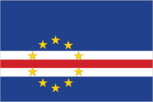
two equal horizontal bands of yellow (top) and green with a vertical red band on the hoist side; in the upper portion of the red band is a black five-pointed star framed by two corn stalks and a yellow clam shell; uses the popular pan-African colors of Ethiopia; similar to the flag of Guinea-Bissau, which is longer and has an unadorned black star centered in the red band
Head of Government
Prime Minister Carlos VEIGA (since 13 January 1991)
Independence
5 July 1975 (from Portugal)
Judicial branch
Supreme Tribunal of Justice (Supremo Tribunal de Justia)
Legislative branch
unicameral People's National Assembly (Assembleia Nacional Popular)
Long-form name
Republic of Cape Verde
Member of
ACP, AfDB, ECA, ECOWAS, FAO, G-77, IBRD, ICAO, IDA, IFAD, ILO, IMF, IMO, INTERPOL, IOM (observer), ITU, LORCS, NAM, OAU, UN, UNCTAD, UNESCO, UNIDO, UPU, WCL, WHO, WMO
National holiday
Independence Day, 5 July (1975)
People's National Assembly
last held 13 January 1991 (next to be held January 1996); results - percent of vote by party NA; seats - (79 total) MPD 56, PAICV 23; note - this multiparty Assembly election ended 15 years of single-party rule
Political parties and leaders
Movement for Democracy (MPD), Prime Minister Carlos VEIGA, founder and chairman; African Party for Independence of Cape Verde (PAICV), Pedro Verona Rodrigues PIRES, chairman
President
last held 17 February 1991 (next to be held February 1996); results - Antonio Monteiro MASCARENHAS (MPD) received 72.6% of vote
Suffrage
universal at age 18
Type
republic
Economy
Agriculture
accounts for 16% of GDP; largely subsistence farming; bananas are the only export crop; other crops - corn, beans, sweet potatoes, coffee; growth potential of agricultural sector limited by poor soils and limited rainfall; annual food imports required; fish catch provides for both domestic consumption and small exports
Budget
revenues $98.3 million; expenditures $138.4 million, including capital expenditures of $NA (1988 est.)
Currency
Cape Verdean escudo (plural - escudos); 1 Cape Verdean escudo (CVEsc) = 100 centavos
Economic aid
US commitments, including Ex-Im (FY75-89), $88 million; Western (non-US) countries, ODA and OOF bilateral commitments (1970-89), $537 million; OPEC bilateral aid (1979-89), $12 million; Communist countries (1970-89), $36 million
Electricity
15,000 kW capacity; 15 million kWh produced, 40 kWh per capita (1991)
Exchange rates
Cape Verdean escudos (CVEsc) per US$1 - 71.28 (March 1992), 71.41 (1991), 64.10 (November 1990), 74.86 (December 1989), 72.01 (1988), 72.5 (1987)
Exports
$10.9 million (f.o.b., 1989 est.) commodities: fish, bananas, salt partners: Portugal 40%, Algeria 31%, Angola, Netherlands (1990 est.)
External debt
$150 million (December 1990 est.)
Fiscal year
calendar year
GDP
exchange rate conversion - $310 million, per capita $800; real growth rate 4% (1990 est.)
Imports
$107.8 million (c.i.f., 1989) commodities: petroleum, foodstuffs, consumer goods, industrial products partners: Sweden 33%, Spain 11%, Germany 5%, Portugal 3%, France 3%, Netherlands, US (1990 est.)
Industrial production
growth rate 18% (1988 est.); accounts for 7% of GDP
Industries
fish processing, salt mining, clothing factories, ship repair, construction materials, food and beverage production
Inflation rate (consumer prices)
10% (1990 est.)
Overview
Cape Verde's low per capita GDP reflects a poor natural resource base, a 17-year drought, and a high birthrate. The economy is service oriented, with commerce, transport, and public services accounting for 65% of GDP during the period 1985-88. Although nearly 70% of the population lives in rural areas, agriculture's share of GDP is only 16%; the fishing sector accounts for 4%. About 90% of food must be imported. The fishing potential, mostly lobster and tuna, is not fully exploited. In 1988 fishing represented only 3.5% of GDP. Cape Verde annually runs a high trade deficit, financed by remittances from emigrants and foreign aid. Economic reforms launched by the new democratic government in February 1991 are aimed at developing the private sector and attracting foreign investment to diversify the economy.
Unemployment rate
25% (1988)
Communications
Airports
6 total, 6 usable; 6 with permanent-surface runways; none with runways over 3,659 m; 1 with runways 2,440-3,659 m; 2 with runways 1,220-2,439 m
Civil air
3 major transport aircraft
Merchant marine
7 cargo ships (1,000 GRT or over) totaling 11,717 GRT/19,000 DWT
Ports
Mindelo, Praia
Telecommunications
interisland radio relay system, high-frequency radio to Senegal and Guinea-Bissau; over 1,700 telephones; broadcast stations - 1 AM, 6 FM, 1 TV; 2 coaxial submarine cables; 1 Atlantic Ocean INTELSAT earth station
Military and Security
Branches
People's Revolutionary Armed Forces (FARP) - Army and Navy are separate components of FARP; Security Service
Defense expenditures
exchange rate conversion - $NA, NA% of GDP
Manpower availability
males 15-49, 72,916; 43,010 fit for military service