1989 Edition
CIA World Factbook 1989 (Internet Archive)
Geography
Climate
temperate; warm, dry, summer precipitation very erratic
Coastline
965 km
Comparative area
slightly larger than Rhode Island
Environment
subject to prolonged droughts; harmattan wind can obscure visibility; volcanically and seismically active; deforestation; overgrazing
Extended economic zone
200 nm
Land boundaries
none
Land use
9% arable land; NEGL% permanent crops; 6% meadows and pastures; NEGL% forest and woodland; 85% other; includes 1% irrigated
Maritime claims
(measured from claimed archipelagic baselines)
Natural resources
salt, basalt rock, pozzolana, limestone, kaolin, fish
Note
strategic location 500 km from African coast near major north-south sea routes; important communications station; important sea and air refueling site
Terrain
steep, rugged, rocky, volcanic
Territorial sea
1 2 nm
Total area
4,030 km2; land area: 4,030 km2
Total area
75km ns*' Nicotau North Atlantic Ocean Boa Visit •' /K~\F°9° Brava® \ ) Sec re{ion«l mip \\\ „*»•/<> /PRAIA Sao Tiago
People and Society
Birth rate
49 births/ 1,000 population (1990)
Death rate
11 deaths/ 1,000 population (1990)
Ethnic divisions
about 71% Creole (mulatto), 28% African, 1% European
Infant mortality rate
65 deaths/ 1,000 live births (1990)
Labor force
102,000 (1985 est.); 57% agriculture (mostly subsistence), 29% services, 14% industry (1981); 51% of population of working age (1985)
Language
Portuguese and Crioulo, a blend of Portuguese and West African words
Life expectancy at birth
59 years male, 63 years female (1990)
Literacy
48% (1986)
Nationality
noun — Cape Verdean(s); adjective— Cape Verdean
Net migration rate
— 8 migrants/ 1 ,000 population (1990)
Organized labor
Trade Unions of Cape Verde Unity Center (UNTC-CS) closely associated with ruling party
Population
374,984 (July 1990), growth rate 3.0% (1990)
Religion
Roman Catholicism fused with indigenous beliefs
Total fertility rate
6.7 children born/ woman (1990)
Government
Administrative divisions
1 2 districts (eoncelhos, singular — concelho); Boa Vista, Brava, Fogo, Maio, Paul, Praia, Ribeira Grande, Sal, Santa Catarina, Sao Nicolau, Sao Vicente, Tarrafal; there may be 2 new districts named Porto Novo and Santa Cruz
Capital
Praia
Communists
a few Communists and some sympathizers
Constitution
7 September 1980, amended 12 February 1981 and December 1988
Diplomatic representation
Ambassador Jose Luis FERNANDES LOPES; Chancery at 3415 Massachusetts Avenue NW, Washington DC 20007; telephone (202) 965-6820; there is a Cape Verdean Consulate General in Boston; US — Ambassador Terry McNAMARA; Embassy at Rua Hojl Ya Yenna 81, Praia (mailing address is C. P. 201, Praia); telephone [238] 614363 or 253
Elections
President — last held 13 January 1986 (next to be held January 1991); results— President Aristides Maria Pereira (PAICV) was reelected without opposition; National People 's Assembly — last held 7 December 1985 (next to be held December 1990); results— PAICV is the only party; seats— (83 total) PAICV 83
Executive branch
president, prime minister, deputy minister, Council of Ministers (cabinet)
Flag
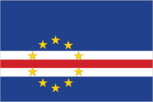
two equal horizontal bands of yellow (top) and green with a vertical red band on the hoist side; in the upper portion of the red band is a black five-pointed star framed by two corn stalks and a yellow clam shell; uses the popular pan-African colors of Ethiopia; similar to the flag of Guinea-Bissau which is longer and has an unadorned black star centered in the red band
Independence
5 July 1975 (from Portugal)
Judicial branch
Supreme Tribunal of Justice (Supremo Tribunal de Justia)
Leaders
Chief of State — President Aristides Maria PEREIRA (since 5 July 1975); Head of Government — Prime Minister Pedro Verona Rodrigues PIRES, (since 5 July 1975); Deputy Minister Aguinaldo Liboa RAMOS (since NA February 1990) Political parties and leaders: only party — African Party for Independence of Cape Verde (PAICV), Aristides Maria Pereira, secretary general
Legislative branch
unicameral National People's Assembly (Assembleia Nacional Popular)
Long-form name
Republic of Cape Verde
Member of
ACP, AfDB, ECA, ECOWAS, FAO, G-77, GATT (de facto), IBRD, ICAO, IDA, IFAD, IFC, ILO, IMF, IMO, IPU, ITU, NAM, OAU, UN, UNESCO, UPU, WHO, WMO
National holiday
Independence Day, 5 July (1975)
Suffrage
universal at age 15
Type
republic
Economy
Agriculture
accounts for 16% of GDP; largely subsistence farming; bananas are the only export crop; other crops — corn, beans, sweet potatoes, coffee; growth potential of agricultural sector limited by poor soils and limited rainfall; annual food imports required; fish catch provides for both domestic consumption and small exports
Aid
US commitments, including Ex-Im (FY75-88), $83 million; Western (non-US) countries, ODA and OOF bilateral commitments (1970-87), $540 million; OPEC bilateral aid (1979-89), $12 million; Communist countries (1970-88), $36 million
Budget
revenues $80 million; expenditures $87 million, including capital expenditures of $45 million (1988 est.)
Currency
Cape Verdean escudo (plural — escudos); 1 Cape Verdean escudo (CVEsc) = 100 centavos
Electricity
14,000 kW capacity; 18 million kWh produced, 50 kWh per capita (1989)
Exchange rates
Cape Verdean escudos (CVEsc) per US$1— 72.31 (February 1990), 74.86 (December 1989), 72.01 (1988), 72.5 (1987), 76.56 (1986), 85.38 (1985)
Exports
$8.9 million (f.o.b., 1987); commodities— fish, bananas, salt; partners — Portugal, Angola, Algeria, Belgium/ Luxembourg, Italy
External debt
$140 million (December 1988) Cape Verde (continued)
Fiscal year
calendar year
GDP
$158 million, per capita $494; real growth rate 6.1% (1987)
Imports
$124 million (c.i.f., 1987); commodities— petroleum, foodstuffs, consumer goods, industrial products; partners — Portugal, Netherlands, Spain, France, US, FRG
Industrial production
growth rate 0% (1986est.)
Industry
fish processing, salt mining, clothing factories, ship repair
Inflation rate (consumer prices)
3.8% (1987)
Overview
Cape Verde's low per capita GDP reflects a poor natural resource base, a 17-year drought, and a high birth rate. The economy is service oriented, with commerce, transport, and public services accounting for 60% of GDP during the period 1984-86. Although nearly 70% of the population lives in rural areas, agriculture's share of GDP is only 16%; the fishing and manufacturing sectors are 4% each. About 90% of food must be imported. The fishing potential of the islands is not fully exploited (the fish catch — mostly lobster and tuna — came to only 10,000 tons in 1985). Cape Verde annually runs a high trade deficit, financed by remittances from emigrants, cash grants, food aid, and foreign loans.
Unemployment rate
25% (1988)
Communications
Airports
6 total, 6 usable; 4 with permanent-surface runways; none with runways over 3,659 m; 1 with runways 2,440-3,659 m; 4 with runways 1, 220-2,439 m
Branches
People's Revolutionary Armed Forces (FARP); Army, Navy, and Air Force are separate components of FARP
Civil air
2 major transport aircraft
Defense expenditures
1 1.8% of GDP (1981)
Merchant marine
5 cargo ships ( 1 ,000 GRT or over) totaling 9,308 GRT/16,172 DWT
Military manpower
males 15-49, 68,776; 40,731 fit for military service
Ports
Mindelo and Praia
Telecommunications
interisland radio relay system, high-frequency radio to mainland Portugal and Guinea-Bissau; 1,740 telephones; stations— 5 AM, 1 FM, 1 TV; 2 coaxial submarine cables; 1 Atlantic Ocean INTELSAT earth station Defense Forces