1996 Edition
CIA World Factbook 1996 (Project Gutenberg)
Introduction
Description
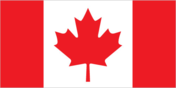
three vertical bands of red (hoist side), white (double width, square), and red with a red maple leaf centered in the white band
Location
60 00 N, 95 00 W -- Northern North America, bordering the North Atlantic Ocean and North Pacific Ocean, north of the conterminous US Flag ----
Geography
Area
- comparative area
- slightly larger than US
- land area
- 9,220,970 sq km
- total area
- 9,976,140 sq km
Climate
varies from temperate in south to subarctic and arctic in north
Coastline
243,791 km
Environment
- current issues
- air pollution and resulting acid rain severely affecting lakes and damaging forests; metal smelting, coal-burning utilities, and vehicle emissions impacting on agricultural and forest productivity; ocean waters becoming contaminated due to agricultural, industrial, mining, and forestry activities
- international agreements
- party to - Air Pollution, Air Pollution-Nitrogen Oxides, Air Pollution-Sulphur 85, Antarctic Treaty, Biodiversity, Climate Change, Desertification, Endangered Species, Environmental Modification, Hazardous Wastes, Marine Dumping, Nuclear Test Ban, Ozone Layer Protection, Ship Pollution, Tropical Timber 83, Wetlands, Whaling; signed, but not ratified - Air Pollution-Sulphur 94, Air Pollution-Volatile Organic Compounds, Antarctic-Environmental Protocol, Law of the Sea, Tropical Timber 94
- natural hazards
- continuous permafrost in north is a serious obstacle to development; cyclonic storms form east of the Rocky Mountains, a result of the mixing of air masses from the Arctic, Pacific, and North American interior, and produce most of the country's rain and snow
Geographic coordinates
60 00 N, 95 00 W
Geographic note
second-largest country in world (after Russia); strategic location between Russia and US via north polar route; nearly 90% of the population is concentrated within 161 km of the US/Canada border
International disputes
maritime boundary disputes with the US; Saint Pierre and Miquelon is focus of maritime boundary dispute between Canada and France
Irrigated land
8,400 sq km (1989 est.)
Land boundaries
- border country
- US 8,893 km (includes 2,477 km with Alaska)
- total
- 8,893 km
Land use
- arable land
- 9%
- forest and woodland
- 45%
- meadows and pastures
- 3%
- other
- 43%
- permanent crops
- 0%
Location
Northern North America, bordering the North Atlantic Ocean and North Pacific Ocean, north of the conterminous US
Map references
North America
Maritime claims
- continental shelf
- 200 nm or to the edge of the continental margin
- exclusive fishing zone
- 200 nm
- territorial sea
- 12 nm
Natural resources
nickel, zinc, copper, gold, lead, molybdenum, potash, silver, fish, timber, wildlife, coal, petroleum, natural gas
Terrain
- mostly plains with mountains in west and lowlands in southeast
- highest point
- Mount Logan 5,950 m
- lowest point
- Atlantic Ocean 0 m
People and Society
Age structure
0-14 years: 21% (male 3,032,458; female 2,889,603) 15-64 years: 67% (male 9,663,955; female 9,660,648) 65 years and over: 12% (male 1,501,542; female 2,072,465) (July 1996 est.)
Birth rate
13.33 births/1,000 population (1996 est.)
Death rate
7.17 deaths/1,000 population (1996 est.)
Ethnic divisions
British Isles origin 40%, French origin 27%, other European 20%, indigenous Indian and Eskimo 1.5%, other, mostly Asian 11.5%
Infant mortality rate
6.1 deaths/1,000 live births (1996 est.)
Languages
English (official), French (official)
Life expectancy at birth
- female
- 82.65 years (1996 est.)
- male
- 75.67 years
- total population
- 79.07 years
Literacy
- age 15 and over can read and write (1986 est.)
- female
- NA%
- male
- NA%
- total population
- 97%
Nationality
- adjective
- Canadian
- noun
- Canadian(s)
Net migration rate
4.47 migrant(s)/1,000 population (1996 est.)
Population
28,820,671 (July 1996 est.)
Population growth rate
1.06% (1996 est.)
Religions
Roman Catholic 45%, United Church 12%, Anglican 8%, other 35% (1991)
Sex ratio
- all ages
- 0.97 male(s)/female (1996 est.)
- at birth
- 1.05 male(s)/female
- under 15 years
- 1.05 male(s)/female 15-64 years: 1 male(s)/female 65 years and over: 0.72 male(s)/female
Total fertility rate
1.81 children born/woman (1996 est.)
Government
Administrative divisions
10 provinces and 2 territories*; Alberta, British Columbia, Manitoba, New Brunswick, Newfoundland, Northwest Territories*, Nova Scotia, Ontario, Prince Edward Island, Quebec, Saskatchewan, Yukon Territory*
Capital
Ottawa
Constitution
amended British North America Act 1867 patriated to Canada 17 April 1982; charter of rights and unwritten customs
Data code
CA
Diplomatic representation in US
- chancery
- 501 Pennsylvania Avenue NW, Washington, DC 20001
- chief of mission
- Ambassador Raymond A. J. CHRETIEN
- telephone
- [1] (202) 682-1740
Executive branch
- cabinet
- Federal Ministry was chosen by the prime minister from members of his own party sitting in Parliament
- chief of state
- Queen ELIZABETH II (since 6 February 1952), a hereditary monarch, is represented by Governor General Romeo LeBLANC (since 8 February 1995), who was appointed by the queen
- head of government
- Prime Minister Jean CHRETIEN (since 4 November 1993) was appointed by the governor general; on 25 October 1993; Deputy Prime Minister Sheila COPPS (since NA); note - the prime minister is the leader of the political party commanding a majority in the House of Commons
FAX
- [1] (202) 682-7726
- [1] (613) 238-5720
- consulate(s)
- Cincinnati, Cleveland, Miami, Philadelphia, Pittsburgh, Princeton, San Diego, San Francisco, San Jose, and San Juan (Puerto Rico)
- consulate(s) general
- Atlanta, Boston, Buffalo, Chicago, Dallas, Detroit, Los Angeles, Minneapolis, New York, and Seattle
- consulate(s) general
- Calgary, Halifax, Montreal, Quebec, Toronto, and Vancouver
Flag
three vertical bands of red (hoist side), white (double width, square), and red with a red maple leaf centered in the white band
House of Commons (Chambre des Communes)
elections last held 25 October 1993 (next to be held by NA October 1998); results - percent of votes by party NA; seats - (295 total) Liberal Party 179, Bloc Quebecois 53, Reform Party 52, New Democratic Party 8, Progressive Conservative Party 2, independents 1
Independence
1 July 1867 (from UK)
International organization participation
ACCT, AfDB, AG (observer), APEC, AsDB, Australia Group, BIS, C, CCC, CDB (non-regional), EBRD, ECE, ECLAC, ESA (cooperating state), FAO, G- 7, G- 8, G-10, IADB, IAEA, IBRD, ICAO, ICC, ICFTU, ICRM, IDA, IEA, IFAD, IFC, IFRCS, ILO, IMF, IMO, Inmarsat, Intelsat, Interpol, IOC, IOM, ISO, ITU, MTCR, NACC, NAM (guest), NATO, NEA, NSG, OAS, OECD, OSCE, PCA, UN, UNAMIR, UNCRO, UNCTAD, UNDOF, UNESCO, UNFICYP, UNHCR, UNIDO, UNIKOM, UNITAR, UNPREDEP, UNPROFOR, UNTSO, UNU, UPU, WCL, WFTU, WHO, WIPO, WMO, WToO, WTrO, ZC
Judicial branch
Supreme Court
Legal system
based on English common law, except in Quebec, where civil law system based on French law prevails; accepts compulsory ICJ jurisdiction, with reservations
Legislative branch
bicameral Parliament (Parlement)
Name of country
- conventional long form
- none
- conventional short form
- Canada
National holiday
Canada Day, 1 July (1867)
Political parties and leaders
Liberal Party, Jean CHRETIEN; Bloc Quebecois, Michel GAUTHIER; Reform Party, Preston MANNING; New Democratic Party, Alexa MCDONOUGH; Progressive Conservative Party, Jean CHAREST
Senate (Senat)
consisting of a body whose members are appointed to serve until 75 years of age by the governor general and selected on the advice of the prime minister; its normal limit is 104 senators
Suffrage
18 years of age; universal
Type of government
confederation with parliamentary democracy
US diplomatic representation
- chief of mission
- Ambassador (vacant)
- embassy
- 100 Wellington Street, K1P 5T1, Ottawa
- mailing address
- P. O. Box 5000, Ogdensburg, NY 13669-0430
- telephone
- [1] (613) 238-5335, 4470
Economy
Agriculture
wheat, barley, oilseed, tobacco, fruits, vegetables; dairy products; forest products; commercial fisheries provide annual catch of 1.5 million metric tons, of which 75% is exported
Budget
- expenditures
- $114.1 billion, including capital expenditures of $NA (FY94/95 est.)
- revenues
- $90.4 billion
Currency
1 Canadian dollar (Can$) = 100 cents
Economic aid
- donor
- ODA, $2.373 billion (1993)
- note
- ODA and OOF commitments, $10.1 billion (1986-91)
Economic overview
As an affluent, high-tech industrial society, Canada today closely resembles the US in per capita output, market-oriented economic system, and pattern of production. Since World War II, the impressive growth of the manufacturing, mining, and service sectors has transformed the nation from a largely rural economy into one primarily industrial and urban. Canada started the 1990s in recession, and real rates of growth have averaged only 1.1% so far this decade. Because of slower growth, Canada still faces high unemployment and a large public sector debt. With its great natural resources, skilled labor force, and modern capital plant, however, Canada will enjoy better economic prospects in the future. The continuing constitutional impasse between English- and French-speaking areas is raising the possibility of a split in the confederation, making foreign investors somewhat edgy.
Electricity
- capacity
- 108,090,000 kW
- consumption per capita
- 16,133 kWh (1993)
- production
- 511 billion kWh
Exchange rates
Canadian dollars (Can$) per US$1 - 1.3666 (January 1996), 1.3724 (1995), 1.3656 (1994), 1.2901 (1993), 1.2087 (1992), 1.1457 (1991)
Exports
- $185 billion (f.o.b., 1995 est.)
- commodities
- newsprint, wood pulp, timber, crude petroleum, machinery, natural gas, aluminum, motor vehicles and parts; telecommunications equipment
- partners
- US, Japan, UK, Germany, South Korea, Netherlands, China
External debt
$233 billion (1994)
Fiscal year
1 April - 31 March
GDP
purchasing power parity - $694 billion (1995 est.)
GDP composition by sector
- agriculture
- 2%
- industry
- 26%
- services
- 72% (1994)
GDP per capita
$24,400 (1995 est.)
GDP real growth rate
2.1% (1995 est.)
Illicit drugs
illicit producer of cannabis for the domestic drug market; use of hydroponics technology permits growers to plant large quantities of high-quality marijuana indoors; growing role as a transit point for heroin and cocaine entering the US market
Imports
- $166.7 billion (c.i.f., 1995 est.)
- commodities
- crude oil, chemicals, motor vehicles and parts, durable consumer goods, electronic computers; telecommunications equipment and parts
- partners
- US, Japan, UK, Germany, France, Mexico, Taiwan, South Korea
Industrial production growth rate
5.9% (1994)
Industries
processed and unprocessed minerals, food products, wood and paper products, transportation equipment, chemicals, fish products, petroleum and natural gas
Inflation rate (consumer prices)
2.4% (1995 est.)
Labor force
- 13.38 million
- by occupation
- services 75%, manufacturing 14%, agriculture 4%, construction 3%, other 4% (1988)
Unemployment rate
9.5% (1995)
Communications
Branches
Canadian Armed Forces (includes Land Forces Command or LC, Maritime Command or MC, Air Command or AC, Communications Command or CC, Training Command or TC), Royal Canadian Mounted Police (RCMP)
Defense expenditures
exchange rate conversion - $9.0 billion, 1.6% of GDP (FY95/96)
Manpower availability
- males age 15-49
- 7,645,245
- males fit for military service
- 6,575,057
- males reach military age (17) annually
- 197,688 (1996 est.)
Radio broadcast stations
AM 900, FM 29, shortwave 0
Radios
NA
Telephone system
- excellent service provided by modern technology
- domestic
- domestic satellite system with about 300 earth stations
- international
- 5 coaxial submarine cables; satellite earth stations - 5 Intelsat (4 Atlantic Ocean and 1 Pacific Ocean) and 2 Intersputnik (Atlantic Ocean Region)
Telephones
15.3 million (1990)
Television broadcast stations
70 (repeaters 1,400) (1991)
Televisions
11.53 million (1983 est.) Defense
Transportation
Airports
- total
- 1,138
- with paved runways 1 524 to 2 437 m
- 136
- with paved runways 2 438 to 3 047 m
- 15
- with paved runways 914 to 1 523 m
- 226
- with paved runways over 3 047 m
- 17
- with paved runways under 914 m
- 422
- with unpaved runways 1 524 to 2 437 m
- 53
- with unpaved runways 914 to 1 523 m
- 269 (1995 est.)
Heliports
14 (1995 est.)
Highways
- paved
- 297,291 km (including 15,983 km of expressways)
- total
- 849,404 km
- unpaved
- 552,113 km (1991 est.)
Merchant marine
- note
- does not include ships used exclusively in the Great Lakes (1995 est.)
- ships by type
- bulk 17, cargo 9, chemical tanker 4, oil tanker 15, passenger 2, passenger-cargo 1, railcar carrier 2, roll-on/roll-off cargo 7, short-sea passenger 3, specialized tanker 2
- total
- 62 ships (1,000 GRT or over) totaling 573,089 GRT/804,436 DWT
Pipelines
crude and refined oil 23,564 km; natural gas 74,980 km
Ports
Becancour (Quebec), Churchill, Halifax, Montreal, New Westminister, Prince Rupert, Quebec, Saint John (New Brunswick), Saint John's (Newfoundland), Seven Islands, Sydney, Three Rivers, Thunder Bay, Toronto, Vancouver, Windsor
Railways
- freight railway systems
- Canadian National (privatized November 1995) and Canadian Pacific Railway; passenger service provided by government-operated firm VIA, which has no trackage of its own
- narrow gauge
- 176 km 0.914-m gauge (1995)
- standard gauge
- 70,000 km 1.435-m gauge (63 km electrified)
- total
- 70,176 km; note - there are two major transcontinental
Waterways
3,000 km, including Saint Lawrence Seaway