1991 Edition
CIA World Factbook 1991 (Project Gutenberg)
Geography
Climate
varies from temperate in south to subarctic and arctic in north
Coastline
243,791 km
Comparative area
slightly larger than US
Disputes
maritime boundary disputes with France (Saint Pierre and Miquelon) and US
Environment
80% of population concentrated within 160 km of US border; continuous permafrost in north a serious obstacle to development
Land boundaries
8,893 km with US (includes 2,477 km with Alaska)
Land use
arable land 5%; permanent crops NEGL%; meadows and pastures 3%; forest and woodland 35%; other 57%; includes NEGL% irrigated
Maritime claims
Continental shelf: 200 m (depth) or to depth of exploitation; Exclusive fishing zone: 200 nm; Territorial sea: 12 nm
Natural resources
nickel, zinc, copper, gold, lead, molybdenum, potash, silver, fish, timber, wildlife, coal, crude oil, natural gas
Note
second-largest country in world (after USSR); strategic location between USSR and US via north polar route
Terrain
mostly plains with mountains in west and lowlands in southeast
Total area
9,976,140 km2; land area: 9,220,970 km2
People and Society
Birth rate
14 births/1,000 population (1991)
Death rate
7 deaths/1,000 population (1991)
Ethnic divisions
British Isles origin 40%, French origin 27%, other European 20%, indigenous Indian and Eskimo 1.5%
Infant mortality rate
7 deaths/1,000 live births (1991)
Labor force
13,380,000; services 75%, manufacturing 14%, agriculture 4%, construction 3%, other 4% (1988)
Language
English and French (both official)
Life expectancy at birth
74 years male, 81 years female (1991)
Literacy
99% (male NA%, female NA%) age 15 and over can read and write (1981 est.)
Nationality
noun--Canadian(s); adjective--Canadian
Net migration rate
5 migrants/1,000 population (1991)
Organized labor
30.6% of labor force; 39.6% of nonagricultural paid workers
Population
26,835,036 (July 1991), growth rate 1.1% (1991)
Religion
Roman Catholic 46%, United Church 16%, Anglican 10%
Total fertility rate
1.7 children born/woman (1991)
Government
Administrative divisions
10 provinces and 2 territories*; Alberta, British Columbia, Manitoba, New Brunswick, Newfoundland, Northwest Territories*, Nova Scotia, Ontario, Prince Edward Island, Quebec, Saskatchewan, Yukon Territory*
Capital
Ottawa
Communists
3,000
Constitution
amended British North America Act 1867 patriated to Canada 17 April 1982; charter of rights and unwritten customs
Diplomatic representation
Ambassador Derek BURNEY; Chancery at 1746 Massachusetts Avenue NW, Washington DC 20036; telephone (202) 785-1400; there are Canadian Consulates General in Atlanta, Boston, Buffalo, Chicago, Cleveland, Dallas, Detroit, Los Angeles, Minneapolis, New York, Philadelphia, San Francisco, and Seattle; US--Ambassador Edward N. NEY; Embassy at 100 Wellington Street, K1P 5T1, Ottawa (mailing address is P. O. Box 5000, Ogdensburg, NY 13669-0430); telephone (613) 248-25256, 25106, 25271, and 25170; there are US Consulates General in Calgary, Halifax, Montreal, Quebec, Toronto, and Vancouver
Elections
House of Commons--last held 21 November 1988 (next to be held by November 1993); results--Progressive Conservative 43.0%, Liberal 32%, New Democratic Party 20%, other 5%; seats--(295 total) Progressive Conservative 159, Liberal 80, New Democratic Party 44, independent 12
Executive branch
British monarch, governor general, prime minister, deputy prime minister, Cabinet
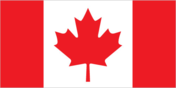
Flag
three vertical bands of red (hoist side), white (double width, square), and red with a red maple leaf centered in the white band
Independence
1 July 1867 (from UK)
Judicial branch
Supreme Court
Leaders
Chief of State--Queen ELIZABETH II (since 6 February 1952), represented by Governor General Raymond John HNATSHYN (since 29 January 1990); Head of Government--Prime Minister (Martin) Brian MULRONEY (since 4 September 1984); Deputy Prime Minister Donald Frank MAZANKOWSKI (since NA June 1986)
Legal system
based on English common law, except in Quebec, where civil law system based on French law prevails; accepts compulsory ICJ jurisdiction, with reservations
Legislative branch
bicameral Parliament (Parlement) consists of an upper house or Senate (Senat) and a lower house or House of Commons (Chambre des Communes)
Long-form name
none
Member of
ACCT, AfDB, AG (observer), APEC, AsDB, BIS, C, CCC, CDB, COCOM, CP, CSCE, EBRD, ECE, ECLAC, FAO, G-7, G-8, G-10, GATT, IADB, IAEA, IBRD, ICAO, ICC, ICFTU, IDA, IEA, IFAD, IFC, ILO, IMF, IMO, INMARSAT, INTELSAT, INTERPOL, IOC, IOM (observer), ISO, ITU, LORCS, NATO, NEA, OAS, OECD, PCA, UN, UNCTAD, UNDOF, UNESCO, UNFICYP, UNHCR, UNIDO, UNIIMOG, UNTSO, UPU, WCL, WHO, WIPO, WMO, WTO
National holiday
Canada Day, 1 July (1867)
Political parties and leaders
Progressive Conservative, Brian MULRONEY; Liberal, Jean CHRETIEN; New Democratic, Audrey McLAUGHLIN
Suffrage
universal at age 18
Type
confederation with parliamentary democracy
Economy
Agriculture
accounts for about 3% of GDP; one of the world's major producers and exporters of grain (wheat and barley); key source of US agricultural imports; large forest resources cover 35% of total land area; commercial fisheries provide annual catch of 1.5 million metric tons, of which 75% is exported
Budget
revenues $105.8 billion; expenditures $131.6 billion, including capital expenditures of $NA (FY90 est.)
Currency
Canadian dollar (plural--dollars); 1 Canadian dollar (Can$) = 100 cents
Economic aid
donor--ODA and OOF commitments (1970-89), $7.2 billion
Electricity
105,000,000 kW capacity; 500,000 million kWh produced, 18,840 kWh per capita (1990)
Exchange rates
Canadian dollars (Can$) per US$1--1.1559 (January 1991), 1.1668 (1990), 1.1840 (1989), 1.2307 (1988), 1.3260 (1987), 1.3895 (1986), 1.3655 (1985)
Exports
$126.7 billion (f.o.b., 1990); commodities--newsprint, wood pulp, timber, grain, crude petroleum, machinery, natural gas, ferrous and nonferrous ores, motor vehicles and parts; partners--US, Japan, UK, FRG, other EC, USSR
External debt
$247 billion (1987)
Fiscal year
1 April-31 March
GDP
$516.7 billion, per capita $19,500; real growth rate 0.9% (1990)
Illicit drugs
illicit producer of cannabis for the domestic drug market; use of hydroponics technology permits growers to plant large quantities of high-quality marijuana indoors
Imports
$116.3 billion (c.i.f., 1990); commodities--processed foods, beverages, crude petroleum, chemicals, industrial machinery, motor vehicles and parts, durable consumer goods, electronic computers; partners--US, Japan, UK, FRG, other EC, Taiwan, South Korea, Mexico
Industrial production
growth rate - 2.7% (1990); accounts for 34% of GDP
Industries
processed and unprocessed minerals, food products, wood and paper products, transportation equipment, chemicals, fish products, petroleum and natural gas
Inflation rate (consumer prices)
4.8% (1990)
Overview
As an affluent, high-tech industrial society, Canada today closely resembles the US in per capita output, market-oriented economic system, and pattern of production. Since World War II the impressive growth of the manufacturing, mining, and service sectors has transformed the nation from a largely rural economy into one primarily industrial and urban. In the 1980s Canada registered one of the highest rates of real growth among the OECD nations, averaging about 3.2%. With its great natural resources, skilled labor force, and modern capital plant, Canada has excellent economic prospects. In mid-1990, however, the long-simmering problems between English- and French-speaking areas became so acute that observers spoke openly of a possible split in the confederation; foreign investors were becoming edgy.
Unemployment rate
8.1% (1990)
Communications
Airports
1,397 total, 1,154 usable; 443 with permanent-surface runways; 4 with runways over 3,659 m; 30 with runways 2,440-3,659 m; 328 with runways 1,220-2,439 m
Civil air
636 major transport aircraft; Air Canada is the major carrier
Highways
884,272 km total; 712,936 km surfaced (250,023 km paved), 171,336 km earth
Inland waterways
3,000 km, including Saint Lawrence Seaway
Merchant marine
75 ships (1,000 GRT or over) totaling 532,062 GRT/727,118 DWT; includes 1 passenger, 5 short-sea passenger, 2 passenger-cargo, 13 cargo, 2 railcar carrier, 1 refrigerated cargo, 8 roll-on/roll-off, 1 container, 27 petroleum, oils, and lubricants (POL) tanker, 6 chemical tanker, 1 specialized tanker, 8 bulk; note--does not include ships used exclusively in the Great Lakes
Pipelines
oil, 23,564 km total crude and refined; natural gas, 74,980 km
Ports
Halifax, Montreal, Quebec, Saint John (New Brunswick), Saint John's (Newfoundland), Toronto, Vancouver
Railroads
93,544 km total; two major transcontinental freight railway systems--Canadian National (government owned) and Canadian Pacific Railway; passenger service--VIA (government operated)
Telecommunications
excellent service provided by modern media; 18.0 million telephones; stations--900 AM, 29 FM, 53 (1,400 repeaters) TV; 5 coaxial submarine cables; over 300 earth stations operating in INTELSAT (including 4 Atlantic Ocean and 1 Pacific Ocean) and domestic systems
Military and Security
Branches
Canadian Armed Forces (including Mobile Command, Maritime Command, Air Command, Communications Command, Canadian Forces Europe, Training Commands), Royal Canadian Mounted Police (RCMP)
Defense expenditures
$11.3 billion, 2% of GDP (FY90) _%_
Manpower availability
males 15-49, 7,243,909; 6,297,520 fit for military service; 188,996 reach military age (17) annually