2009 Edition
CIA World Factbook 2009 (Project Gutenberg)
Introduction
Background
The former French Cameroon and part of British Cameroon merged in 1961 to form the present country. Cameroon has generally enjoyed stability, which has permitted the development of agriculture, roads, and railways, as well as a petroleum industry. Despite a slow movement toward democratic reform, political power remains firmly in the hands of President Paul BIYA.
Geography
Area
total: 475,440 sq km country comparison to the world: 53 land: 472,710 sq km water: 2,730 sq km
Area - comparative
slightly larger than California
Climate
varies with terrain, from tropical along coast to semiarid and hot in north
Coastline
402 km
Elevation extremes
lowest point: Atlantic Ocean 0 m highest point: Fako 4,095 m (on Mt. Cameroon)
Environment - current issues
waterborne diseases are prevalent; deforestation; overgrazing; desertification; poaching; overfishing
Environment - international agreements
party to: Biodiversity, Climate Change, Climate Change-Kyoto Protocol, Desertification, Endangered Species, Hazardous Wastes, Law of the Sea, Ozone Layer Protection, Tropical Timber 83, Tropical Timber 94, Wetlands, Whaling signed, but not ratified: none of the selected agreements
Freshwater withdrawal (domestic/industrial/agricultural)
total: 0.99 cu km/yr (18%/8%/74%) per capita: 61 cu m/yr (2000)
Geographic coordinates
6 00 N, 12 00 E
Geography - note
sometimes referred to as the hinge of Africa; throughout the country there are areas of thermal springs and indications of current or prior volcanic activity; Mount Cameroon, the highest mountain in Sub-Saharan west Africa, is an active volcano
Irrigated land
260 sq km (2003)
Land boundaries
total: 4,591 km border countries: Central African Republic 797 km, Chad 1,094 km, Republic of the Congo 523 km, Equatorial Guinea 189 km, Gabon 298 km, Nigeria 1,690 km
Land use
arable land: 12.54% permanent crops: 2.52% other: 84.94% (2005)
Location
Western Africa, bordering the Bight of Biafra, between Equatorial Guinea and Nigeria
Map references
Africa
Maritime claims
territorial sea: 12 nm contiguous zone: 24 nm
Natural hazards
volcanic activity with periodic releases of poisonous gases from Lake Nyos and Lake Monoun volcanoes
Natural resources
petroleum, bauxite, iron ore, timber, hydropower
Terrain
diverse, with coastal plain in southwest, dissected plateau in center, mountains in west, plains in north
Total renewable water resources
285.5 cu km (2003)
People and Society
Age structure
0-14 years: 40.9% (male 3,891,762/female 3,822,870) 15-64 years: 55.9% (male 5,298,143/female 5,250,493) 65 years and over: 3.3% (male 283,289/female 332,744) (2009 est.)
Birth rate
34.1 births/1,000 population (2009 est.) country comparison to the world: 41
Death rate
12.2 deaths/1,000 population (July 2009 est.) country comparison to the world: 36
Education expenditures
3.3% of GDP (2006) country comparison to the world: 138
Ethnic groups
Cameroon Highlanders 31%, Equatorial Bantu 19%, Kirdi 11%, Fulani 10%, Northwestern Bantu 8%, Eastern Nigritic 7%, other African 13%, non-African less than 1%
HIV/AIDS - adult prevalence rate
5.1% (2007 est.) country comparison to the world: 15
HIV/AIDS - deaths
39,000 (2007 est.) country comparison to the world: 15
HIV/AIDS - people living with HIV/AIDS
540,000 (2007 est.) country comparison to the world: 19
Infant mortality rate
total: 63.34 deaths/1,000 live births country comparison to the world: 36 male: 68.08 deaths/1,000 live births female: 58.47 deaths/1,000 live births (2009 est.)
Languages
24 major African language groups, English (official), French (official)
Life expectancy at birth
total population: 53.69 years country comparison to the world: 197 male: 52.89 years female: 54.52 years (2009 est.)
Literacy
definition: age 15 and over can read and write total population: 67.9% male: 77% female: 59.8% (2001 est.)
Major infectious diseases
degree of risk: very high food or waterborne diseases: bacterial and protozoal diarrhea, hepatitis A and E, and typhoid fever vectorborne diseases: malaria and yellow fever water contact disease: schistosomiasis respiratory disease: meningococcal meningitis animal contact disease: rabies (2009)
Median age
total: 19.2 years male: 19 years female: 19.3 years (2009 est.)
Nationality
noun: Cameroonian(s) adjective: Cameroonian
Net migration rate
NA (2009 est.)
Population
18,879,301 country comparison to the world: 58 note: estimates for this country explicitly take into account the effects of excess mortality due to AIDS; this can result in lower life expectancy, higher infant mortality, higher death rates, lower population growth rates, and changes in the distribution of population by age and sex than would otherwise be expected (July 2009 est.)
Population growth rate
2.19% (2009 est.) country comparison to the world: 44
Religions
indigenous beliefs 40%, Christian 40%, Muslim 20%
School life expectancy (primary to tertiary education)
total: 9 years male: 10 years female: 8 years (2006)
Sex ratio
at birth: 1.03 male(s)/female under 15 years: 1.02 male(s)/female 15-64 years: 1.01 male(s)/female 65 years and over: 0.85 male(s)/female total population: 1.01 male(s)/female (2009 est.)
Total fertility rate
4.33 children born/woman (2009 est.) country comparison to the world: 43
Urbanization
urban population: 57% of total population (2008) rate of urbanization: 3.5% annual rate of change (2005-10 est.)
Government
Administrative divisions
10 regions (regions, singular - region); Adamaoua, Centre, Est, Extreme-Nord, Littoral, Nord, North-West (Nord-Ouest), Ouest, Sud, South-West (Sud-Ouest)
Capital
name: Yaounde geographic coordinates: 3 52 N, 11 31 E time difference: UTC+1 (6 hours ahead of Washington, DC during Standard Time)
Constitution
approved by referendum 20 May 1972; adopted 2 June 1972; revised January 1996
Country name
conventional long form: Republic of Cameroon conventional short form: Cameroon local long form: Republique du Cameroun/Republic of Cameroon local short form: Cameroun/Cameroon former: French Cameroon, British Cameroon, Federal Republic of Cameroon, United Republic of Cameroon
Diplomatic representation from the US
chief of mission: Ambassador Janet E. GARVEY embassy: Avenue Rosa Parks, Yaounde mailing address: P. O. Box 817, Yaounde; pouch: American Embassy, US Department of State, Washington, DC 20521-2520 telephone: [237] 2220 15 00; Consular: [237] 2220 16 03
Diplomatic representation in the US
chief of mission: Ambassador Joseph FOE-ATANGANA chancery: 2349 Massachusetts Avenue NW, Washington, DC 20008 telephone: [1] (202) 265-8790
Executive branch
chief of state: President Paul BIYA (since 6 November 1982) head of government: Prime Minister Philemon YANG (since 30 June 2009) cabinet: Cabinet appointed by the president from proposals submitted by the prime minister elections: president elected by popular vote for a seven-year term (eligible for a second term); election last held 11 October 2004 (next to be held by October 2011); prime minister appointed by the president election results: President Paul BIYA reelected; percent of vote - Paul BIYA 70.9%, John FRU NDI 17.4%, Adamou Ndam NJOYA 4.5%, Garga Haman ADJI 3.7%
FAX
- [1] (202) 387-3826
- [237] 2220 16 00 Ext. 4531; Consular FAX: [237] 2220 17 52 branch office(s): Douala
Flag description
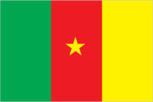
three equal vertical bands of green (hoist side), red, and yellow, with a yellow five-pointed star centered in the red band note: uses the popular pan-African colors of Ethiopia
Government type
republic; multiparty presidential regime
Independence
1 January 1960 (from French-administered UN trusteeship)
International organization participation
ACCT, ACP, AfDB, AU, BDEAC, C, CEMAC, FAO, FZ, G-77, IAEA, IBRD, ICAO, ICC, ICCt (signatory), ICRM, IDA, IDB, IFAD, IFC, IFRCS, ILO, IMF, IMO, IMSO, Interpol, IOC, IOM, IPU, ISO (correspondent), ITSO, ITU, ITUC, MIGA, NAM, OIC, OIF, OPCW, PCA, UN, UNCTAD, UNESCO, UNIDO, UNWTO, UPU, WCL, WCO, WFTU, WHO, WIPO, WMO, WTO
Judicial branch
Supreme Court (judges are appointed by the president); High Court of Justice (consists of nine judges and six substitute judges; elected by the National Assembly)
Legal system
based on French civil law system, with common law influence; accepts compulsory ICJ jurisdiction
Legislative branch
unicameral National Assembly or Assemblee Nationale (180 seats; members are elected by direct popular vote to serve five-year terms); note - the president can either lengthen or shorten the term of the legislature elections: last held 22 July 2007 (next to be held in 2012) election results: percent of vote by party - NA; seats by party - CPDM 140, SDF 14, UDC 4, UNDP 4, MP 1, vacant 17 note: the constitution calls for an upper chamber for the legislature, to be called a Senate, but it has yet to be established
National holiday
Republic Day (National Day), 20 May (1972)
Political parties and leaders
Cameroonian Democratic Union or UDC [Adamou Ndam NJOYA]; Cameroon People's Democratic Movement or CPDM [Paul BIYA]; Movement for the Defense of the Republic or MDR [Dakole DAISSALA]; Movement for the Liberation and Development of Cameroon or MLDC [Marcel YONDO]; National Union for Democracy and Progress or UNDP [Maigari BELLO BOUBA]; Progressive Movement or MP; Social Democratic Front or SDF [John FRU NDI]; Union of Peoples of Cameroon or UPC [Augustin Frederic KODOCK]
Political pressure groups and leaders
Human Rights Defense Group [Albert MUKONG, president]; Southern Cameroon National Council [Ayamba Ette OTUN]
Suffrage
20 years of age; universal
Economy
Agriculture - products
coffee, cocoa, cotton, rubber, bananas, oilseed, grains, root starches; livestock; timber
Budget
revenues: $4.714 billion expenditures: $4.261 billion (2008 est.)
Central bank discount rate
4.75% (31 December 2008) country comparison to the world: 86 5.25% (31 December 2007)
Commercial bank prime lending rate
NA% (31 December 2008) country comparison to the world: 47 15% (31 December 2007)
Current account balance
-$96 million (2008 est.) country comparison to the world: 78 -$547 million (2007 est.)
Debt - external
$3.066 billion (31 December 2008 est.) country comparison to the world: 126 $2.554 billion (31 December 2007 est.)
Distribution of family income - Gini index
44.6 (2001) country comparison to the world: 45 47.7 (1996)
Economy - overview
Because of its modest oil resources and favorable agricultural conditions, Cameroon has one of the best-endowed primary commodity economies in sub-Saharan Africa. Still, it faces many of the serious problems facing other underdeveloped countries, such as stagnating per capita income, a relatively inequitable distribution of income, a top-heavy civil service, and a generally unfavorable climate for business enterprise. International oil and cocoa prices have a significant impact on the economy. Since 1990, the government has embarked on various IMF and World Bank programs designed to spur business investment, increase efficiency in agriculture, improve trade, and recapitalize the nation's banks. The IMF is pressing for more reforms, including increased budget transparency, privatization, and poverty reduction programs.
Electricity - consumption
4.801 billion kWh (2007 est.) country comparison to the world: 107
Electricity - exports
0 kWh (2008 est.)
Electricity - imports
0 kWh (2008 est.)
Electricity - production
5.601 billion kWh (2007 est.) country comparison to the world: 108
Exchange rates
Cooperation Financiere en Afrique Centrale francs (XAF) per US dollar - 447.81 (2008 est.), 493.51 (2007), 522.59 (2006), 527.47 (2005), 528.29 (2004) note: since 1 January 1999, the Central African CFA franc (XAF) has been pegged to the euro at a rate of 655.957 CFA francs per euro; Central African CFA franc (XAF) coins and banknotes are not accepted in countries using West African CFA francs (XOF), and vice versa, even though the two currencies trade at par
Exports
$4.707 billion (2008 est.) country comparison to the world: 113 $4.345 billion (2007 est.)
Exports - commodities
crude oil and petroleum products, lumber, cocoa beans, aluminum, coffee, cotton
Exports - partners
Spain 19.8%, Italy 13.5%, US 10.6%, France 8.2%, Netherlands 8.1%, China 7.9%, Belgium 4% (2008)
GDP - composition by sector
agriculture: 43.6% industry: 15.9% services: 40.5% (2008 est.)
GDP - per capita (PPP)
$2,300 (2008 est.) country comparison to the world: 178 $2,300 (2007 est.) $2,300 (2006 est.) note: data are in 2008 US dollars
GDP - real growth rate
3.3% (2008 est.) country comparison to the world: 115 3.5% (2007 est.) 3.2% (2006 est.)
GDP (official exchange rate)
$23.73 billion (2008 est.)
GDP (purchasing power parity)
$42.69 billion (2008 est.) country comparison to the world: 94 $41.33 billion (2007 est.) $39.93 billion (2006 est.) note: data are in 2008 US dollars
Household income or consumption by percentage share
lowest 10%: 2.3% highest 10%: 35.4% (2001)
Imports
$4.303 billion (2008 est.) country comparison to the world: 124 $4.05 billion (2007 est.)
Imports - commodities
machinery, electrical equipment, transport equipment, fuel, food
Imports - partners
France 21.1%, Nigeria 13.8%, China 9.5%, Belgium 6.1% (2008)
Industrial production growth rate
4.2% (2008 est.) country comparison to the world: 63
Industries
petroleum production and refining, aluminum production, food processing, light consumer goods, textiles, lumber, ship repair
Inflation rate (consumer prices)
5.3% (2008 est.) country comparison to the world: 89 1.1% (2007 est.)
Investment (gross fixed)
17.7% of GDP (2008 est.) country comparison to the world: 131
Labor force
6.759 million (2008 est.) country comparison to the world: 62
Labor force - by occupation
agriculture: 70% industry: 13% services: 17% (2001 est.)
Market value of publicly traded shares
$NA
Natural gas - consumption
20 million cu m (2008 est.) country comparison to the world: 111
Natural gas - exports
0 cu m (2008) country comparison to the world: 182
Natural gas - imports
0 cu m (2008 est.) country comparison to the world: 192
Natural gas - production
20 million cu m (2008 est.) country comparison to the world: 88
Natural gas - proved reserves
135.1 billion cu m (1 January 2009 est.) country comparison to the world: 49
Oil - consumption
26,000 bbl/day (2008 est.) country comparison to the world: 116
Oil - exports
107,100 bbl/day (2007 est.) country comparison to the world: 66
Oil - imports
45,520 bbl/day (2007 est.) country comparison to the world: 92
Oil - production
81,720 bbl/day (2008 est.) country comparison to the world: 55
Oil - proved reserves
200 million bbl (1 January 2009 est.) country comparison to the world: 56
Population below poverty line
48% (2000 est.)
Public debt
13.5% of GDP (2008 est.) country comparison to the world: 109 69.1% of GDP (2004 est.)
Reserves of foreign exchange and gold
$3.091 billion (31 December 2008 est.) country comparison to the world: 93 $2.932 billion (31 December 2007 est.)
Stock of domestic credit
$NA (31 December 2008) $1.3 billion (31 December 2007)
Stock of money
$NA (31 December 2008) $2.616 billion (31 December 2007)
Stock of quasi money
$NA (31 December 2008) $1.698 billion (31 December 2007)
Unemployment rate
30% (2001 est.) country comparison to the world: 176
Communications
Internet country code
.cm
Internet hosts
70 (2009) country comparison to the world: 204
Internet users
725,000 (2008) country comparison to the world: 99
Radio broadcast stations
AM 2, FM 9, shortwave 3 (2001)
Telephone system
general assessment: fixed-line connections stand at less than 1 per 100 persons; equipment is old and outdated, and connections with many parts of the country are unreliable; mobile-cellular usage, in part a reflection of the poor condition and general inadequacy of the fixed-line network, has increased sharply, reaching a subscribership base of 33 per 100 persons domestic: cable, microwave radio relay, and tropospheric scatter international: country code - 237; landing point for the SAT-3/WASC fiber-optic submarine cable that provides connectivity to Europe and Asia; satellite earth stations - 2 Intelsat (Atlantic Ocean) (2008)
Telephones - main lines in use
198,300 (2008) country comparison to the world: 124
Telephones - mobile cellular
6.161 million (2008) country comparison to the world: 79
Television broadcast stations
1 (2001)
Transportation
Airports
36 (2009) country comparison to the world: 107
Airports - with paved runways
total: 11 over 3,047 m: 2 2,438 to 3,047 m: 5 1,524 to 2,437 m: 3 914 to 1,523 m: 1 (2009)
Airports - with unpaved runways
total: 25 1,524 to 2,437 m: 3 914 to 1,523 m: 16 under 914 m: 6 (2009)
Pipelines
oil 889 km (2008)
Ports and terminals
Douala, Limboh Terminal
Railways
total: 987 km country comparison to the world: 89 narrow gauge: 987 km 1.000-m gauge (2008)
Roadways
total: 50,000 km country comparison to the world: 79 paved: 5,000 km unpaved: 45,000 km (2004)
Waterways
navigation mainly on Benue River; limited during rainy season (2008)
Military and Security
Cameroon Armed Forces (Forces Armees Camerounaises, FAC)
Army (L'Armee de Terre), Navy (includes naval infantry), Air Force (Armee de l'Air du Cameroun, AAC) (2009)
Manpower available for military service
males age 16-49: 4,321,175 females age 16-49: 4,228,625 (2008 est.)
Manpower fit for military service
males age 16-49: 2,645,601 females age 16-49: 2,574,948 (2009 est.)
Manpower reaching militarily significant age annually
male: 213,027 female: 208,642 (2009 est.)
Military expenditures
1.3% of GDP (2006) country comparison to the world: 121
Military service age and obligation
18 years of age for male and female voluntary military service; no conscription; the government makes periodic calls for volunteers (2009)
Transnational Issues
Disputes - international
Joint Border Commission with Nigeria reviewed 2002 ICJ ruling on the entire boundary and bilaterally resolved differences, including June 2006 Greentree Agreement that immediately ceded sovereignty of the Bakassi Peninsula to Cameroon with a full phase-out of Nigerian control and patriation of residents in 2008; Cameroon and Nigeria agree on maritime delimitation in March 2008; sovereignty dispute between Equatorial Guinea and Cameroon over an island at the mouth of the Ntem River; only Nigeria and Cameroon have heeded the Lake Chad Commission's admonition to ratify the delimitation treaty, which also includes the Chad-Niger and Niger-Nigeria boundaries
Refugees and internally displaced persons
refugees (country of origin): 20,000-30,000 (Chad); 3,000 (Nigeria); 24,000 (Central African Republic) (2007)
Trafficking in persons
current situation: Cameroon is a source, transit, and destination country for women and children trafficked for the purposes of forced labor and commercial sexual exploitation; most victims are children trafficked within country, with girls primarily trafficked for domestic servitude and sexual exploitation; both boys and girls are also trafficked within Cameroon for forced labor in sweatshops, bars, restaurants, and on tea and cocoa plantations; children are trafficked into Cameroon from neighboring states for forced labor in agriculture, fishing, street vending, and spare-parts shops; Cameroon is a transit country for children trafficked between Gabon and Nigeria, and from Nigeria to Saudi Arabia; it is a source country for women transported by sex-trafficking rings to Europe tier rating: Tier 2 Watch List - Cameroon is on the Tier 2 Watch List for its failure to provide evidence of increasing efforts to combat human trafficking in 2007, particularly in terms of efforts to prosecute and convict trafficking offenders; while Cameroon reported some arrests of traffickers, none of them were prosecuted or punished; the government does not identify trafficking victims among vulnerable populations nor does it monitor the number of victims it intercepts (2008) page last updated on November 11, 2009