1990 Edition
CIA World Factbook 1990 (Project Gutenberg)
Geography
Climate
varies with terrain from tropical along coast to semiarid and hot in north
Coastline
402 km
Comparative area
slightly larger than California
Continental shelf
not specific;
Disputes
exact locations of the Chad-Niger-Nigeria and Cameroon-Chad-Nigeria tripoints in Lake Chad have not been determined, so the boundary has not been demarcated and border incidents have resulted; Nigerian proposals to reopen maritime boundary negotiations and redemarcate the entire land boundary have been rejected by Cameroon
Environment
recent volcanic activity with release of poisonous gases; deforestation; overgrazing; desertification
Land boundaries
4,591 km total; Central African Republic 797 km, Chad 1,094 km, Congo 523 km, Equatorial Guinea 189 km, Gabon 298 km, Nigeria 1,690 km
Land use
13% arable land; 2% permanent crops; 18% meadows and pastures; 54% forest and woodland; 13% other; includes NEGL% irrigated
Natural resources
crude oil, bauxite, iron ore, timber, hydropower potential
Note
sometimes referred to as the hinge of Africa
Terrain
diverse with coastal plain in southwest, dissected plateau in center, mountains in west, plains in north
Territorial sea
50 nm
Total area
475,440 km2; land area: 469,440 km2
People and Society
Birth rate
42 births/1,000 population (1990)
Death rate
15 deaths/1,000 population (1990)
Ethnic divisions
over 200 tribes of widely differing background; 31% Cameroon Highlanders, 19% Equatorial Bantu, 11% Kirdi, 10% Fulani, 8% Northwestern Bantu, 7% Eastern Nigritic, 13% other African, less than 1% non-African
Infant mortality rate
120 deaths/1,000 live births (1990)
Labor force
NA; 74.4% agriculture, 11.4% industry and transport, 14.2% other services (1983); 50% of population of working age (15-64 years)
Language
English and French (official), 24 major African language groups
Life expectancy at birth
49 years male, 53 years female (1990)
Literacy
56.2%
Nationality
noun--Cameroonian(s); adjective--Cameroonian
Net migration rate
0 migrants/1,000 population (1990)
Organized labor
under 45% of wage labor force
Population
11,092,470 (July 1990), growth rate 2.7% (1990)
Religion
51% indigenous beliefs, 33% Christian, 16% Muslim
Total fertility rate
5.7 children born/woman (1990)
Government
Administrative divisions
10 provinces; Adamaoua, Centre, Est, Extreme-Nord, Littoral, Nord, Nord-Ouest, Ouest, Sud, Sud-Ouest
Capital
Yaounde
Communists
no Communist party or significant number of sympathizers
Constitution
20 May 1972
Diplomatic representation
Ambassador Paul PONDI; Chancery at 2349 Massachusetts Avenue NW, Washington DC 20008; telephone (202) 265-8790 through 8794; US--Ambassador Frances COOK; Embassy at Rue Nachtigal, Yaounde (mailing address is B. P. 817, Yaounde); telephone [237] 234014; there is a US Consulate General in Douala
Elections
President--last held 24 April 1988 (next to be held April 1993); results--President Paul Biya reelected without opposition; National Assembly--last held 24 April 1988 (next to be held April 1993); results--RDPC is the only party; seats--(180 total) RDPC 180
Executive branch
president, Cabinet
Flag
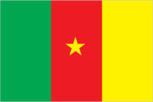
three equal vertical bands of green (hoist side), red, and yellow with a yellow five-pointed star centered in the red band; uses the popular pan-African colors of Ethiopia
Independence
1 January 1960 (from UN trusteeship under French administration; formerly French Cameroon)
Judicial branch
Supreme Court
Leaders
Chief of State and Head of Government President Paul BIYA (since 6 November 1982)
Legal system
based on French civil law system, with common law influence; has not accepted compulsory ICJ jurisdiction
Legislative branch
unicameral National Assembly (Assemblee Nationale)
Long-form name
Republic of Cameroon
Member of
ACP, AfDB, CCC, EAMA, ECA, EIB (associate), FAO, G-77, GATT, IAEA, IBRD, ICAC, ICAO, ICO, IDA, IDB--Islamic Development Bank, IFAD, IFC, ILO, IMF, IMO, INTELSAT, INTERPOL, IPU, ISO, ITU, Lake Chad Basin Commission, NAM, Niger River Commission, OAU, OIC, UDEAC, UN, UNESCO, UPU, WHO, WIPO, WMO, WTO
National holiday
National Day, 20 May (1972)
Other political or pressure groups
Cameroon People's Union (UPC), remains an illegal group with its factional leaders in exile
Political parties and leaders
only party--Cameroon People's Democratic Movement (RDPC), Paul Biya, president
Suffrage
universal at age 21
Type
unitary republic; one-party presidential regime
Economy
Agriculture
the agriculture and forestry sectors provide employment for the majority of the population, contributing nearly 25% to GDP and providing a high degree of self-sufficiency in staple foods; commercial and food crops include coffee, cocoa, timber, cotton, rubber, bananas, oilseed, grains, livestock, root starches
Aid
US commitments, including Ex-Im (FY70-88), $400 million; Western (non-US) countries, ODA and OOF bilateral commitments (1970-87), $3.9 billion; OPEC bilateral aid (1979-89), $29 million; Communist countries (1970-88), $120 million
Budget
revenues $2.17 billion; expenditures $2.17 billion, including capital expenditures of $833 million (FY88)
Currency
Communaute Financiere Africaine franc (plural--francs); 1 CFA franc (CFAF) = 100 centimes
Electricity
752,000 kW capacity; 2,940 million kWh produced, 270 kWh per capita (1989)
Exchange rates
Communaute Financiere Africaine francs (CFAF) per US$1--287.99 (January 1990), 319.01 (1989), 297.85 (1988), 300.54 (1987), 346.30 (1986), 449.26 (1985)
Exports
$2.0 billion (f.o.b., 1988); commodities--petroleum products 56%, coffee, cocoa, timber, manufactures; partners--EC (particularly the Netherlands) about 50%, US 3%
External debt
$4.9 billion (December 1989 est.)
Fiscal year
1 July-30 June
GDP
$12.9 billion, per capita $955; real growth rate - 8.6% (1988)
Imports
$2.3 billion (c.i.f., 1988); commodities--machines and electrical equipment, transport equipment, chemical products, consumer goods; partners--France 42%, Japan 7%, US 4%
Industrial production
growth rate - 6.4% (FY87)
Industries
crude oil products, small aluminum plant, food processing, light consumer goods industries, sawmills
Inflation rate (consumer prices)
8.6% (FY88)
Overview
Over the past decade the economy has registered a remarkable performance because of the development of an offshore oil industry. Real GDP growth annually averaged 10% from 1978 to 1985. In 1986 Cameroon had one of the highest levels of income per capita in tropical Africa, with oil revenues picking up the slack as growth in other sectors softened. Because of the sharp drop in oil prices, however, the economy is now experiencing serious budgetary difficulties and balance-of-payments disequalibrium. Oil reserves currently being exploited will be depleted in the early 1990s, so ways must be found to boost agricultural and industrial exports in the medium term. The Sixth Cameroon Development Plan (1986-91) stresses balanced development and designates agriculture as the basis of the country's economic future.
Unemployment rate
7% (1985)
Communications
Airports
61 total, 54 usable; 10 with permanent-surface runways; none with runways over 3,659 m; 5 with runways 2,440-3,659 m; 22 with runways 1,220-2,439 m
Civil air
5 major transport aircraft
Highways
about 65,000 km total; includes 2,682 km bituminous, 30,000 km unimproved earth, 32,318 km gravel, earth, and improved earth
Inland waterways
2,090 km; of decreasing importance
Merchant marine
2 cargo ships (1,000 GRT or over) totaling 24,122 GRT/33,509 DWT
Ports
Douala
Railroads
1,003 km total; 858 km 1.000-meter gauge, 145 km 0.600-meter gauge
Telecommunications
good system of open wire, cable, troposcatter, and radio relay; 26,000 telephones; stations--10 AM, 1 FM, 1 TV; 2 Atlantic Ocean INTELSAT earth stations
Military and Security
Branches
Army, Navy, Air Force; paramilitary Gendarmerie
Defense expenditures
1.7% of GDP, or $219 million (1990 est.)
Military manpower
males 15-49, 2,553,867; 1,286,831 fit for military service; 121,773 reach military age (18) annually