1999 Edition
CIA World Factbook 1999 (Internet Archive)
Geography
Area
total: 181,040 sq km land: 176,520 sq km water: 4,520 sq km
Area--comparative
slightly smaller than Oklahoma
Climate
tropical; rainy, monsoon season (May to November); dry season (December to April); little seasonal temperature variation
Coastline
443 km
Elevation extremes
lowest point: Gulf of Thailand 0 m highest point: Phnum Aoral 1,810 m
Environment--current issues
illegal logging activities throughout the country and strip mining for gems in the western region along the border with Thailand are resulting in habitat loss and declining biodiversity (in particular, destruction of mangrove swamps threatens natural fisheries); soil erosion; in rural areas, a majority of the population does not have access to potable water; toxic waste delivery from Taiwan sparked unrest in Kampong Saom (Sihanoukville) in December 1998
Environment--international agreements
party to: Biodiversity, Climate Change, Desertification, Endangered Species, Marine Life Conservation, Ship Pollution, Tropical Timber 94 signed, but not ratified: Law of the Sea, Marine Dumping
Geographic coordinates
13 00 N, 105 00 E
Geography--note
a land of paddies and forests dominated by the Mekong River and Tonle Sap
Irrigated land
920 sq km (1993 est.)
Land boundaries
total: 2,572 km border countries: Laos 541 km, Thailand 803 km, Vietnam 1,228 km
Land use
arable land: 13% permanent crops: 0% permanent pastures: 11% forests and woodland: 66% other: 10% (1993 est.)
Location
Southeastern Asia, bordering the Gulf of Thailand, between Thailand, Vietnam, and Laos
Map references
Southeast Asia
Maritime claims
contiguous zone: 24 nm continental shelf: 200 nm exclusive economic zone: 200 nm territorial sea: 12 nm
Natural hazards
monsoonal rains (June to November); flooding; occasional droughts
Natural resources
timber, gemstones, some iron ore, manganese, phosphates, hydropower potential
Terrain
mostly low, flat plains; mountains in southwest and north
People and Society
Age structure
0-14 years: 45% (male 2,667,768; female 2,587,590) 15-64 years: 52% (male 2,821,772; female 3,197,604) 65 years and over: 3% (male 143,016; female 208,770) (1999 est.)
Birth rate
41.05 births/1,000 population (1999 est.)
Death rate
16.2 deaths/1,000 population (1999 est.)
Ethnic groups
Khmer 90%, Vietnamese 5%, Chinese 1%, other 4%
Infant mortality rate
105.06 deaths/1,000 live births (1999 est.)
Languages
Khmer (official), French
Life expectancy at birth
total population: 48.24 years male: 46.81 years female: 49.75 years (1999 est.)
Literacy
definition: age 15 and over can read and write total population: 35% male: 48% female: 22% (1990 est.)
Nationality
noun: Cambodian(s) adjective: Cambodian
Net migration rate
0 migrant(s)/1,000 population (1999 est.)
Population
11,626,520 (July 1999 est.)
Population growth rate
2.49% (1999 est.)
Religions
Theravada Buddhism 95%, other 5%
Sex ratio
at birth: 1.05 male(s)/female under 15 years: 1.03 male(s)/female 15-64 years: 0.88 male(s)/female 65 years and over: 0.69 male(s)/female total population: 0.94 male(s)/female (1999 est.)
Total fertility rate
5.81 children born/woman (1999 est.)
Government
Administrative divisions
20 provinces (khett, singular and plural) and 3 municipalities* (krong, singular and plural); Banteay Mean Cheay, Batdambang, Kampong Cham, Kampong Chhnang, Kampong Spoe, Kampong Thum, Kampot, Kandal, Kaoh Kong, Keb*, Krachen, Mondol Kiri, Otdar Mean Cheay, Phnum Penh*, Pouthisat, Preah Seihanu* (Sihanoukville), Preah Vihear, Prey Veng, Rotanah Kiri, Siem Reab, Stoeng Treng, Svay Rieng, Takev note: there may be a new municipality called Pailin
Capital
Phnom Penh
Constitution
promulgated 21 September 1993
Country name
conventional long form: Kingdom of Cambodia conventional short form: Cambodia local long form: Preahreacheanachakr Kampuchea local short form: Kampuchea
Data code
CB
Executive branch
chief of state: King Norodom SIHANOUK (reinstated 24 September 1993) head of government: Prime Minister HUN SEN (since 30 November 1998) cabinet: Council of Ministers appointed by the monarch elections: none; the monarch is hereditary; prime minister appointed by the monarch after a vote of confidence by the National Assembly
Flag description
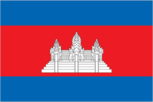
three horizontal bands of blue (top), red (double width), and blue with a white three-towered temple representing Angkor Wat outlined in black in the center of the red band
Government type
multiparty liberal democracy under a constitutional monarchy established in September 1993
Independence
9 November 1953 (from France)
International organization participation
ACCT, AsDB, ASEAN (observer), CP, ESCAP, FAO, G-77, IAEA, IBRD, ICAO, ICRM, IDA, IFAD, IFC, IFRCS, ILO, IMF, IMO, Intelsat (nonsignatory user), Interpol, IOC, ISO (subscriber), ITU, NAM, OPCW, PCA, UN, UNCTAD, UNESCO, UNIDO, UPU, WFTU, WHO, WIPO, WMO, WToO, WTrO (applicant) Diplomatic representation in the US: chief of mission: Ambassador VAR HUOTH chancery: 4500 16th Street NW, Washington, DC 20011 Diplomatic representation from the US: chief of mission: Ambassador Kenneth M. QUINN embassy: 27 EO Street 240, Phnom Penh mailing address: Box P, APO AP 96546
Judicial branch
Supreme Council of the Magistracy, provided for in the constitution, was formed in December 1997; a Supreme Court and lower courts exercise judicial authority Political parties and leaders: National United Front for an Independent, Neutral, Peaceful, and Cooperative Cambodia or
Legal system
primarily a civil law mixture of French-influenced codes from the United Nations Transitional Authority in Cambodia (UNTAC) period, royal decrees, and acts of the legislature, with influences of customary law and remnants of communist legal theory; increasing influence of common law in recent years
Legislative branch
unicameral National Assembly (122 seats; members elected by popular vote to serve five-year terms) elections: last held 26 July 1998 (next to be held NA 2003) election results: percent of vote by party--CPP 41%, FUNCINPEC 32%, SRP 14%, other 13%; seats by party--CPP 64, FUNCINPEC 43, SRP 15 note: pursuant to the coalition agreement signed in November 1998, a Senate is being created and the legislature will thus become bicameral
National holiday
Independence Day, 9 November (1953)
Suffrage
18 years of age; universal
Economy
Agriculture--products
rice, rubber, corn, vegetables
Budget
revenues: $261 million expenditures: $496 million, including capital expenditures of $NA (1995 est.)
Currency
1 new riel (CR) = 100 sen
Debt--external
$2.2 billion (1996 est.)
Economic aid--recipient
$569.8 million (1995)
Economy--overview
After four years of solid macroeconomic performance, Cambodia's economy slowed dramatically in 1997-98 due to the regional economic crisis, civil violence, and political infighting. Foreign investment fell off, and tourism has declined from 1996 levels. Also, in 1998 the main harvest was hit by drought. The long-term development of the economy after decades of war remains a daunting challenge. Human resource levels in the population are low, particularly in the poverty-ridden countryside. The almost total lack of basic infrastructure in the countryside will continue to hinder development. Recurring political instability and corruption within government discourage foreign investment and delay foreign aid. Even so, growth may resume in 1999 at, say, 2%.
Electricity--consumption
195 million kWh (1996)
Electricity--exports
0 kWh (1996)
Electricity--imports
0 kWh (1996)
Electricity--production
195 million kWh (1996)
Electricity--production by source
fossil fuel: 61.54% hydro: 38.46% nuclear: 0% other: 0% (1996)
Exchange rates
riels (CR) per US$1--3,772.0 (January 1999), 3,744.4 (1998), 2,946.3 (1997), 2,624.1 (1996), 2,450.8 (1995), 2,545.3 (1994)
Exports
$736 million (f.o.b., 1997 est.)
Exports--commodities
timber, garments, rubber, soybeans, sesame
Exports--partners
Singapore, Japan, Thailand, Hong Kong, Indonesia, Malaysia, US
Fiscal year
calendar year
GDP
purchasing power parity--$7.8 billion (1998 est.)
GDP--composition by sector
agriculture: 51% industry: 15% services: 34% (1997 est.)
GDP--per capita
purchasing power parity?$700 (1998 est.)
GDP--real growth rate
0% (1998 est.)
Household income or consumption by percentage share
lowest 10%: NA% highest 10%: NA%
Imports
$1.1 billion (f.o.b., 1997 est.)
Imports--commodities
cigarettes, gold, construction materials, petroleum products, machinery, motor vehicles
Imports--partners
Singapore, Vietnam, Japan, Australia, Hong Kong, Indonesia, Thailand
Industrial production growth rate
7% (1995 est.)
Industries
rice milling, fishing, wood and wood products, rubber, cement, gem mining, textiles
Inflation rate (consumer prices)
15% (1998 est.)
Labor force
2.5 million to 3 million
Labor force--by occupation
agriculture 80% (1997 est.)
Population below poverty line
NA%
Unemployment rate
NA%
Communications
Radio broadcast stations
AM 7, FM 3, shortwave 3 (1998)
Radios
NA
Telephone system
adequate landline and/or cellular service in Phnom Penh and other provincial cities; rural areas have little telephone service domestic: NA international: adequate but expensive landline and cellular service available to all countries from Phnom Penh and major provincial cities; satellite earth station--1 Intersputnik (Indian Ocean Region)
Telephones
7,000 (1981 est.)
Television broadcast stations
1 government-operated station and four commercial stations broadcasting to Phnom Penh and major provincial cities via relay (1998)
Televisions
800,000 (1996 est.)
Transportation
Airports
20 (1998 est.) Airports--with paved runways: total: 7 2,438 to 3,047 m: 2 1,524 to 2,437 m: 2 914 to 1,523 m: 3 (1998 est.) Airports--with unpaved runways: total: 13 1,524 to 2,437 m: 3 914 to 1,523 m: 10 (1998 est.)
Heliports
3 (1998 est.)
Highways
total: 35,769 km paved: 4,165 km unpaved: 31,604 km (1997 est.)
Merchant marine
total: 141 ships (1,000 GRT or over) totaling 598,867 GRT/841,240 DWT ships by type: barge carrier 1, bulk 16, cargo 108, container 4, livestock carrier 2, multifunctional large-load carrier 1, oil tankers 1, refrigerated cargo 4, roll-on/roll-off cargo 4 note: a flag of convenience registry; includes ships of 8 countries: Aruba 1, Cyprus 7, Egypt 1, South Korea 1, Malta 1, Panama 1, Russia 5, Singapore 1 (1998 est.)
Railways
total: 603 km narrow gauge: 603 km 1.000-m gauge
Waterways
3,700 km navigable all year to craft drawing 0.6 m; 282 km navigable to craft drawing 1.8 m Ports and harbors: Kampong Saom (Sihanoukville), Kampot, Krong Kaoh Kong, Phnom Penh
Military and Security
Military branches
Royal Cambodian Armed Forces (RCAF)--created in 1993 by the merger of the Cambodian People's Armed Forces and the two noncommunist resistance armies note: there are also resistance forces comprised of the Khmer Rouge (also known as the National United Army or NUA) and a separate royalist resistance movement
Military expenditures--dollar figure
$85.3 million (1998)
Military expenditures--percent of GDP
2.4% (1998)
Military manpower--availability
males age 15-49: 2,562,112 (1999 est.) Military manpower--fit for military service: males age 15-49: 1,428,523 (1999 est.)
Military manpower--military age
18 years of age
Military manpower--reaching military age annually
males: 119,839 (1999 est.)
Transnational Issues
Disputes--international
offshore islands and sections of the boundary with Vietnam are in dispute; maritime boundary with Vietnam not defined; parts of border with Thailand are indefinite; maritime boundary with Thailand not clearly defined
Illicit drugs
transshipment site for Golden Triangle heroin; possible money laundering; narcotics-related corruption reportedly involving some in the government, military, and police; possible small-scale opium, heroin, and amphetamine production; large producer of cannabis for the international market