2017 Edition
CIA World Factbook 2017 Archive (HTML)
Introduction
Background
Burundi is a small country in East Africa bordered by Tanzania, Rwanda, and Lake Tanganyika. Burundi gained its independence from Belgium in 1962. Much of its history has been turbulent, and Burundi's first democratically elected president was assassinated in October 1993 after only 100 days in office. The internationally brokered Arusha Agreement ended the 1993-2005 civil war, paving the way for a new constitution and 2005 elections. Pierre NKURUNZIZA was elected president in 2005 and 2010 and again in a controversial election in 2015. Burundi continues to face many political and economic challenges.
Geography
Area
- 27,830 sq km 25,680 sq km 2,150 sq km
- land
- 25,680 sq km
- total
- 27,830 sq km
- water
- 2,150 sq km
Area - comparative
slightly smaller than Maryland
Climate
equatorial; high plateau with considerable altitude variation (772 m to 2,670 m above sea level); average annual temperature varies with altitude from 23 to 17 degrees Celsius but is generally moderate as the average altitude is about 1,700 m; average annual rainfall is about 150 cm; two wet seasons (February to May and September to November), and two dry seasons (June to August and December to January)
Coastline
0 km (landlocked)
Elevation
- 1,504 m lowest point: Lake Tanganyika 772 m highest point: Heha 2,670 m
- elevation extremes
- lowest point: Lake Tanganyika 772 m
- highest point
- Heha 2,670 m
- mean elevation
- 1,504 m
Environment - current issues
soil erosion as a result of overgrazing and the expansion of agriculture into marginal lands; deforestation (little forested land remains because of uncontrolled cutting of trees for fuel); habitat loss threatens wildlife populations
Environment - international agreements
- Biodiversity, Climate Change, Climate Change-Kyoto Protocol, Desertification, Endangered Species, Hazardous Wastes, Ozone Layer Protection, Wetlands Law of the Sea
- party to
- Biodiversity, Climate Change, Climate Change-Kyoto Protocol, Desertification, Endangered Species, Hazardous Wastes, Ozone Layer Protection, Wetlands
- signed, but not ratified
- Law of the Sea
Geographic coordinates
3 30 S, 30 00 E
Geography - note
landlocked; straddles crest of the Nile-Congo watershed; the Kagera, which drains into Lake Victoria, is the most remote headstream of the White Nile
Irrigated land
230 sq km (2012)
Land boundaries
- 1,140 km Democratic Republic of the Congo 236 km, Rwanda 315 km, Tanzania 589 km
- border countries (3)
- Democratic Republic of the Congo 236 km, Rwanda 315 km, Tanzania 589 km
- total
- 1,140 km
Land use
- 73.3% arable land 38.9%; permanent crops 15.6%; permanent pasture 18.8% 6.6% 20.1% (2011 est.)
- agricultural land
- 73.3%
- forest
- 6.6%
- other
- 20.1% (2011 est.)
Location
Central Africa, east of the Democratic Republic of the Congo, west of Tanzania
Map references
Africa
Maritime claims
none (landlocked)
Natural hazards
flooding; landslides; drought
Natural resources
nickel, uranium, rare earth oxides, peat, cobalt, copper, platinum, vanadium, arable land, hydropower, niobium, tantalum, gold, tin, tungsten, kaolin, limestone
Population - distribution
one of Africa's most densely populated countries; concentrations tend to be in the north and along the northern shore of Lake Tanganyika in the west; most people live on farms near areas of fertile volcanic soil
Terrain
hilly and mountainous, dropping to a plateau in east, some plains
People and Society
Age structure
- 45.57% (male 2,628,767/female 2,596,719) 19.15% (male 1,095,213/female 1,100,314) 28.74% (male 1,643,319/female 1,651,679) 3.92% (male 212,074/female 237,324) 2.63% (male 129,482/female 171,865) (2017 est.)
- 0-14 years
- 45.57% (male 2,628,767/female 2,596,719)
- 15-24 years
- 19.15% (male 1,095,213/female 1,100,314)
- 25-54 years
- 28.74% (male 1,643,319/female 1,651,679)
- 55-64 years
- 3.92% (male 212,074/female 237,324)
- 65 years and over
- 2.63% (male 129,482/female 171,865) (2017 est.)
Birth rate
41.3 births/1,000 population (2017 est.)
Children under the age of 5 years underweight
29.1% (2010)
Contraceptive prevalence rate
31.7% (2012)
Death rate
8.8 deaths/1,000 population (2017 est.)
Demographic profile
Burundi is a densely populated country with a high population growth rate, factors that combined with land scarcity and poverty place a large share of its population at risk of food insecurity. About 90% of the population relies on subsistence agriculture. Subdivision of land to sons, and redistribution to returning refugees, results in smaller, overworked, and less productive plots. Food shortages, poverty, and a lack of clean water contribute to a 60% chronic malnutrition rate among children. A lack of reproductive health services has prevented a significant reduction in Burundi’s maternal mortality and fertility rates, which are both among the world’s highest. With two-thirds of its population under the age of 25 and a birth rate of about 6 children per woman, Burundi’s population will continue to expand rapidly for decades to come, putting additional strain on a poor country. Historically, migration flows into and out of Burundi have consisted overwhelmingly of refugees from violent conflicts. In the last decade, more than a half million Burundian refugees returned home from neighboring countries, mainly Tanzania. Reintegrating the returnees has been problematic due to their prolonged time in exile, land scarcity, poor infrastructure, poverty, and unemployment. Repatriates and existing residents (including internally displaced persons) compete for limited land and other resources. To further complicate matters, international aid organizations reduced their assistance because they no longer classified Burundi as a post-conflict country. Conditions have deteriorated since renewed violence erupted in April 2015, causing another outpouring of refugees. In addition to refugee out-migration, Burundi has hosted thousands of refugees from neighboring countries, mostly from the Democratic Republic of the Congo and lesser numbers from Rwanda.
Dependency ratios
- 89.6 84.8 4.7 21.1 (2015 est.)
- elderly dependency ratio
- 4.7
- potential support ratio
- 21.1 (2015 est.)
- total dependency ratio
- 89.6
- youth dependency ratio
- 84.8
Drinking water source
- urban: 91.1% of population rural: 73.8% of population total: 75.9% of population urban: 8.9% of population rural: 26.2% of population total: 24.1% of population (2015 est.)
- rural
- 26.2% of population
- total
- 24.1% of population (2015 est.)
- urban
- 8.9% of population
Education expenditures
5.4% of GDP (2013)
Ethnic groups
Hutu (Bantu) 85%, Tutsi (Hamitic) 14%, Twa (Pygmy) 1%, Europeans 3,000, South Asians 2,000
Health expenditures
7.5% of GDP (2014)
HIV/AIDS - adult prevalence rate
1.1% (2016 est.)
HIV/AIDS - deaths
2,900 (2016 est.)
HIV/AIDS - people living with HIV/AIDS
84,000 (2016 est.)
Hospital bed density
1.9 beds/1,000 population (2011)
Infant mortality rate
- 58.8 deaths/1,000 live births 65.3 deaths/1,000 live births 52.2 deaths/1,000 live births (2017 est.)
- female
- 52.2 deaths/1,000 live births (2017 est.)
- male
- 65.3 deaths/1,000 live births
- total
- 58.8 deaths/1,000 live births
Languages
- Kirundi 29.7% (official), Kirundi and other language 9.1%, French (official) and French and other language 0.3%, Swahili and Swahili and other language 0.2% (along Lake Tanganyika and in the Bujumbura area), English (official) and English and other language 0.06%, more than 2 languages 3.7%, unspecified 56.9% data represent language read and written by people 10 years of age or older; spoken Kirundi is widespread (2008 est.)
- note
- data represent language read and written by people 10 years of age or older; spoken Kirundi is widespread (2008 est.)
Life expectancy at birth
- 60.9 years 59.2 years 62.7 years (2017 est.)
- female
- 62.7 years (2017 est.)
- male
- 59.2 years
- total population
- 60.9 years
Literacy
- age 15 and over can read and write 85.6% 88.2% 83.1% (2015 est.)
- definition
- age 15 and over can read and write
- female
- 83.1% (2015 est.)
- male
- 88.2%
- total population
- 85.6%
Major infectious diseases
- very high bacterial and protozoal diarrhea, hepatitis A, and typhoid fever malaria and dengue fever schistosomiasis rabies (2016)
- animal contact disease
- rabies (2016)
- degree of risk
- very high
- food or waterborne diseases
- bacterial and protozoal diarrhea, hepatitis A, and typhoid fever
- vectorborne diseases
- malaria and dengue fever
- water contact disease
- schistosomiasis
Major urban areas - population
BUJUMBURA (capital) 751,000 (2015)
Maternal mortality ratio
712 deaths/100,000 live births (2015 est.)
Median age
- 17 years 16.8 years 17.3 years (2017 est.)
- female
- 17.3 years (2017 est.)
- male
- 16.8 years
- total
- 17 years
Mother's mean age at first birth
- 21.3 years median age at first birth among women 25-29 (2010 est.)
- note
- median age at first birth among women 25-29 (2010 est.)
Nationality
- Burundian(s) Burundian
- adjective
- Burundian
- noun
- Burundian(s)
Net migration rate
0 migrant(s)/1,000 population (2017 est.)
Obesity - adult prevalence rate
5.4% (2016)
Population
- 11,466,756 estimates for this country explicitly take into account the effects of excess mortality due to AIDS; this can result in lower life expectancy, higher infant mortality, higher death rates, lower population growth rates, and changes in the distribution of population by age and sex than would otherwise be expected (July 2017 est.)
- note
- estimates for this country explicitly take into account the effects of excess mortality due to AIDS; this can result in lower life expectancy, higher infant mortality, higher death rates, lower population growth rates, and changes in the distribution of population by age and sex than would otherwise be expected (July 2017 est.)
Population distribution
one of Africa's most densely populated countries; concentrations tend to be in the north and along the northern shore of Lake Tanganyika in the west; most people live on farms near areas of fertile volcanic soil
Population growth rate
3.25% (2017 est.)
Religions
Roman Catholic 62.1%, Protestant 23.9% (includes Adventist 2.3% and other Protestant 21.6%), Muslim 2.5%, other 3.6%, unspecified 7.9% (2008 est.)
Sanitation facility access
- urban: 43.8% of population rural: 48.6% of population total: 48% of population urban: 56.2% of population rural: 51.4% of population total: 52% of population (2015 est.)
- rural
- 51.4% of population
- total
- 52% of population (2015 est.)
- urban
- 56.2% of population
School life expectancy (primary to tertiary education)
- 11 years 11 years 10 years (2013)
- female
- 10 years (2013)
- male
- 11 years
- total
- 11 years
Sex ratio
- 1.03 male(s)/female 1.01 male(s)/female 1 male(s)/female 1 male(s)/female 0.89 male(s)/female 0.74 male(s)/female 0.99 male(s)/female (2016 est.)
- 0-14 years
- 1.01 male(s)/female
- 15-24 years
- 1 male(s)/female
- 25-54 years
- 1 male(s)/female
- 55-64 years
- 0.89 male(s)/female
- 65 years and over
- 0.74 male(s)/female
- at birth
- 1.03 male(s)/female
- total population
- 0.99 male(s)/female (2016 est.)
Total fertility rate
5.99 children born/woman (2017 est.)
Urbanization
- 12.7% of total population (2017) 5.48% annual rate of change (2015-20 est.)
- rate of urbanization
- 5.48% annual rate of change (2015-20 est.)
- urban population
- 12.7% of total population (2017)
Government
Administrative divisions
18 provinces; Bubanza, Bujumbura Mairie, Bujumbura Rural, Bururi, Cankuzo, Cibitoke, Gitega, Karuzi, Kayanza, Kirundo, Makamba, Muramvya, Muyinga, Mwaro, Ngozi, Rumonge, Rutana, Ruyigi
Capital
- Bujumbura 3 22 S, 29 21 E UTC+2 (7 hours ahead of Washington, DC, during Standard Time)
- geographic coordinates
- 3 22 S, 29 21 E
- name
- Bujumbura
- time difference
- UTC+2 (7 hours ahead of Washington, DC, during Standard Time)
Citizenship
- no the father must be a citizen of Burundi no 10 years
- citizenship by birth
- no
- citizenship by descent only
- the father must be a citizen of Burundi
- dual citizenship recognized
- no
- residency requirement for naturalization
- 10 years
Constitution
- several previous; latest ratified by referendum 28 February 2005 proposed by the president of the republic after consultation with the government or by absolute majority support of the membership in both houses of Parliament; passage requires at least two-thirds majority vote by the Senate membership and at least four-fifths majority vote by the National Assembly; the president can opt to submit amendment bills to a referendum; constitutional articles including those on national unity, the secularity of Burundi, its democratic form of government, and its sovereignty cannot be amended (2017)
- amendments
- proposed by the president of the republic after consultation with the government or by absolute majority support of the membership in both houses of Parliament; passage requires at least two-thirds majority vote by the Senate membership and at least four-fifths majority vote by the National Assembly; the president can opt to submit amendment bills to a referendum; constitutional articles including those on national unity, the secularity of Burundi, its democratic form of government, and its sovereignty cannot be amended (2017)
- history
- several previous; latest ratified by referendum 28 February 2005
Country name
- Republic of Burundi Burundi Republique du Burundi/Republika y'u Burundi Burundi Urundi name derived from the pre-colonial Kingdom of Burundi (17th-19th century)
- conventional long form
- Republic of Burundi
- conventional short form
- Burundi
- etymology
- name derived from the pre-colonial Kingdom of Burundi (17th-19th century)
- former
- Urundi
- local long form
- Republique du Burundi/Republika y'u Burundi
- local short form
- Burundi
Diplomatic representation from the US
- Ambassador Anne S. CASPER (since 20 October 2016) Avenue Des Etats-Unis, Bujumbura B.P. 1720, Bujumbura [257] 22-207-000 [257] 22-222-926
- chief of mission
- Ambassador Anne S. CASPER (since 20 October 2016)
- embassy
- Avenue Des Etats-Unis, Bujumbura
- FAX
- [257] 22-222-926
- mailing address
- B.P. 1720, Bujumbura
- telephone
- [257] 22-207-000
Diplomatic representation in the US
- Ambassador (vacant); Charge D’Affaires Benjamin MANIRAKIZA (since 7 December 2017) 2233 Wisconsin Avenue NW, Suite 408, Washington, DC 20007 [1] (202) 342-2574 [1] (202) 342-2578
- chancery
- 2233 Wisconsin Avenue NW, Suite 408, Washington, DC 20007
- chief of mission
- Ambassador (vacant); Charge D’Affaires Benjamin MANIRAKIZA (since 7 December 2017)
- FAX
- [1] (202) 342-2578
- telephone
- [1] (202) 342-2574
Executive branch
- President Pierre NKURUNZIZA (since 26 August 2005); First Vice President Gaston SINDIMWO (since 20 August 2015); Second Vice President Joseph BUTORE (since 20 August 2015); note - the president is both chief of state and head of government President Pierre NKURUNZIZA (since 26 August 2005); First Vice President Gaston SINDIMWO (since 20 August 2015); Second Vice President Joseph BUTORE (since 20 August 2015) Council of Ministers appointed by president president directly elected by absolute majority popular vote in 2 rounds if needed for a 5-year term (eligible for a second term); election last held on 21 July 2015(next to be held in 2020); vice presidents nominated by the president, endorsed by Parliament Pierre NKURUNZIZA reelected president; percent of vote - Pierre NKURUNZIZA (CNDD-FDD) 69.4%, Agathon RWASA (Independents of Hope - Amizerio y'Abarundi) 19%, other 11.6%
- cabinet
- Council of Ministers appointed by president
- chief of state
- President Pierre NKURUNZIZA (since 26 August 2005); First Vice President Gaston SINDIMWO (since 20 August 2015); Second Vice President Joseph BUTORE (since 20 August 2015); note - the president is both chief of state and head of government
- election results
- Pierre NKURUNZIZA reelected president; percent of vote - Pierre NKURUNZIZA (CNDD-FDD) 69.4%, Agathon RWASA (Independents of Hope - Amizerio y'Abarundi) 19%, other 11.6%
- elections/appointments
- president directly elected by absolute majority popular vote in 2 rounds if needed for a 5-year term (eligible for a second term); election last held on 21 July 2015(next to be held in 2020); vice presidents nominated by the president, endorsed by Parliament
- head of government
- President Pierre NKURUNZIZA (since 26 August 2005); First Vice President Gaston SINDIMWO (since 20 August 2015); Second Vice President Joseph BUTORE (since 20 August 2015)
Flag description
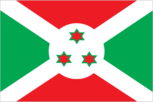
- divided by a white diagonal cross into red panels (top and bottom) and green panels (hoist side and fly side) with a white disk superimposed at the center bearing three red six-pointed stars outlined in green arranged in a triangular design (one star above, two stars below); green symbolizes hope and optimism, white purity and peace, and red the blood shed in the struggle for independence; the three stars in the disk represent the three major ethnic groups: Hutu, Twa, Tutsi, as well as the three elements in the national motto: unity, work, progress
- divided by a white diagonal cross into red panels (top and bottom) and green panels (hoist side and fly side) with a white disk superimposed at the center bearing three red six-pointed stars outlined in green arranged in a triangular design (one star abov
- Hutu, Twa, Tutsi, as well as the three elements in the national motto: unity, work, progress
Government type
presidential republic
Independence
1 July 1962 (from UN trusteeship under Belgian administration)
International law organization participation
has not submitted an ICJ jurisdiction declaration; accepts ICCt jurisdiction
International organization participation
ACP, AfDB, AU, CEMAC, CEPGL, CICA, COMESA, EAC, FAO, G-77, IBRD, ICAO, ICCt, ICRM, IDA, IFAD, IFC, IFRCS, ILO, IMF, Interpol, IOC, IOM, IPU, ISO (correspondent), ITU, ITUC (NGOs), MIGA, NAM, OIF, OPCW, UN, UNAMID, UNCTAD, UNESCO, UNIDO, UNISFA, UNWTO, UPU, WCO, WHO, WIPO, WMO, WTO
Judicial branch
- Supreme Court (consists of 9 judges and organized into judicial, administrative, and cassation chambers); Constitutional Court (consists of 7 members) Supreme Court judges nominated by the Judicial Service Commission, a 15-member independent body of judicial and legal profession officials), appointed by the president and confirmed by the Senate; judge tenure NA; Constitutional Court judges appointed by the president and confirmed by the Senate and serve 6-year nonrenewable terms Courts of Appeal; County Courts; Courts of Residence; Martial Court; Court Against Corruption; Commercial Court; Commerce Court
- highest court(s)
- Supreme Court (consists of 9 judges and organized into judicial, administrative, and cassation chambers); Constitutional Court (consists of 7 members)
- judge selection and term of office
- Supreme Court judges nominated by the Judicial Service Commission, a 15-member independent body of judicial and legal profession officials), appointed by the president and confirmed by the Senate; judge tenure NA; Constitutional Court judges appointed by the president and confirmed by the Senate and serve 6-year nonrenewable terms
- subordinate courts
- Courts of Appeal; County Courts; Courts of Residence; Martial Court; Court Against Corruption; Commercial Court; Commerce Court
Legal system
mixed legal system of Belgian civil law and customary law
Legislative branch
- bicameral Parliament or Parlement consists of the Senate or Inama Nkenguzamateka (43 seats in the July 2015 election; 36 members indirectly elected by an electoral college of provincial councils using a three-round voting system, which requires a two-thirds majority vote in the first two rounds and a simple majority vote for the two leading candidates in the final round; 4 seats reserved for former heads of state, 3 seats reserved for Twas, and 30% of all votes reserved for women; members serve 5-year terms) and the National Assembly or Inama Nshingamateka (121 seats in the June 2015 election; 100 members directly elected in multi-seat constituencies by proportional representation vote and 21 co-opted members – 3 seats reserved for Twas and 30% of total seats reserved for women; members serve 5-year terms) Senate - last held on 24 July 2015 (next to be held in 2019); National Assembly - last held on 29 June 2015 (next to be held in 2020) Senate - percent of vote by party - NA; seats by party - CNDD-FDD 33, FRODEBU 2, CNDD 1, former heads of state 4, Twas 3, women 8; National Assembly - percent of vote by party (provisional results) - CNDD-FDD 60.3%, Independents of Hope 11.2%, UPRONA 2.5%, other 26%; seats by party - CNDD-FDD 77, Independents of Hope 21, UPRONA 2, women 18, Twas 3
- description
- bicameral Parliament or Parlement consists of the Senate or Inama Nkenguzamateka (43 seats in the July 2015 election; 36 members indirectly elected by an electoral college of provincial councils using a three-round voting system, which requires a two-thirds majority vote in the first two rounds and a simple majority vote for the two leading candidates in the final round; 4 seats reserved for former heads of state, 3 seats reserved for Twas, and 30% of all votes reserved for women; members serve 5-year terms) and the National Assembly or Inama Nshingamateka (121 seats in the June 2015 election; 100 members directly elected in multi-seat constituencies by proportional representation vote and 21 co-opted members – 3 seats reserved for Twas and 30% of total seats reserved for women; members serve 5-year terms)
- election results
- Senate - percent of vote by party - NA; seats by party - CNDD-FDD 33, FRODEBU 2, CNDD 1, former heads of state 4, Twas 3, women 8; National Assembly - percent of vote by party (provisional results) - CNDD-FDD 60.3%, Independents of Hope 11.2%, UPRONA 2.5%, other 26%; seats by party - CNDD-FDD 77, Independents of Hope 21, UPRONA 2, women 18, Twas 3
- elections
- Senate - last held on 24 July 2015 (next to be held in 2019); National Assembly - last held on 29 June 2015 (next to be held in 2020)
National anthem
- "Burundi Bwacu" (Our Beloved Burundi) Jean-Baptiste NTAHOKAJA/Marc BARENGAYABO adopted 1962
- lyrics/music
- Jean-Baptiste NTAHOKAJA/Marc BARENGAYABO
- name
- "Burundi Bwacu" (Our Beloved Burundi)
- note
- adopted 1962
National holiday
Independence Day, 1 July (1962)
National symbol(s)
- lion; national colors: red, white, green
- lion; national colors
- red, white, green
Political parties and leaders
Front for Democracy in Burundi or FRODEBU [Keffa NIBIZI] Independents of Hope (Amizero y'Abarundi) [Agathon RWASA and Charles NDITIJE] Movement for Solidarity and Development or MSD [Alexis SINDUHUE] National Council for the Defense of Democracy - Front for the Defense of Democracy or CNDD-FDD [Evariste NDAYISHIMIYE] National Liberation Forces or FNL [Jacques BIGITIMANA] Union for National Progress (Union pour le Progress Nationale) or UPRONA [Abel GASHATSI]
Political pressure groups and leaders
Forum for the Strengthening of Civil Society or FORSC (civil society umbrella organization) [Vital NSHMIRIMANA]
Suffrage
18 years of age; universal
Economy
Agriculture - products
coffee, cotton, tea, corn, beans, sorghum, sweet potatoes, bananas, cassava (manioc, tapioca); beef, milk, hides
Budget
- $528.4 million $669.6 million (2016 est.)
- expenditures
- $669.6 million (2016 est.)
- revenues
- $528.4 million
Budget surplus (+) or deficit (-)
-4.5% of GDP (2016 est.)
Central bank discount rate
11.25% (31 December 2010) 10% (31 December 2009)
Commercial bank prime lending rate
14.24% (31 December 2016 est.) 15.33% (31 December 2015 est.)
Current account balance
$-411 million (2016 est.) $-374.7 million (2015 est.)
Debt - external
$622.4 million (31 December 2016 est.) $626 million (31 December 2015 est.)
Distribution of family income - Gini index
42.4 (1998)
Economy - overview
Burundi is a landlocked, resource-poor country with an underdeveloped manufacturing sector. Agriculture accounts for over 40% of GDP and employs more than 90% of the population. Burundi's primary exports are coffee and tea, which account for more than 60% of foreign exchange earnings. Thus, Burundi's export earnings - and its ability to pay for imports - rest primarily on favorable weather conditions and international coffee and tea prices, although exports are a relatively small share of GDP. Burundi is heavily dependent on aid from bilateral and multilateral donors. Foreign aid represented 48% of Burundi's national income in 2015, one of the highest percentages in Sub-Saharan Africa, but decreased to 33.5% in 2016. Burundi joined the East African Community (EAC) in 2009. The 1993-2005 civil war resulted in more than 200,000 deaths, forced more than 48,000 refugees into Tanzania, and displaced 140,000 others internally. Political stability, aid flows, and economic activity improved following the war’s end, but underlying weaknesses – low governmental capacity, a high poverty rate, poor educational levels, a weak legal system, a poor transportation network, and overburdened utilities – have prevented the implementation of planned economic reforms. Government corruption has also hindered the development of a private sector. The purchasing power of most Burundians has decreased as wage increases have not kept pace with inflation. In 2015, Burundi’s economy suffered from political turmoil, including street protests and an attempted coup, following President NKURUNZIZA’s controversial announcement that he would run for a third term. Insecurity and refugee flows to neighboring countries slowed down economic activity and donors withdrew aid, increasing Burundi’s budget deficit and decreasing hard currency reserves. Real GDP growth dropped precipitously and has yet to recover to pre-conflict levels.
Exchange rates
Burundi francs (BIF) per US dollar - 1,654.63 (2016 est.) 1,654.63 (2015 est.) 1,571.9 (2014 est.) 1,546.7 (2013 est.) 1,442.51 (2012 est.)
Exports
$109.7 million (2016 est.) $120.8 million (2015 est.)
Exports - commodities
coffee, tea, sugar, cotton, hides
Exports - partners
Democratic Republic of the Congo 30.6%, UAE 15.7%, Kenya 14.5%, Rwanda 7.2% (2016)
Fiscal year
calendar year
GDP - composition, by end use
- 87.3% 21.5% 16.9% 0% 6.2% -31.9% (2016 est.)
- exports of goods and services
- 6.2%
- government consumption
- 21.5%
- household consumption
- 87.3%
- imports of goods and services
- -31.9% (2016 est.)
- investment in fixed capital
- 16.9%
- investment in inventories
- 0%
GDP - composition, by sector of origin
- 39.8% 16.6% 43.7% (2016 est.)
- agriculture
- 39.8%
- industry
- 16.6%
- services
- 43.7% (2016 est.)
GDP - per capita (PPP)
- $800 (2016 est.) $800 (2015 est.) $900 (2014 est.) data are in 2016 dollars
- note
- data are in 2016 dollars
GDP - real growth rate
-1% (2016 est.) -4% (2015 est.) 4.5% (2014 est.)
GDP (official exchange rate)
$3.138 billion (2016 est.)
GDP (purchasing power parity)
- $7.849 billion (2016 est.) $7.831 billion (2015 est.) $8.066 billion (2014 est.) data are in 2016 dollars
- note
- data are in 2016 dollars
Gross national saving
-4.1% of GDP (2016 est.) -6.7% of GDP (2015 est.) -3.4% of GDP (2014 est.)
Household income or consumption by percentage share
- 4.1% 28% (2006)
- highest 10%
- 28% (2006)
- lowest 10%
- 4.1%
Imports
$509.4 million (2016 est.) $595.9 million (2015 est.)
Imports - commodities
capital goods, petroleum products, foodstuffs
Imports - partners
China 13.3%, India 13%, Tanzania 8.6%, Saudi Arabia 7.9%, Kenya 7.5%, UAE 5.2%, Uganda 5% (2016)
Industrial production growth rate
-7.1% (2016 est.)
Industries
light consumer goods (sugar, shoes, soap, beer); cement, assembly of imported components; public works construction; food processing (fruits)
Inflation rate (consumer prices)
5.5% (2016 est.) 5.5% (2015 est.)
Labor force
4.842 million (2016 est.)
Labor force - by occupation
- 93.6% 2.3% 4.1% (2002 est.)
- agriculture
- 93.6%
- industry
- 2.3%
- services
- 4.1% (2002 est.)
Market value of publicly traded shares
$NA
Population below poverty line
64.6% (2014 est.)
Public debt
43.4% of GDP (2016 est.) 39.6% of GDP (2015 est.)
Reserves of foreign exchange and gold
$95.17 million (31 December 2016 est.) $136.2 million (31 December 2015 est.)
Stock of broad money
$612.8 million (31 December 2016 est.) $571.2 million (31 December 2015 est.)
Stock of domestic credit
$955.1 million (31 December 2016 est.) $851.3 million (31 December 2015 est.)
Stock of narrow money
$456.3 million (31 December 2016 est.) $397.7 million (31 December 2015 est.)
Taxes and other revenues
16.9% of GDP (2016 est.)
Unemployment rate
NA%
Energy
Carbon dioxide emissions from consumption of energy
300,000 Mt (2013 est.)
Crude oil - exports
0 bbl/day (2014 est.)
Crude oil - imports
0 bbl/day (2014 est.)
Crude oil - production
0 bbl/day (2016 est.)
Crude oil - proved reserves
0 bbl (1 January 2017 es)
Electricity - consumption
303.9 million kWh (2015 est.)
Electricity - exports
0 kWh (2016 est.)
Electricity - from fossil fuels
13.2% of total installed capacity (2015 est.)
Electricity - from hydroelectric plants
83.8% of total installed capacity (2015 est.)
Electricity - from nuclear fuels
0% of total installed capacity (2015 est.)
Electricity - from other renewable sources
4.4% of total installed capacity (2015 est.)
Electricity - imports
90 million kWh (2015 est.)
Electricity - installed generating capacity
68,000 kW (2015 est.)
Electricity - production
230 million kWh (2015 est.)
Electricity access
- 9,700,000 5% 28% 2% (2013)
- electrification - rural areas
- 2% (2013)
- electrification - total population
- 5%
- electrification - urban areas
- 28%
- population without electricity
- 9,700,000
Natural gas - consumption
0 cu m (2013 est.)
Natural gas - exports
0 cu m (2013 est.)
Natural gas - imports
0 cu m (2013 est.)
Natural gas - production
0 cu m (2013 est.)
Natural gas - proved reserves
0 cu m (1 January 2014 es)
Refined petroleum products - consumption
1,500 bbl/day (2015 est.)
Refined petroleum products - exports
0 bbl/day (2014 est.)
Refined petroleum products - imports
1,636 bbl/day (2014 est.)
Refined petroleum products - production
0 bbl/day (2014 est.)
Communications
Broadcast media
state-controlled Radio Television Nationale de Burundi (RTNB) operates a TV station and a national radio network; 3 private TV stations and about 10 privately owned radio stations; transmissions of several international broadcasters are available in Bujumbura (2017)
Internet country code
.bi
Internet users
- 574,236 5.2% (July 2016 est.)
- percent of population
- 5.2% (July 2016 est.)
- total
- 574,236
Telephone system
- sparse system of open-wire, radiotelephone communications, and low-capacity microwave radio relays telephone density one of the lowest in the world; fixed-line connections stand at well less than 1 per 100 persons; mobile-cellular usage is approaching 50 per 100 persons country code - 257; satellite earth station - 1 Intelsat (Indian Ocean) (2016)
- domestic
- telephone density one of the lowest in the world; fixed-line connections stand at well less than 1 per 100 persons; mobile-cellular usage is approaching 50 per 100 persons
- general assessment
- sparse system of open-wire, radiotelephone communications, and low-capacity microwave radio relays
- international
- country code - 257; satellite earth station - 1 Intelsat (Indian Ocean) (2016)
Telephones - fixed lines
- 19,540 less than 1 (July 2016 est.)
- subscriptions per 100 inhabitants
- less than 1 (July 2016 est.)
- total subscriptions
- 19,540
Telephones - mobile cellular
- 5,357,816 48 (July 2016 est.)
- subscriptions per 100 inhabitants
- 48 (July 2016 est.)
- total
- 5,357,816
Transportation
Airports
7 (2013)
Airports - with paved runways
- 1 (2017)
- over 3,047 m
- 1 (2017)
- total
- 1
Airports - with unpaved runways
- 2 (2013)
- 914 to 1,523 m
- 4
- total
- 6
- under 914 m
- 2 (2013)
Civil aircraft registration country code prefix
9U (2016)
Heliports
1 (2012)
Ports and terminals
- Bujumbura (Lake Tanganyika)
- lake port(s)
- Bujumbura (Lake Tanganyika)
Roadways
- 12,322 km 1,500 km 10,822 km (2016)
- paved
- 1,500 km
- total
- 12,322 km
- unpaved
- 10,822 km (2016)
Waterways
(mainly on Lake Tanganyika between Bujumbura, Burundi's principal port, and lake ports in Tanzania, Zambia, and the Democratic Republic of the Congo) (2011)
Military and Security
Military branches
- National Defense Forces (Forces de Defense Nationale, FDN): Army (includes maritime wing, Air Wing), National Police (2017)
- National Defense Forces (Forces de Defense Nationale, FDN)
- Army (includes maritime wing, Air Wing), National Police (2017)
Military expenditures
2.21% of GDP (2016) 2.14% of GDP (2015) 2.01% of GDP (2014) 2.24% of GDP (2013) 2.39% of GDP (2012)
Military service age and obligation
- 18 years of age for voluntary military service; the armed forces law of 31 December 2004 did not specify a minimum age for enlistment, but the government claimed that no one younger than 18 was being recruited; mandatory retirement ages: 45 (enlisted), 50 (NCOs), 55 (officers), and 60 (officers with the rank of general) (2017)
- 18 years of age for voluntary military service; the armed forces law of 31 December 2004 did not specify a minimum age for enlistment, but the government claimed that no one younger than 18 was being recruited; mandatory retirement ages
- 45 (enlisted), 50 (NCOs), 55 (officers), and 60 (officers with the rank of general) (2017)
Transnational Issues
Disputes - international
Burundi and Rwanda dispute two sq km (0.8 sq mi) of Sabanerwa, a farmed area in the Rukurazi Valley where the Akanyaru/Kanyaru River shifted its course southward after heavy rains in 1965; cross-border conflicts persist among Tutsi, Hutu, other ethnic groups, associated political rebels, armed gangs, and various government forces in the Great Lakes region
Refugees and internally displaced persons
- 61,427 (Democratic Republic of the Congo) (2017) 187,626 (some ethnic Tutsis remain displaced from intercommunal violence that broke out after the 1993 coup and fighting between government forces and rebel groups; violence since April 2015) (2017) 974 (2016)
- IDPs
- 187,626 (some ethnic Tutsis remain displaced from intercommunal violence that broke out after the 1993 coup and fighting between government forces and rebel groups; violence since April 2015) (2017)
- refugees (country of origin)
- 61,427 (Democratic Republic of the Congo) (2017)
- stateless persons
- 974 (2016)
Trafficking in persons
- Burundi is a source country for children and possibly women subjected to forced labor and sex trafficking; business people recruit Burundian girls for prostitution domestically, as well as in Rwanda, Kenya, Uganda, and the Middle East, and recruit boys and girls for forced labor in Burundi and Tanzania; children and young adults are coerced into forced labor in farming, mining, informal commerce, fishing, or collecting river stones for construction; sometimes family, friends, and neighbors are complicit in exploiting children, at times luring them in with offers of educational or job opportunities Tier 3 – Burundi does not comply fully with the minimum standards for the elimination of human trafficking and is not making significant efforts to do so; corruption, a lack of political will, and limited resources continue to hamper efforts to combat human trafficking; in 2014, the government did not inform judicial and law enforcement officials of the enactment of an anti-trafficking law or how to implement it and approved – but did not fund – its national anti-trafficking action plan; authorities again failed to identify trafficking victims or to provide them with adequate protective services; the government has focused on transnational child trafficking but gave little attention to its domestic child trafficking problem and adult trafficking victims (2015)
- current situation
- Burundi is a source country for children and possibly women subjected to forced labor and sex trafficking; business people recruit Burundian girls for prostitution domestically, as well as in Rwanda, Kenya, Uganda, and the Middle East, and recruit boys and girls for forced labor in Burundi and Tanzania; children and young adults are coerced into forced labor in farming, mining, informal commerce, fishing, or collecting river stones for construction; sometimes family, friends, and neighbors are complicit in exploiting children, at times luring them in with offers of educational or job opportunities
- tier rating
- Tier 3 – Burundi does not comply fully with the minimum standards for the elimination of human trafficking and is not making significant efforts to do so; corruption, a lack of political will, and limited resources continue to hamper efforts to combat human trafficking; in 2014, the government did not inform judicial and law enforcement officials of the enactment of an anti-trafficking law or how to implement it and approved – but did not fund – its national anti-trafficking action plan; authorities again failed to identify trafficking victims or to provide them with adequate protective services; the government has focused on transnational child trafficking but gave little attention to its domestic child trafficking problem and adult trafficking victims (2015)