2008 Edition
CIA World Factbook 2008 (Project Gutenberg)
Introduction
Background
Burundi's first democratically elected president was assassinated in October 1993 after only 100 days in office, triggering widespread ethnic violence between Hutu and Tutsi factions. More than 200,000 Burundians perished during the conflict that spanned almost a dozen years. Hundreds of thousands of Burundians were internally displaced or became refugees in neighboring countries. An internationally brokered power-sharing agreement between the Tutsi-dominated government and the Hutu rebels in 2003 paved the way for a transition process that led to an integrated defense force, established a new constitution in 2005, and elected a majority Hutu government in 2005. The new government, led by President Pierre NKURUNZIZA, signed a South African brokered ceasefire with the country's last rebel group in September of 2006 but still faces many challenges.
Geography
Area
total: 27,830 sq km land: 25,650 sq km water: 2,180 sq km
Area - comparative
slightly smaller than Maryland
Climate
equatorial; high plateau with considerable altitude variation (772 m to 2,670 m above sea level); average annual temperature varies with altitude from 23 to 17 degrees centigrade but is generally moderate as the average altitude is about 1,700 m; average annual rainfall is about 150 cm; two wet seasons (February to May and September to November), and two dry seasons (June to August and December to January)
Coastline
0 km (landlocked)
Elevation extremes
lowest point: Lake Tanganyika 772 m highest point: Heha 2,670 m
Environment - current issues
soil erosion as a result of overgrazing and the expansion of agriculture into marginal lands; deforestation (little forested land remains because of uncontrolled cutting of trees for fuel); habitat loss threatens wildlife populations
Environment - international agreements
party to: Biodiversity, Climate Change, Climate Change-Kyoto Protocol, Desertification, Endangered Species, Hazardous Wastes, Ozone Layer Protection, Wetlands signed, but not ratified: Law of the Sea
Freshwater withdrawal (domestic/industrial/agricultural)
total: 0.29 cu km/yr (17%/6%/77%) per capita: 38 cu m/yr (2000)
Geographic coordinates
3 30 S, 30 00 E
Geography - note
landlocked; straddles crest of the Nile-Congo watershed; the Kagera, which drains into Lake Victoria, is the most remote headstream of the White Nile
Irrigated land
210 sq km (2003)
Land boundaries
total: 974 km border countries: Democratic Republic of the Congo 233 km, Rwanda 290 km, Tanzania 451 km
Land use
arable land: 35.57% permanent crops: 13.12% other: 51.31% (2005)
Location
Central Africa, east of Democratic Republic of the Congo
Map references
Africa
Maritime claims
none (landlocked)
Natural hazards
flooding, landslides, drought
Natural resources
nickel, uranium, rare earth oxides, peat, cobalt, copper, platinum, vanadium, arable land, hydropower, niobium, tantalum, gold, tin, tungsten, kaolin, limestone
Terrain
hilly and mountainous, dropping to a plateau in east, some plains
Total renewable water resources
3.6 cu km (1987)
People and Society
Age structure
0-14 years: 46.3% (male 2,021,320/female 1,998,502) 15-64 years: 51.2% (male 2,210,157/female 2,240,921) 65 years and over: 2.5% (male 87,600/female 132,505) (2008 est.)
Birth rate
41.72 births/1,000 population (2008 est.)
Death rate
12.91 deaths/1,000 population (2008 est.)
Education expenditures
5.1% of GDP (2005)
Ethnic groups
Hutu (Bantu) 85%, Tutsi (Hamitic) 14%, Twa (Pygmy) 1%, Europeans 3,000, South Asians 2,000
HIV/AIDS - adult prevalence rate
6% (2003 est.)
HIV/AIDS - deaths
25,000 (2003 est.)
HIV/AIDS - people living with HIV/AIDS
250,000 (2003 est.)
Infant mortality rate
total: 60.77 deaths/1,000 live births male: 67.6 deaths/1,000 live births female: 53.73 deaths/1,000 live births (2008 est.)
Languages
Kirundi (official), French (official), Swahili (along Lake Tanganyika and in the Bujumbura area)
Life expectancy at birth
total population: 51.71 years male: 50.86 years female: 52.6 years (2008 est.)
Literacy
definition: age 15 and over can read and write total population: 59.3% male: 67.3% female: 52.2% (2000 est.)
Major infectious diseases
degree of risk: very high food or waterborne diseases: bacterial and protozoal diarrhea, hepatitis A, and typhoid fever vectorborne disease: malaria (2008)
Median age
total: 16.7 years male: 16.4 years female: 17 years (2008 est.)
Nationality
noun: Burundian(s) adjective: Burundian
Net migration rate
5.62 migrant(s)/1,000 population (2008 est.)
Population
8,691,005 note: estimates for this country explicitly take into account the effects of excess mortality due to AIDS; this can result in lower life expectancy, higher infant mortality, higher death rates, lower population growth rates, and changes in the distribution of population by age and sex than would otherwise be expected (July 2008 est.)
Population growth rate
3.443% (2008 est.)
Religions
Christian 67% (Roman Catholic 62%, Protestant 5%), indigenous beliefs 23%, Muslim 10%
School life expectancy (primary to tertiary education)
total: 7 years male: 8 years female: 7 years (2006)
Sex ratio
at birth: 1.03 male(s)/female under 15 years: 1.01 male(s)/female 15-64 years: 0.99 male(s)/female 65 years and over: 0.66 male(s)/female total population: 0.99 male(s)/female (2008 est.)
Total fertility rate
6.4 children born/woman (2008 est.)
Government
Administrative divisions
17 provinces; Bubanza, Bujumbura Mairie, Bujumbura Rurale, Bururi, Cankuzo, Cibitoke, Gitega, Karuzi, Kayanza, Kirundo, Makamba, Muramvya, Muyinga, Mwaro, Ngozi, Rutana, Ruyigi
Capital
name: Bujumbura geographic coordinates: 3 22 S, 29 21 E time difference: UTC+2 (7 hours ahead of Washington, DC during Standard Time)
Constitution
28 February 2005; ratified by popular referendum
Country name
conventional long form: Republic of Burundi conventional short form: Burundi local long form: Republique du Burundi/Republika y'u Burundi local short form: Burundi former: Urundi
Diplomatic representation from the US
chief of mission: Ambassador Patricia Newton MOLLER embassy: Avenue des Etats-Unis, Bujumbura mailing address: B. P. 1720, Bujumbura telephone: [257] 223454
Diplomatic representation in the US
chief of mission: Ambassador Celestin NIYONGABO chancery: Suite 212, 2233 Wisconsin Avenue NW, Washington, DC 20007 telephone: [1] (202) 342-2574
Executive branch
chief of state: President Pierre NKURUNZIZA (since 26 August 2005); First Vice President Yves SAVINGUVU - Tutsi (since 9 November 2007); Second Vice President Gabriel NTISEZERANA - Hutu (since 9 February 2007); note - the president is both the chief of state and head of
FAX
- [1] (202) 342-2578
- [257] 222926
Flag description
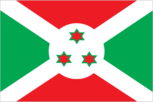
divided by a white diagonal cross into red panels (top and bottom) and green panels (hoist side and fly side) with a white disk superimposed at the center bearing three red six-pointed stars outlined in green arranged in a triangular design (one star above, two stars below)
Government type
republic
Independence
1 July 1962 (from UN trusteeship under Belgian administration)
International organization participation
ACCT, ACP, AfDB, AU, CEPGL, COMESA, EAC, FAO, G-77, IBRD, ICAO, ICCt, ICRM, IDA, IFAD, IFC, IFRCS, ILO, IMF, Interpol, IOC, IOM, IPU, ISO (subscriber), ITU, ITUC, MIGA, NAM, OIF, OPCW, UN, UNAMID, UNCTAD, UNESCO, UNIDO, UNWTO, UPU, WCO, WFTU, WHO, WIPO, WMO, WTO
Judicial branch
Supreme Court or Cour Supreme; Constitutional Court; High Court of Justice (composed of the Supreme Court and the Constitutional Court)
Legal system
based on German and Belgian civil codes and customary law; has not accepted compulsory ICJ jurisdiction
Legislative branch
bicameral Parliament or Parlement, consists of a National Assembly or Assemblee Nationale (minimum 100 seats, 60% Hutu and 40% Tutsi with at least 30% being women; additional seats appointed by a National Independent Electoral Commission to ensure ethnic representation; members are elected by popular vote to serve five-year terms) and a Senate (54 seats; 34 members elected by indirect vote to serve five-year terms, with remaining seats assigned to ethnic groups and former chiefs of state) elections: National Assembly - last held 4 July 2005 (next to be held in 2010); Senate - last held 29 July 2005 (next to be held in 2010) election results: National Assembly - percent of vote by party - CNDD-FDD 58.6%, FRODEBU 21.7%, UPRONA 7.2%, CNDD 4.1%, MRC-Rurenzangemero 2.1%, others 6.2%; seats by party - CNDD-FDD 59, FRODEBU 25, UPRONA 10, CNDD 4, MRC-Rurenzangemero 2; Senate - percent of vote by party - NA%; seats by party - CNDD-FDD 30, FRODEBU 3, CNDD 1
National holiday
Independence Day, 1 July (1962)
Political parties and leaders
governing parties: Burundi Democratic Front or FRODEBU [Leonce NGENDAKUMANA]; National Council for the Defense of Democracy - Front for the Defense of Democracy or CNDD-FDD [Jeremie NGENDAKUMANA]; Unity for National Progress or UPRONA [Aloys RUBUKA] note: a multiparty system was introduced after 1998, included are: National Council for the Defense of Democracy or CNDD [Leonard NYANGOMA]; National Resistance Movement for the Rehabilitation of the Citizen or MRC-Rurenzangemero [Epitace BANYAGANAKANDI]; Party for National Redress or PARENA [Jean-Baptiste BAGAZA]
Political pressure groups and leaders
Observatoire de lutte contre la corruption et les malversations economiques or OLUCOME [Gabriel RUFYIRI] (anti-corruption pressure group) other: Hutu and Tutsi militias (loosely organized)
Suffrage
NA years of age; universal (adult)
Economy
Agriculture - products
coffee, cotton, tea, corn, sorghum, sweet potatoes, bananas, manioc (tapioca); beef, milk, hides
Budget
revenues: $264.2 million expenditures: $335.4 million; including capital expenditures of $NA (2007 est.)
Central bank discount rate
10.12% (31 December 2007)
Commercial bank prime lending rate
16.84% (31 December 2007)
Currency (code)
Burundi franc (BIF)
Currency code
BIF
Current account balance
-$101 million (2007 est.)
Debt - external
$1.2 billion (2003)
Distribution of family income - Gini index
42.4 (1998)
Economic aid - recipient
$365 million (2005)
Economy - overview
Burundi is a landlocked, resource-poor country with an underdeveloped manufacturing sector. The economy is predominantly agricultural with more than 90% of the population dependent on subsistence agriculture. Economic growth depends on coffee and tea exports, which account for 90% of foreign exchange earnings. The ability to pay for imports, therefore, rests primarily on weather conditions and international coffee and tea prices. The Tutsi minority, 14% of the population, dominates the government and the coffee trade at the expense of the Hutu majority, 85% of the population. An ethnic-based war that lasted for over a decade resulted in more than 200,000 deaths, forced more than 48,000 refugees into Tanzania, and displaced 140,000 others internally. Only one in two children go to school, and approximately one in 15 adults has HIV/AIDS. Food, medicine, and electricity remain in short supply. Burundi's GDP grew around 5% annually in 2006-07. Political stability and the end of the civil war have improved aid flows and economic activity has increased, but underlying weaknesses - a high poverty rate, poor education rates, a weak legal system, and low administrative capacity - risk undermining planned economic reforms. Burundi will continue to remain heavily dependent on aid from bilateral and multilateral donors; the delay of funds after a corruption scandal cut off bilateral aid in 2007 reduced government's revenues and its ability to pay salaries.
Electricity - consumption
120.9 million kWh (2006 est.)
Electricity - exports
0 kWh (2007 est.)
Electricity - imports
40 million kWh; note - supplied by the Democratic Republic of the Congo (2007 est.)
Electricity - production
87 million kWh (2006 est.)
Electricity - production by source
fossil fuel: 0.6% hydro: 99.4% nuclear: 0% other: 0% (2001)
Exchange rates
Burundi francs (BIF) per US dollar - 1,065 (2007), 1,030 (2006), 1,138 (2005), 1,100.91 (2004), 1,082.62 (2003)
Exports
$44 million f.o.b. (2007 est.)
Exports - commodities
coffee, tea, sugar, cotton, hides
Exports - partners
Germany 31.3%, Pakistan 6.8%, Belgium 5.8%, Sweden 4.3%, Rwanda 4.3%, France 4.2%, Sudan 4% (2007)
Fiscal year
calendar year
GDP - composition by sector
agriculture: 33.7% industry: 20.9% services: 45.4% (2007 est.)
GDP - per capita (PPP)
$300 (2007 est.)
GDP - real growth rate
3.6% (2007 est.)
GDP (official exchange rate)
$1.001 billion (2007 est.)
GDP (purchasing power parity)
$2.907 billion (2007 est.)
Household income or consumption by percentage share
lowest 10%: 1.7% highest 10%: 32.8% (1998)
Imports
$272 million f.o.b. (2007 est.)
Imports - commodities
capital goods, petroleum products, foodstuffs
Imports - partners
Saudi Arabia 17%, Kenya 11.4%, Belgium 8.7%, France 6.1%, Uganda 5.4%, Germany 5.4%, India 4.8%, Pakistan 4.2% (2007)
Industrial production growth rate
6.4% (2007 est.)
Industries
light consumer goods such as blankets, shoes, soap; assembly of imported components; public works construction; food processing
Inflation rate (consumer prices)
8.3% (2007 est.)
Investment (gross fixed)
24.4% of GDP (2007 est.)
Labor force
2.99 million (2002)
Labor force - by occupation
agriculture: 93.6% industry: 2.3% services: 4.1% (2002 est.)
Market value of publicly traded shares
$NA
Natural gas - consumption
0 cu m (2007 est.)
Natural gas - exports
0 cu m (2007 est.)
Natural gas - imports
0 cu m (2007 est.)
Natural gas - production
0 cu m (2007 est.)
Natural gas - proved reserves
0 cu m (1 January 2006 est.)
Oil - consumption
2,956 bbl/day (2006 est.)
Oil - exports
0 bbl/day (2005)
Oil - imports
2,635 bbl/day (2005)
Oil - production
0 bbl/day (2007 est.)
Oil - proved reserves
0 bbl (1 January 2006 est.)
Population below poverty line
68% (2002 est.)
Reserves of foreign exchange and gold
$177.1 million (31 December 2007 est.)
Stock of domestic credit
$342 million (31 December 2007)
Stock of money
$208.7 million (31 December 2007)
Stock of quasi money
$141 million (31 December 2007)
Unemployment rate
NA%
Communications
Internet country code
.bi
Internet hosts
162 (2008)
Internet Service Providers (ISPs)
1 (2000)
Internet users
60,000 (2006)
Radio broadcast stations
AM 0, FM 4, shortwave 1 (2001)
Radios
440,000 (2001)
Telephone system
general assessment: primitive system; telephone density one of the lowest in the world; fixed-line connections stand at well less than 1 per 100 persons; mobile-cellular usage is increasing but remains at a meager 3 per 100 persons domestic: sparse system of open-wire, radiotelephone communications, and low-capacity microwave radio relay international: country code - 257; satellite earth station - 1 Intelsat (Indian Ocean) (2007)
Telephones - main lines in use
35,000 (2006)
Telephones - mobile cellular
250,000 (2007)
Television broadcast stations
1 (2001)
Televisions
25,000 (1997)
Transportation
Airports
8 (2007)
Airports - with paved runways
total: 1 over 3,047 m: 1 (2007)
Airports - with unpaved runways
total: 7 914 to 1,523 m: 4 under 914 m: 3 (2007)
Heliports
1 (2007)
Ports and terminals
Bujumbura
Roadways
total: 12,322 km paved: 1,286 km unpaved: 11,036 km (2004)
Waterways
mainly on Lake Tanganyika (2005)
Military and Security
Manpower available for military service
males age 16-49: 1,878,544 females age 16-49: 1,851,676 (2008 est.)
Manpower fit for military service
males age 16-49: 1,083,899 females age 16-49: 1,062,488 (2008 est.)
Manpower reaching militarily significant age annually
male: 98,105 female: 98,533 (2008 est.)
Military expenditures
5.9% of GDP (2006 est.)
Military service age and obligation
16 years of age for compulsory and voluntary military service; children as young as 10 years of age have been conscripted into the armed forces; the enrollment of children is still not prohibited (2007)
National Defense Force (Forces de Defense Nationales, FDN)
Army (includes Naval Detachment and Air Wing), Gendarmerie (2008)
Transnational Issues
Disputes - international
Burundi and Rwanda dispute sections of border on the Akanyaru/Kanyaru and the Kagera/Nyabarongo rivers, which have changed course since the 1960s, when the boundary was delimited; cross-border conflicts among Tutsi, Hutu, other ethnic groups, associated political rebels, armed gangs, and various government forces persist in the Great Lakes region
IDPs
100,000 (armed conflict between government and rebels; most IDPs in northern and western Burundi) (2007)
Refugees and internally displaced persons
refugees (country of origin): 9,849 (Democratic Republic of the Congo)
Trafficking in persons
current situation: Burundi is a source country for children trafficked for the purposes of child soldiering, domestic servitude, and commercial sexual exploitation; a small number of Burundian children may be trafficked internally for domestic servitude or commercial sexual exploitation; in early 2008, Burundian children were allegedly trafficked to Uganda, via Rwanda, for agricultural labor and commercial sexual exploitation tier rating: Tier 2 Watch List - Burundi is on the Tier 2 Watch List for the second consecutive year for its failure to provide sufficient evidence of increasing efforts to combat trafficking in persons in 2007; the government's inability to provide adequate protective services to children accused of association with armed groups and to conduct anti-trafficking law enforcement activities continue to be causes for concern; Burundi has not ratified the 2000 UN TIP Protocol (2008) This page was last updated on 18 December, 2008