2003 Edition
CIA World Factbook 2003 (Project Gutenberg)
Introduction
Administrative divisions
16 provinces; Bubanza, Bujumbura, Bururi, Cankuzo, Cibitoke, Gitega, Karuzi, Kayanza, Kirundo, Makamba, Muramvya, Muyinga, Mwaro, Ngozi, Rutana, Ruyigi
Age structure
0-14 years: 46.7% (male 1,438,759; female 1,409,567) 15-64 years: 50.6% (male 1,516,833; female 1,564,513) 65 years and over: 2.7% (male 66,355; female 100,129) (2003 est.)
Agriculture - products
coffee, cotton, tea, corn, sorghum, sweet potatoes, bananas, manioc (tapioca); beef, milk, hides
Airports
7 (2002)
Airports - with paved runways
- over 3,047 m
- 1 (2002)
- total
- 1
Airports - with unpaved runways
- total
- 6 914 to 1,523 m: 3
- under 914 m
- 3 (2002) Military Burundi
Area
- land
- 25,650 sq km
- total
- 27,830 sq km
- water
- 2,180 sq km
Area - comparative
slightly smaller than Maryland
Background
Burundi's first democratically elected president was assassinated in October 1993 after only four months in office. Since then, some 200,000 Burundians have perished in widespread, often intense ethnic violence between Hutu and Tutsi factions. Hundreds of thousands have been internally displaced or have become refugees in neighboring countries. Burundi troops, seeking to secure their borders, intervened in the conflict in the Democratic Republic of the Congo in 1998. More recently, many of these troops have been redeployed back to Burundi to deal with periodic upsurges in rebel activity. A new transitional government, inaugurated on 1 November 2001, was to be the first step toward holding national elections in three years. While the Government of Burundi signed a cease-fire agreement in December 2002 with three of Burundi's four Hutu rebel groups, implementation of the agreement has been problematic and one rebel group refuses to sign on, clouding prospects for a sustainable peace. Geography Burundi
Birth rate
39.72 births/1,000 population (2003 est.)
Budget
- expenditures
- $176 million, including capital expenditures of $NA (2000 est.)
- revenues
- $125 million
Capital
Bujumbura
Climate
equatorial; high plateau with considerable altitude variation (772 m to 2,670 m above sea level); average annual temperature varies with altitude from 23 to 17 degrees centigrade but is generally moderate as the average altitude is about 1,700 m; average annual rainfall is about 150 cm; wet seasons from February to May and September to November, and dry seasons from June to August and December to January
Coastline
0 km (landlocked)
Constitution
13 March 1992; provided for establishment of a plural political system; supplanted on 6 June 1998 by a Transitional Constitution which enlarged the National Assembly and created two vice presidents
Country name
- conventional long form
- Republic of Burundi
- conventional short form
- Burundi
- former
- Urundi
- local long form
- Republika y'u Burundi
- local short form
- Burundi
Currency
Burundi franc (BIF)
Currency code
BIF
Death rate
17.8 deaths/1,000 population (2003 est.)
Debt - external
$1.14 billion (2001)
Diplomatic representation from the US
- chief of mission
- Ambassador James Howard YELLIN
- embassy
- Avenue des Etats-Unis, Bujumbura
- mailing address
- B. P. 1720, Bujumbura
- telephone
- [257] 223454
Diplomatic representation in the US
- chancery
- Suite 212, 2233 Wisconsin Avenue NW, Washington, DC 20007
- chief of mission
- Ambassador Antoine NTAMOBWA
Disputes - international
Tutsi, Hutu, and other conflicting ethnic groups, associated political rebels, armed gangs, and various government forces continue fighting in the Great Lakes region, transcending the boundaries of Burundi, Democratic Republic of the Congo, Rwanda, and Uganda to gain control over populated and natural resource areas; government heads pledge to end conflict, but localized violence continues despite UN peacekeeping efforts This page was last updated on 18 December, 2003
Distribution of family income - Gini index
42.5 (1998)
Economic aid - recipient
$92.7 million (2000)
Economy - overview
Burundi is a landlocked, resource-poor country with an underdeveloped manufacturing sector. The economy is predominantly agricultural with roughly 90% of the population dependent on subsistence agriculture. Economic growth depends on coffee and tea exports, which account for 90% of foreign exchange earnings. The ability to pay for imports, therefore, rests primarily on weather conditions and international coffee and tea prices. The Tutsi minority, 14% of the population, dominates the government and the coffee trade at the expense of the Hutu majority, 85% of the population. Since October 1993 an ethnic-based war has resulted in the death of over 200,000 persons, sent 800,000 refugees into Tanzania, and displaced 525,000 others internally. Doubts about the prospects for sustainable peace continue to impede development. Only one in two children go to school, and approximately one in ten adults has HIV/AIDS. Food, medicine, and electricity remain in short supply.
Electricity - consumption
177.5 million kWh (2001)
Electricity - exports
0 kWh (2001)
Electricity - imports
33 million kWh; note - supplied by the Democratic Republic of the Congo (2001)
Electricity - production
155.4 million kWh (2001)
Electricity - production by source
- fossil fuel
- 0.6%
- hydro
- 99.4%
- nuclear
- 0%
- other
- 0% (2001)
Elevation extremes
- highest point
- Mount Heha 2,670 m
- lowest point
- Lake Tanganyika 772 m
Environment - current issues
soil erosion as a result of overgrazing and the expansion of agriculture into marginal lands; deforestation (little forested land remains because of uncontrolled cutting of trees for fuel); habitat loss threatens wildlife populations
Environment - international agreements
- party to
- Biodiversity, Climate Change, Climate Change-Kyoto Protocol, Desertification, Endangered Species, Hazardous Wastes, Ozone Layer Protection
- signed, but not ratified
- Law of the Sea, Nuclear Test Ban
Ethnic groups
Hutu (Bantu) 85%, Tutsi (Hamitic) 14%, Twa (Pygmy) 1%, Europeans 3,000, South Asians 2,000
Exchange rates
Burundi francs per US dollar - NA (2002), 830.35 (2001), 720.67 (2000), 563.56 (1999), 447.77 (1998)
Executive branch
- cabinet
- Council of Ministers appointed by president
- chief of state
- President Domitien NDAYIZEYE (since 30 April 2003); note - NDAYIZEYE, a Hutu, was sworn in as president for the second half of the three-year transitional government inaugurated on 1 November 2001; Vice President Alphonse KADEGE (since 30 April 2003); note - from the Tutsi minority
- elections
- NA; current president assumed power on 30 April 2003 as part of the transitional government established by the 2000 Arusha Accord
- head of government
- President Domitien NDAYIZEYE (since 30 April 2003); note - NDAYIZEYE, a Hutu, was sworn in as president for the second half of the three-year transitional government inaugurated on 1 November 2001; Vice President Alphonse KADEGE (since 30 April 2003); note - from the Tutsi minority
Exports
$26 million f.o.b. (2002 est.)
Exports - commodities
coffee, tea, sugar, cotton, hides
Exports - partners
Switzerland 28.8%, Germany 20.2%, Belgium 9.4%, Kenya 7.8%, Rwanda 6.5%, Netherlands 4.6% (2002)
FAX
- [1] (202) 342-2578
- [257] 222926
- telephone
- [1] (202) 342-2574
Fiscal year
calendar year Communications Burundi
Flag description
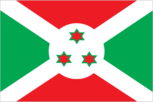
divided by a white diagonal cross into red panels (top and bottom) and green panels (hoist side and outer side) with a white disk superimposed at the center bearing three red six-pointed stars outlined in green arranged in a triangular design (one star above, two stars below) Economy Burundi
GDP
purchasing power parity - $3.146 billion (2002 est.)
GDP - composition by sector
- agriculture
- 50%
- industry
- 19%
- services
- 31% (2002 est.)
GDP - per capita
purchasing power parity - $500 (2002 est.)
GDP - real growth rate
4.5% (2002 est.)
Geographic coordinates
3 30 S, 30 00 E
Geography - note
landlocked; straddles crest of the Nile-Congo watershed; the Kagera, which drains into Lake Victoria, is the most remote headstream of the White Nile People Burundi
Government type
republic
Highways
- paved
- 1,028 km
- total
- 14,480 km
- unpaved
- 13,452 km (1999 est.)
HIV/AIDS - adult prevalence rate
8.3% (2001 est.)
HIV/AIDS - deaths
40,000 (2001 est.)
HIV/AIDS - people living with HIV/AIDS
390,000 (2001 est.)
Household income or consumption by percentage share
- highest 10%
- 32.9% (1998)
- lowest 10%
- 1.8%
Imports
$135 million f.o.b. (2002 est.)
Imports - commodities
capital goods, petroleum products, foodstuffs
Imports - partners
Belgium 12.4%, Saudi Arabia 12.3%, Tanzania 9.3%, Kenya 7.7%, France 7.4%, India 4.5% (2002)
Independence
1 July 1962 (from UN trusteeship under Belgian administration)
Industrial production growth rate
18% (2001)
Industries
light consumer goods such as blankets, shoes, soap; assembly of imported components; public works construction; food processing
Infant mortality rate
- female
- 64.42 deaths/1,000 live births (2003 est.)
- male
- 78.45 deaths/1,000 live births
- total
- 71.54 deaths/1,000 live births
Inflation rate (consumer prices)
12% (2002 est.)
International organization participation
ACCT, ACP, AfDB, CEEAC, CEPGL, ECA, FAO, G-77, IBRD, ICAO, ICCt (signatory), ICRM, IDA, IFAD, IFC, IFRCS, ILO, IMF, Interpol, IOC, IOM (observer), ISO (subscriber), ITU, NAM, OAU, OPCW, UN, UNCTAD, UNESCO, UNIDO, UPU, WCO, WHO, WIPO, WMO, WToO, WTrO
Internet country code
.bi
Internet Service Providers (ISPs)
1 (2000)
Internet users
6,000 (2002) Transportation Burundi
Irrigated land
740 sq km (1998 est.)
Judicial branch
Supreme Court or Cour Supreme; Constitutional Court; Courts of Appeal (there are three in separate locations); Tribunals of First Instance (17 at the province level and 123 small local tribunals)
Labor force
3.7 million (2000)
Labor force - by occupation
NA
Land boundaries
- border countries
- Democratic Republic of the Congo 233 km, Rwanda 290 km, Tanzania 451 km
- total
- 974 km
Land use
- arable land
- 29.98%
- other
- 57.17% (1998 est.)
- permanent crops
- 12.85%
Languages
Kirundi (official), French (official), Swahili (along Lake Tanganyika and in the Bujumbura area)
Legal system
based on German and Belgian civil codes and customary law; has not accepted compulsory ICJ jurisdiction
Legislative branch
- bicameral, consists of a National Assembly or Assemblee Nationale (expanded from 121 to approximately 140 seats under the transitional government inaugurated 1 November 2001; members are elected by popular vote to serve five-year terms) and a Senate (54 seats; term length is undefined, the current senators will likely serve out the three-year transition period)
- election results
- percent of vote by party - FRODEBU 71.04%, UPRONA 21.4%, other 7.56%; seats by party - FRODEBU 65, UPRONA 16, civilians 27, other parties 13
- elections
- last held 29 June 1993 (next was scheduled to be held in 1998, but was suspended by presidential decree in 1996; elections are planned to follow the completion of the three-year transitional government)
Life expectancy at birth
- female
- 43.88 years (2003 est.)
- male
- 42.54 years
- total population
- 43.2 years
Literacy
- definition
- age 15 and over can read and write
- female
- 45.2% (2003 est.) Government Burundi
- male
- 58.5%
- total population
- 51.6%
Location
Central Africa, east of Democratic Republic of the Congo
Map references
Africa
Maritime claims
none (landlocked)
Median age
- female
- 16.7 years (2002)
- male
- 15.9 years
- total
- 16.3 years
Military branches
Army (including naval and air units), Gendarmerie
Military expenditures - dollar figure
$42.13 million (FY02)
Military expenditures - percent of GDP
5.3% (FY02) Transnational Issues Burundi
Military manpower - availability
- males age 15-49
- 1,375,900 (2003 est.)
Military manpower - fit for military service
- males age 15-49
- 723,516 (2003 est.)
Military manpower - military age
16 years of age (2003 est.)
Military manpower - reaching military age annually
- males
- 79,462 (2003 est.)
National holiday
Independence Day, 1 July (1962)
Nationality
- adjective
- Burundian
- noun
- Burundian(s)
Natural hazards
flooding, landslides, drought
Natural resources
nickel, uranium, rare earth oxides, peat, cobalt, copper, platinum (not yet exploited), vanadium, arable land, hydropower
Net migration rate
-0.12 migrant(s)/1,000 population (2003 est.)
Oil - consumption
2,750 bbl/day (2001 est.)
Oil - exports
NA (2001)
Oil - imports
NA (2001)
Oil - production
0 bbl/day (2001 est.)
Political parties and leaders
- the two national, mainstream, governing parties are: Unity for National Progress or UPRONA [Alphonse KADEGE, president]; Burundi Democratic Front or FRODEBU [Jean MINANI, president]
- note
- a multiparty system was introduced after 1998, included are: Burundi African Alliance for the Salvation or ABASA [Terrence NSANZE]; Rally for Democracy and Economic and Social Development or RADDES [Joseph NZEYIMANA]; Party for National Redress or PARENA [Jean-Baptiste BAGAZA]; People's Reconciliation Party or PRP [Mathias HITIMANA]
Political pressure groups and leaders
loosely organized Hutu and Tutsi militias, often affiliated with Hutu and Tutsi extremist parties or subordinate to government security forces
Population
- 6,096,156
- note
- estimates for this country explicitly take into account the effects of excess mortality due to AIDS; this can result in lower life expectancy, higher infant mortality and death rates, lower population and growth rates, and changes in the distribution of population by age and sex than would otherwise be expected (July 2003 est.)
Population below poverty line
70% (2002 est.)
Population growth rate
2.18% (2003 est.)
Ports and harbors
Bujumbura
Radio broadcast stations
AM 0, FM 4, shortwave 1 (2001)
Radios
440,000 (2001)
Railways
0 km
Religions
Christian 67% (Roman Catholic 62%, Protestant 5%), indigenous beliefs 23%, Muslim 10%
Sex ratio
- at birth
- 1.03 male(s)/female
- total population
- 0.98 male(s)/female (2003 est.)
- under 15 years
- 1.02 male(s)/female 15-64 years: 0.97 male(s)/female 65 years and over: 0.66 male(s)/female
Suffrage
NA years of age; universal adult
Telephone system
- domestic
- sparse system of open-wire, radiotelephone communications, and low-capacity microwave radio relay
- general assessment
- primitive system
- international
- satellite earth station - 1 Intelsat (Indian Ocean)
Telephones - main lines in use
18,000 (2002)
Telephones - mobile cellular
30,000 (2002)
Television broadcast stations
1 (2001)
Televisions
25,000 (1997)
Terrain
hilly and mountainous, dropping to a plateau in east, some plains
Total fertility rate
5.99 children born/woman (2003 est.)
Unemployment rate
NA%
Waterways
Lake Tanganyika