1998 Edition
CIA World Factbook 1998 (Internet Archive)
Geography
Area
total: 27,830 sq km land: 25,650 sq km water: 2,180 sq km
Area-comparative
slightly smaller than Maryland
Climate
equatorial; high plateau with considerable altitude variation (772 m to 2,760 m); average annual temperature varies with altitude from 23 to 17 degrees centigrade but is generally moderate as the average altitude is about 1,700 m; average annual rainfall is about 150 cm; wet seasons from February to May and September to November, and dry seasons from June to August and December to January
Coastline
0 km (landlocked)
Elevation extremes
lowest point: Lake Tanganyika 772 m highest point: Mount Heha 2,760 m
Environment-current issues
soil erosion as a result of overgrazing and the expansion of agriculture into marginal lands; deforestation (little forested land remains because of uncontrolled cutting of trees for fuel); habitat loss threatens wildlife populations
Environment-international agreements
party to: Biodiversity, Climate Change, Desertification, Endangered Species, Hazardous Wastes, Ozone Layer Protection signed, but not ratified: Law of the Sea, Nuclear Test Ban
Geographic coordinates
3 30 S, 30 00 E
Geography-note
landlocked; straddles crest of the Nile-Congo watershed
Irrigated land
140 sq km (1993 est.)
Land boundaries
total: 974 km border countries: Democratic Republic of the Congo 233 km, Rwanda 290 km, Tanzania 451 km
Land use
arable land: 44% permanent crops: 9% permanent pastures: 36% forests and woodland: 3% other: 8% (1993 est.)
Location
Central Africa, east of Democratic Republic of the Congo
Map references
Africa
Maritime claims
none (landlocked)
Natural hazards
flooding, landslides
Natural resources
nickel, uranium, rare earth oxides, peat, cobalt, copper, platinum (not yet exploited), vanadium
Terrain
hilly and mountainous, dropping to a plateau in east, some plains
People and Society
Age structure
0-14 years: 47% (male 1,313,112; female 1,309,600) 15-64 years: 50% (male 1,331,336; female 1,417,228) 65 years and over: 3% (male 69,718; female 96,393) (July 1998 est.)
Birth rate
41.61 births/1,000 population (1998 est.)
Death rate
17.38 deaths/1,000 population (1998 est.)
Ethnic groups
Hutu (Bantu) 85%, Tutsi (Hamitic) 14%, Twa (Pygmy) 1%, Europeans 3,000, South Asians 2,000
Infant mortality rate
101.19 deaths/1,000 live births (1998 est.)
Languages
Kirundi (official), French (official), Swahili (along Lake Tanganyika and in the Bujumbura area)
Life expectancy at birth
total population: 45.56 years male: 43.79 years female: 47.38 years (1998 est.)
Literacy
definition: age 15 and over can read and write total population: 35.3% male: 49.3% female: 22.5% (1995 est.)
Nationality
noun: Burundian(s) adjective: Burundi
Net migration rate
10.84 migrant(s)/1,000 population (1998 est.)
Population
5,537,387 (July 1998 est.)
Population growth rate
3.51% (1998 est.)
Religions
Christian 67% (Roman Catholic 62%, Protestant 5%), indigenous beliefs 32%, Muslim 1%
Sex ratio
at birth: 1.03 male(s)/female under 15 years: 1 male(s)/female 15-64 years: 0.93 male(s)/female 65 years and over: 0.72 male(s)/female (1998 est.)
Total fertility rate
6.4 children born/woman (1998 est.)
Government
Administrative divisions
15 provinces; Bubanza, Bujumbura, Bururi, Cankuzo, Cibitoke, Gitega, Karuzi, Kayanza, Kirundo, Makamba, Muramvya, Muyinga, Ngozi, Rutana, Ruyigi
Constitution
13 March 1992; provides for establishment of a plural political system
Country name
conventional long form: Republic of Burundi conventional short form: Burundi local long form: Republika y'u Burundi local short form: Burundi
Data code
BY
Executive branch
chief of state: President Pierre BUYOYA (interim president since 27 September 1996); note-former President NTIBANTUNGANYA was overthrown in a coup on 25 July 1996 and took refuge for 11 months in the US ambassador's residence in Bujumbura; former Major (retired) Pierre BUYOYA has not been recognized as president of Burundi by the US or most other governments head of government: Prime Minister Pascal-Firmin NDIMIRA (since 31 July 1996) cabinet: Council of Ministers appointed by prime minister elections: NA
FAX
[257] (2) 222926
Flag description
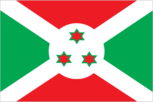
divided by a white diagonal cross into red panels (top and bottom) and green panels (hoist side and outer side) with a white disk superimposed at the center bearing three red six-pointed stars outlined in green arranged in a triangular design (one star above, two stars below)
Government type
republic
Independence
1 July 1962 (from UN trusteeship under Belgian administration)
International organization participation
ACCT, ACP, AfDB, CCC, CEEAC, CEPGL, ECA, FAO, G-77, IBRD, ICAO, ICRM, IDA, IFAD, IFC, IFRCS, ILO, IMF, Intelsat (nonsignatory user), Interpol, IOC, ITU, NAM, OAU, UN, UNCTAD, UNESCO, UNIDO, UPU, WHO, WIPO, WMO, WToO, WTrO Diplomatic representation in the US: chief of mission: Ambassador (vacant); Charge d'Affaires Henri SIMBAKWTRA chancery: Suite 212, 2233 Wisconsin Avenue NW, Washington, DC 20007 telephone: [1] (202) 342-2574 Diplomatic representation from the US: chief of mission: Ambassador Morris N. HUGHES, Jr. (27 June l996) embassy: Avenue des Etats-Unis, Bujumbura mailing address: B. P. 1720, Bujumbura telephone: [257] (2) 223454
Judicial branch
Supreme Court or Cour Supreme Political parties and leaders: Unity for National Progress or UPRONA [Charles MUKASI, president]; Burundi Democratic Front or FRODEBU [Jean MINANI, president]; Socialist Party of Burundi or PSB; People's Reconciliation Party or PRP [Mathias HITIMANA, leader]; opposition parties, legalized in March 1992, include Burundi African Alliance for the Salvation or ABASA; Rally for Democracy and Economic and Social Development or RADDES [Cyrille SIGEJEJE, chairman]; and Party for National Redress or PARENA [Jean-Baptiste BAGAZA, leader]
Legal system
based on German and Belgian civil codes and customary law; does not accept compulsory ICJ jurisdiction
Legislative branch
unicameral National Assembly or Assemblee Nationale (81 seats; members are popularly elected on a proportional basis to serve five-year terms) elections: last held 29 June 1993 (scheduled to be held in 1998, although no date has been set) election results: percent of vote by party-FRODEBU 71%, UPRONA 21.4%; seats by party - FRODEBU 65, UPRONA 16; other parties won too small shares of the vote to win seats in the assembly
National capital
Bujumbura
National holiday
Independence Day, 1 July (1962)
Suffrage
NA years of age; universal adult
Economy
Agriculture-products
coffee, cotton, tea, corn, sorghum, sweet potatoes, bananas, manioc (tapioca); meat, milk, hides
Budget
revenues: $222 million expenditures: $258 million, including capital expenditures of $92 million (1995 est.)
Currency
1 Burundi franc (FBu) = 100 centimes
Debt-external
$1.1 billion (1995 est.)
Economic aid
recipient: ODA, $NA
Economy-overview
Burundi is a landlocked, resource-poor country in an early stage of economic development. The economy is predominately agricultural with roughly 90% of the population dependent on subsistence agriculture. Its economic health depends on the coffee crop, which accounts for 80% of foreign exchange earnings. The ability to pay for imports therefore rests largely on the vagaries of the climate and the international coffee market. As part of its economic reform agenda, launched in February 1991 with IMF and World Bank support, Burundi is trying to diversify its agricultural exports, attract foreign investment in industry, and modernize government budgetary practices. Since October 1993 the nation has suffered from massive ethnic-based violence which has resulted in the death of perhaps 100,000 persons and the displacement of a million others. Foods, medicines, and electricity remain in short supply. An impoverished and disorganized government can hardly implement the needed reform programs.
Electricity-capacity
43,000 kW (1995)
Electricity-consumption per capita
32 kWh (1995)
Electricity-production
158 million kWh (1995) note: imports some electricity from Democratic Republic of the Congo
Exchange rates
Burundi francs (FBu) per US$1-412.59 (January 1998), 352.35 (1997), 302.75 (1996), 249.76 (1995), 252.66 (1994), 242.78 (1993)
Exports
total value: $40 million (f.o.b., 1996) commodities: coffee 81%, tea, cotton, hides partners: EU 60%, US 7%, Asia 1%
Fiscal year
calendar year Communications
GDP
purchasing power parity-$4 billion (1997 est.)
GDP-composition by sector
agriculture: 56% industry: 18% services: 26% (1995 est.)
GDP-per capita
purchasing power parity-$660 (1997 est.)
GDP-real growth rate
4.4% (1997 est.)
Imports
total value: $127 million (c.i.f., 1996) commodities: capital goods 26%, petroleum products, foodstuffs, consumer goods partners: EU 47%, Asia 25%, US 6%
Industrial production growth rate
NA%
Industries
light consumer goods such as blankets, shoes, soap; assembly of imported components; public works construction; food processing
Inflation rate-consumer price index
26% (1996 est.)
Labor force
total: 1.9 million by occupation: agriculture 93.0%, government 4.0%, industry and commerce 1.5%, services 1.5% (1983 est.)
Radio broadcast stations
AM 2, FM 2, shortwave 0
Radios
NA
Telephone system
primitive system domestic: sparse system of open wire, radiotelephone communications, and low-capacity microwave radio relay international: satellite earth station-1 Intelsat (Indian Ocean)
Telephones
7,200 (1987 est.)
Television broadcast stations
1
Televisions
4,500 (1993 est.)
Unemployment rate
NA%
Transportation
Airports
4 (1997 est.) Airports-with paved runways: total: 1 over 3,047 m: 1 (1997 est.) Airports-with unpaved runways: total: 3 914 to 1,523 m: 2 under 914 m: 1 (1997 est.)
Highways
total: 14,480 km paved: 1,028 km unpaved: 13,452 km (1995 est.)
Railways
0 km
Waterways
Lake Tanganyika Ports and harbors: Bujumbura
Military and Security
Military branches
Army (includes naval and air units), paramilitary Gendarmerie
Military expenditures-dollar figure
$25 million (1993)
Military expenditures-percent of GDP
2.6% (1993)
Military manpower-availability
males age 15-49: 1,203,518 (1998 est.) Military manpower-fit for military service: males: 627,587 (1998 est.)
Military manpower-military age
16 years of age
Military manpower-reaching military age annually
males: 69,030 (1998 est.)
Transnational Issues
Disputes-international
none