1995 Edition
CIA World Factbook 1995 (Project Gutenberg)
Geography
Area
total area: 27,830 sq km land area: 25,650 sq km comparative area: slightly larger than Maryland
Climate
temperate; warm; occasional frost in uplands; dry season from June to September
Coastline
0 km (landlocked)
Environment
current issues: soil erosion as a result of overgrazing and the expansion of agriculture into marginal lands; deforestation (little forested land remains because of uncontrolled cutting of trees for fuel); habitat loss threatens wildlife populations natural hazards: flooding, landslides international agreements: party to - Endangered Species; signed, but not ratified - Biodiversity, Climate Change, Desertification, Law of the Sea, Nuclear Test Ban
International disputes
none
Irrigated land
720 sq km (1989 est.)
Land boundaries
total 974 km, Rwanda 290 km, Tanzania 451 km, Zaire 233 km
Land use
arable land: 43% permanent crops: 8% meadows and pastures: 35% forest and woodland: 2% other: 12%
Location
Central Africa, east of Zaire
Map references
Africa
Maritime claims
none; landlocked
Natural resources
nickel, uranium, rare earth oxide, peat, cobalt, copper, platinum (not yet exploited), vanadium
Note
landlocked; straddles crest of the Nile-Congo watershed
Terrain
hilly and mountainous, dropping to a plateau in east, some plains
People and Society
Africans
Hutu (Bantu) 85%, Tutsi (Hamitic) 14%, Twa (Pygmy) 1% non-Africans: Europeans 3,000, South Asians 2,000
Age structure
0-14 years: 48% (female 1,489,721; male 1,494,730) 15-64 years: 50% (female 1,606,307; male 1,498,021) 65 years and over: 2% (female 105,446; male 68,204) (July 1995 est.)
Birth rate
43.35 births/1,000 population (1995 est.)
Death rate
21.51 deaths/1,000 population (1995 est.)
Infant mortality rate
111.9 deaths/1,000 live births (1995 est.)
Labor force
1.9 million (1983 est.) by occupation: agriculture 93.0%, government 4.0%, industry and commerce 1.5%, services 1.5%
Languages
Kirundi (official), French (official), Swahili (along Lake Tanganyika and in the Bujumbura area)
Life expectancy at birth
total population: 39.86 years male: 37.84 years female: 41.95 years (1995 est.)
Literacy
age 15 and over can read and write (1990 est.) total population: 50% male: 61% female: 40%
Nationality
noun: Burundian(s) adjective: Burundi
Net migration rate
NA migrant(s)/1,000 population (1995 est.) note: in a number of waves since April 1994, hundreds of thousands of refugees have fled the civil strife between the Hutu and Tutsi factions in Burundi and crossed into Rwanda, Tanzania, and Zaire; the refugee flows are continuing in 1995 as the ethnic violence has persisted
Population
6,262,429 (July 1995 est.)
Population growth rate
2.18% (1995 est.)
Religions
Christian 67% (Roman Catholic 62%, Protestant 5%), indigenous beliefs 32%, Muslim 1%
Total fertility rate
6.63 children born/woman (1995 est.)
Government
Administrative divisions
15 provinces; Bubanza, Bujumbura, Bururi, Cankuzo, Cibitoke, Gitega, Karuzi, Kayanza, Kirundo, Makamba, Muramvya, Muyinga, Ngozi, Rutana, Ruyigi
Capital
Bujumbura
Constitution
13 March 1992; provides for establishment of a plural political system
Digraph
BY
Diplomatic representation in US
chief of mission: post vacant since recall of Ambassador Jacques BACAMURWANKO in November 1994 chancery: Suite 212, 2233 Wisconsin Avenue NW, Washington, DC 20007 telephone: [1] (202) 342-2574
Executive branch
chief of state: President Sylvestre NTIBANTUNGANYA (since September 1994) note: President Melchior NDADAYE, Burundi's first democratically elected president, died in the military coup of 21 October 1993 and was succeeded on 5 February 1994 by President Cyprien NTARYAMIRA, who was killed in a mysterious airplane explosion on 6 April 1994 head of government: Prime Minister Antoine NDUWAYO (since February 1995); selected by President NTIBANTUNGANYA following the resignation of Anatole KANYENKIKO on 15 February 1995 cabinet: Council of Ministers; appointed by prime minister
FAX
[257] (2) 22926
Flag
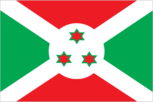
divided by a white diagonal cross into red panels (top and bottom) and green panels (hoist side and outer side) with a white disk superimposed at the center bearing three red six-pointed stars outlined in green arranged in a triangular design (one star above, two stars below)
Independence
1 July 1962 (from UN trusteeship under Belgian administration)
Judicial branch
Supreme Court (Cour Supreme)
Legal system
based on German and Belgian civil codes and customary law; has not accepted compulsory ICJ jurisdiction
Legislative branch
unicameral
Member of
ACCT, ACP, AfDB, CCC, CEEAC, CEPGL, ECA, FAO, G-77, GATT, IBRD, ICAO, ICRM, IDA, IFAD, IFC, IFRCS, ILO, IMF, INTELSAT (nonsignatory user), INTERPOL, IOC, ISO (subscriber), ITU, NAM, OAU, UN, UNCTAD, UNESCO, UNIDO, UPU, WHO, WIPO, WMO, WTO
Names
conventional long form: Republic of Burundi conventional short form: Burundi local long form: Republika y'u Burundi local short form: Burundi
National Assembly (Assemblee Nationale)
elections last held 29 June 1993 (next to be held NA); results - FRODEBU 71%, UPRONA 21.4%; seats - (81 total) FRODEBU 65, UPRONA 16; other parties won too small shares of the vote to win seats in the assembly note: The National Unity Charter outlining the principles for constitutional government was adopted by a national referendum on 5 February 1991
National holiday
Independence Day, 1 July (1962)
Other political or pressure groups
NA;
Political parties and leaders
Unity for National Progress (UPRONA); Burundi Democratic Front (FRODEBU); Organization of the People of Burundi (RBP); Socialist Party of Burundi (PSB); People's Reconciliation Party (PRP); opposition parties, legalized in March 1992, include Burundi African Alliance for the Salvation (ABASA); Rally for Democracy and Economic and Social Development (RADDES); and Party for National Redress (PARENA)
Suffrage
universal adult at age NA
Type
republic
US diplomatic representation
chief of mission: Ambassador Robert C. KRUEGER embassy: Avenue des Etats-Unis, Bujumbura mailing address: B. P. 1720, Bujumbura telephone: [257] (2) 23454
Economy
Agriculture
accounts for 50% of GDP; cash crops - coffee, cotton, tea; food crops - corn, sorghum, sweet potatoes, bananas, manioc; livestock - meat, milk, hides and skins
Budget
revenues: $318 million expenditures: $326 million, including capital expenditures of $150 million (1991 est.)
Currency
1 Burundi franc (FBu) = 100 centimes
Economic aid
recipient: US commitments, including Ex-Im (FY70-89), $71 million; Western (non-US) countries, ODA and OOF bilateral commitments (1970-89), $10.2 billion; OPEC bilateral aid (1979-89), $32 million; Communist countries (1970-89), $175 million
Electricity
capacity: 55,000 kW production: 100 million kWh consumption per capita: 20 kWh (1993)
Exchange rates
Burundi francs (FBu) per US$1 - 248.51 (December 1994), 252.66 (1994), 242.78 (1993), 208.30 (1992), 181.51 (1991), 171.26 (1990), 158.67 (1989), 140.40 (1988)
Exports
$68 million (f.o.b., 1993) commodities: coffee 81%, tea, cotton, hides, and skins partners: EC 57%, US 19%, Asia 1%
External debt
$1.05 billion (1994 est.)
Fiscal year
calendar year
Imports
$203 million (c.i.f., 1993) commodities: capital goods 31%, petroleum products 15%, foodstuffs, consumer goods partners: EC 45%, Asia 29%, US 2%
Industrial production
growth rate 11% (1991 est.); accounts for about 15% of GDP
Industries
light consumer goods such as blankets, shoes, soap; assembly of imported components; public works construction; food processing
Inflation rate (consumer prices)
10% (1993 est.)
National product
GDP - purchasing power parity - $3.7 billion (1994 est.)
National product per capita
$600 (1994 est.)
National product real growth rate
-13.5% (1994 est.)
Overview
A landlocked, resource-poor country in an early stage of economic development, Burundi since October 1993 has suffered from massive ethnic-based violence that has displaced an estimated million people, disrupted production, and set back needed reform programs. Burundi is predominately agricultural with roughly 90% of the population dependent on subsistence agriculture. Its economic health depends on the coffee crop, which accounts for 80% of foreign exchange earnings. The ability to pay for imports therefore continues to rest largely on the vagaries of the climate and the international coffee market. As part of its economic reform agenda, launched in February 1991 with IMF and World Bank support, Burundi is trying to diversify its agricultural exports, attract foreign investment in industry, and modernize government budgetary practices. Although the government remains committed to reforms, it fears new austerity measures would add to ethnic tensions.
Unemployment rate
NA%
Communications
Radio
broadcast stations: AM 2, FM 2, shortwave 0 radios: NA
Telephone system
8,000 telephones; primative system; telephone density - 1.3 telephones/1,000 persons local: NA intercity: sparse system of wire, radiocommunications, and low-capacity microwave radio relay links international: 1 INTELSAT (Indian Ocean) earth station
Television
broadcast stations: 1 televisions: NA
Transportation
Airports
total: 4 with paved runways over 3,047 m: 1 with paved runways under 914 m: 1 with unpaved runways 914 to 1,523 m: 2
Highways
total: 5,900 km paved: 640 km unpaved: gravel, crushed stone 2,260 km; improved, unimproved earth 3,000 km (1990)
Inland waterways
Lake Tanganyika
Ports
Bujumbura
Railroads
0 km
Military and Security
Branches
Army (includes naval and air units), paramilitary Gendarmerie
Defense expenditures
exchange rate conversion - $25 million, 2.6% of GDP (1993) ________________________________________________________________________ CAMBODIA
Manpower availability
males age 15-49 1,350,042; males fit for military service 705,864; males reach military age (16) annually 73,308 (1995 est.)