2021 Edition
CIA World Factbook 2021 (factbook.json @ e0d5604b9e27)
Introduction
Background
The Sultanate of Brunei's influence peaked between the 15th and 17th centuries when its control extended over coastal areas of northwest Borneo and the southern Philippines. Brunei subsequently entered a period of decline brought on by internal strife over royal succession, colonial expansion of European powers, and piracy. In 1888, Brunei became a British protectorate; independence was achieved in 1984. The same family has ruled Brunei for over six centuries. Brunei benefits from extensive petroleum and natural gas fields, the source of one of the highest per capita GDPs in the world. In 2017, Brunei celebrated the 50th anniversary of the Sultan Hassanal BOLKIAH’s accession to the throne.
Geography
Area
- land
- 5,265 sq km
- total
- 5,765 sq km
- water
- 500 sq km
Area - comparative
slightly smaller than Delaware
Climate
tropical; hot, humid, rainy
Coastline
161 km
Elevation
- highest point
- Bukit Pagon 1,850 m
- lowest point
- South China Sea 0 m
- mean elevation
- 478 m
Geographic coordinates
4 30 N, 114 40 E
Geography - note
close to vital sea lanes through South China Sea linking Indian and Pacific Oceans; two parts physically separated by Malaysia; the eastern part, the Temburong district, is an exclave and is almost an enclave within Malaysia
Irrigated land
10 sq km (2012)
Land boundaries
- border countries
- Malaysia 266 km
- total
- 266 km
Land use
- agricultural land
- 2.5% (2018 est.)
- agricultural land: arable land
- arable land: 0.8% (2018 est.)
- agricultural land: permanent crops
- permanent crops: 1.1% (2018 est.)
- agricultural land: permanent pasture
- permanent pasture: 0.6% (2018 est.)
- forest
- 71.8% (2018 est.)
- other
- 25.7% (2018 est.)
Location
Southeastern Asia, along the northern coast of the island of Borneo, bordering the South China Sea and Malaysia
Map references
Southeast Asia
Maritime claims
- exclusive economic zone
- 200 nm or to median line
- territorial sea
- 12 nm
Natural hazards
typhoons, earthquakes, and severe flooding are rare
Natural resources
petroleum, natural gas, timber
Terrain
flat coastal plain rises to mountains in east; hilly lowland in west
People and Society
Age structure
- 0-14 years
- 22.41% (male 53,653/female 50,446)
- 15-24 years
- 16.14% (male 37,394/female 37,559)
- 25-54 years
- 47.21% (male 103,991/female 115,291)
- 55-64 years
- 8.34% (male 19,159/female 19,585)
- 65 years and over
- 5.9% (male 13,333/female 14,067) (2020 est.)
Birth rate
16.3 births/1,000 population (2021 est.)
Children under the age of 5 years underweight
NA
Contraceptive prevalence rate
NA
Current Health Expenditure
2.4% (2018)
Death rate
3.75 deaths/1,000 population (2021 est.)
Demographic profile
Brunei is a small, oil-rich sultanate of less than half a million people, making it the smallest country in Southeast Asia by population. Its total fertility rate – the average number of births per woman – has been steadily declining over the last few decades, from over 3.5 in the 1980s to below replacement level today at nearly 1.8. The trend is due to women’s increased years of education and participation in the workforce, which have resulted in later marriages and fewer children. Yet, the population continues to grow because of the large number of women of reproductive age and a reliance on foreign labor – mainly from Malaysia, Thailand, the Philippines, Indonesia, and South Asian countries – to fill low-skilled jobs. Brunei is officially Muslim, and Malay is the official language. The country follows an official Malay national ideology, Malay Islamic Monarchy, which promotes Malay language and culture, Islamic values, and the monarchy. Only seven of Brunei’s native groups are recognized in the constitution and are defined as “Malay” – Brunei Malays, Belait, Kedayan, Dusun, Bisayak, Lun Bawang, and Sama-Baiau. Together they make up about 66% percent of the population and are referred to as the Bumiputera. The Bumiputera are entitled to official privileges, including land ownership, access to certain types of employment (Royal Brunei Armed Forces and Brunei Shell Petroleum), easier access to higher education, and better job opportunities in the civil service. Brunei’s Chinese population descends from migrants who arrived when Brunei was a British protectorate (1888 and 1984). They are prominent in the non-state commercial sector and account for approximately 10% of the population. Most Bruneian Chinese are permanent residents rather than citizens despite roots going back several generations. Many are stateless and are denied rights granted to citizens, such as land ownership, subsidized health care, and free secondary and university education. Because of the discriminatory policies, the number of Chinese in Brunei has shrunk considerably in the last 50 years. Native ethnic groups that are not included in the Bumiputera are not recognized in the constitution and are not officially identified as “Malay” or automatically granted citizenship. Foreign workers constitute some quarter of the labor force.
Dependency ratios
- elderly dependency ratio
- 7.7
- potential support ratio
- 12.9 (2020 est.)
- total dependency ratio
- 38.7
- youth dependency ratio
- 31
Drinking water source
- improved: total
- total: 100% of population
- unimproved: total
- total: 0% of population (2017 est.)
Education expenditures
4.4% of GDP (2016)
Ethnic groups
Malay 65.8%, Chinese 10.2%, other 24% (2020 est.)
HIV/AIDS - adult prevalence rate
NA
HIV/AIDS - deaths
NA
HIV/AIDS - people living with HIV/AIDS
NA
Hospital bed density
2.9 beds/1,000 population (2017)
Infant mortality rate
- female
- 8.25 deaths/1,000 live births (2021 est.)
- male
- 13.21 deaths/1,000 live births
- total
- 10.79 deaths/1,000 live births
Languages
- Languages
- Malay (Bahasa Melayu) (official), English, Chinese dialects
- major-language sample(s)
- Buku Fakta Dunia, sumber yang diperlukan untuk maklumat asas. (Malay)The World Factbook, the indispensable source for basic information.
Life expectancy at birth
- female
- 80.63 years (2021 est.)
- male
- 75.75 years
- total population
- 78.14 years
Literacy
- definition
- age 15 and over can read and write
- female
- 93.4% (2018)
- male
- 98.1%
- total population
- 97.2%
Major urban areas - population
- 241,000 BANDAR SERI BEGAWAN (capital) (2011)
- note
- note: the boundaries of the capital city were expanded in 2007, greatly increasing the city area; the population of the capital increased tenfold
Maternal mortality ratio
31 deaths/100,000 live births (2017 est.)
Median age
- female
- 31.8 years (2020 est.)
- male
- 30.5 years
- total
- 31.1 years
Nationality
- adjective
- Bruneian
- noun
- Bruneian(s)
Net migration rate
2.22 migrant(s)/1,000 population (2021 est.)
Obesity - adult prevalence rate
14.1% (2016)
Physicians density
1.61 physicians/1,000 population (2017)
Population
- 471,103 (July 2021 est.)
- note
- note: immigrants make up approximately 26% of the total population, according to UN data (2019)
Population growth rate
1.48% (2021 est.)
Religions
Muslim (official) 80.9%, Christian 7.1%, Buddhist 7.1%, other (includes indigenous beliefs) 5% (2016 est.)
School life expectancy (primary to tertiary education)
- female
- 14 years (2020)
- male
- 14 years
- total
- 14 years
Sex ratio
- 0-14 years
- 1.06 male(s)/female
- 15-24 years
- 1 male(s)/female
- 25-54 years
- 0.9 male(s)/female
- 55-64 years
- 0.98 male(s)/female
- 65 years and over
- 0.95 male(s)/female
- at birth
- 1.05 male(s)/female
- total population
- 0.96 male(s)/female (2020 est.)
Total fertility rate
1.75 children born/woman (2021 est.)
Unemployment, youth ages 15-24
- female
- 25.8% (2019 est.)
- male
- 19%
- total
- 21.4%
Urbanization
- rate of urbanization
- 1.44% annual rate of change (2020-25 est.)
- urban population
- 78.6% of total population (2021)
Government
Administrative divisions
4 districts (daerah-daerah, singular - daerah); Belait, Brunei dan Muara, Temburong, Tutong
Capital
- etymology
- named in 1970 after Sultan Omar Ali SAIFUDDIEN III (1914-1986; "The Father of Independence") who adopted the title of "Seri Begawan" (approximate meaning "honored lord") upon his abdication in 1967; "bandar" in Malay means "town" or "city"; the capital had previously been called Bandar Brunei (Brunei Town)
- geographic coordinates
- 4 53 N, 114 56 E
- name
- Bandar Seri Begawan
- time difference
- UTC+8 (13 hours ahead of Washington, DC, during Standard Time)
Citizenship
- citizenship by birth
- no
- citizenship by descent only
- the father must be a citizen of Brunei
- dual citizenship recognized
- no
- residency requirement for naturalization
- 12 years
Constitution
- amendments
- proposed by the monarch; passage requires submission to the Privy Council for Legislative Council review and finalization takes place by proclamation; the monarch can accept or reject changes to the original proposal provided by the Legislative Council; amended several times, last in 2010
- history
- drafted 1954 to 1959, signed 29 September 1959; note - some constitutional provisions suspended since 1962 under a State of Emergency, others suspended since independence in 1984
Country name
- conventional long form
- Brunei Darussalam
- conventional short form
- Brunei
- etymology
- derivation of the name is unclear; according to legend, MUHAMMAD SHAH, who would become the first sultan of Brunei, upon discovering what would become Brunei exclaimed "Baru nah," which roughly translates as "there" or "that's it"
- local long form
- Negara Brunei Darussalam
- local short form
- Brunei
Diplomatic representation from the US
- chief of mission
- Ambassador (vacant); Charge d'Affaires Emily M. FLECKNER (since 20 August 2020)
- email address and website
- ConsularBrunei@state.govhttps://bn.usembassy.gov/
- embassy
- Simpang 336-52-16-9, Jalan Duta, Bandar Seri Begawan, BC4115
- FAX
- (673) 238-7533
- mailing address
- 4020 Bandar Seri Begawan Place, Washington DC 20521-4020
- telephone
- (673) 238-7400
Diplomatic representation in the US
- chancery
- 3520 International Court NW, Washington, DC 20008
- chief of mission
- Ambassador Dato Paduka Haji Serbini bin Haji ALI (since 28 January 2016)
- consulate(s)
- New York
- email address and website
- info@bruneiembassy.orghttp://www.bruneiembassy.org/index.html
- FAX
- [1] (202) 885-0560
- telephone
- [1] (202) 237-1838
Executive branch
- cabinet
- Council of Ministers appointed and presided over by the monarch; note(s)- 4 additional advisory councils appointed by the monarch are the Religious Council, Privy Council for constitutional issues, Council of Succession, and Legislative Council; Sultan and Prime Minister Sir HASSANAL Bolkiah is also Minister of Finance, Defense, and Foreign Affairs and Trade
- chief of state
- Sultan and Prime Minister Sir HASSANAL Bolkiah (since 5 October 1967); note - the monarch is both chief of state and head of government
- elections/appointments
- none; the monarchy is hereditary
- head of government
- Sultan and Prime Minister Sir HASSANAL Bolkiah (since 5 October 1967)
Flag description
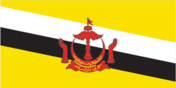
yellow with two diagonal bands of white (top, almost double width) and black starting from the upper hoist side; the national emblem in red is superimposed at the center; yellow is the color of royalty and symbolizes the sultanate; the white and black bands denote Brunei's chief ministers; the emblem includes five main components: a swallow-tailed flag, the royal umbrella representing the monarchy, the wings of four feathers symbolizing justice, tranquility, prosperity, and peace, the two upraised hands signifying the government's pledge to preserve and promote the welfare of the people, and the crescent moon denoting Islam, the state religion; the state motto "Always render service with God's guidance" appears in yellow Arabic script on the crescent; a ribbon below the crescent reads "Brunei, the Abode of Peace"
Government type
absolute monarchy or sultanate
Independence
1 January 1984 (from the UK)
International law organization participation
has not submitted an ICJ jurisdiction declaration; non-party state to the ICC
International organization participation
ADB, APEC, ARF, ASEAN, C, CP, EAS, FAO, G-77, IAEA, IBRD, ICAO, ICC (NGOs), ICRM, IDA, IFRCS, ILO, IMF, IMO, IMSO, Interpol, IOC, ISO (correspondent), ITSO, ITU, NAM, OIC, OPCW, UN, UNCTAD, UNESCO, UNIFIL, UNWTO, UPU, WCO, WHO, WIPO, WMO, WTO
Judicial branch
- highest courts
- Supreme Court (consists of the Court of Appeal and the High Court, each with a chief justice and 2 judges); Sharia Court (consists the Court of Appeals and the High Court); note - Brunei has a dual judicial system of secular and sharia (religious) courts; the Judicial Committee of Privy Council (in London) serves as the final appellate court for civil cases only
- judge selection and term of office
- Supreme Court judges appointed by the monarch to serve until age 65, and older if approved by the monarch; Sharia Court judges appointed by the monarch for life
- subordinate courts
- Intermediate Court; Magistrates' Courts; Juvenile Court; small claims courts; lower sharia courts
Legal system
mixed legal system based on English common law and Islamic law; note - in April 2019, the full sharia penal codes came into force and apply to Muslims and non-Muslims in parallel with present common law codes
Legislative branch
- description
- unicameral Legislative Council or Majlis Mesyuarat Negara Brunei (33 seats; 20 members appointed by the sultan from ex-officio cabinet ministers, titled people, and prominent citizens in public service and various professional fields and 13 members from 4 multi-seat constituencies, and 3 ex-officio members - the speaker and first and second secretaries
- election results
- NA; composition (as of July 2021) - men 30, women 3, percent of women 9.1%
- elections
- appointed by the sultan
National anthem
- lyrics/music
- Pengiran Haji Mohamed YUSUF bin Pengiran Abdul Rahim/Awang Haji BESAR bin Sagap
- name
- "Allah Peliharakan Sultan" (God Bless His Majesty)
- note
- note: adopted 1951
National holiday
National Day, 23 February (1984); note - 1 January 1984 was the date of independence from the UK, 23 February 1984 was the date of independence from British protection; the Sultan's birthday, 15 June
National symbol(s)
royal parasol; national colors: yellow, white, black
Political parties and leaders
- National Development Party or NDP [YASSIN Affendi]
- note
- note: Brunei National Solidarity Party or PPKB [Abdul LATIF bin Chuchu] and People's Awareness Party or PAKAR [Awang Haji MAIDIN bin Haji Ahmad] were deregistered in 2007; parties are small and have limited activity
Suffrage
18 years of age for village elections; universal
Economy
Agricultural products
poultry, eggs, fruit, cassava, bananas, legumes, cucumbers, rice, pineapples, beef
Budget
- expenditures
- 4.345 billion (2017 est.)
- revenues
- 2.245 billion (2017 est.)
Budget surplus (+) or deficit (-)
-17.3% (of GDP) (2017 est.)
Current account balance
- Current account balance 2016
- $1.47 billion (2016 est.)
- Current account balance 2017
- $2.021 billion (2017 est.)
Debt - external
- Debt - external 2013
- $0 (2013)
- Debt - external 2014
- $0 (2014)
- note
- note: public external debt only; private external debt unavailable
Economic overview
Brunei is an energy-rich sultanate on the northern coast of Borneo in Southeast Asia. Brunei boasts a well-educated, largely English-speaking population; excellent infrastructure; and a stable government intent on attracting foreign investment. Crude oil and natural gas production account for approximately 65% of GDP and 95% of exports, with Japan as the primary export market.Per capita GDP is among the highest in the world, and substantial income from overseas investment supplements income from domestic hydrocarbon production. Bruneian citizens pay no personal income taxes, and the government provides free medical services and free education through the university level.The Bruneian Government wants to diversify its economy away from hydrocarbon exports to other industries such as information and communications technology and halal manufacturing, permissible under Islamic law. Brunei’s trade increased in 2016 and 2017, following its regional economic integration in the ASEAN Economic Community, and the expected ratification of the Trans-Pacific Partnership trade agreement.
Exchange rates
- currency
- Bruneian dollars (BND) per US dollar -
- Exchange rates 2013
- 1.267 (2013 est.)
- Exchange rates 2014
- 1.3749 (2014 est.)
- Exchange rates 2018
- 1.3699 (2018 est.)
- Exchange rates 2019
- 1.35945 (2019 est.)
- Exchange rates 2020
- 1.33685 (2020 est.)
Exports
- Exports 2018
- $7.04 billion note: data are in current year dollars (2018 est.)
- Exports 2019
- $7.83 billion note: data are in current year dollars (2019 est.)
Exports - commodities
natural gas, crude petroleum, refined petroleum, industrial alcohols, industrial hydrocarbons (2019)
Exports - partners
Japan 34%, Australia 12%, Singapore 10%, India 8%, Malaysia 8%, Thailand 7%, China 6%, South Korea 5% (2019)
Fiscal year
1 April - 31 March
GDP - composition, by end use
- exports of goods and services
- 45.9% (2017 est.)
- government consumption
- 24.8% (2017 est.)
- household consumption
- 25% (2017 est.)
- imports of goods and services
- -36.8% (2017 est.)
- investment in fixed capital
- 32.6% (2017 est.)
- investment in inventories
- 8.5% (2017 est.)
GDP - composition, by sector of origin
- agriculture
- 1.2% (2017 est.)
- industry
- 56.6% (2017 est.)
- services
- 42.3% (2017 est.)
GDP (official exchange rate)
$12.13 billion (2017 est.)
Household income or consumption by percentage share
- highest 10%
- NA
- lowest 10%
- NA
Imports
- Imports 2018
- $5.68 billion note: data are in current year dollars (2018 est.)
- Imports 2019
- $6.81 billion note: data are in current year dollars (2019 est.)
Imports - commodities
crude petroleum, refined petroleum, cars, tug boats, valves (2019)
Imports - partners
Singapore 18%, China 14%, Malaysia 12%, Nigeria 5%, United Arab Emirates 5%, United States 5% (2019)
Industrial production growth rate
1.5% (2017 est.)
Industries
petroleum, petroleum refining, liquefied natural gas, construction, agriculture, aquaculture, transportation
Inflation rate (consumer prices)
- Inflation rate (consumer prices) 2016
- -0.7% (2016 est.)
- Inflation rate (consumer prices) 2017
- -0.2% (2017 est.)
Labor force
203,600 (2014 est.)
Labor force - by occupation
- agriculture
- 4.2%
- industry
- 62.8%
- services
- 33% (2008 est.)
Population below poverty line
NA
Public debt
- Public debt 2016
- 3% of GDP (2016 est.)
- Public debt 2017
- 2.8% of GDP (2017 est.)
Real GDP (purchasing power parity)
- note
- note: data are in 2017 dollars
- Real GDP (purchasing power parity) 2018
- $25.9 billion note: data are in 2017 dollars (2018 est.)
- Real GDP (purchasing power parity) 2019
- $26.91 billion note: data are in 2017 dollars (2019 est.)
- Real GDP (purchasing power parity) 2020
- $27.23 billion note: data are in 2017 dollars (2020 est.)
Real GDP growth rate
- Real GDP growth rate 2015
- -0.4% (2015 est.)
- Real GDP growth rate 2016
- -2.5% (2016 est.)
- Real GDP growth rate 2017
- 1.3% (2017 est.)
Real GDP per capita
- note
- note: data are in 2017 dollars
- Real GDP per capita 2018
- $60,400 note: data are in 2017 dollars (2018 est.)
- Real GDP per capita 2019
- $62,100 note: data are in 2017 dollars (2019 est.)
- Real GDP per capita 2020
- $62,200 note: data are in 2017 dollars (2020 est.)
Reserves of foreign exchange and gold
- Reserves of foreign exchange and gold 31 December 2015
- $3.366 billion (31 December 2015 est.)
- Reserves of foreign exchange and gold 31 December 2017
- $3.488 billion (31 December 2017 est.)
Taxes and other revenues
18.5% (of GDP) (2017 est.)
Unemployment rate
- Unemployment rate 2016
- 6.9% (2016 est.)
- Unemployment rate 2017
- 6.9% (2017 est.)
Unemployment, youth ages 15-24
- female
- 25.8% (2019 est.)
- male
- 19%
- total
- 21.4%
Energy
Crude oil - exports
127,400 bbl/day (2015 est.)
Crude oil - imports
160 bbl/day (2015 est.)
Crude oil - production
100,000 bbl/day (2018 est.)
Crude oil - proved reserves
1.1 billion bbl (1 January 2018 est.)
Electricity - consumption
3.771 billion kWh (2016 est.)
Electricity - exports
0 kWh (2016 est.)
Electricity - from fossil fuels
100% of total installed capacity (2016 est.)
Electricity - from hydroelectric plants
0% of total installed capacity (2017 est.)
Electricity - from nuclear fuels
0% of total installed capacity (2017 est.)
Electricity - from other renewable sources
0% of total installed capacity (2017 est.)
Electricity - imports
0 kWh (2016 est.)
Electricity - installed generating capacity
821,000 kW (2016 est.)
Electricity - production
4.014 billion kWh (2016 est.)
Electricity access
- electrification - total population
- 100% (2020)
Natural gas - consumption
3.936 billion cu m (2017 est.)
Natural gas - exports
8.268 billion cu m (2017 est.)
Natural gas - imports
0 cu m (2017 est.)
Natural gas - production
12.74 billion cu m (2017 est.)
Natural gas - proved reserves
260.5 billion cu m (1 January 2018 est.)
Refined petroleum products - consumption
18,000 bbl/day (2016 est.)
Refined petroleum products - exports
0 bbl/day (2015 est.)
Refined petroleum products - imports
6,948 bbl/day (2015 est.)
Refined petroleum products - production
10,310 bbl/day (2015 est.)
Communications
Broadband - fixed subscriptions
- subscriptions per 100 inhabitants
- 16.25 (2020 est.)
- total
- 71,078 (2020)
Broadcast media
state-controlled Radio Television Brunei (RTB) operates 5 channels; 3 Malaysian TV stations are available; foreign TV broadcasts are available via satellite systems; RTB operates 5 radio networks and broadcasts on multiple frequencies; British Forces Broadcast Service (BFBS) provides radio broadcasts on 2 FM stations; some radio broadcast stations from Malaysia are available via repeaters
Internet country code
.bn
Internet users
- percent of population
- 95% (2019 est.)
- total
- 417,500 (2021 est.)
Telecommunication systems
- domestic
- every service available; 20 per 100 fixed-line, 129 per 100 mobile-cellular (2019)
- general assessment
- Brunei is improving its national telecom network; telecommunications infrastructure and services are of high standard, due to healthy investment in networks and services; relatively mature telecom system compared to other Asian countries; mobile subscription increasing steadily to high penetration; launch of 5G pilot services in April 2021 aimed to increase awareness of the benefits of 5G and boost the mobile broadband sector; access to telecom services via the Kacific-1 satellite (2021)
- international
- country code - 673; landing points for the SEA-ME-WE-3, SJC, AAG, Lubuan-Brunei Submarine Cable via optical telecommunications submarine cables that provides links to Asia, the Middle East, Southeast Asia, Africa, Australia, and the US; satellite earth stations - 2 Intelsat (1 Indian Ocean and 1 Pacific Ocean) (2019)
- note
- note: the COVID-19 pandemic continues to have a significant impact on production and supply chains globally; since 2020, some aspects of the telecom sector have experienced downturn, particularly in mobile device production; many network operators delayed upgrades to infrastructure; progress towards 5G implementation was postponed or slowed in some countries; consumer spending on telecom services and devices was affected by large-scale job losses and the consequent restriction on disposable incomes; the crucial nature of telecom services as a tool for work and school from home became evident, and received some support from governments
Telephones - fixed lines
- subscriptions per 100 inhabitants
- 23.75 (2020 est.)
- total subscriptions
- 103,885 (2020)
Telephones - mobile cellular
- subscriptions per 100 inhabitants
- 120.4 (2020 est.)
- total subscriptions
- 526,732 (2020)
Transportation
Airports
- total
- 1 (2020)
Airports - with paved runways
- over 3,047 m
- 1 (2019)
- total
- 1
Civil aircraft registration country code prefix
V8
Heliports
3 (2013)
Merchant marine
- by type
- general cargo 18, oil tanker 3, other 75 (2021)
- total
- 96
National air transport system
- annual freight traffic on registered air carriers
- 129.35 million mt-km (2018)
- annual passenger traffic on registered air carriers
- 1,234,455 (2018)
- inventory of registered aircraft operated by air carriers
- 10
- number of registered air carriers
- 1 (2020)
Pipelines
33 km condensate, 86 km condensate/gas, 628 km gas, 492 km oil (2013)
Ports and terminals
- LNG terminal(s) (export)
- Lumut
- major seaport(s)
- Muara
- oil terminal(s)
- Lumut, Seria
Roadways
- paved
- 2,559 km (2014)
- total
- 2,976 km (2014)
- unpaved
- 417 km (2014)
Waterways
209 km (navigable by craft drawing less than 1.2 m; the Belait, Brunei, and Tutong Rivers are major transport links) (2012)
Military and Security
Military - note
Brunei has a long-standing defense relationship with the United Kingdom and hosts a British Army garrison, which includes the Gurkha Battalion and a jungle warfare school; Brunei also hosts a Singaporean military training base (2021)
Military and security forces
Royal Brunei Armed Forces: Royal Brunei Land Force, Royal Brunei Navy, Royal Brunei Air Force (2021)
Military and security service personnel strengths
the Royal Brunei Armed Forces is comprised of approximately 6,500 total active troops (4,500 Army; 1,000 Navy; 1,000 Air Force) (2021)
Military equipment inventories and acquisitions
the Royal Brunei Armed Forces imports nearly all of its military equipment and weapons systems; suppliers since 2010 include France, Germany, Singapore, Sweden, and the US (2021)
Military expenditures
- Military Expenditures 2016
- 3.5% of GDP (2016)
- Military Expenditures 2017
- 2.9% of GDP (2017)
- Military Expenditures 2018
- 2.6% of GDP (2018)
- Military Expenditures 2019
- 3.3% of GDP (2019)
- Military Expenditures 2020
- 3.7% of GDP (2020 est.)
Military service age and obligation
17 years of age for voluntary military service; non-Malays are ineligible to serve; recruits from the army, navy, and air force all undergo 43-week initial training (2021)
Transnational Issues
Disputes - international
per Letters of Exchange signed in 2009, Malaysia in 2010 ceded two hydrocarbon concession blocks to Brunei in exchange for Brunei's sultan dropping claims to the Limbang corridor, which divides Brunei; nonetheless, Brunei claims a maritime boundary extending as far as a median with Vietnam, thus asserting an implicit claim to Louisa Reef
Illicit drugs
drug trafficking and illegally importing controlled substances are serious offenses in Brunei and carry a mandatory death penalty
Refugees and internally displaced persons
- stateless persons
- 20,863 (2020); note - thousands of stateless persons, often ethnic Chinese, are permanent residents and their families have lived in Brunei for generations; obtaining citizenship is difficult and requires individuals to pass rigorous tests on Malay culture, customs, and language; stateless residents receive an International Certificate of Identity, which enables them to travel overseas; the government is considering changing the law prohibiting non-Bruneians, including stateless permanent residents, from owning land
Trafficking in persons
- current situation
- human traffickers exploit foreign victims in Brunei; some men and women who migrate to Brunei to work as domestics or in retail or construction are subject to involuntary servitude, debt-based coercion, contract switching, non-payment of wages, passport confiscation, physical abuse, or confinement; some female migrants entering Brunei on tourist visas are forced into prostitution; some traffickers use Brunei as a transit point for victims used for sex and labor trafficking in Malaysia and Indonesia
- tier rating
- Tier 2 Watch List — Brunei does not fully meet the minimum standards for the elimination of trafficking but is making significant efforts to do so; the government enacted the 2019 Trafficking in Persons Order, which criminalized sex and labor trafficking and separated trafficking crimes from migrant smuggling crimes; the government formalized its interagency anti-trafficking in persons committee; instituted a committee to review foreign worker recruitment practices, ratified the ASEAN Convention against Trafficking in Persons, and acceded to the UN TIP Protocol; however, authorities did not formally identify any trafficking cases, did not initiate any new trafficking prosecutions, and did not convict any traffickers; trafficking victims continued to be detained, deported, and charged with crimes without law enforcement determining if they were forced to commit the illegal acts by traffickers; the government again did not allocate money to a fund established in 2004 for victim compensation and repatriation; a draft national action plan to combat trafficking was not completed for the sixth consecutive year (2020)
Environment
Air pollutants
- carbon dioxide emissions
- 7.66 megatons (2016 est.)
- methane emissions
- 8.4 megatons (2020 est.)
- particulate matter emissions
- 5.78 micrograms per cubic meter (2016 est.)
Climate
tropical; hot, humid, rainy
Environment - current issues
no major environmental problems, but air pollution control is becoming a concern; seasonal trans-boundary haze from forest fires in Indonesia
Environment - international agreements
- party to
- Biodiversity, Climate Change, Climate Change-Kyoto Protocol, Climate Change-Paris Agreement, Comprehensive Nuclear Test Ban, Desertification, Endangered Species, Hazardous Wastes, Law of the Sea, Ozone Layer Protection, Ship Pollution
- signed, but not ratified
- none of the selected agreements
Land use
- agricultural land
- 2.5% (2018 est.)
- agricultural land: arable land
- arable land: 0.8% (2018 est.)
- agricultural land: permanent crops
- permanent crops: 1.1% (2018 est.)
- agricultural land: permanent pasture
- permanent pasture: 0.6% (2018 est.)
- forest
- 71.8% (2018 est.)
- other
- 25.7% (2018 est.)
Revenue from coal
- coal revenues
- 0% of GDP (2018 est.)
Revenue from forest resources
- forest revenues
- 0.05% of GDP (2018 est.)
Total renewable water resources
8.5 billion cubic meters (2017 est.)
Total water withdrawal
- agricultural
- 5.3 million cubic meters (2017 est.)
- municipal
- 151.5 million cubic meters (2017 est.)
Urbanization
- rate of urbanization
- 1.44% annual rate of change (2020-25 est.)
- urban population
- 78.6% of total population (2021)
Waste and recycling
- municipal solid waste generated annually
- 216,253 tons (2016 est.)