2013 Edition
CIA World Factbook 2013 Archive (HTML)
Introduction
Background
The Sultanate of Brunei's influence peaked between the 15th and 17th centuries when its control extended over coastal areas of northwest Borneo and the southern Philippines. Brunei subsequently entered a period of decline brought on by internal strife over royal succession, colonial expansion of European powers, and piracy. In 1888, Brunei became a British protectorate; independence was achieved in 1984. The same family has ruled Brunei for over six centuries. Brunei benefits from extensive petroleum and natural gas fields, the source of one of the highest per capita GDPs in Asia.
Geography
Area
- 5,765 sq km 5,265 sq km 500 sq km
- total
- 5,765 sq km
- water
- 500 sq km
Area - comparative
slightly smaller than Delaware
Climate
tropical; hot, humid, rainy
Coastline
161 km
Elevation extremes
- South China Sea 0 m Bukit Pagon 1,850 m
- highest point
- Bukit Pagon 1,850 m
- lowest point
- South China Sea 0 m
Environment - current issues
seasonal smoke/haze resulting from forest fires in Indonesia
Environment - international agreements
- Biodiversity, Climate Change, Desertification, Endangered Species, Hazardous Wastes, Law of the Sea, Ozone Layer Protection, Ship Pollution none of the selected agreements
- party to
- Biodiversity, Climate Change, Desertification, Endangered Species, Hazardous Wastes, Law of the Sea, Ozone Layer Protection, Ship Pollution
- signed, but not ratified
- none of the selected agreements
Freshwater withdrawal (domestic/industrial/agricultural)
- 0.09 cu km/yr (97%/0%/3%) 301.6 cu m/yr (2009)
- per capita
- 301.6 cu m/yr (2009)
- total
- 0.09 cu km/yr (97%/0%/3%)
Geographic coordinates
4 30 N, 114 40 E
Geography - note
close to vital sea lanes through South China Sea linking Indian and Pacific Oceans; two parts physically separated by Malaysia; almost an enclave within Malaysia
Irrigated land
10 sq km (2003)
Land boundaries
- 381 km Malaysia 381 km
- border countries
- Malaysia 381 km
- total
- 381 km
Land use
- 0.52% 0.87% 98.61% (2011)
- arable land
- 0.52%
- other
- 98.61% (2011)
- permanent crops
- 0.87%
Location
Southeastern Asia, bordering the South China Sea and Malaysia
Map references
Southeast Asia
Maritime claims
- 12 nm 200 nm or to median line
- exclusive economic zone
- 200 nm or to median line
- territorial sea
- 12 nm
Natural hazards
typhoons, earthquakes, and severe flooding are rare
Natural resources
petroleum, natural gas, timber
Terrain
flat coastal plain rises to mountains in east; hilly lowland in west
Total renewable water resources
8.5 cu km (2011)
People and Society
Age structure
- 24.6% (male 52,761/female 49,538) 17.5% (male 35,879/female 36,767) 46.8% (male 94,827/female 99,779) 7.3% (male 15,594/female 14,642) 3.8% (male 7,767/female 8,163) (2013 est.)
- 0-14 years
- 24.6% (male 52,761/female 49,538)
- 15-24 years
- 17.5% (male 35,879/female 36,767)
- 25-54 years
- 46.8% (male 94,827/female 99,779)
- 55-64 years
- 7.3% (male 15,594/female 14,642)
- 65 years and over
- 3.8% (male 7,767/female 8,163) (2013 est.)
Birth rate
17.63 births/1,000 population (2013 est.)
Death rate
3.43 deaths/1,000 population (2013 est.)
Dependency ratios
- 42 % 36 % 6.1 % 16.4 (2013)
- elderly dependency ratio
- 6.1 %
- potential support ratio
- 16.4 (2013)
- total dependency ratio
- 42 %
- youth dependency ratio
- 36 %
Education expenditures
3.3% of GDP (2012)
Ethnic groups
Malay 66.3%, Chinese 11.2%, indigenous 3.4%, other 19.1% (2004 est.)
Health expenditures
2.5% of GDP (2011)
HIV/AIDS - adult prevalence rate
less than 0.1% (2003 est.)
HIV/AIDS - deaths
fewer than 200 (2003 est.)
HIV/AIDS - people living with HIV/AIDS
fewer than 200 (2003 est.)
Hospital bed density
2.8 beds/1,000 population (2011)
Infant mortality rate
- 10.81 deaths/1,000 live births 12.89 deaths/1,000 live births 8.64 deaths/1,000 live births (2013 est.)
- female
- 8.64 deaths/1,000 live births (2013 est.)
- total
- 10.81 deaths/1,000 live births
Languages
Malay (official), English, Chinese
Life expectancy at birth
- 76.57 years 74.28 years 78.97 years (2013 est.)
- female
- 78.97 years (2013 est.)
- total population
- 76.57 years
Literacy
- age 15 and over can read and write 95.4% 97% 93.9% (2011 est.)
- definition
- age 15 and over can read and write
- female
- 93.9% (2011 est.)
- male
- 97%
- total population
- 95.4%
Major urban areas - population
BANDAR SERI BEGAWAN (capital) 241,000 the boundaries of the capital city were expanded in 2007, greatly increasing the city area; the population of the capital increased tenfold (2011)
Maternal mortality rate
24 deaths/100,000 live births (2010)
Median age
- 29 years 28.7 years 29.2 years (2013 est.)
- female
- 29.2 years (2013 est.)
- male
- 28.7 years
- total
- 29 years
Nationality
- Bruneian(s) Bruneian
- adjective
- Bruneian
- noun
- Bruneian(s)
Net migration rate
2.51 migrant(s)/1,000 population (2013 est.)
Obesity - adult prevalence rate
7.5% (2008)
Physicians density
1.36 physicians/1,000 population (2010)
Population
415,717 (July 2013 est.)
Population growth rate
1.67% (2013 est.)
Religions
Muslim (official) 67%, Buddhist 13%, Christian 10%, other (includes indigenous beliefs) 10%
School life expectancy (primary to tertiary education)
- 15 years 15 years 16 years (2011)
- female
- 16 years (2011)
- male
- 15 years
- total
- 15 years
Sex ratio
- 1.05 male(s)/female 1.07 male(s)/female 0.97 male(s)/female 0.96 male(s)/female 1.07 male(s)/female 0.95 male(s)/female 1 male(s)/female (2013 est.)
- 0-14 years
- 1.07 male(s)/female
- 15-24 years
- 0.97 male(s)/female
- 25-54 years
- 0.96 male(s)/female
- 55-64 years
- 1.07 male(s)/female
- 65 years and over
- 0.95 male(s)/female
- at birth
- 1.05 male(s)/female
- total population
- 1 male(s)/female (2013 est.)
Total fertility rate
1.83 children born/woman (2013 est.)
Urbanization
- 76% of total population (2011) 2.13% annual rate of change (2010-15 est.)
- rate of urbanization
- 2.13% annual rate of change (2010-15 est.)
- urban population
- 76% of total population (2011)
Government
Administrative divisions
4 districts (daerah-daerah, singular - daerah); Belait, Brunei-Muara, Temburong, Tutong
Capital
- Bandar Seri Begawan 4 53 N, 114 56 E UTC+8 (13 hours ahead of Washington, DC during Standard Time)
- geographic coordinates
- 4 53 N, 114 56 E
- name
- Bandar Seri Begawan
- time difference
- UTC+8 (13 hours ahead of Washington, DC during Standard Time)
Constitution
drafted 1954 to 1959, signed 29 September 1959; amended 1984, 2004, 2011; note - some constitutional provisions suspended since 1962 under a State of Emergency, others since independence in 1984 (2011)
Country name
- Brunei Darussalam Brunei Negara Brunei Darussalam Brunei
- conventional long form
- Brunei Darussalam
- conventional short form
- Brunei
- local long form
- Negara Brunei Darussalam
- local short form
- Brunei
Diplomatic representation from the US
- Ambassador Daniel L. SHIELDS III (since 28 March 2011) Simpang 336-52-16-9, Jalan Datu, Bandar Seri Begawan, BC4115 Unit 4280, Box 40, FPO AP 96507; P.O. Box 2991, Bandar Seri Begawan BS8675, Negara Brunei Darussalam [673] 238-4616 [673] 238-4604
- chief of mission
- Ambassador Daniel L. SHIELDS III (since 28 March 2011)
- embassy
- Simpang 336-52-16-9, Jalan Datu, Bandar Seri Begawan, BC4115
- FAX
- [673] 238-4604
- mailing address
- Unit 4280, Box 40, FPO AP 96507; P.O. Box 2991, Bandar Seri Begawan BS8675, Negara Brunei Darussalam
- telephone
- [673] 238-4616
Diplomatic representation in the US
- Ambassador Dato Yusoff Abd HAMID (since 2 October 2009) 3520 International Court NW #300, Washington, DC 20008 [1] (202) 237-1838 [1] (202) 885-0560
- chancery
- 3520 International Court NW #300, Washington, DC 20008
- chief of mission
- Ambassador Dato Yusoff Abd HAMID (since 2 October 2009)
- FAX
- [1] (202) 885-0560
- telephone
- [1] (202) 237-1838
Executive branch
- Sultan and Prime Minister Sir HASSANAL Bolkiah (since 5 October 1967); note - the monarch is both the chief of state (Yang Di-Pertuan Agong) and head of government Sultan and Prime Minister Sir HASSANAL Bolkiah (since 5 October 1967) Council of Cabinet Ministers appointed and presided over by the monarch; deals with executive matters; note - there is also a Religious Council (members appointed by the monarch) that advises on religious matters, a Privy Council (members appointed by the monarch) that deals with constitutional matters, and the Council of Succession (members appointed by the monarch) that determines the succession to the throne if the need arises none; the monarchy is hereditary
- cabinet
- Council of Cabinet Ministers appointed and presided over by the monarch; deals with executive matters; note - there is also a Religious Council (members appointed by the monarch) that advises on religious matters, a Privy Council (members appointed by the monarch) that deals with constitutional matters, and the Council of Succession (members appointed by the monarch) that determines the succession to the throne if the need arises
- chief of state
- Sultan and Prime Minister Sir HASSANAL Bolkiah (since 5 October 1967); note - the monarch is both the chief of state (Yang Di-Pertuan Agong) and head of government
- elections
- none; the monarchy is hereditary
- head of government
- Sultan and Prime Minister Sir HASSANAL Bolkiah (since 5 October 1967)
Flag description
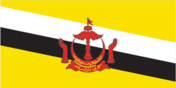
- yellow with two diagonal bands of white (top, almost double width) and black starting from the upper hoist side; the national emblem in red is superimposed at the center; yellow is the color of royalty and symbolizes the sultanate; the white and black bands denote Brunei's chief ministers; the emblem includes five main components: a swallow-tailed flag, the royal umbrella representing the monarchy, the wings of four feathers symbolizing justice, tranquility, prosperity, and peace, the two upraised hands signifying the government's pledge to preserve and promote the welfare of the people, and the crescent moon denoting Islam, the state religion; the state motto "Always render service with God's guidance" appears in yellow Arabic script on the crescent; a ribbon below the crescent reads "Brunei, the Abode of Peace"
- yellow with two diagonal bands of white (top, almost double width) and black starting from the upper hoist side; the national emblem in red is superimposed at the center; yellow is the color of royalty and symbolizes the sultanate; the white and black ban
- a swallow-tailed flag, the royal umbrella representing the monarchy, the wings of four feathers symbolizing justice, tranquility, prosperity, and peace, the two upraised hands signifying the government's pledge to preserve and promote the welfare of the people, and the crescent moon denoting Islam, the state religion; the state motto "Always render service with God's guidance" appears in yellow Arabic script on the crescent; a ribbon below the crescent reads "Brunei, the Abode of Peace"
Government type
constitutional sultanate (locally known as Malay Islamic Monarchy)
Independence
1 January 1984 (from the UK)
International law organization participation
has not submitted an ICJ jurisdiction declaration; non-party state to the ICCt
International organization participation
ADB, APEC, ARF, ASEAN, C, CP, EAS, G-77, IBRD, ICAO, ICC (NGOs), ICRM, IDA, IDB, IFRCS, ILO, IMF, IMO, IMSO, Interpol, IOC, ISO (correspondent), ITSO, ITU, NAM, OIC, OPCW, UN, UNCTAD, UNESCO, UNIFIL, UNWTO, UPU, WCO, WHO, WIPO, WMO, WTO
Judicial branch
- Supreme Court (consists of Court of Appeal and High Court, each with a chief justice and 2 judges); Sharia Court of Appeal (consists of judges appointed by the monarch) note - Brunei has a dual judicial system of secular and sharia (religious) courts; the Judicial Committee of Privy Council in London serves as the final appellate court for civil cases only Supreme Court judges appointed by the monarch to serve until age 65, and older if approved by the monarch; Sharia Court of Appeal judges appointed by the monarch; judge tenure NA Intermediate Court; Magistrate's Courts; Juvenile Court; small claims courts; lower sharia courts (2006)
- highest court(s)
- Supreme Court (consists of Court of Appeal and High Court, each with a chief justice and 2 judges); Sharia Court of Appeal (consists of judges appointed by the monarch)
- judge selection and term of office
- Supreme Court judges appointed by the monarch to serve until age 65, and older if approved by the monarch; Sharia Court of Appeal judges appointed by the monarch; judge tenure NA
- subordinate courts
- Intermediate Court; Magistrate's Courts; Juvenile Court; small claims courts; lower sharia courts (2006)
Legal system
mixed legal system based on English common law and Islamic law
Legislative branch
- the Sultan appointed a Legislative Council with 29 members in September 2005; he increased the size of the council to 33 members in June 2011; the council meets annually in March last held in March 1962 (date of next election NA) the Legislative Council met on 25 September 2004 for first time in 20 years with 21 members appointed by the Sultan; it passed constitutional amendments calling for a 45-seat council with 15 elected members; no timeframe for an election was announced
- elections
- last held in March 1962 (date of next election NA)
National anthem
- "Allah Peliharakan Sultan" (God Bless His Majesty) Pengiran Haji Mohamed YUSUF bin Pengiran Abdul Rahim/Awang Haji BESAR bin Sagap adopted 1951
- lyrics/music
- Pengiran Haji Mohamed YUSUF bin Pengiran Abdul Rahim/Awang Haji BESAR bin Sagap
- name
- "Allah Peliharakan Sultan" (God Bless His Majesty)
National holiday
National Day, 23 February (1984); note - 1 January 1984 was the date of independence from the UK, 23 February 1984 was the date of independence from British protection
Political parties and leaders
National Development Party or NDP [YASSIN Affendi] Brunei National Solidarity Party or PPKB [Abdul LATIF bin Chuchu] and People's Awareness Party or PAKAR [Awang Haji MAIDIN bin Haji Ahmad] were deregistered in 2007; parties are small and have limited activity
Political pressure groups and leaders
NA
Suffrage
18 years of age for village elections; universal
Economy
Agriculture - products
rice, vegetables, fruits; chickens, water buffalo, cattle, goats, eggs
Budget
- $7.363 billion $5.122 billion (2012 est.)
- expenditures
- $5.122 billion (2012 est.)
- revenues
- $7.363 billion
Budget surplus (+) or deficit (-)
13.4% of GDP (2012 est.)
Commercial bank prime lending rate
5.5% (31 December 2012 est.) 5.5% (31 December 2011 est.)
Current account balance
$3.977 billion (2009 est.)
Debt - external
$0 (2005)
Economy - overview
Brunei has a small well-to-do economy that depends on revenue from natural resource extraction but encompasses a mixture of foreign and domestic entrepreneurship, government regulation, welfare measures, and village tradition. Crude oil and natural gas production account for 60% of GDP and more than 90% of exports. Per capita GDP is among the highest in Asia, and substantial income from overseas investment supplements income from domestic production. For Bruneian citizens the government provides for all medical services and free education through the university level. The government of Brunei has been emphasizing through policy and resource investments it strong desire to diversity its economy both within the oil and gas sector and to new sectors.
Exchange rates
Bruneian dollars (BND) per US dollar - 1.25 (2012 est.) 1.26 (2011 est.) 1.36 (2010 est.) 1.45 (2009)
Exports
$12.75 billion (2011) $9.88 billion (2010)
Exports - commodities
crude oil, natural gas, garments
Exports - partners
Japan 45.7%, South Korea 15.1%, Australia 9.1%, NZ 6.6%, India 5.8%, Vietnam 4.7% (2012)
Fiscal year
1 April - 31 March
GDP - composition, by end use
- 20.5% 17.3% 13.6% -1.5% 81.4% -31.2% (2012 est.)
- exports of goods and services
- 81.4%
- government consumption
- 17.3%
- household consumption
- 20.5%
- imports of goods and services
- -31.2%
- investment in fixed capital
- 13.6%
- investment in inventories
- -1.5%
GDP - composition, by sector of origin
- 0.7% 71.1% 28.2% (2012 est.)
- agriculture
- 0.7%
- industry
- 71.1%
- services
- 28.2% (2012 est.)
GDP - per capita (PPP)
$54,100 (2012 est.) $54,500 (2011 est.) $53,600 (2010 est.) data are in 2012 US dollars
GDP - real growth rate
0.9% (2012 est.) 3.4% (2011 est.) 2.6% (2010 est.)
GDP (official exchange rate)
$16.72 billion (2012 est.)
GDP (purchasing power parity)
$21.64 billion (2012 est.) $21.43 billion (2011 est.) $20.72 billion (2010 est.) data are in 2012 US dollars
Household income or consumption by percentage share
- NA% NA%
- highest 10%
- NA%
- lowest 10%
- NA%
Imports
$3.02 billion (2011 est.) $2.73 billion (2010 est.)
Imports - commodities
iron and steel, motor vehicles, machinery and transport equipment, manufactured goods, food, chemicals
Imports - partners
Singapore 26.3%, China 21.3%, UK 21.3%, Malaysia 11.8% (2012)
Industrial production growth rate
-1.9% (2012 est.)
Industries
petroleum, petroleum refining, liquefied natural gas, construction, agriculture, transportation
Inflation rate (consumer prices)
0.5% (2012 est.) 2.1% (2011 est.)
Labor force
205,800 (2011 est.)
Labor force - by occupation
- 4.2% 62.8% 33% (2008 est.)
- agriculture
- 4.2%
- industry
- 62.8%
- services
- 33% (2008 est.)
Market value of publicly traded shares
$NA
Population below poverty line
NA%
Stock of broad money
$11.62 billion (31 December 2012 est.) $10.64 billion (31 December 2011 est.)
Stock of domestic credit
$2.351 billion (31 December 2012 est.) $1.33 billion (31 December 2011 est.)
Stock of narrow money
$3.509 billion (31 December 2012 est.) $3.255 billion (31 December 2011 est.)
Taxes and other revenues
44% of GDP (2012 est.)
Unemployment rate
2.6% (2011) 2.7% (2010)
Energy
Carbon dioxide emissions from consumption of energy
8.656 million Mt (2011 est.)
Crude oil - exports
147,900 bbl/day (2010 est.)
Crude oil - imports
0 bbl/day (2011 est.)
Crude oil - production
141,000 bbl/day (2012 est.)
Crude oil - proved reserves
1.1 billion bbl (1 January 2013 es)
Electricity - consumption
3.391 billion kWh (2011 est.)
Electricity - exports
0 kWh (2012 est.)
Electricity - from fossil fuels
100% of total installed capacity (2010 est.)
Electricity - from hydroelectric plants
0% of total installed capacity (2010 est.)
Electricity - from nuclear fuels
0% of total installed capacity (2010 est.)
Electricity - from other renewable sources
0% of total installed capacity (2010 est.)
Electricity - imports
0 kWh (2012 est.)
Electricity - installed generating capacity
759,000 kW (2010 est.)
Electricity - production
3.723 billion kWh (2011 est.)
Natural gas - consumption
2.97 billion cu m (2010 est.)
Natural gas - exports
9.42 billion cu m (2011 est.)
Natural gas - imports
0 cu m (2011 est.)
Natural gas - production
12.44 billion cu m (2011 est.)
Natural gas - proved reserves
390.8 billion cu m (1 January 2013 es)
Refined petroleum products - consumption
14,640 bbl/day (2011 est.)
Refined petroleum products - exports
0 bbl/day (2010 est.)
Refined petroleum products - imports
3,198 bbl/day (2010 est.)
Refined petroleum products - production
13,500 bbl/day (2010 est.)
Communications
Broadcast media
state-controlled Radio Television Brunei (RTB) operates 5 channels; 3 Malaysian TV stations are available; foreign TV broadcasts are available via satellite and cable systems; RTB operates 5 radio networks and broadcasts on multiple frequencies; British Forces Broadcast Service (BFBS) provides radio broadcasts on 2 FM stations; some radio broadcast stations from Malaysia are available via repeaters (2009)
Internet country code
.bn
Internet hosts
49,457 (2012)
Internet users
314,900 (2009)
Telephone system
- service throughout the country is good; international service is good to Southeast Asia, Middle East, Western Europe, and the US every service available country code - 673; landing point for the SEA-ME-WE-3 optical telecommunications submarine cable that provides links to Asia, the Middle East, and Europe; the Asia-America Gateway submarine cable network provides new links to Asia and the US; satellite earth stations - 2 Intelsat (1 Indian Ocean and 1 Pacific Ocean) (2011)
- domestic
- every service available
- general assessment
- service throughout the country is good; international service is good to Southeast Asia, Middle East, Western Europe, and the US
- international
- country code - 673; landing point for the SEA-ME-WE-3 optical telecommunications submarine cable that provides links to Asia, the Middle East, and Europe; the Asia-America Gateway submarine cable network provides new links to Asia and the US; satellite earth stations - 2 Intelsat (1 Indian Ocean and 1 Pacific Ocean) (2011)
Telephones - main lines in use
70,933 (2012)
Telephones - mobile cellular
469,700 (2012)
Transportation
Airports
1 (2013)
Airports - with paved runways
- 1 (2013)
- over 3,047 m
- 1 (2013)
- total
- 1
Heliports
3 (2013)
Merchant marine
- chemical tanker 1, liquefied gas 8 2 (UK 2) (2010)
- foreign-owned
- 2 (UK 2) (2010)
- total
- 9
Pipelines
condensate 33 km; condensate/gas 86 km; gas 628 km; oil 492 km (2013)
Ports and terminals
- Muara Lumut, Seria
- major seaport(s)
- Muara
- oil/gas terminal(s)
- Lumut, Seria
Roadways
- 3,029 km 2,425 km 604 km (2010)
- total
- 3,029 km
- unpaved
- 604 km (2010)
Waterways
209 km (navigable by craft drawing less than 1.2 m; the Belait, Brunei, and Tutong rivers are major transport links) (2012)
Military and Security
Manpower available for military service
- 112,688 117,536 (2010 est.)
- females age 16-49
- 117,536 (2010 est.)
- males age 16-49
- 112,688
Manpower fit for military service
- 95,141 99,386 (2010 est.)
- females age 16-49
- 99,386 (2010 est.)
- males age 16-49
- 95,141
Manpower reaching militarily significant age annually
- 3,572 3,465 (2010 est.)
- female
- 3,465 (2010 est.)
- male
- 3,572
Military branches
- Royal Brunei Armed Forces: Royal Brunei Land Forces, Royal Brunei Navy, Royal Brunei Air Force (Tentera Udara Diraja Brunei) (2013)
- Royal Brunei Armed Forces
- Royal Brunei Land Forces, Royal Brunei Navy, Royal Brunei Air Force (Tentera Udara Diraja Brunei) (2013)
Military expenditures
2.4% of GDP (2011)
Military service age and obligation
17 years of age for voluntary military service; non-Malays are ineligible to serve; recruits from the army, navy, and air force all undergo 43-week initial training (2013)
Transnational Issues
Disputes - international
per Letters of Exchange signed in 2009, Malaysia in 2010 ceded two hydrocarbon concession blocks to Brunei in exchange for Brunei's sultan dropping claims to the Limbang corridor, which divides Brunei; nonetheless, Brunei claims a maritime boundary extending as far as a median with Vietnam, thus asserting an implicit claim to Louisa Reef
Illicit drugs
drug trafficking and illegally importing controlled substances are serious offenses in Brunei and carry a mandatory death penalty
Refugees and internally displaced persons
- 21,009 (2012); note - thousands of stateless persons, often ethnic Chinese, are permanent residents and their families have lived in Brunei for generations; obtaining citizenship is difficult and requires individuals to pass rigorous tests on Malay culture, customs, and language; stateless residents receive an International Certificate of Identity, which enables them to travel overseas; the government is considering changing the law prohibiting non-Bruneians, including stateless permanent residents, from owning land
- stateless persons
- 21,009 (2012); note - thousands of stateless persons, often ethnic Chinese, are permanent residents and their families have lived in Brunei for generations; obtaining citizenship is difficult and requires individuals to pass rigorous tests on Malay culture, customs, and language; stateless residents receive an International Certificate of Identity, which enables them to travel overseas; the government is considering changing the law prohibiting non-Bruneians, including stateless permanent residents, from owning land