1998 Edition
CIA World Factbook 1998 (Internet Archive)
Geography
Area
total: 5,770 sq km land: 5,270 sq km water: 500 sq km
Area-comparative
slightly smaller than Delaware
Climate
tropical; hot, humid, rainy
Coastline
161 km
Elevation extremes
lowest point: South China Sea 0 m highest point: Bukit Pagon 1,850 m
Environment-current issues
seasonal smoke/haze resulting from forest fires in Indonesia
Environment-international agreements
party to: Endangered Species, Law of the Sea, Ozone Layer Protection, Ship Pollution, Whaling signed, but not ratified: none of the selected agreements
Geographic coordinates
4 30 N, 114 40 E
Geography-note
close to vital sea lanes through South China Sea linking Indian and Pacific Oceans; two parts physically separated by Malaysia; almost an enclave of Malaysia
Irrigated land
10 sq km (1993 est.)
Land boundaries
total: 381 km border countries: Malaysia 381 km
Land use
arable land: 1% permanent crops: 1% permanent pastures: 1% forests and woodland: 85% other: 12% (1993 est.)
Location
Southeastern Asia, bordering the South China Sea and Malaysia
Map references
Southeast Asia
Maritime claims
exclusive economic zone: 200 nm or to median line territorial sea: 12 nm
Natural hazards
typhoons, earthquakes, and severe flooding are very rare
Natural resources
petroleum, natural gas, timber
Terrain
flat coastal plain rises to mountains in east; hilly lowland in west
People and Society
Age structure
0-14 years: 33% (male 53,219; female 50,906) 15-64 years: 63% (male 103,949; female 93,370) 65 years and over: 4% (male 7,569; female 6,279) (July 1998 est.)
Birth rate
24.92 births/1,000 population (1998 est.)
Death rate
5.17 deaths/1,000 population (1998 est.)
Ethnic groups
Malay 64%, Chinese 20%, other 16%
Infant mortality rate
23.3 deaths/1,000 live births (1998 est.)
Languages
Malay (official), English, Chinese
Life expectancy at birth
total population: 71.69 years male: 70.17 years female: 73.29 years (1998 est.)
Literacy
definition: age 15 and over can read and write total population: 88.2% male: 92.6% female: 83.4% (1995 est.)
Nationality
noun: Bruneian(s) adjective: Bruneian
Net migration rate
4.61 migrant(s)/1,000 population (1998 est.)
Population
315,292 (July 1998 est.)
Population growth rate
2.44% (1998 est.)
Religions
Muslim (official) 63%, Buddhism 14%, Christian 8%, indigenous beliefs and other 15% (1981)
Sex ratio
at birth: 1.06 male(s)/female under 15 years: 1.05 male(s)/female 15-64 years: 1.11 male(s)/female 65 years and over: 1.21 male(s)/female (1998 est.)
Total fertility rate
3.35 children born/woman (1998 est.)
Government
Administrative divisions
4 districts (daerah-daerah, singular-daerah); Belait, Brunei and Muara, Temburong, Tutong
Constitution
29 September 1959 (some provisions suspended under a State of Emergency since December 1962, others since independence on 1 January 1984)
Country name
conventional long form: Negara Brunei Darussalam conventional short form: Brunei
Data code
BX
Executive branch
chief of state: Sultan and Prime Minister His Majesty Paduka Seri Baginda Sultan Haji HASSANAL Bolkiah Mu'izzaddin Waddaulah (since 5 October 1967); note-the sultan is both the chief of state and head of government head of government: Sultan and Prime Minister His Majesty Paduka Seri Baginda Sultan Haji HASSANAL Bolkiah Mu'izzaddin Waddaulah (since 5 October 1967); note-the sultan is both the chief of state and head of government cabinet: Council of Cabinet Ministers appointed and presided over by the sultan; deals with executive matters note: there is also a Religious Council (members appointed by the sultan) that advises on religious matters, a Privy Council (members appointed by the sultan) that deals with constitutional matters, and the Council of Succession (members appointed by the sultan) that determines the succession to the throne if the need arises elections: none; the sultan is a traditional Islamic monarch
FAX
- [1] (202) 342-0158 Diplomatic representation from the US: chief of mission: Ambassador Glen Robert RASE embassy: Third Floor, Teck Guan Plaza, Jalan Sultan, Bandar Seri Begawan mailing address: American Embassy Box B, Bandar Seri Begawan, APO AP 96440 telephone: [673] (2) 229670
- [673] (2) 225293
Flag description
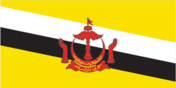
yellow with two diagonal bands of white (top, almost double width) and black starting from the upper hoist side; the national emblem in red is superimposed at the center; the emblem includes a swallow-tailed flag on top of a winged column within an upturned crescent above a scroll and flanked by two upraised hands
Government type
constitutional sultanate
Independence
1 January 1984 (from UK)
International organization participation
APEC, ASEAN, C, CCC, ESCAP, G-77, IBRD, ICAO, IDB, IFRCS, IMF, IMO, Inmarsat, Intelsat, Interpol, IOC, ISO (correspondent), ITU, NAM, OIC, UN, UNCTAD, UPU, WHO, WIPO, WMO, WTrO Diplomatic representation in the US: chief of mission: Ambassador Pengiran Anak Dato Haji PUTEH Ibni Mohammad Alam chancery: Watergate, Suite 300, 3rd floor, 2600 Virginia Avenue NW, Washington, DC 20037 telephone: [1] (202) 342-0159
Judicial branch
Supreme Court, chief justice and judges are sworn in by the sultan for three-year terms Political parties and leaders: Brunei United National Party (inactive), Anak HASANUDDIN, chairman; Brunei National Solidarity Party (the first legal political party and now banned), Mohamad HATTA bin Maji Zainal Abidin, secretary general; Brunei Peoples Party (banned), Sheik A. M. AZAHARI, leader; Brunei National Democratic Party or BNDP (deregistered), Haji Abdul LATIF bin Abdul Hamad, president
Legal system
based on English common law; for Muslims, Islamic Shari'a law supersedes civil law in a number of areas
Legislative branch
unicameral Legislative Council or Majlis Masyuarat Megeri (a privy council that serves only in a consultative capacity; NA seats; members appointed by the sultan) elections: last held in March 1962 note: in 1970 the Council was changed to an appointive body by decree of the sultan; an elected Legislative Council is being considered as part of constitutional reform, but elections are unlikely for several years
National capital
Bandar Seri Begawan
National holiday
National Day, 23 February (1984)
Suffrage
none
Economy
Agriculture-products
rice, cassava (tapioca), bananas; water buffalo
Budget
revenues: $2.5 billion expenditures: $2.6 billion, including capital expenditures of $768 million (1995 est.)
Currency
1 Bruneian dollar (B$) = 100 cents
Debt-external
$0
Economic aid
$NA
Economy-overview
This small, wealthy economy is a mixture of foreign and domestic entrepreneurship, government regulation and welfare measures, and village tradition. It is almost totally supported by exports of crude oil and natural gas, with revenues from the petroleum sector accounting for perhaps half of GDP. Per capita GDP is far above most other Third World countries, and substantial income from overseas investment supplements income from domestic production. The government provides for all medical services and subsidizes food and housing. The government is beginning to show progress on its basic policy of diversifying the economy away from oil and gas. Brunei's leaders are concerned that steadily increased integration in the world economy will undermine internal social cohesion.
Electricity-capacity
646,000 kW (1997 est.)
Electricity-consumption per capita
4,311 kWh (1995)
Electricity-production
1.26 billion kWh (1995)
Exchange rates
Bruneian dollars (B$) per US$1-1.7533 (January 1998), 1.4848 (1997), 1.4100 (1996), 1.4174 (1995), 1.5274 (1994), 1.6158 (1993); note-the Bruneian dollar is at par with the Singapore dollar
Exports
total value: $2.62 billion (f.o.b., 1996 est.) commodities: crude oil, liquefied natural gas, petroleum products partners: ASEAN 31%, Japan 27%, South Korea 26%, UK, Taiwan (1996 est.)
Fiscal year
calendar year Communications
GDP
purchasing power parity-$5.4 billion (1997 est.)
GDP-composition by sector
agriculture: 5% industry: 46% services: 49% (1996 est.)
GDP-per capita
purchasing power parity-$18,000 (1997 est.)
GDP-real growth rate
3.5% (1997 est.)
Imports
total value: $2.65 billion (c.i.f., 1996 est.) commodities: machinery and transport equipment, manufactured goods, food, chemicals partners: Singapore 29%, UK 19%, US 13%, Malaysia 9%, Japan 5% (1994 est.)
Industrial production growth rate
4% (1997 est.)
Industries
petroleum, petroleum refining, liquefied natural gas, construction
Inflation rate-consumer price index
2% (1997 est.)
Labor force
total: 144,000 (1995 est.); note-includes foreign workers and military personnel by occupation: government 48%, production of oil, natural gas, services, and construction 42%, agriculture, forestry, and fishing 4%, other 6% (1986 est.) note: temporary residents make up 41% of labor force (1991)
Radio broadcast stations
AM 4, FM 4, shortwave 0
Radios
284,000 (1995 est.)
Telephone system
service throughout country is excellent; international service good to Europe, US, and East Asia domestic: NA international: satellite earth stations-2 Intelsat (1 Indian Ocean and 1 Pacific Ocean)
Telephones
90,000 (1997 est.)
Television broadcast stations
1 (1984 est.)
Televisions
173,000 (1995 est.)
Unemployment rate
4.8% (1994 est.)
Transportation
Airports
2 (1997 est.) Airports-with paved runways: total: 1 over 3,047 m: 1 (1997 est.) Airports-with unpaved runways: total: 1 914 to 1,523 m: 1 (1997 est.)
Heliports
3 (1997 est.)
Highways
total: 1,150 km paved: 399 km unpaved: 751 km (1996 est.)
Merchant marine
total: 7 liquefied gas tankers (1,000 GRT or over) totaling 348,476 GRT/340,635 DWT (1997 est.)
Pipelines
crude oil 135 km; petroleum products 418 km; natural gas 920 km Ports and harbors: Bandar Seri Begawan, Kuala Belait, Muara, Seria, Tutong
Railways
total: 13 km (private line) narrow gauge: 13 km 0.610-m gauge
Waterways
209 km; navigable by craft drawing less than 1.2 m
Military and Security
Military branches
Land Forces, Navy, Air Force, Royal Brunei Police
Military expenditures-dollar figure
$312 million (1994)
Military expenditures-percent of GDP
6.2% (1994)
Military manpower-availability
males age 15-49: 87,048 (1998 est.) Military manpower-fit for military service: males: 50,408 (1998 est.)
Military manpower-military age
18 years of age
Military manpower-reaching military age annually
males: 3,126 (1998 est.)
Transnational Issues
Disputes-international
may wish to purchase the Malaysian salient that divides the country; possibly involved in a complex dispute over the Spratly Islands with China, Malaysia, Philippines, Taiwan, and Vietnam; in 1984, Brunei established an exclusive fishing zone that encompasses Louisa Reef in the southern Spratly Islands, but has not publicly claimed the island