1993 Edition
CIA World Factbook 1993 (Project Gutenberg)
Geography
Area
total area: 5,770 km2 land area: 5,270 km2 comparative area: slightly larger than Delaware
Climate
tropical; hot, humid, rainy
Coastline
161 km
Environment
typhoons, earthquakes, and severe flooding are rare
International disputes
may wish to purchase the Malaysian salient that divides the country; all of the Spratly Islands are claimed by China, Taiwan, and Vietnam; parts of them are claimed by Malaysia and the Philippines; in 1984, Brunei established an exclusive fishing zone that encompasses Louisa Reef, but has not publicly claimed the island
Irrigated land
10 km2 (1989 est.)
Land boundaries
total 381 km, Malysia 381 km
Land use
arable land: 1% permanent crops: 1% meadows and pastures: 1% forest and woodland: 79% other: 18%
Location
Southeast Asia, on the northern coast of Borneo almost completely surrounded by Malaysia
Map references
Asia, Oceania, Southeast Asia, Standard Time Zones of the World
Maritime claims
exclusive fishing zone: 200 nm territorial sea: 12 nm
Natural resources
petroleum, natural gas, timber
Note
close to vital sea lanes through South China Sea linking Indian and Pacific Oceans; two parts physically separated by Malaysia; almost an enclave of Malaysia
Terrain
flat coastal plain rises to mountains in east; hilly lowland in west
People and Society
Birth rate
26.55 births/1,000 population (1993 est.)
Death rate
5.02 deaths/1,000 population (1993 est.)
Ethnic divisions
Malay 64%, Chinese 20%, other 16%
Infant mortality rate
25.7 deaths/1,000 live births (1993 est.)
Labor force
89,000 (includes members of the Army) by occupation: government 47.5%, production of oil, natural gas, services, and construction 41.9%, agriculture, forestry, and fishing 3.8% (1986) note: 33% of labor force is foreign (1988)
Languages
Malay (official), English, Chinese
Life expectancy at birth
total population: 70.94 years male: 69.27 years female: 72.65 years (1993 est.)
Literacy
age 15 and over can read and write (1981) total population: 77% male: 85% female: 69%
Nationality
noun: Bruneian(s) adjective: Bruneian
Net migration rate
6.15 migrant(s)/1,000 population (1993 est.)
Population
276,984 (July 1993 est.)
Population growth rate
2.77% (1993 est.)
Religions
Muslim (official) 63%, Buddhism 14%, Christian 8%, indigenous beliefs and other 15% (1981)
Total fertility rate
3.45 children born/woman (1993 est.)
Government
Administrative divisions
4 districts (daerah-daerah, singular - daerah); Belait, Brunei and Muara, Temburong, Tutong
Capital
Bandar Seri Begawan
Chief of State and Head of Government
Sultan and Prime Minister His Majesty Paduka Seri Baginda Sultan Haji HASSANAL Bolkiah Mu'izzaddin Waddaulah (since 5 October 1967)
Constitution
29 September 1959 (some provisions suspended under a State of Emergency since December 1962, others since independence on 1 January 1984)
Digraph
BX
Diplomatic representation in US
chief of mission: Ambassador Mohamed KASSIM bin Haji Mohamed Daud chancery: 2600 Virginia Avenue NW, Suite 3000, Washington, DC 20037 telephone: (202) 342-0159
Executive branch
sultan, prime minister, Council of Cabinet Ministers
FAX
[673] (2) 225-293
Flag
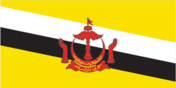
yellow with two diagonal bands of white (top, almost double width) and black starting from the upper hoist side; the national emblem in red is superimposed at the center; the emblem includes a swallow-tailed flag on top of a winged column within an upturned crescent above a scroll and flanked by two upraised hands
Independence
1 January 1984 (from UK)
Judicial branch
Supreme Court
Legal system
based on Islamic law
Legislative branch
unicameral Legislative Council (Majlis Masyuarat Megeri)
Legislative Council
last held in March 1962; in 1970 the Council was changed to an appointive body by decree of the sultan and no elections are planned
Member of
APEC, ASEAN, C, ESCAP, FAO, G-77, ICAO, IDB, IMO, INTERPOL, IOC, ISO (correspondent), ITU, OIC, UN, UNCTAD, UPU, WHO, WMO
Names
conventional long form: Negara Brunei Darussalam conventional short form: Brunei
National holiday
23 February (1984)
Political parties and leaders
Brunei United National Party (inactive), Anak HASANUDDIN, chairman; Brunei National Democratic Party (the first legal political party and now banned), leader NA
Suffrage
none
Type
constitutional sultanate
US diplomatic representation
chief of mission: Ambassador Donald Burnham ENSENAT embassy: Third Floor, Teck Guan Plaza, Jalan Sultan, Bandar Seri Begawan
Economy
Agriculture
imports about 80% of its food needs; principal crops and livestock include rice, cassava, bananas, buffaloes, and pigs
Budget
revenues $1.3 billion; expenditures $1.5 billion, including capital expenditures of $255 million (1989 est.)
Currency
1 Bruneian dollar (B$) = 100 cents
Economic aid
US commitments, including Ex-Im (FY70-87), $20.6 million; Western (non-US) countries, ODA and OOF bilateral commitments (1970-89), $153 million
Electricity
310,000 kW capacity; 890 million kWh produced, 3,300 kWh per capita (1990)
Exchange rates
Bruneian dollars (B$) per US$1 - 1.6531 (January 1993), 1.6290 (1992), 1.7276 (1991), 1.8125 (1990), 1.9503 (1989), 2.0124 (1988); note - the Bruneian dollar is at par with the Singapore dollar
Exports
$2.2 billion (f.o.b., 1990 est.) commodities: crude oil, liquefied natural gas, petroleum products partners: Japan 53%, UK 12%, South Korea 9%, Thailand 7%, Singapore 5% (1990)
External debt
$0
Fiscal year
calendar year
Imports
$1.7 billion (c.i.f., 1990 est.) commodities: machinery and transport equipment, manufactured goods, food, chemicals partners: Singapore 35%, UK 26%, Switzerland 9%, US 9%, Japan 5% (1990)
Industrial production
growth rate 12.9% (1987); accounts for 52.4% of GDP
Industries
petroleum, petroleum refining, liquefied natural gas, construction
Inflation rate (consumer prices)
1.3% (1989)
National product
GDP - exchange rate conversion - $3.5 billion (1990 est.)
National product per capita
$8,800 (1990 est.)
National product real growth rate
1% (1990 est.)
Overview
The economy is a mixture of foreign and domestic entrepreneurship, government regulation and welfare measures, and village tradition. It is almost totally supported by exports of crude oil and natural gas, with revenues from the petroleum sector accounting for more than 50% of GDP. Per capita GDP of $8,800 is among the highest in the Third World, and substantial income from overseas investment supplements domestic production. The government provides for all medical services and subsidizes food and housing.
Unemployment rate
3.7% (1989)
Communications
Airports
total: 2 usable: 2 with permanent-surface runways: 1 with runway over 3,659 m: 1 with runway 2,440-3,659 m: with runway 1,220-2,439 m: 1
Highways
1,090 km total; 370 km paved (bituminous treated) and another 52 km under construction, 720 km gravel or unimproved
Inland waterways
209 km; navigable by craft drawing less than 1.2 meters
Merchant marine
7 liquefied gas carriers (1,000 GRT or over) totaling 348,476 GRT/340,635 DWT
Pipelines
crude oil 135 km; petroleum products 418 km; natural gas 920 km
Ports
Kuala Belait, Muara
Railroads
13 km 0.610-meter narrow-gauge private line
Telecommunications
service throughout country is adequate for present needs; international service good to adjacent Malaysia; radiobroadcast coverage good; 33,000 telephones (1987); broadcast stations - 4 AM/FM, 1 TV; 74,000 radio receivers (1987); satellite earth stations - 1 Indian Ocean INTELSAT and 1 Pacific Ocean INTELSAT
Military and Security
Branches
Ground Force, Navy, Air Force, Royal Brunei Police
Defense expenditures
exchange rate conversion - $300 million, 9% of GDP (1990)
Manpower availability
males age 15-49 77,407; fit for military service 45,112; reach military age (18) annually 2,676 (1993 est.)