1987 Edition
CIA World Factbook 1987 (Internet Archive)
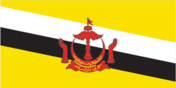
Geography
Boundary disputes
none; possible territorial claim in complex dispute over Spratly Islands involving China, Malaysia, Philippines, Taiwan, and Vietnam
Climate
tropical; hot, humid, rainy
Coastline
161 km
Comparative area
slightly larger than Delaware
Environment
typhoons, earthquakes, and severe flooding are rare
Exclusive fishing zone
200 nm
Land boundary
381 km with Malaysia
Land use
1% arable land; 1% permanent crops; 1% meadows and pastures; 79% forest and woodland; 18% other; includes NEGL®% irrigated
Member of
ASEAN, ESCAP (associate member), IMO, INTERPOL, O1C, UN
Special notes
close to vital sea lanes through South China Sea linking Indian and Pacific Oceans; two parts physically separated by Malaysia; almost an enclave of Malaysia
Terrain
flat coastal plain rises to mountains in east; hilly lowland in west
Territorial sea
12 nm
Total area
- 25. km_ South China Sea Kuala Belait
- 5,770 km?; land area: 5,270 km?
People and Society
Ethnic divisions
64% Malay, 20% Chinese, 16% other
Labor force
68,128 (includes members of the Army); 50.4% production of oil, natural gas, and construction; 47.6% trade, services, and other; 2.0% agriculture, forestry, and fishing (1984)
Language
Malay (official), English, and Chinese
Life expectancy
73.7
Literacy
45%
Nationality
noun—Bruneian(s); adjective—Bruneian
Organized labor
2% of labor force
Population
249,961 (July 1987), average annual growth rate 3.67%
Religion
60% Muslim (official); 8% Christian; 32% Buddhist and indigenous beliefs
Government
Administrative divisions
four administrative districts
Branches
chief of state is Sultan (advised by appointed Privy Council), who appoints Executive Council and Legislative Council
Capital
Bandar Seri Begawan
Communists
probably none
Elections
last elections—March 1965; further elections postponed indefinitely Political parties and leaders: Brunei National Democratic Party (established on 18 September 1985, the first legal political party), Abdul Latif bin Abdul Hamid, Chairman; Brunei National United Party (established on 4 February 1986), Anak Hasanuddin, chairman
Government leader
Sir HASSANAL Bolkiah, Sultan and Prime Minister (since August 1968)
Legal system
based on Islamic law; constitution promulgated by the Sultan in
National holiday
National Day, 23 February
Official name
State of Brunei Darussalam
Suffrage
universal at 21; three-tiered system of indirect elections; popular vote cast for lowest level (district councilors)
Type
constitutional sultanate; became a sovereign state and fully independent from United Kingdom on 1 January 1984
Economy
Agriculture
rice, pepper; imports most food
Budget
revenues, $2,109 million; expenditures, $1,219 million; surplus $890 million (1985)
Electric power
163,000 kW capacity; 470 million kWh produced, 2,000 kWh per capita (1986)
Exports
$3.1 billion (1985); 98-99% crude oil, liquefied natural gas, and petroleum products
Fiscal year
calendar year
GDP
$3.422 billion, $14,750 per capita (1985)
Imports
$640 million (1985); includes machinery and transport equipment, manufactured goods, food, beverages, tobacco, and other; most consumer goods imported
Major industry
crude petroleum, liquefied natural gas, construction
Major trade partners
exports—{erude petroleum and liquefied natural gas) roughly two-thirds to Japan; imports— Singapore 24%, Japan 20%, US 16% (1985)
Monetary conversion rate
2.16 Brunei dollars=US$1 (March 1986) inflation under 2.0% (1985/86)
Natural resources
oil, natura! gas
Communications
Airfields
3 total, 2 usable; 2 with permanent-surface runways; 1 with runways over 3,659 m; 1 with runways 1,220-2,439 m
Civil air
8 major transport aircraft
Highways
1,090 km total; 370 km paved (bituminous treated) and another 52 km under construction, 720 km gravel or unimproved
Inland waterways
209 km; navigable by craft drawing less than 1.2 meters
Pipelines
crude oil, 135 km; refined products, 418 km; natural gas, 920 km
Ports
1 major (Muara), 4 minor
Railroads
13 km 0.610-meter narrowgauge private line
Telecommunications
service throughout country is adequate for present needs; international service good to adjacent Sabah and Sarawak; radiobroadcast coverage good; 27,000 telephones (11.0 per 100 popl.); Radio Brunei broadcasts from 4 AM/FM stations and 1 TV station; 52,000 radio receivers; 1 satellite station
Military and Security
Branches
Royal Brunei Armed Forces, including air wing, navy, and ground forces; British Gurkha Battalion; Royal Brunei Police; Gurkha Reserve Unit
Military budget
for fiscal year ending 31 December 1986, $197.6 million; about 17% of central government budget
Military manpower
males 15-49, 61,000; 37,000 fit for military service; about 3,300 reach military age (18) annually