1991 Edition
CIA World Factbook 1991 (Project Gutenberg)
Geography
Climate
mostly tropical, but temperate in south
Coastline
7,491 km
Comparative area
slightly smaller than the US
Disputes
short section of the boundary with Paraguay (just west of Guaira Falls on the Rio Parana) is in dispute; two short sections of boundary with Uruguay are in dispute (Arroyo de la Invernada area of the Rio Quarai and the islands at the confluence of the Rio Quarai and the Uruguay); has noted possible Latin claims in Antarctica
Environment
recurrent droughts in northeast; floods and frost in south; deforestation in Amazon basin; air and water pollution in Rio de Janeiro and Sao Paulo
Land boundaries
14,691 km total; Argentina 1,224 km, Bolivia 3,400 km, Colombia 1,643 km, French Guiana 673 km, Guyana 1,119 km, Paraguay 1,290 km, Peru 1,560 km, Suriname 597 km, Uruguay 985 km, Venezuela 2,200 km
Land use
arable land 7%; permanent crops 1%; meadows and pastures 19%; forest and woodland 67%; other 6%; includes irrigated NEGL%
Maritime claims
Continental shelf: 200 m (depth) or to depth of exploitation; Exclusive fishing zone: 200 nm; Territorial sea: 200 nm
Natural resources
iron ore, manganese, bauxite, nickel, uranium, phosphates, tin, hydropower, gold, platinum, crude oil, timber
Note
largest country in South America; shares common boundaries with every South American country except Chile and Ecuador
Terrain
mostly flat to rolling lowlands in north; some plains, hills, mountains, and narrow coastal belt
Total area
8,511,965 km2; land area: 8,456,510 km2; includes Arquipelago de Fernando de Noronha, Atol das Rocas, Ilha da Trindade, Ilhas Martin Vaz, and Penedos de Sao Pedro e Sao Paulo
People and Society
Birth rate
26 births/1,000 population (1991)
Death rate
7 deaths/1,000 population (1991)
Ethnic divisions
Portuguese, Italian, German, Japanese, black, Amerindian; white 55%, mixed 38%, black 6%, other 1%
Infant mortality rate
68 deaths/1,000 live births (1991)
Labor force
57,000,000 (1989 est.); services 42%, agriculture 31%, industry 27%
Language
Portuguese (official), Spanish, English, French
Life expectancy at birth
62 years male, 68 years female (1991)
Literacy
81% (male 82%, female 80%) age 15 and over can read and write (1990 est.)
Nationality
noun--Brazilian(s); adjective--Brazilian
Net migration rate
0 migrants/1,000 population (1991)
Organized labor
13,000,000 dues paying members (1989 est.)
Population
155,356,073 (July 1991), growth rate 1.8% (1991)
Religion
Roman Catholic (nominal) 90%
Total fertility rate
3.1 children born/woman (1991)
Government
Administrative divisions
26 states (estados, singular--estado) and 1 federal district* (distrito federal); Acre, Alagoas, Amapa, Amazonas, Bahia, Ceara, Distrito Federal*, Espirito Santo, Goias, Maranhao, Mato Grosso, Mato Grosso do Sul, Minas Gerais, Para, Paraiba, Parana, Pernambuco, Piaui, Rio de Janeiro, Rio Grande do Norte, Rio Grande do Sul, Rondonia, Roraima, Santa Catarina, Sao Paulo, Sergipe, Tocantins; note--the former territories of Amapa and Roraima became states in January 1991
Capital
Brasilia
Communists
about 30,000
Constitution
5 October 1988
Diplomatic representation
Ambassador Marcilio Marques MOREIRA; Chancery at 3006 Massachusetts Avenue NW, Washington DC 20008; telephone (202) 745-2700; there are Brazilian Consulates General in Atlanta, Chicago, Los Angeles, Miami, New Orleans, and New York, and Consulates in Dallas, Houston, and San Francisco; US--Ambassador Richard MELTON; Embassy at Avenida das Nocoes, Lote 3, Brasilia, Distrito Federal (mailing address is APO Miami 34030); telephone [55] (6) 321-7272; there are US Consulates General in Rio de Janeiro and Sao Paulo, and Consulates in Porto Alegre and Recife
Elections
President--last held 15 November 1989, with runoff on 17 December 1989 (next to be held November 1994); results--Fernando COLLOR de Mello 53%, Luis Inacio da SILVA 47%; note--first free, direct presidential election since 1960; Senate--last held 3 October 1990 (next to be held November 1994); results--percent of vote by party NA; seats--(81 total as of 3 February 1991) PMDB 27, PFL 15, PSDB 10, PTB 8, PDT 5, other 16; Chamber of Deputies--last held 3 October 1990 (next to be held November 1994); results--PMDB 21%, PFL 17%, PDT 9%, PDS 8%, PRN 7.9%, PTB 7%, PT 7%, other 23.1%; seats--(503 total as of 3 February 1991) PMDB 108, PFL 87, PDT 46, PDS 43, PRN 40, PTB 35, PT 35, other 109;
Executive branch
president, vice president, Cabinet
Flag
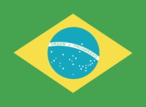
green with a large yellow diamond in the center bearing a blue celestial globe with 23 white five-pointed stars (one for each state) arranged in the same pattern as the night sky over Brazil; the globe has a white equatorial band with the motto ORDEM E PROGRESSO (Order and Progress)
Independence
7 September 1822 (from Portugal)
Judicial branch
Supreme Federal Tribunal
Leaders
Chief of State and Head of Government--President Fernando Affonso COLLOR de Mello (since 15 March 1990); Vice President Itamar FRANCO (since 15 March 1990)
Legal system
based on Latin codes; has not accepted compulsory ICJ jurisdiction
Legislative branch
bicameral National Congress (Congresso Nacional) consists of an upper chamber or Federal Senate (Senado Federal) and a lower chamber or Chamber of Deputies (Camara dos Deputados)
Long-form name
Federative Republic of Brazil
Member of
AfDB, AG (observer), CCC, ECLAC, FAO, G-11, G-19, G-24, G-77, GATT, IADB, IAEA, IBRD, ICAO, ICC, ICFTU, IDA, IFAD, IFC, ILO, IMF, IMO, INMARSAT, INTELSAT, INTERPOL, IOC, IOM (observer), ISO, ITU, LAES, LAIA, LORCS, NAM (observer), OAS, OPANAL, PCA, RG, UN, UNAVEM, UNCTAD, UNESCO, UNHCR, UNIDO, UPU, WCL, WHO, WIPO, WMO, WTO
National holiday
Independence Day, 7 September (1822)
Other political or pressure groups
left wing of the Catholic Church and labor unions allied to leftist Worker's Party are critical of government's social and economic policies
Political parties and leaders
National Reconstruction Party (PRN), Daniel TOURINHO, president; Brazilian Democratic Movement Party (PMDB), Orestes QUERCIA, president; Liberal Front Party (PFL), Hugo NAPOLEAO, president; Workers' Party (PT), Luis Ignacio (Lula) da SILVA, president; Brazilian Labor Party (PTB), Luiz GONZAGA de Paiva Muniz, president; Democratic Labor Party (PDT), Leonel BRIZOLA, president; Democratic Social Party (PDS), Amaral NETTO, president; Brazilian Social Democracy Party (PSDB), Mario COVAS, president; Brazilian Communist Party (PCB), Salomao MALINA, secretary general; Communist Party of Brazil (PCdoB), Joao AMAZONAS, president; Christian Democratic Party (PDC), Eduardo CAMPOS, president
Suffrage
voluntary at age 16; compulsory between ages 18 and 70; voluntary at age 70
Type
federal republic
Economy
Agriculture
accounts for 12% of GDP; world's largest producer and exporter of coffee and orange juice concentrate and second-largest exporter of soybeans; other products--rice, corn, sugarcane, cocoa, beef; self-sufficient in food, except for wheat
Budget
revenues $36.5 billion; expenditures $48.2 billion, including capital expenditures of $4.6 billion (1988)
Currency
cruzeiro (plural--cruzeiros); 1 cruzeiro (Cr$) = 100 centavos
Economic aid
US commitments, including Ex-Im (FY70-89), $2.5 billion; Western (non-US) countries, ODA and OOF bilateral commitments (1970-88), $9.9 billion; OPEC bilateral aid (1979-89), $284 million; Communist countries (1970-89), $1.3 billion
Electricity
55,773,000 kW capacity; 214,116 million kWh produced, 1,400 kWh per capita (1990)
Exchange rates
cruzeiros (Cr$) per US$1--193.189 (January 1991), 68.300 (1990), 2.834 (1989), 0.26238 (1988), 0.03923 (1987), 0.01366 (1986), 0.00620 (1985)
Exports
$31.4 billion (1990); commodities--iron ore, soybean bran, orange juice, footwear, coffee partners--EC 29%, US 23%, Latin America 10%, Japan 7% (1989)
External debt
$122 billion (December 1990)
Fiscal year
calendar year
GDP
$388 billion, per capita $2,540; real growth rate - 4.6% (1990)
Illicit drugs
illicit producer of cannabis and coca, mostly for domestic consumption; government has a modest eradication program to control cannabis and coca cultivation
Imports
$20.4 billion (1990); commodities--crude oil, capital goods, chemical products, foodstuffs, coal; partners--US 21%, Middle East and Africa 20%, EC 20%, Latin America 18%, Japan 7% (1989)
Industrial production
growth rate - 8.9% (1990); accounts for 35% of GDP
Industries
textiles and other consumer goods, shoes, chemicals, cement, lumber, iron ore, steel, motor vehicles and auto parts, metalworking, capital goods, tin
Inflation rate (consumer prices)
1,795% (December 1990)
Overview
The economy, with large agrarian, mining, and manufacturing sectors, entered the 1990s with declining real growth, runaway inflation, an unserviceable foreign debt of $122 billion, and a lack of policy direction. In addition, the economy remained highly regulated, inward-looking, and protected by substantial trade and investment barriers. Ownership of major industrial and mining facilities is divided among private interests--including several multinationals--and the government. Most large agricultural holdings are private, with the government channeling financing to this sector. Conflicts between large landholders and landless peasants have produced intermittent violence. The government is seeking an IMF standby loan despite several failed agreements over the past decade. Relations with foreign commercial banks remain strained because of mounting interest arrears on Brazil's long-term debt. The Collor government, which assumed office in March 1990, is embarked on an ambitious reform program that seeks to modernize and reinvigorate the economy by stabilizing prices, deregulating the economy, and opening it to increased foreign competition. A major long-run strength is Brazil's vast natural resources.
Unemployment rate
4.4% (1990)
Communications
Airports
3,751 total, 3,078 usable; 401 with permanent-surface runways; 2 with runways over 3,659 m; 22 with runways 2,240-3,659 m; 533 with runways 1,220-2,439 m
Civil air
176 major transport aircraft
Highways
1,448,000 km total; 48,000 km paved, 1,400,000 km gravel or earth
Inland waterways
50,000 km navigable
Merchant marine
263 ships (1,000 GRT or over) totaling 5,898,838 GRT/9,975,272 DWT; includes 2 passenger-cargo, 59 cargo, 1 refrigerated cargo, 13 container, 7 roll-on/roll-off, 60 petroleum, oils, and lubricants (POL) tanker, 15 chemical tanker, 11 liquefied gas, 14 combination ore/oil, 79 bulk, 2 combination bulk; additionally, 2 naval tanker and 4 military transport are sometimes used commercially
Pipelines
crude oil, 2,000 km; refined products, 3,804 km; natural gas, 1,095 km
Ports
Belem, Fortaleza, Ilheus, Manaus, Paranagua, Porto Alegre, Recife, Rio de Janeiro, Rio Grande, Salvador, Santos
Railroads
29,694 km total; 25,268 km 1.000-meter gauge, 4,339 km 1.600-meter gauge, 74 km mixed 1.600-1.000-meter gauge, 13 km 0.760-meter gauge; 2,308 km electrified
Telecommunications
good system; extensive radio relay facilities; 9.86 million telephones; stations--1,223 AM, no FM, 112 TV, 151 shortwave; 3 coaxial submarine cables 3 Atlantic Ocean INTELSAT earth stations with total of 3 antennas; 64 domestic satellite stations
Military and Security
Branches
Brazilian Army, Navy of Brazil (including Marines), Brazilian Air Force, Federal Police Force
Defense expenditures
$1.1 billion, 2.6% of GDP (1990) _%_
Manpower availability
males 15-49, 40,559,052; 27,364,392 fit for military service; 1,637,434 reach military age (18) annually