1998 Edition
CIA World Factbook 1998 (Internet Archive)
Geography
Area
total: 51,233 sq km land: 51,233 sq km water: 0 sq km
Area-comparative
slightly smaller than West Virginia
Climate
hot summers and cold winters; areas of high elevation have short, cool summers and long, severe winters; mild, rainy winters along coast
Coastline
20 km
Elevation extremes
lowest point: Adriatic Sea 0 m highest point: Maglic 2,386 m
Environment-current issues
air pollution from metallurgical plants; sites for disposing of urban waste are limited; widespread casualties, water shortages, and destruction of infrastructure because of the 1992-95 civil strife
Environment-international agreements
party to: Air Pollution, Law of the Sea, Marine Dumping, Marine Life Conservation, Nuclear Test Ban, Ozone Layer Protection signed, but not ratified: none of the selected agreements
Geographic coordinates
44 00 N, 18 00 E
Geography-note
within Bosnia and Herzegovina's recognized borders, the country is divided into a joint Muslim/Croat Federation (about 51% of the territory) and a Serb Republic, The Republika Srpska [RS] (about 49% of the territory); the region called Herzegovina is contiguous to Croatia and traditionally has been settled by an ethnic Croat majority
Irrigated land
20 sq km (1993 est.)
Land boundaries
total: 1,459 km border countries: Croatia 932 km, Serbia and Montenegro 527 km (312 km with Serbia, 215 km with Montenegro)
Land use
arable land: 14% permanent crops: 5% permanent pastures: 20% forests and woodland: 39% other: 22% (1993 est.)
Location
Southeastern Europe, bordering the Adriatic Sea and Croatia
Map references
Bosnia and Herzegovina, Europe
Maritime claims
NA
Natural hazards
frequent and destructive earthquakes
Natural resources
coal, iron, bauxite, manganese, forests, copper, chromium, lead, zinc
Terrain
mountains and valleys
People and Society
Age structure
0-14 years: 18% (male 307,857; female 291,424) 15-64 years: 71% (male 1,177,516; female 1,195,419) 65 years and over: 11% (male 156,041; female 237,470) (July 1998 est.)
Birth rate
8.72 births/1,000 population (1998 est.)
Death rate
12.32 deaths/1,000 population (1998 est.)
Ethnic groups
Serb 40%, Muslim 38%, Croat 22% (est.)
Infant mortality rate
30.8 deaths/1,000 live births (1998 est.)
Languages
Serbo-Croatian (often called Bosnian) 99%
Life expectancy at birth
total population: 63.03 years male: 58.35 years female: 68.02 years (1998 est.)
Literacy
NA
Nationality
noun: Bosnian(s), Herzegovinian(s) adjective: Bosnian, Herzegovinian
Net migration rate
39.91 migrant(s)/1,000 population (1998 est.)
Population
3,365,727 (July 1998 est.) note: all data dealing with population is subject to considerable error because of the dislocations caused by military action and ethnic cleansing
Population growth rate
3.63% (1998 est.)
Religions
Muslim 40%, Orthodox 31%, Catholic 15%, Protestant 4%, other 10%
Sex ratio
at birth: 1.07 male(s)/female under 15 years: 1.05 male(s)/female 15-64 years: 0.98 male(s)/female 65 years and over: 0.65 male(s)/female (1998 est.)
Total fertility rate
1.14 children born/woman (1998 est.)
Government
Administrative divisions
there are two first-order administrative divisions approved by the US Government-the Muslim/Croat Federation of Bosnia and Herzegovina (Federacija Bosna i Hercegovina) and Republika Srpska; it has been reported that the Muslim/Croat Federation is comprised of 10 cantons identified by either number or name - Goradzde (5), Livno (10), Middle Bosnia (6), Neretva (7), Posavina (2), Sarajevo (9), Tuzla Podrinje (3), Una Sana (1), West Herzegovina (8), Zenica Doboj (4)
Constitution
the Dayton Agreement, signed 14 December 1995, included a new constitution now in force
Country name
conventional long form: none conventional short form: Bosnia and Herzegovina local long form: none local short form: Bosna i Hercegovina
Data code
BK
Executive branch
chief of state: Chairman of the Presidency Alija IZETBEGOVIC (since 14 September 1996); other members of the three-member rotating presidency: Kresimir ZUBAK (since 14 September 1996-Croat) and Momcilo KRAJISNIK (since 14 September 1996 - Serb) head of government: Cochairman of the Council of Ministers Haris SILAJDZIC (since NA January 1997); Cochairman of the Council of Ministers Boro BOSIC (since NA January 1997) NA cabinet: Council of Ministers nominated by the council chairmen note: president of the Muslim/Croat Federation of Bosnia and
FAX
- [1] (202) 833-2061 consulate(s) general: New York Diplomatic representation from the US: chief of mission: Ambassador Richard KAUZLARICH embassy: 43 Ul. Dure Dakovica, Sarajevo mailing address: use street address telephone: [387] (71) 445-700, 667-391, 667-389, 667-743, 667-390, 659-969, 659-992
- [387] (71) 659-722
Flag description
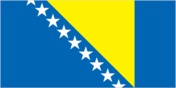
a wide medium blue vertical band on the fly side with a yellow isosceles triangle abutting the band and the top of the flag; the remainder of the flag is medium blue with seven full five-pointed white stars and two half stars top and bottom along the hypotenuse of the triangle
Government type
emerging democracy
Government-note
Until declaring independence in spring 1992, Bosnia and Herzegovina existed as a republic in the former Yugoslavia. Bosnia was partitioned by fighting during 1992-95 and governed by competing ethnic factions. Bosnia's current governing structures were created by the Dayton Accords, the 1995 peace agreement which was officially signed in Paris on 14 December 1995 by Bosnian President IZETBEGOVIC, Croatian President TUDJMAN, and Serbian President MILOSEVIC. This agreement retained Bosnia's exterior border and created a joint multi-ethnic and democratic government. This national government-based on proportional representation similar to that which existed in the former socialist regime-is charged with conducting foreign, economic, and fiscal policy. The Dayton Accords also recognized a second tier of government, comprised of two entities-a joint Muslim/Croat Federation and the Bosnian Serb Republika Srpska (RS)-each presiding over roughly one-half the territory. The Federation and RS governments are charged with overseeing internal functions. As mandated by the Dayton Accords, the Bosnians on 14 September 1996 participated in the first post-war elections of national, entity, and cantonal leaders. The Bosnians have been slow to form and install new joint institutions. A new Federation cabinet was sworn in 18 December 1996 and the new Bosnian central government cabinet was confirmed on 3 January 1997. The Bosnians on 13-14 September 1997 participated in municipal elections, postponed in 1996 because of voter registration irregularities.
Herzegovina
Ejup GANIC (since 1 January 1998); president of the
Independence
NA April 1992 (from Yugoslavia)
International organization participation
CE (guest), CEI, EBRD, ECE, FAO, IAEA, IBRD, ICAO, IDA, IFAD, IFC, ILO, IMF, IMO, Intelsat, Interpol, IOC, IOM (observer), ISO, ITU, NAM (guest), OIC (observer), OSCE, UN, UNCTAD, UNESCO, UNIDO, UPU, WHO, WIPO, WMO, WToO Diplomatic representation in the US: chief of mission: Ambassador Sven ALKALAJ chancery: Suite 760, 1707 L Street NW, Washington, DC 20036 telephone: [1] (202) 833-3612, 3613, 3615
Judicial branch
Supreme Court, supervised by the Ministry of Justice; Constitutional Court, supervised by the Ministry of Justice Political parties and leaders: Party of Democratic Action or SDA [Alija IZETBEGOVIC]; Croatian Democratic Union of BiH or HDZ-BiH [Bozo RAJIC]; Serb Democratic Party or SDS [Aleksa BUHA]; Party for Bosnia and Herzegovina or SBiH [Haris SILAJDZIC]; Joint List (consists of the following parties: UBSD, RP, MBO, HSG, and SPP); Civic Democratic Party or GDS [Ibrahim SPAHIC]; Croatian Peasants' Party of BiH or HSS [Ivo KOMSIC]; Independent Social Democratic Party or SNSD [Milorad DODIK]; Liberal Bosniak Organization or LBO [Muhamed FILIPOVIC]; Liberal Party or LS [Rasim KADIC, president]; Muslim-Bosniac Organization or MBO [Adil ZULFIKARPASIC]; Republican Party of Bosnia and Herzegovina or RS [Stjepan KLJUIC]; Serb Civic Council or SGV [Mirko PEJANOVIC]; Social Democratic Party or SDP (formerly the Democratic Party of Socialists or DSS) [Zlatko LAGUMDZIJA]; Socialist Party of Republika Srpska or SPRS [Zivko RADISIC]; Social Democrats of Bosnia Herzegovina [Selim BESLAGIC]; Serb Radical Party of RS [Nikola POPLASEN]; Serb Party of Krojina and Posavina or SSKIP [Predrag LAZAREVIC]; National Democratic Union (also known as Democratic People's Union or DNZ) [Fikret ABDIC]; Serb National Alliance or SNS [Biljana PLAVSIC]; Coalition for a United and Democratic BiH (coalition of SDA, SBiH, LS, and GDS) note: 82 parties participated in the September 1997 municipal elections Political pressure groups and leaders: NA
Legal system
based on civil law system
Legislative branch
bicameral Parliamentary Assembly or Skupstina consists of the National House of Representatives or Vijece Opcina (42 seats-14 Serb, 14 Croat, and 14 Muslim; members serve two-year terms) and the House of Peoples or Vijece Gradanstvo (15 seats-5 Muslim, 5 Croat, 5 Serb; members serve two-year terms) elections: National House of Representatives-elections last held 14 September 1996 (next to be held NA); note-the House of Peoples is elected by the Muslim/Croat Federation's 140-seat House of Representatives (two-thirds) and the Republika Srpska's 83-seat National Assembly (one-third) election results: National House of Representatives: two-thirds chosen from the Muslim/Croat Federation: percent of vote by party-NA; seats by party-SDA 16, HDZ-BiH 7, Joint List of Social Democrats 3, Party for Bosnia and Herzegovina 2; one-third chosen from the Bosnian Serb
National capital
Sarajevo
National holiday
Republika Srpska-"Republic Day," 9 January; Independence Day, 1 March; Bosnia-"Republic Day," 25 November
Republic
percent of vote by party-NA; seats by party-SDS 9, SDA 3, Democratic Patriotic Front/Union for Peace and Progress 2 note: the Muslim/Croat Federation has a House of Representatives with 140 seats: seats by party-SDA 80, HDZ-BiH 33, Party for Bosnia and Herzegovina 11, Joint List of Social Democrats 10, other 6; the Republika Srpska has a National Assembly with 83 seats: seats by party-SDS 24, Serb Radical Party 15, Serb National Alliance 15, Socialist Party 9, Independent Social Democrats 2, Coalition for United Bosnia and Herzegovina and others 18
Republika Srpska
Biljana PLAVSIC (since September 1996) elections: the three presidency members (one each Muslim, Croat, Serb) are elected by direct election (first election for a two-year term, thereafter for a four-year term); the president with the most votes becomes the chairman; election last held 14 September 1996 (next to be held September 1998); the cochairmen are nominated by the presidency election results: Alija IZETBEGOVIC elected chairman of the collective presidency with the highest number of votes; percent of vote-Alija IZETBEGOVIC received 80% of the Muslim vote to Haris SILAJDZIC's 14%; Kresimir ZUBAK received 88% of the Croat vote to Ivo KOMSIC's 11%; Momcilo KRAJISNIK received 68% of the Serb vote to Mladen IVANIC's 30%
Suffrage
16 years of age, if employed; 18 years of age, universal
Economy
Agriculture-products
wheat, corn, fruits, vegetables; livestock
Budget
revenues: $NA expenditures: $NA, including capital expenditures of $NA
Currency
1 convertible marka = 100 convertible pfenniga; former currencies still used
Debt-external
$3.5 billion (yearend 1995 est.)
Economic aid
recipient: $1.2 billion (1997 pledged)
Economy-overview
Bosnia and Herzegovina ranked next to The Former Yugoslav Republic of Macedonia as the poorest republic in the old Yugoslav federation. Although agriculture has been almost all in private hands, farms have been small and inefficient, and the republic traditionally has been a net importer of food. Industry has been greatly overstaffed, one reflection of the rigidities of communist central planning and management. TITO had pushed the development of military industries in the republic with the result that Bosnia hosted a large share of Yugoslavia's defense plants. The bitter interethnic warfare in Bosnia caused production to plummet by 80% from 1990 to 1995, unemployment to soar, and human misery to multiply. With an uneasy peace in place, output has recovered in 1996-97 at high percentage rates on a low base, but remains less than half the 1990 level. The country, especially in the Muslim-Croat area, receives substantial amounts of humanitarian aid from the international community. Wide regional differences in war damage and access to the outside world have resulted in substantial variations in living conditions among local areas and individual families.
Electricity-capacity
2.339 million kW (1995)
Electricity-consumption per capita
506 kWh (1995)
Electricity-production
1.4 billion kWh (1995)
Exchange rates
NA
Exports
total value: $152 million (1995 est.) commodities: NA partners: NA
Fiscal year
calendar year Communications
GDP
purchasing power parity-$4.41 billion (1997 est.)
GDP-composition by sector
agriculture: 19% industry: 23% services: 58% (1996 est.)
GDP-per capita
purchasing power parity-$1,690 (1997 est.)
GDP-real growth rate
35% (1997 est.)
Imports
total value: $1.1 billion (1995 est.) commodities: NA partners: NA
Industrial production growth rate
NA%
Industries
steel, coal, iron ore, lead, zinc, manganese, bauxite, vehicle assembly, textiles, tobacco products, wooden furniture, tank and aircraft assembly, domestic appliances, oil refining; much of capacity damaged or shut down (1995)
Inflation rate-consumer price index
NA%
Labor force
total: 1,026,254 by occupation: NA%
Radio broadcast stations
AM 9, FM 2, shortwave 0
Radios
840,000
Telephone system
telephone and telegraph network is in need of modernization and expansion; many urban areas are below average when compared with services in other former Yugoslav republics domestic: NA international: no satellite earth stations
Telephones
727,000
Television broadcast stations
6
Televisions
1,012,094
Unemployment rate
40%-50% (1996 est.)
Transportation
Airports
26 (1997 est.) Airports-with paved runways: total: 9 2,438 to 3,047 m: 4 1,524 to 2,437 m: 2 914 to 1,523 m: 1 under 914 m: 2 (1997 est.) Airports-with unpaved runways: total: 17 1,524 to 2,437 m: 1 914 to 1,523 m: 9 under 914 m: 7 (1997 est.)
Heliports
2 (1997 est.)
Highways
total: 21,846 km paved: 11,425 km unpaved: 10,421 km (1996 est.) note: roads need maintenance and repair
Merchant marine
none
Pipelines
crude oil 174 km; natural gas 90 km (1992); note-pipelines now disrupted Ports and harbors: Bosanski Brod (an inland waterway port on the Sava which is not useable), Orasje (ferry)
Railways
total: 1,021 km (electrified 795 km; operating as diesel or steam until grids are repaired) standard gauge: 1,021 km 1.435-m gauge (1995); note-some segments still need repair and/or reconstruction
Waterways
NA km; Sava blocked by downed bridges
Military and Security
Military branches
Army
Military expenditures-dollar figure
$NA
Military expenditures-percent of GDP
NA%
Military manpower-availability
males age 15-49: 912,536 (1998 est.) Military manpower-fit for military service: males: 733,931 (1998 est.)
Military manpower-military age
19 years of age
Military manpower-reaching military age annually
males: 26,114 (1998 est.)
Transnational Issues
Disputes-international
disputes with Serbia over Serbian populated areas
Illicit drugs
transit point for minor regional marijuana and opiate trafficking routes