1995 Edition
CIA World Factbook 1995 (Project Gutenberg)
Geography
Area
total area: 51,233 sq km land area: 51,233 sq km comparative area: slightly larger than Tennessee
Climate
hot summers and cold winters; areas of high elevation have short, cool summers and long, severe winters; mild, rainy winters along coast
Coastline
20 km
Environment
current issues: air pollution from metallurgical plants; sites for disposing of urban waste are limited; widespread casualties, water shortages, and destruction of infrastructure because of civil strife natural hazards: frequent and destructive earthquakes international agreements: party to - Air Pollution, Law of the Sea, Marine Dumping, Marine Life Conservation, Nuclear Test Ban, Ozone Layer Protection
International disputes
as of January 1995, Bosnian Government and Bosnian Serb leaders remain far apart on territorial and constitutional solutions for Bosnia; the two sides did, however, sign a four-month cessation of hostilities agreement effective January 1; the Bosnian Serbs continue to reject the Contact Group Plan submitted by the United States, United Kingdom, France, Germany, and Russia, and accepted by the Bosnian Government, which stands firm in its desire to regain lost territory and preserve Bosnia as a multiethnic state within its current borders; Bosnian Serb forces control approximately 70% of Bosnian territory
Irrigated land
NA sq km
Land boundaries
total 1,459 km, Croatia 932 km, Serbia and Montenegro 527 km (312 km with Serbia; 215 km with Montenegro)
Land use
arable land: 20% permanent crops: 2% meadows and pastures: 25% forest and woodland: 36% other: 17%
Location
Southeastern Europe, bordering the Adriatic Sea and Croatia
Map references
Ethnic Groups in Eastern Europe, Europe
Maritime claims
NA
Natural resources
coal, iron, bauxite, manganese, timber, wood products, copper, chromium, lead, zinc
Terrain
mountains and valleys
People and Society
Age structure
0-14 years: 22% (female 337,787; male 370,966) 15-64 years: 68% (female 1,082,357; male 1,085,610) 65 years and over: 10% (female 190,992; male 134,111) (July 1995 est.)
Birth rate
11.29 births/1,000 population (1995 est.)
Death rate
7.51 deaths/1,000 population (1995 est.)
Ethnic divisions
Muslim 38%, Serb 40%, Croat 22% (est.)
Infant mortality rate
11.6 deaths/1,000 live births (1995 est.)
Labor force
1,026,254 by occupation: NA%
Languages
Serbo-Croatian 99%
Life expectancy at birth
total population: 75.47 years male: 72.75 years female: 78.37 years (1995 est.)
Literacy
NA%
Nationality
noun: Bosnian(s), Herzegovinian(s) adjective: Bosnian, Herzegovinian
Net migration rate
2.72 migrant(s)/1,000 population (1995 est.)
Population
3,201,823 (July 1995 est.) note: all data dealing with population is subject to considerable error because of the dislocations caused by military action and ethnic cleansing
Population growth rate
0.65% (1995 est.)
Religions
Muslim 40%, Orthodox 31%, Catholic 15%, Protestant 4%, other 10%
Total fertility rate
1.65 children born/woman (1995 est.)
Government
Administrative divisions
109 districts (opstinas, singular - opstina) Banovici, Banja Luka, Bihac, Bijeljina, Bileca, Bosanska Dubica, Bosanska Gradiska, Bosanska Krupa, Bosanski Brod, Bosanski Novi, Bosanski Petrovac, Bosanski Samac, Bosansko Grahovo, Bratunac, Brcko, Breza, Bugojno, Busovaca, Cazin, Cajnice, Capljina, Celinac, Citluk, Derventa, Doboj, Donji Vakuf, Foca, Fojnica, Gacko, Glamoc, Gorazde, Gornji Vakuf, Gracanica, Gradacac, Grude, Han Pijesak, Jablanica, Jajce, Kakanj, Kalesija, Kalinovik, Kiseljak, Kladanj, Kljuc, Konjic, Kotor Varos, Kresevo, Kupres, Laktasi, Listica, Livno, Lopare, Lukavac, Ljubinje, Ljubuski, Maglaj, Modrica, Mostar, Mrkonjic-Grad, Neum, Nevesinje, Odzak, Olovo, Orasje, Posusje, Prijedor, Prnjavor, Prozor, (Pucarevo) Novi Travnik, Rogatica, Rudo, Sanski Most, Sarajevo-Centar, Sarajevo-Hadzici, Sarajevo-Ilidza, Sarajevo-Ilijas, Sarajevo-Novi Grad, Sarajevo-Novo, Sarajevo-Pale, Sarajevo-Stari Grad, Sarajevo-Trnovo, Sarajevo-Vogosca, Skender Vakuf, Sokolac, Srbac, Srebrenica, Srebrenik, Stolac, Sekovici, Sipovo, Teslic, Tesanj, Drvar, Duvno, Travnik, Trebinje, Tuzla, Ugljevik, Vares, Velika Kladusa, Visoko, Visegrad, Vitez, Vlasenica, Zavidovici, Zenica, Zvornik, Zepce, Zivinice note: currently under negotiation with the assistance of international mediators
Capital
Sarajevo
Chamber of Citizens (Vijece Gradanstvo)
elections last held November-December 1990 (next to be held NA); percent of vote by party NA; seats - (130 total) SDA 43, SDS BiH 34, HDZ BiH 21, Party of Democratic Changes 15, SRSJ BiH 12, LBO 2, DSS 1, DSZ 1, LS 1 note: legislative elections for Federation of Bosnia and Herzegovina are slated for late 1994
Chamber of Municipalities (Vijece Opeina)
elections last held November-December 1990 (next to be held NA); percent of vote by party NA; seats - (110 total) SDA 43, SDS BiH 38, HDZ BiH 23, Party of Democratic Changes 4, DSS 1, SPO 1
Constitution
promulgated in 1974 (under the Communists), amended 1989, 1990, and 1991; the Assembly planned to draft a new constitution in 1991, before conditions deteriorated; constitution of Federation of Bosnia and Herzegovina (including Muslim and Croatian controlled parts of Republic) ratified April 1994
Digraph
BK
Diplomatic representation in US
chief of mission: Ambassador Sven ALKALAJ chancery: Suite 760, 1707 L Street NW, Washington, DC 20036 telephone: [1] (202) 833-3612, 3613, 3615
Executive branch
chief of state: President Alija IZETBEGOVIC (since 20 December 1990), other members of the collective presidency: Ejup GANIC (since NA November 1990), Nijaz DURAKOVIC (since NA October 1993), Stjepan KLJUJIC (since NA October 1993), Ivo KOMSIC (since NA October 1993), Mirko PEJANOVIC (since NA June 1992), Tatjana LJUJIC-MIJATOVIC (since NA December 1992) head of government: Prime Minister Haris SILAJDZIC (since NA October 1993) cabinet: executive body of ministers; members of, and responsible to, the National Assembly note: the president of the Federation of Bosnia and Herzegovina is Kresimir ZUBAK (since 31 May 1994); Vice President Ejup GANIC (since 31 May 1994)
FAX
- [1] (202) 833-2061 consulate(s) general: New York
- [43] (1) 310-0682
Flag
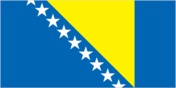
white with a large blue shield; the shield contains white Roman crosses with a white diagonal band running from the upper hoist corner to the lower fly side
Independence
NA April 1992 (from Yugoslavia)
Judicial branch
Supreme Court, Constitutional Court
Legal system
based on civil law system
Legislative branch
bicameral National Assembly
Member of
CE (guest), CEI, ECE, FAO, ICAO, IFAD, ILO, IMO, INTELSAT (nonsignatory user), INTERPOL, IOC, IOM (observer), ITU, NAM (guest), OSCE, UN, UNCTAD, UNESCO, UNIDO, UPU, WHO, WIPO, WTO
Names
conventional long form: Republic of Bosnia and Herzegovina conventional short form: Bosnia and Herzegovina local long form: Republika Bosna i Hercegovina local short form: Bosna i Hercegovina
National holiday
NA
Note
The US recognizes the Republic of Bosnia and Herzegovina. The Federation of Bosnia and Herzegovina, formed by the Muslims and Croats in March 1994, remains in the implementation stages.
Other political or pressure groups
NA
Political parties and leaders
Party of Democratic Action (SDA), Alija IZETBEGOVIC; Croatian Democratic Union of Bosnia and Herzegovina (HDZ BiH), Dario KORDIC; Serbian Democratic Party of Bosnia and Herzegovina (SDS BiH), Radovan KARADZIC, president; Liberal Bosnian Organization (LBO), Adil ZULFIKARPASIC, president; Democratic Party of Socialists (DSS), Nijaz DURAKOVIC, president; Party of Democratic Changes, leader NA; Serbian Movement for Renewal (SPO), Milan TRIVUNCIC; Alliance of Reform Forces of Yugoslavia for Bosnia and Herzegovina (SRSJ BiH), Dr. Nenad KECMANOVIC, president; Democratic League of Greens (DSZ), Drazen PETROVIC; Liberal Party (LS), Rasim KADIC, president
Suffrage
16 years of age, if employed; 18 years of age, universal
Type
emerging democracy
US diplomatic representation
chief of mission: Ambassador Victor JACKOVICH embassy: address NA mailing address: American Embassy Bosnia, c/o AmEmbassy Vienna Boltzmangasse 16, A-1091, Vienna, Austria; APO: (Bosnia) Vienna, Department of State, Washington, DC 20521-9900 telephone: [43] (1) 313-39
Economy
Agriculture
accounted for 9.0% of GDP in 1989; regularly produces less than 50% of food needs; the foothills of northern Bosnia support orchards, vineyards, livestock, and some wheat and corn; long winters and heavy precipitation leach soil fertility reducing agricultural output in the mountains; farms are mostly privately held, small, and not very productive (1991)
Budget
revenues: $NA expenditures: $NA, including capital expenditures of $NA
Currency
1 dinar = 100 para; Croatian dinar used in Croat-held area, presumably to be replaced by new Croatian kuna; old and new Serbian dinars used in Serb-held area; hard currencies probably supplanting local currencies in areas held by Bosnian government
Economic aid
$NA
Electricity
capacity: 3,800,000 kW production: NA kWh consumption per capita: NA kWh (1993)
Exchange rates
NA
Exports
$NA commodities: NA partners: NA
External debt
$NA
Fiscal year
calendar year
Illicit drugs
NA
Imports
$NA commodities: NA partners: NA
Industrial production
growth rate NA%; production is sharply down because of interethnic and interrepublic warfare (1991-94)
Industries
steel production, mining (coal, iron ore, lead, zinc, manganese, and bauxite), manufacturing (vehicle assembly, textiles, tobacco products, wooden furniture, 40% of former Yugoslavia's armaments including tank and aircraft assembly, domestic appliances), oil refining (1991)
Inflation rate (consumer prices)
NA%
National product
GDP - purchasing power parity - $NA
National product per capita
$NA
National product real growth rate
NA%
Overview
Bosnia and Herzegovina ranked next to The Former Yugoslav Republic of Macedonia as the poorest republic in the old Yugoslav federation. Although agriculture has been almost all in private hands, farms have been small and inefficient, and the republic traditionally has been a net importer of food. Industry has been greatly overstaffed, one reflection of the rigidities of Communist central planning and management. TITO had pushed the development of military industries in the republic with the result that Bosnia hosted a large share of Yugoslavia's defense plants. As of February 1995, Bosnia and Herzegovina was being torn apart by the continued bitter interethnic warfare that has caused production to plummet, unemployment and inflation to soar, and human misery to multiply. No economic statistics for 1992-94 are available, although output clearly has fallen substantially below the levels of earlier years and almost certainly is well below $1,000 per head. The country receives substantial amounts of humanitarian aid from the international community.
Unemployment rate
NA%
Communications
Radio
broadcast stations: AM 9, FM 2, shortwave 0 radios: 840,000
Telephone system
727,000 telephones; telephone and telegraph network is in need of modernization and expansion; many urban areas are below average when compared with services in other former Yugoslav republics local: NA intercity: NA international: no earth stations
Television
broadcast stations: 6 televisions: 1,012,094
Transportation
Airports
total: 27 with paved runways 2,438 to 3,047 m: 4 with paved runways 1,524 to 2,437 m: 3 with paved runways under 914 m: 11 with unpaved runways 1,524 to 2,438 m: 1 with unpaved runways 914 to 1,523 m: 8
Highways
total: 21,168 km paved: 11,436 km unpaved: gravel 8,146 km; earth 1,586 km (1991)
Inland waterways
NA km
Merchant marine
none
Pipelines
crude oil 174 km; natural gas 90 km (1992); note - pipelines now disrupted
Ports
Bosanski Brod
Railroads
total: 1,021 km (electrified 795 km) standard gauge: 1,021 km 1.435-m gauge (1994)
Military and Security
Branches
Army
Defense expenditures
$NA, NA% of GDP ________________________________________________________________________ BOTSWANA
Manpower availability
males age 15-49 815,055; males fit for military service 657,454; males reach military age (19) annually 38,201 (1995 est.)