2017 Edition
CIA World Factbook 2017 Archive (HTML)
Introduction
Background
Following Britain’s victory in the 1865 Duar War, Britain and Bhutan signed the Treaty of Sinchulu, under which Bhutan would receive an annual subsidy in exchange for ceding land to British India. Ugyen WANGCHUCK - who had served as the de facto ruler of an increasingly unified Bhutan and had improved relations with the British toward the end of the 19th century - was named king in 1907. Three years later, a treaty was signed whereby the British agreed not to interfere in Bhutanese internal affairs, and Bhutan allowed Britain to direct its foreign affairs. Bhutan negotiated a similar arrangement with independent India after 1947. Two years later, a formal Indo-Bhutanese accord returned to Bhutan a small piece of the territory annexed by the British, formalized the annual subsidies the country received, and defined India's responsibilities in defense and foreign relations. Under a succession of modernizing monarchs beginning in the 1950s, Bhutan joined the UN in 1971 and slowly continued its engagement beyond its borders. In March 2005, King Jigme Singye WANGCHUCK unveiled the government's draft constitution - which introduced major democratic reforms - and held a national referendum for its approval. In December 2006, the King abdicated the throne in favor of his son, Jigme Khesar Namgyel WANGCHUCK. In early 2007, India and Bhutan renegotiated their treaty, eliminating the clause that stated that Bhutan would be "guided by" India in conducting its foreign policy, although Thimphu continues to coordinate closely with New Delhi. Elections for seating the country's first parliament were completed in March 2008; the king ratified the country's first constitution in July 2008. Bhutan experienced a peaceful turnover of power following parliamentary elections in 2013, which resulted in the defeat of the incumbent party. The disposition of some 18,000 refugees of the roughly 100,000 who fled or were forced out of Bhutan in the 1990s - and who are housed in two UN refugee camps in Nepal - remains unresolved.
Geography
Area
- 38,394 sq km 38,394 sq km 0 sq km
- land
- 38,394 sq km
- total
- 38,394 sq km
- water
- 0 sq km
Area - comparative
slightly larger than Maryland; about one-half the size of Indiana
Climate
varies; tropical in southern plains; cool winters and hot summers in central valleys; severe winters and cool summers in Himalayas
Coastline
0 km (landlocked)
Elevation
- 2,220 m lowest point: Drangeme Chhu 97 m highest point: Gangkar Puensum 7,570 m
- elevation extremes
- lowest point: Drangeme Chhu 97 m
- highest point
- Gangkar Puensum 7,570 m
- mean elevation
- 2,220 m
Environment - current issues
soil erosion; limited access to potable water
Environment - international agreements
- Biodiversity, Climate Change, Climate Change-Kyoto Protocol, Desertification, Endangered Species, Hazardous Wastes, Ozone Layer Protection Law of the Sea
- party to
- Biodiversity, Climate Change, Climate Change-Kyoto Protocol, Desertification, Endangered Species, Hazardous Wastes, Ozone Layer Protection
- signed, but not ratified
- Law of the Sea
Geographic coordinates
27 30 N, 90 30 E
Geography - note
landlocked; strategic location between China and India; controls several key Himalayan mountain passes
Irrigated land
320 sq km (2012)
Land boundaries
- 1,136 km China 477 km, India 659 km
- border countries (2)
- China 477 km, India 659 km
- total
- 1,136 km
Land use
- 13.6% arable land 2.6%; permanent crops 0.3%; permanent pasture 10.7% 85.5% 0.9% (2011 est.)
- agricultural land
- 13.6%
- forest
- 85.5%
- other
- 0.9% (2011 est.)
Location
Southern Asia, between China and India
Map references
Asia
Maritime claims
none (landlocked)
Natural hazards
violent storms from the Himalayas are the source of the country's Bhutanese name, which translates as Land of the Thunder Dragon; frequent landslides during the rainy season
Natural resources
timber, hydropower, gypsum, calcium carbonate
Terrain
mostly mountainous with some fertile valleys and savanna
People and Society
Age structure
- 25.8% (male 99,977/female 95,652) 18.81% (male 72,634/female 70,018) 43.07% (male 173,310/female 153,314) 6.03% (male 24,482/female 21,206) 6.29% (male 24,874/female 22,821) (2017 est.)
- 0-14 years
- 25.8% (male 99,977/female 95,652)
- 15-24 years
- 18.81% (male 72,634/female 70,018)
- 25-54 years
- 43.07% (male 173,310/female 153,314)
- 55-64 years
- 6.03% (male 24,482/female 21,206)
- 65 years and over
- 6.29% (male 24,874/female 22,821) (2017 est.)
Birth rate
17.3 births/1,000 population (2017 est.)
Children under the age of 5 years underweight
12.8% (2010)
Contraceptive prevalence rate
65.6% (2010)
Death rate
6.5 deaths/1,000 population (2017 est.)
Dependency ratios
- 47.3 40.4 6.9 14.5 (2015 est.)
- elderly dependency ratio
- 6.9
- potential support ratio
- 14.5 (2015 est.)
- total dependency ratio
- 47.3
- youth dependency ratio
- 40.4
Drinking water source
- urban: 100% of population rural: 100% of population total: 100% of population urban: 0% of population rural: 0% of population total: 0% of population (2015 est.)
- rural
- 0% of population
- total
- 0% of population (2015 est.)
- urban
- 0% of population
Education expenditures
7.4% of GDP (2015)
Ethnic groups
Ngalop (also known as Bhote) 50%, ethnic Nepalese 35% (includes Lhotsampas - one of several Nepalese ethnic groups), indigenous or migrant tribes 15%
Health expenditures
3.6% of GDP (2014)
HIV/AIDS - adult prevalence rate
NA
HIV/AIDS - deaths
NA
HIV/AIDS - people living with HIV/AIDS
NA
Hospital bed density
1.8 beds/1,000 population (2012)
Infant mortality rate
- 32.1 deaths/1,000 live births 32.3 deaths/1,000 live births 31.8 deaths/1,000 live births (2017 est.)
- female
- 31.8 deaths/1,000 live births (2017 est.)
- male
- 32.3 deaths/1,000 live births
- total
- 32.1 deaths/1,000 live births
Languages
Sharchhopka 28%, Dzongkha (official) 24%, Lhotshamkha 22%, other 26% (includes foreign languages) (2005 est.)
Life expectancy at birth
- 70.6 years 69.6 years 71.7 years (2017 est.)
- female
- 71.7 years (2017 est.)
- male
- 69.6 years
- total population
- 70.6 years
Literacy
- age 15 and over can read and write 64.9% 73.1% 55% (2015 est.)
- definition
- age 15 and over can read and write
- female
- 55% (2015 est.)
- male
- 73.1%
- total population
- 64.9%
Major infectious diseases
- high bacterial and protozoal diarrhea, hepatitis A, and typhoid fever dengue fever (2016)
- degree of risk
- high
- food or waterborne diseases
- bacterial and protozoal diarrhea, hepatitis A, and typhoid fever
- vectorborne diseases
- dengue fever (2016)
Major urban areas - population
THIMPHU (capital) 152,000 (2014)
Maternal mortality rate
148 deaths/100,000 live births (2015 est.)
Median age
- 27.6 years 28.2 years 27.1 years (2017 est.)
- female
- 27.1 years (2017 est.)
- male
- 28.2 years
- total
- 27.6 years
Nationality
- Bhutanese (singular and plural) Bhutanese
- adjective
- Bhutanese
- noun
- Bhutanese (singular and plural)
Net migration rate
0 migrant(s)/1,000 population (2017 est.)
Obesity - adult prevalence rate
6.4% (2016)
Physicians density
0.26 physicians/1,000 population (2014)
Population
758,288 (July 2017 est.)
Population growth rate
1.07% (2017 est.)
Religions
Lamaistic Buddhist 75.3%, Indian- and Nepalese-influenced Hinduism 22.1%, other 2.6% (2005 est.)
Sanitation facility access
- urban: 77.9% of population rural: 33.1% of population total: 50.4% of population urban: 22.1% of population rural: 66.9% of population total: 49.6% of population (2015 est.)
- rural
- 66.9% of population
- total
- 49.6% of population (2015 est.)
- urban
- 22.1% of population
School life expectancy (primary to tertiary education)
- 13 years 12 years 13 years (2013)
- female
- 13 years (2013)
- male
- 12 years
- total
- 13 years
Sex ratio
- 1.05 male(s)/female 1.04 male(s)/female 1.04 male(s)/female 1.14 male(s)/female 1.16 male(s)/female 1.1 male(s)/female 1.09 male(s)/female (2016 est.)
- 0-14 years
- 1.04 male(s)/female
- 15-24 years
- 1.04 male(s)/female
- 25-54 years
- 1.14 male(s)/female
- 55-64 years
- 1.16 male(s)/female
- 65 years and over
- 1.1 male(s)/female
- at birth
- 1.05 male(s)/female
- total population
- 1.09 male(s)/female (2016 est.)
Total fertility rate
1.9 children born/woman (2017 est.)
Unemployment, youth ages 15-24
- 10.7% 8.2% 12.7% (2015 est.)
- female
- 12.7% (2015 est.)
- male
- 8.2%
- total
- 10.7%
Urbanization
- 40.1% of total population (2017) 2.89% annual rate of change (2015-20 est.)
- rate of urbanization
- 2.89% annual rate of change (2015-20 est.)
- urban population
- 40.1% of total population (2017)
Government
Administrative divisions
20 districts (dzongkhag, singular and plural); Bumthang, Chhukha, Chirang, Daga, Gasa, Geylegphug, Ha, Lhuntshi, Mongar, Paro, Pemagatsel, Punakha, Samchi, Samdrup Jongkhar, Shemgang, Tashigang, Tashi Yangtse, Thimphu, Tongsa, Wangdi Phodrang
Capital
- Thimphu 27 28 N, 89 38 E UTC+6 (11 hours ahead of Washington, DC, during Standard Time)
- geographic coordinates
- 27 28 N, 89 38 E
- name
- Thimphu
- time difference
- UTC+6 (11 hours ahead of Washington, DC, during Standard Time)
Citizenship
- no the father must be a citizen of Bhutan no 10 years
- citizenship by birth
- no
- citizenship by descent only
- the father must be a citizen of Bhutan
- dual citizenship recognized
- no
- residency requirement for naturalization
- 10 years
Constitution
- previous governing documents were various royal decrees; first constitution drafted November 2001 - March 2005, ratified 18 July 2008 proposed as a motion by simple majority vote in a joint session of Parliament; passage requires at least a three-fourths majority vote in a joint session of the next Parliament and assented to by the king; amended 2011 (2017)
- amendments
- proposed as a motion by simple majority vote in a joint session of Parliament; passage requires at least a three-fourths majority vote in a joint session of the next Parliament and assented to by the king; amended 2011 (2017)
- history
- previous governing documents were various royal decrees; first constitution drafted November 2001 - March 2005, ratified 18 July 2008
Country name
- Kingdom of Bhutan Bhutan Druk Gyalkhap Druk Yul named after the Bhotia, the ethnic Tibetans who migrated from Tibet to Bhutan; "Bod" is the Tibetan name for their land; the Bhutanese name "Druk Yul" means "Land of the Thunder Dragon"
- conventional long form
- Kingdom of Bhutan
- conventional short form
- Bhutan
- etymology
- named after the Bhotia, the ethnic Tibetans who migrated from Tibet to Bhutan; "Bod" is the Tibetan name for their land; the Bhutanese name "Druk Yul" means "Land of the Thunder Dragon"
- local long form
- Druk Gyalkhap
- local short form
- Druk Yul
Diplomatic representation from the US
the US and Bhutan have no formal diplomatic relations, although frequent informal contact is maintained via the US embassy in New Delhi (India) and Bhutan's Permanent Mission to the UN
Diplomatic representation in the US
- none; note - the Permanent Mission to the UN for Bhutan has consular jurisdiction in the US; the permanent representative to the UN is Kunzang C. NAMGYEL (since February 2014); address: 343 East 43rd Street, New York, NY 10017; telephone [1] (212) 682-2268; FAX [1] (212) 661-0551 New York
- consulate(s) general
- New York
- none; note - the Permanent Mission to the UN for Bhutan has consular jurisdiction in the US; the permanent representative to the UN is Kunzang C. NAMGYEL (since February 2014); address
- 343 East 43rd Street, New York, NY 10017; telephone [1] (212) 682-2268; FAX [1] (212) 661-0551
Executive branch
- King Jigme Khesar Namgyel WANGCHUCK (since 14 December 2006); note - King Jigme Singye WANGCHUCK abdicated the throne on 14 December 2006 to his son Prime Minister Tshering TOBGAY (since 27 July 2013) Council of Ministers or Lhengye Zhungtshog members nominated by the monarch in consultation with the prime minister and approved by the National Assembly; members serve 5-year terms the monarchy is hereditary but can be removed by a two-third vote of Parliament; leader of the majority party in Parliament is nominated as the prime minister, appointed by the monarch
- cabinet
- Council of Ministers or Lhengye Zhungtshog members nominated by the monarch in consultation with the prime minister and approved by the National Assembly; members serve 5-year terms
- chief of state
- King Jigme Khesar Namgyel WANGCHUCK (since 14 December 2006); note - King Jigme Singye WANGCHUCK abdicated the throne on 14 December 2006 to his son
- elections/appointments
- the monarchy is hereditary but can be removed by a two-third vote of Parliament; leader of the majority party in Parliament is nominated as the prime minister, appointed by the monarch
- head of government
- Prime Minister Tshering TOBGAY (since 27 July 2013)
Flag description
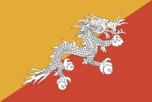
- divided diagonally from the lower hoist-side corner; the upper triangle is yellow and the lower triangle is orange; centered along the dividing line is a large black and white dragon facing away from the hoist side; the dragon, called the Druk (Thunder Dragon), is the emblem of the nation; its white color stands for purity and the jewels in its claws symbolize wealth; the background colors represent spiritual and secular powers within Bhutan: the orange is associated with Buddhism, while the yellow denotes the ruling dynasty
- divided diagonally from the lower hoist-side corner; the upper triangle is yellow and the lower triangle is orange; centered along the dividing line is a large black and white dragon facing away from the hoist side; the dragon, called the Druk (Thunder Dr
- the orange is associated with Buddhism, while the yellow denotes the ruling dynasty
Government type
constitutional monarchy
Independence
17 December 1907 (became a unified kingdom under its first hereditary king)
International law organization participation
has not submitted an ICJ jurisdiction declaration; non-party state to the ICCt
International organization participation
ADB, BIMSTEC, CP, FAO, G-77, IBRD, ICAO, IDA, IFAD, IFC, IMF, Interpol, IOC, IOM (observer), IPU, ISO (correspondent), ITSO, ITU, MIGA, NAM, OPCW, SAARC, SACEP, UN, UNCTAD, UNESCO, UNIDO, UNTSO, UNWTO, UPU, WCO, WHO, WIPO, WMO, WTO (observer)
Judicial branch
- Supreme Court (consists of 5 justices including the chief justice); note - the Supreme Court has sole jurisdiction in constitutional matters Supreme Court chief justice appointed by the monarch upon the advice of the National Judicial Commission, a 4-member body to include the Legislative Committee of the National Assembly, the attorney general, the Chief Justice of Bhutan and the senior Associate Justice of the Supreme Court; other judges (drangpons) appointed by the monarch from among the High Court judges selected by the National Judicial Commission; chief justice serves a 5-year term or until reaching age 65 years, whichever is earlier; the 4 other judges serve 10-year terms or until age 65, whichever is earlier High Court (first appellate court); District or Dzongkhag Courts; sub-district or Dungkhag Courts
- highest court(s)
- Supreme Court (consists of 5 justices including the chief justice); note - the Supreme Court has sole jurisdiction in constitutional matters
- judge selection and term of office
- Supreme Court chief justice appointed by the monarch upon the advice of the National Judicial Commission, a 4-member body to include the Legislative Committee of the National Assembly, the attorney general, the Chief Justice of Bhutan and the senior Associate Justice of the Supreme Court; other judges (drangpons) appointed by the monarch from among the High Court judges selected by the National Judicial Commission; chief justice serves a 5-year term or until reaching age 65 years, whichever is earlier; the 4 other judges serve 10-year terms or until age 65, whichever is earlier
- subordinate courts
- High Court (first appellate court); District or Dzongkhag Courts; sub-district or Dungkhag Courts
Legal system
civil law based on Buddhist religious law
Legislative branch
- bicameral Parliament or Chi Tshog consists of the non-partisan National Council or Gyelyong Tshogde (25 seats; 20 members directly elected in single-seat constituencies by simple majority vote and 5 members appointed by the king; members serve 5-year terms) and the National Assembly or Tshogdu (47 seats; members directly elected in single-seat constituencies by proportional representation vote to serve 5-year terms) National Council election last held on 23 April 2013 (next to be held in 2018); National Assembly election first round held on 31 May 2013 and second round on 13 July 2013 ((next to be held in 2018) National Council - seats by party - independent 20 (all candidates required to run as independents); National Assembly - percent of vote by party in first round - DPT 44.5%; PDP 32.5%; DNT 17.0%; DCT 5.9%; percent of vote in second round - PDP 54.9%, DPT 45.1%; seats by party - PDP 32, DPT 15
- description
- bicameral Parliament or Chi Tshog consists of the non-partisan National Council or Gyelyong Tshogde (25 seats; 20 members directly elected in single-seat constituencies by simple majority vote and 5 members appointed by the king; members serve 5-year terms) and the National Assembly or Tshogdu (47 seats; members directly elected in single-seat constituencies by proportional representation vote to serve 5-year terms)
- election results
- National Council - seats by party - independent 20 (all candidates required to run as independents); National Assembly - percent of vote by party in first round - DPT 44.5%; PDP 32.5%; DNT 17.0%; DCT 5.9%; percent of vote in second round - PDP 54.9%, DPT 45.1%; seats by party - PDP 32, DPT 15
- elections
- National Council election last held on 23 April 2013 (next to be held in 2018); National Assembly election first round held on 31 May 2013 and second round on 13 July 2013 ((next to be held in 2018)
National anthem
- "Druk tsendhen" (The Thunder Dragon Kingdom) Gyaldun Dasho Thinley DORJI/Aku TONGMI adopted 1953
- lyrics/music
- Gyaldun Dasho Thinley DORJI/Aku TONGMI
- name
- "Druk tsendhen" (The Thunder Dragon Kingdom)
- note
- adopted 1953
National holiday
National Day (Ugyen WANGCHUCK became first hereditary king), 17 December (1907)
National symbol(s)
- thunder dragon known as Druk Gyalpo; national colors: orange, yellow
- thunder dragon known as Druk Gyalpo; national colors
- orange, yellow
Political parties and leaders
Bhutan Kuen-Nyam Party or BKP [Dasho Neten ZANGMO] Bhutan Peace and Prosperity Party (Druk Phuensum Tshogpa) or DPT [Pema GYAMTSHO] Druk Chirwang Tshogpa or DCT [Lily WANGCHUK] Druk Nymarup Tshogpa or DNT [Tandin DORJI] People's Democratic Party or PDP [Tshering TOBGAY]
Political pressure groups and leaders
- Druk National Congress or DNC [Gedun CHOEPHEL] (group in exile) United Front for Democracy or UFD (group in exile) United Front for Democracy Against Dictatorship or UDD [Jatuporn PROMPAN, chairman] Buddhist clergy; ethnic Nepali-Bhutanese organizations (exiled)
- other
- Buddhist clergy; ethnic Nepali-Bhutanese organizations (exiled)
Suffrage
18 years of age; universal
Economy
Agriculture - products
rice, corn, root crops, citrus; dairy products, eggs
Budget
- $650.9 million $713.7 million the government of India finances nearly one-quarter of Bhutan's budget expenditures (2016 est.)
- expenditures
- $713.7 million
- note
- the government of India finances nearly one-quarter of Bhutan's budget expenditures (2016 est.)
- revenues
- $650.9 million
Budget surplus (+) or deficit (-)
-3% of GDP (2016 est.)
Central bank discount rate
NA%
Commercial bank prime lending rate
14.15% (31 December 2016 est.) 14.15% (31 December 2015 est.)
Current account balance
$-618 million (2016 est.) $-571.7 million (2015 est.)
Debt - external
$2.355 billion (31 December 2016 est.) $1.955 billion (31 December 2015 est.)
Distribution of family income - Gini index
38.8 (2012) 38.1 (2007)
Economy - overview
Bhutan's small economy is based largely on hydropower, agriculture, and forestry, which provide the main livelihood for more than half of the population. Because rugged mountains dominate the terrain and make the building of roads and other infrastructure difficult and expensive, industrial production is primarily of the cottage industry type. The economy is closely aligned with India's through strong trade and monetary links and is dependent on India for financial assistance and migrant laborers for development projects, especially for road construction. Bhutan inked a pact in December 2014 to expand duty-free trade with Bangladesh. Multilateral development organizations administer most educational, social, and environment programs, and take into account the government's desire to protect the country's environment and cultural traditions. For example, the government, in its cautious expansion of the tourist sector, encourages visits by upscale, environmentally conscientious tourists. Complicated controls and uncertain policies in areas such as industrial licensing, trade, labor, and finance continue to hamper foreign investment. Bhutan’s largest export - hydropower to India - could spur sustainable growth in the coming years if Bhutan resolves chronic delays in construction. Bhutan’s hydropower exports comprise 40% of total exports and 25% of GDP. Bhutan currently taps only 6.5% of its 24,000-megawatt hydropower potential and is behind schedule in building 12 new hydropower dams with a combined capacity of 10,000 megawatts by 2020 in accordance with a deal signed in 2008 with India. The high volume of imported materials to build hydropower plants has expanded Bhutan's trade and current account deficits. Bhutan also is exploring energy exports to Bangladesh.
Exchange rates
ngultrum (BTN) per US dollar - 67.195 (2016 est.) 67.2 (2015 est.) 64.15 (2014 est.) 61.03 (2013 est.) 53.44 (2012 est.)
Exports
$495.3 million (2016 est.) $581.5 million (2015 est.)
Exports - commodities
electricity (to India), ferrosilicon, cement, cardamom, calcium carbide, steel rods/bars, dolomite, gypsum
Exports - partners
India 95.7% (2016)
Fiscal year
1 July - 30 June
GDP - composition, by end use
- 54.7% 17.9% 50.1% -0.1% 29.4% -52.1% (2016 est.)
- exports of goods and services
- 29.4%
- government consumption
- 17.9%
- household consumption
- 54.7%
- imports of goods and services
- -52.1% (2016 est.)
- investment in fixed capital
- 50.1%
- investment in inventories
- -0.1%
GDP - composition, by sector of origin
- 16.4% 42.2% 41.4% (2016 est.)
- agriculture
- 16.4%
- industry
- 42.2%
- services
- 41.4% (2016 est.)
GDP - per capita (PPP)
- $8,200 (2016 est.) $7,900 (2015 est.) $7,500 (2014 est.) data are in 2016 dollars
- note
- data are in 2016 dollars
GDP - real growth rate
6.2% (2016 est.) 6.1% (2015 est.) 4% (2014 est.)
GDP (official exchange rate)
$2.121 billion (2016 est.)
GDP (purchasing power parity)
- $6.508 billion (2016 est.) $6.049 billion (2015 est.) $5.638 billion (2014 est.) data are in 2016 dollars
- note
- data are in 2016 dollars
Gross national saving
33.4% of GDP (2016 est.) 32% of GDP (2015 est.) 35% of GDP (2014 est.)
Household income or consumption by percentage share
- 2.8% 30.6% (2012)
- highest 10%
- 30.6% (2012)
- lowest 10%
- 2.8%
Imports
$1.033 billion (2016 est.) $1.009 billion (2015 est.)
Imports - commodities
fuel and lubricants, airplanes, machinery and parts, rice, motor vehicles
Imports - partners
India 91.1% (2016)
Industrial production growth rate
5.3% (2016 est.)
Industries
cement, wood products, processed fruits, alcoholic beverages, calcium carbide, tourism
Inflation rate (consumer prices)
3.9% (2016 est.) 4.5% (2015 est.)
Labor force
- 353,000 major shortage of skilled labor (2015 est.)
- note
- major shortage of skilled labor (2015 est.)
Labor force - by occupation
- 58% 20% 22% (2015 est.)
- agriculture
- 58%
- industry
- 20%
- services
- 22% (2015 est.)
Market value of publicly traded shares
$355.3 million (31 December 2015) $283.4 million (31 December 2012)
Population below poverty line
13.3% (2012 est.)
Public debt
106.8% of GDP (2016 est.) 91.5% of GDP (2015 est.)
Stock of broad money
$1.379 billion (31 December 2016 est.) $1.174 billion (31 December 2015 est.)
Stock of direct foreign investment - at home
$168.4 million (31 December 2016 est.) $238 million (31 December 2015 est.)
Stock of domestic credit
$1.17 billion (31 December 2016 est.) $1.031 billion (31 December 2015 est.)
Stock of narrow money
$769 million (31 December 2016 est.) $669.9 million (31 December 2015 est.)
Taxes and other revenues
30.8% of GDP (2016 est.)
Unemployment rate
3.2% (2016 est.) 2.6% (2014 est.)
Energy
Carbon dioxide emissions from consumption of energy
260,300 Mt (2015 est.)
Crude oil - exports
0 bbl/day (2014 est.)
Crude oil - imports
0 bbl/day (2014 est.)
Crude oil - production
0 bbl/day (2016 est.)
Crude oil - proved reserves
0 bbl (1 January 2017 es)
Electricity - consumption
2.6 billion kWh (2015 est.)
Electricity - exports
5.308 billion kWh (2015 est.)
Electricity - from fossil fuels
1% of total installed capacity (2015 est.)
Electricity - from hydroelectric plants
99% of total installed capacity (2015 est.)
Electricity - from nuclear fuels
0% of total installed capacity (2015 est.)
Electricity - from other renewable sources
0% of total installed capacity (2015 est.)
Electricity - imports
200 million kWh (2015 est.)
Electricity - installed generating capacity
1.631 million kW (2015 est.)
Electricity - production
7.732 billion kWh (2015 est.)
Electricity access
- 187,531 76% 100% 53% (2012)
- electrification - rural areas
- 53% (2012)
- electrification - total population
- 76%
- electrification - urban areas
- 100%
- population without electricity
- 187,531
Natural gas - consumption
0 cu m (2016 est.)
Natural gas - exports
0 cu m (2016 est.)
Natural gas - imports
0 cu m (2016 est.)
Natural gas - production
0 cu m (2016 est.)
Natural gas - proved reserves
0 cu m (2016 est.)
Refined petroleum products - consumption
3,000 bbl/day (2015 est.)
Refined petroleum products - exports
0 bbl/day (2014 est.)
Refined petroleum products - imports
3,135 bbl/day (2014 est.)
Refined petroleum products - production
0 bbl/day (2014 est.)
Communications
Broadcast media
state-owned TV station established in 1999; cable TV service offers dozens of Indian and other international channels; first radio station, privately launched in 1973, is now state-owned; 5 private radio stations are currently broadcasting (2012)
Internet country code
.bt
Internet users
- 313,347 41.8% (July 2016 est.)
- percent of population
- 41.8% (July 2016 est.)
- total
- 313,347
Telephone system
- urban towns and district headquarters have telecommunications services domestic service inadequate, especially in rural areas; mobile-cellular service, begun in 2003, is now widely available; Internet services widely available country code - 975; international telephone and telegraph service via landline and microwave relay through India; satellite earth station - 1 Intelsat (2016)
- domestic
- domestic service inadequate, especially in rural areas; mobile-cellular service, begun in 2003, is now widely available; Internet services widely available
- general assessment
- urban towns and district headquarters have telecommunications services
- international
- country code - 975; international telephone and telegraph service via landline and microwave relay through India; satellite earth station - 1 Intelsat (2016)
Telephones - fixed lines
- 21,081 3 (July 2016 est.)
- subscriptions per 100 inhabitants
- 3 (July 2016 est.)
- total subscriptions
- 21,081
Telephones - mobile cellular
- 698,373 93 (July 2016 est.)
- subscriptions per 100 inhabitants
- 93 (July 2016 est.)
- total
- 698,373
Transportation
Airports
2 (2013)
Airports - with paved runways
- 1 (2017)
- 1,524 to 2,437 m
- 1
- 914 to 1,523 m
- 1 (2017)
- total
- 2
Airports - with unpaved runways
- 1 (2012)
- 914 to 1,523 m
- 1 (2012)
- total
- 1
Civil aircraft registration country code prefix
A5 (2016)
National air transport system
- 162,864 538,041 mt-km (2015)
- annual freight traffic on registered air carriers
- 538,041 mt-km (2015)
- annual passenger traffic on registered air carriers
- 162,864
- inventory of registered aircraft operated by air carriers
- 6
- number of registered air carriers
- 2
Roadways
- 10,578 km 2,975 km (includes 2,180 km of national highways) 7,603 km (2013) a more recent figure for 2015 lists 11,177 km for total roadway length, but no breakdown of paved or unpaved
- note
- a more recent figure for 2015 lists 11,177 km for total roadway length, but no breakdown of paved or unpaved
- paved
- 2,975 km (includes 2,180 km of national highways)
- total
- 10,578 km
- unpaved
- 7,603 km (2013)
Military and Security
Military branches
Royal Bhutan Army (includes Royal Bodyguard and Royal Bhutan Police) (2009)
Military service age and obligation
18 years of age for voluntary military service; no conscription; militia training is compulsory for males aged 20-25, over a 3-year period (2012)
Transnational Issues
Disputes - international
lacking any treaty describing the boundary, Bhutan and China continue negotiations to establish a common boundary alignment to resolve territorial disputes arising from substantial cartographic discrepancies, the most contentious of which lie in Bhutan's west along China’s Chumbi salient