2002 Edition
CIA World Factbook 2002 (Project Gutenberg)
Introduction
Background
In 1865, Britain and Bhutan signed the Treaty of Sinchulu, under which Bhutan would receive an annual subsidy in exchange for ceding some border land. Under British influence, a monarchy was set up in 1907; three years later, a treaty was signed whereby the British agreed not to interfere in Bhutanese internal affairs and Bhutan allowed Britain to direct its foreign affairs. This role was assumed by independent India after 1947. Two years later, a formal Indo-Bhutanese accord returned the areas of Bhutan annexed by the British, formalized the annual subsidies the country received, and defined India's responsibilities in defense and foreign relations. A refugee issue of some 100,000 Bhutanese in Nepal remains unresolved; 90% of the refugees are housed in seven United Nations Office of the High Commissioner for Refugees (UNHCR) camps. Maoist Assamese separatists from India, who have established themselves in the southeast portion of Bhutan, have drawn Indian cross-border incursions.
Geography
Area
total: 47,000 sq km water: 0 sq km land: 47,000 sq km
Area - comparative
about half the size of Indiana
Climate
varies; tropical in southern plains; cool winters and hot summers in central valleys; severe winters and cool summers in Himalayas
Coastline
0 km (landlocked)
Elevation extremes
lowest point: Drangme Chhu 97 m highest point: Kula Kangri 7,553 m
Environment - current issues
soil erosion; limited access to potable water
Environment - international agreements
party to: Biodiversity, Climate Change, Nuclear Test Ban signed, but not ratified: Law of the Sea
Geographic coordinates
27 30 N, 90 30 E
Irrigated land
400 sq km (1998 est.)
Land boundaries
total: 1,075 km border countries: China 470 km, India 605 km
Land use
arable land: 3% permanent crops: 0% other: 97% (1998 est.)
Location
Southern Asia, between China and India
Map references
Asia
Maritime claims
none (landlocked)
Natural hazards
violent storms from the Himalayas are the source of the country's name which translates as Land of the Thunder Dragon; frequent landslides during the rainy season
Natural resources
timber, hydropower, gypsum, calcium carbide
Terrain
mostly mountainous with some fertile valleys and savanna
People and Society
Age structure
0-14 years: 39.8% (male 431,883; female 401,386) 15-64 years: 56.2% (male 606,184; female 571,310) 65 years and over: 4% (male 42,193; female 41,220) (2002 est.)
Birth rate
35.26 births/1,000 population (2002 est.)
Death rate
13.74 deaths/1,000 population (2002 est.)
Ethnic groups
Bhote 50%, ethnic Nepalese 35% (includes Lhotsampas--one of several Nepalese ethnic groups), indigenous or migrant tribes 15%
HIV/AIDS - adult prevalence rate
less than 0.01% (1999 est.)
HIV/AIDS - deaths
NA
HIV/AIDS - people living with HIV/AIDS
less than 100 (1999 est.)
Infant mortality rate
106.79 deaths/1,000 live births (2002 est.)
Languages
Dzongkha (official), Bhotes speak various Tibetan dialects, Nepalese speak various Nepalese dialects
Life expectancy at birth
52.83 years (2002 est.) male: Total fertility rate: 5 children born/woman (2002 est.)
Literacy
definition: age 15 and over can read and write total population: 42.2% male: 56.2% female: 28.1% (1995 est.)
Nationality
noun: Bhutanese (singular and plural) adjective: Bhutanese
Net migration rate
0 migrant(s)/1,000 population (2002 est.)
Population
2,094,176 note: other estimates range as low as 810,000 (July 2002 est.)
Population growth rate
2.15% (2002 est.)
Religions
Lamaistic Buddhist 75%, Indian- and Nepalese-influenced Hinduism 25%
Sex ratio
at birth: 1.05 male(s)/female under 15 years: 1.08 male(s)/female 15-64 years: 1.06 male(s)/female 65 years and over: 1.02 male(s)/female total population: 1.07 male(s)/female (2002 est.)
Government
Administrative divisions
18 districts (dzongkhag, singular and plural); Bumthang, Chhukha, Chirang, Dagana, Geylegphug, Ha, Lhuntshi, Mongar, Paro, Pemagatsel, Punakha, Samchi, Samdrup Jongkhar, Shemgang, Tashigang, Thimphu, Tongsa, Wangdi Phodrang note: there may be two new districts named Gasa and Yangtse
Capital
Thimphu
Constitution
no written constitution or bill of rights; note - Bhutan uses 1953 Royal decree for the Constitution of the National Assembly; on 7 July 1998, a Royal edict was ratified giving the National Assembly additional powers
Country name
conventional long form: Kingdom of Bhutan conventional short form: Bhutan
Diplomatic representation from the US
the US and Bhutan have no formal diplomatic relations, although informal contact is maintained between the Bhutanese and US Embassy in New Delhi (India)
Diplomatic representation in the US
none; note - Bhutan has a Permanent Mission to the UN; address: 2 United Nations Plaza, 27th Floor, New York, NY 10017; telephone [1] (212) 826-1919; the Bhutanese mission to the UN has consular jurisdiction in the US consulate(s) general: New York
Executive branch
chief of state: King Jigme Singye WANGCHUCK (since 24 July 1972) elections: none; the monarch is hereditary, but democratic reforms in July 1998 grant the National Assembly authority to remove the monarch with two-thirds vote head of government: Chairman of the Council of Ministers Lyonpo Khandu WANGCHUK (since 8 August 2001) cabinet: Council of Ministers (Lhengye Shungtsog) nominated by the monarch, approved by the National Assembly; members serve fixed, five-year terms; note - there is also a Royal Advisory Council (Lodoi Tsokde), members nominated by the monarch
Flag description
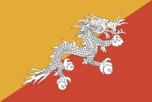
divided diagonally from the lower hoist side corner; the upper triangle is yellow and the lower triangle is orange; centered along the dividing line is a large black and white dragon facing away from the hoist side
Independence
8 August 1949 (from India)
International organization participation
AsDB, CP, ESCAP, FAO, G-77, IBRD, ICAO, IDA, IFAD, IMF, IOC, IOM (observer), ITU, NAM, OPCW (signatory), SAARC, UN, UNCTAD, UNESCO, UNIDO, UPU, WHO, WIPO, WTrO (observer)
Judicial branch
Supreme Court of Appeal (the monarch); High Court (judges appointed by the monarch)
Legal system
based on Indian law and English common law; has not accepted compulsory ICJ jurisdiction
Legislative branch
unicameral National Assembly or Tshogdu (150 seats; 105 elected from village constituencies, 10 represent religious bodies, and 35 are designated by the monarch to represent government and other secular interests; members serve three-year terms) elections: last held NA (next to be held NA) election results: NA
National holiday
National Day (Ugyen WANGCHUCK became first hereditary king), 17 December (1907)
Political parties and leaders
no legal parties
Political pressure groups and leaders
Buddhist clergy; ethnic Nepalese organizations leading militant antigovernment campaign; Indian merchant community; United Front for Democracy (exiled)
Suffrage
each family has one vote in village-level elections
Economy
Agriculture - products
rice, corn, root crops, citrus, foodgrains; dairy products, eggs
Budget
revenues: $146 million expenditures: $152 million, including capital expenditures of $NA (FY95/96 est.) note: the government of India finances nearly three-fifths of Bhutan's budget expenditures
Currency
ngultrum (BTN); Indian rupee (INR)
Currency code
BTN; INR
Debt - external
$245 million (1998)
Economic aid - recipient
substantial aid from India and other nations
Electricity - consumption
380.68 million kWh (2000)
Electricity - exports
1.385 billion kWh (2000)
Electricity - imports
21 million kWh (2000)
Electricity - production
1.876 billion kWh (2000)
Electricity - production by source
fossil fuel: 0.05% hydro: 99.95% other: 0% (2000) nuclear: 0%
Exchange rates
ngultrum per US dollar - 48.336 (January 2002), 47.186 (2001), 44.942 (2000), 43.055 (1999), 41.259 (1998), 36.313 (1997); note - the Bhutanese ngultrum is at par with the Indian rupee which is also legal tender
Exports
$154 million (f.o.b., 2000 est.)
Exports - commodities
electricity (to India), cardamom, gypsum, timber, handicrafts, cement, fruit, precious stones, spices
Exports - partners
India 94%, Bangladesh
Fiscal year
1 July - 30 June
GDP
purchasing power parity - $2.5 billion (2001 est.)
GDP - composition by sector
agriculture: 45% industry: 20% services: 35% (2001 est.)
GDP - per capita
purchasing power parity - $1,200 (2001 est.)
GDP - real growth rate
6% (2000 est.)
Household income or consumption by percentage share
lowest 10%: NA% highest 10%: NA%
Imports
$196 million (c.i.f., 2000 est.)
Imports - commodities
fuel and lubricants, grain, machinery and parts, vehicles, fabrics, rice
Imports - partners
India 77%, Japan, UK, Germany, US
Industrial production growth rate
9.3% (1996 est.)
Industries
cement, wood products, processed fruits, alcoholic beverages, calcium carbide
Inflation rate (consumer prices)
7% (2000 est.)
Labor force
NA note: massive lack of skilled labor
Labor force - by occupation
agriculture 93%, services 5%, industry and commerce 2%
Population below poverty line
NA%
Unemployment rate
NA%
Communications
Internet country code
.bt
Internet Service Providers (ISPs)
NA
Internet users
500 (2000)
Radio broadcast stations
AM 0, FM 1, shortwave 1 (1998)
Radios
37,000 (1997)
Telephone system
general assessment: NA domestic: domestic telephone service is very poor with few telephones in use international: international telephone and telegraph service is by landline through India; a satellite earth station was planned (1990)
Telephones - main lines in use
6,000 (1997)
Telephones - mobile cellular
NA
Television broadcast stations
0 (1997)
Televisions
11,000 (1997)
Transportation
Airports
2 (2001)
Airports - with paved runways
total: 1 1,524 to 2,437 m: 1 (2001)
Airports - with unpaved runways
total: 1 914 to 1,523 m: 1 (2001)
Highways
total: 3,285 km paved: 1,994 km unpaved: 1,291 km (1996)
Ports and harbors
none
Railways
0 km
Waterways
none
Military and Security
Military expenditures - dollar figure
$9.3 million (FY01)
Military expenditures - percent of GDP
1.9% (FY01)
Military manpower - availability
males age 15-49: 517,470 (2002 est.)
Military manpower - fit for military service
males age 15-49: 276,303 (2002 est.)
Military manpower - military age
18 years of age (2002 est.)
Military manpower - reaching military age annually
males: 21,167 (2002 est.)
Transnational Issues
Disputes - international
approximately 100,000 Bhutanese refugees living in Nepal, 90% of whom reside in seven UN Office of the High Commissioner for Refugees camps, place decades-long strains on Nepal This page was last updated on 1 January 2002 Bulgaria