1994 Edition
CIA World Factbook 1994 (Project Gutenberg)
Introduction
Administrative divisions
18 districts (dzongkhag, singular and plural); Bumthang, Chhukha, Chirang, Daga, Geylegphug, Ha, Lhuntshi, Mongar, Paro, Pemagatsel, Punakha, Samchi, Samdrup Jongkhar, Shemgang, Tashigang, Thimphu, Tongsa, Wangdi Phodrang
Agriculture
accounts for 45% of GDP; based on subsistence farming and animal husbandry; self-sufficient in food except for foodgrains; other production - rice, corn, root crops, citrus fruit, dairy products, eggs
Airports
total: 2 usable: 2 with permanent-surface runways: 1 with runways over 3,659 m: with runways 2,440-3,659 m: with runways 1,220-2,439 m: 2
Area
total area: 47,000 sq km land area: 47,000 sq km comparative area: slightly more than half the size of Indiana
Birth rate
39.31 births/1,000 population (1994 est.)
Branches
Royal Bhutan Army, Palace Guard, Militia
Budget
revenues: $100 million expenditures: $112 million, including capital expenditures of $60 million (FY92 est.) note: the government of India finances nearly one-quarter of Bhutan's budget expenditures
Capital
Thimphu
Chief of State and Head of Government
King Jigme Singye WANGCHUCK (since 24 July 1972)
Climate
varies; tropical in southern plains; cool winters and hot summers in central valleys; severe winters and cool summers in Himalayas
Coastline
0 km (landlocked)
Constitution
no written constitution or bill of rights
Currency
1 ngultrum (Nu) = 100 chetrum; note - Indian currency is also legal tender
Death rate
15.93 deaths/1,000 population (1994 est.)
Defense expenditures
$NA, NA% of GDP
Digraph
BT
Diplomatic representation in US
no formal diplomatic relations; the Bhutanese mission to the UN in New York has consular jurisdiction in the US consulate(s) general: New York
Economic aid
recipient: Western (non-US) countries, ODA and OOF bilateral commitments (1970-89), $115 million; OPEC bilateral aid (1979-89), $11 million
Electricity
capacity: 336,000 kW production: 1.5422 billion kWh consumption per capita: 2,203 kWh (25.8% is exported to India leaving 1,633 kWh per capita; 1990-91)
Environment
current issues: soil erosion; limited access to safe drinking water natural hazards: violent storms coming down from the Himalayas are the source of the country's name which translates as Land of the Thunder Dragon international agreements: party to - Nuclear Test Ban; signed, but not ratified - Biodiversity, Climate Change, Law of the Sea
Ethnic divisions
Bhote 50%, ethnic Nepalese 35%, indigenous or migrant tribes 15%
Exchange rates
ngultrum (Nu) per US$1 - 31.370 (January 1994), 30.493 (1993), 25.918 (1992), 22.742 (1991), 17.504 (1990), 16.226 (1989); note - the Bhutanese ngultrum is at par with the Indian rupee
Exports
$66 million (f.o.b., FY93 est.) commodities: cardamon, gypsum, timber, handicrafts, cement, fruit, electricity (to India), precious stones, spices partners: India 82%, Bangladesh, Singapore
External debt
$141 million (June 1993)
Fiscal year
1 July - 30 June
Flag
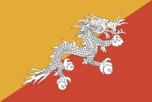
divided diagonally from the lower hoist side corner; the upper triangle is orange and the lower triangle is red; centered along the dividing line is a large black and white dragon facing away from the hoist side
Highways
total: 2,165 km paved: NA unpaved: gravel 1,703 km undifferentiated: 462 km
Imports
$125 million (c.i.f., FY93 est.) commodities: fuel and lubricants, grain, machinery and parts, vehicles, fabrics partners: India 60%, Japan, Germany, US, UK
Independence
8 August 1949 (from India)
Industrial production
growth rate NA%; accounts for 8% of GDP; primarily cottage industry and home based handicrafts
Industries
cement, wood products, processed fruits, alcoholic beverages, calcium carbide
Infant mortality rate
121 deaths/1,000 live births (1994 est.)
Inflation rate (consumer prices)
11% (October 1993)
International disputes
none
Irrigated land
340 sq km (1989 est.)
Judicial branch
High Court
Labor force
NA by occupation: agriculture 93%, services 5%, industry and commerce 2% note: massive lack of skilled labor
Land boundaries
total 1,075 km, China 470 km, India 605 km
Land use
arable land: 2% permanent crops: 0% meadows and pastures: 5% forest and woodland: 70% other: 23%
Languages
Dzongkha (official), Bhotes speak various Tibetan dialects; Nepalese speak various Nepalese dialects
Legal system
based on Indian law and English common law; has not accepted compulsory ICJ jurisdiction
Legislative branch
unicameral National Assembly (Tshogdu); no national elections
Life expectancy at birth
total population: 50.6 years male: 51.15 years female: 50.03 years (1994 est.)
Literacy
total population: NA% male: NA% female: NA%
Location
Southern Asia, in the Himalayas, between China and India
Manpower availability
males age 15-49 424,558; fit for military service 226,851; reach military age (18) annually 17,310 (1994 est.)
Map references
Asia, Standard Time Zones of the World
Maritime claims
none; landlocked
Member of
AsDB, CP, ESCAP, FAO, G-77, IBRD, ICAO, IDA, IFAD, IMF, INTELSAT, IOC, ITU, NAM, SAARC, UN, UNCTAD, UNESCO, UNIDO, UPU, WHO
Names
conventional long form: Kingdom of Bhutan conventional short form: Bhutan
National holiday
National Day, 17 December (1907) (Ugyen Wangchuck became first hereditary king)
National product
GDP - purchasing power equivalent - $500 million (1993 est.)
National product per capita
$700 (1993 est.)
National product real growth rate
5% (FY93 est.)
Nationality
noun: Bhutanese (singular and plural) adjective: Bhutanese
Natural resources
timber, hydropower, gypsum, calcium carbide
Net migration rate
0 migrant(s)/1,000 population (1994 est.)
Note
landlocked; strategic location between China and India; controls several key Himalayan mountain passes
Other political or pressure groups
Buddhist clergy; Indian merchant community; ethnic Nepalese organizations leading militant antigovernment campaign
Overview
The economy, one of the world's least developed, is based on agriculture and forestry, which provide the main livelihood for 90% of the population and account for about 50% of GDP. Rugged mountains dominate the terrain and make the building of roads and other infrastructure difficult and expensive. The economy is closely aligned with that of India through strong trade and monetary links. The industrial sector is small and technologically backward, with most production of the cottage industry type. Most development projects, such as road construction, rely on Indian migrant labor. Bhutan's hydropower potential and its attraction for tourists are its most important natural resources; however, the government limits the number of tourists to 4,000 per year to minimize foreign influence. Much of the impetus for growth has come from large public-sector companies. Nevertheless, in recent years, Bhutan has shifted toward decentralized development planning and greater private initiative. The government privatized several large public-sector firms, is revamping its trade regime and liberalizing administerial procedures over industrial licensing. The government's industrial contribution to GDP decreased from 13% in 1988 to about 10% in 1992.
Political parties and leaders
no legal parties
Population
716,380 (July 1994 est.) note: other estimates range as high as 1.7 million (July 1994 est.)
Population growth rate
2.34% (1994 est.)
Religions
Lamaistic Buddhism 75%, Indian- and Nepalese-influenced Hinduism 25%
Royal Advisory Council (Lodoi Tsokde)
nominated by the king cabinet: Council of Ministers (Lhengye Shungtsog); appointed by the king
Suffrage
each family has one vote in village-level elections
Telecommunications
domestic telephone service is very poor with very few telephones in use; international telephone and telegraph service is by land line through India; a satellite earth station was planned (1990); broadcast stations - 1 AM, 1 FM, no TV (1990)
Terrain
mostly mountainous with some fertile valleys and savanna
Total fertility rate
5.42 children born/woman (1994 est.)
Type
monarchy; special treaty relationship with India
Unemployment rate
NA%
US diplomatic representation
no formal diplomatic relations, although informal contact is maintained between the Bhutanese and US Embassies in New Delhi (India)