2016 Edition
CIA World Factbook 2016 Archive (HTML)
Introduction
Background
Present day Benin was the site of Dahomey, a West African kingdom that rose to prominence in about 1600 and over the next two and a half centuries became a regional power, largely based on its slave trade. Coastal areas of Dahomey began to be controlled by the French in the second half of the 19th century; the entire kingdom was conquered by 1894. French Dahomey achieved independence in 1960; it changed its name to the Republic of Benin in 1975. A succession of military governments ended in 1972 with the rise to power of Mathieu KEREKOU and the establishment of a government based on Marxist-Leninist principles. A move to representative government began in 1989. Two years later, free elections ushered in former Prime Minister Nicephore SOGLO as president, marking the first successful transfer of power in Africa from a dictatorship to a democracy. KEREKOU was returned to power by elections held in 1996 and 2001, though some irregularities were alleged. KEREKOU stepped down at the end of his second term in 2006 and was succeeded by Thomas YAYI Boni, a political outsider and independent. YAYI, who won a second five-year term in March 2011, has attempted to stem corruption and has strongly promoted accelerating Benin's economic growth.
Geography
Area
- 112,622 sq km 110,622 sq km 2,000 sq km
- land
- 110,622 sq km
- total
- 112,622 sq km
- water
- 2,000 sq km
Area - comparative
slightly smaller than Pennsylvania
Climate
tropical; hot, humid in south; semiarid in north
Coastline
121 km
Elevation
- 273 m lowest point: Atlantic Ocean 0 m Mont Sokbaro 658 m
- elevation extremes
- lowest point: Atlantic Ocean 0 m
- mean elevation
- 273 m
Environment - current issues
inadequate supplies of potable water; poaching threatens wildlife populations; deforestation; desertification
Environment - international agreements
- Biodiversity, Climate Change, Climate Change-Kyoto Protocol, Desertification, Endangered Species, Environmental Modification, Hazardous Wastes, Law of the Sea, Ozone Layer Protection, Ship Pollution, Wetlands, Whaling none of the selected agreements
- party to
- Biodiversity, Climate Change, Climate Change-Kyoto Protocol, Desertification, Endangered Species, Environmental Modification, Hazardous Wastes, Law of the Sea, Ozone Layer Protection, Ship Pollution, Wetlands, Whaling
- signed, but not ratified
- none of the selected agreements
Geographic coordinates
9 30 N, 2 15 E
Geography - note
sandbanks create difficult access to a coast with no natural harbors, river mouths, or islands
Irrigated land
230 sq km (2012)
Land boundaries
- 2,123 km Burkina Faso 386 km, Niger 277 km, Nigeria 809 km, Togo 651 km
- border countries (4)
- Burkina Faso 386 km, Niger 277 km, Nigeria 809 km, Togo 651 km
- total
- 2,123 km
Land use
- 31.3% arable land 22.9%; permanent crops 3.5%; permanent pasture 4.9% 40% 28.7% (2011 est.)
- agricultural land
- 31.3%
- forest
- 40%
- other
- 28.7% (2011 est.)
Location
Western Africa, bordering the Bight of Benin, between Nigeria and Togo
Map references
Africa
Maritime claims
- 200 nm
- territorial sea
- 200 nm
Natural hazards
hot, dry, dusty harmattan wind may affect north from December to March
Natural resources
small offshore oil deposits, limestone, marble, timber
Terrain
mostly flat to undulating plain; some hills and low mountains
People and Society
Age structure
- 43.04% (male 2,358,838/female 2,264,204) 20.32% (male 1,110,607/female 1,072,196) 30.24% (male 1,641,547/female 1,606,185) 3.56% (male 165,496/female 217,192) 2.84% (male 120,629/female 184,564) (2016 est.)
- 0-14 years
- 43.04% (male 2,358,838/female 2,264,204)
- 15-24 years
- 20.32% (male 1,110,607/female 1,072,196)
- 25-54 years
- 30.24% (male 1,641,547/female 1,606,185)
- 55-64 years
- 3.56% (male 165,496/female 217,192)
- 65 years and over
- 2.84% (male 120,629/female 184,564) (2016 est.)
Birth rate
35.5 births/1,000 population (2016 est.)
Child labor - children ages 5-14
- 1,020,981 46% (2006 est.)
- percentage
- 46% (2006 est.)
- total number
- 1,020,981
Children under the age of 5 years underweight
18% (2014)
Contraceptive prevalence rate
12.9% (2011/12)
Death rate
8 deaths/1,000 population (2016 est.)
Demographic profile
Benin has a youthful age structure – almost 65% of the population is under the age of 25 – which is bolstered by high fertility and population growth rates. Benin’s total fertility has been falling over time but remains high, declining from almost 7 children per women in 1990 to 4.8 in 2016. Benin’s low contraceptive use and high unmet need for contraception contribute to the sustained high fertility rate. Although the majority of Beninese women use skilled health care personnel for antenatal care and delivery, the high rate of maternal mortality indicates the need for more access to high quality obstetric care. Poverty, unemployment, increased living costs, and dwindling resources increasingly drive the Beninese to migrate. An estimated 4.4 million, more than 40%, of Beninese live abroad. Virtually all Beninese emigrants move to West African countries, particularly Nigeria and Cote d’Ivoire. Of the less than 1% of Beninese emigrants who settle in Europe, the vast majority live in France, Benin’s former colonial ruler. With about 40% of the population living below the poverty line, many desperate parents resort to sending their children to work in wealthy households as domestic servants (a common practice known as vidomegon), mines, quarries, or agriculture domestically or in Nigeria and other neighboring countries, often under brutal conditions. Unlike in other West African countries, where rural people move to the coast, farmers from Benin’s densely populated southern and northwestern regions move to the historically sparsely populated central region to pursue agriculture. Immigrants from West African countries came to Benin in increasing numbers between 1992 and 2002 because of its political stability and porous borders.
Dependency ratios
- 82% 76.7% 5.3% 19% (2015 est.)
- elderly dependency ratio
- 5.3%
- potential support ratio
- 19% (2015 est.)
- total dependency ratio
- 82%
- youth dependency ratio
- 76.7%
Drinking water source
- urban: 85.2% of population rural: 72.1% of population total: 77.9% of population urban: 14.8% of population rural: 27.9% of population total: 22.1% of population (2015 est.)
- rural
- 27.9% of population
- total
- 22.1% of population (2015 est.)
- urban
- 14.8% of population
Education expenditures
4.4% of GDP (2014)
Ethnic groups
Fon and related 38.4%, Adja and related 15.1%, Yoruba and related 12%, Bariba and related 9.6%, Fulani and related 8.6%, Ottamari and related 6.1%, Yoa-Lokpa and related 4.3%, Dendi and related 2.9%, other 0.9%, foreigner 1.9% (2013 est.)
Health expenditures
4.6% of GDP (2014)
HIV/AIDS - adult prevalence rate
1.06% (2015 est.)
HIV/AIDS - deaths
2,800 (2015 est.)
HIV/AIDS - people living with HIV/AIDS
69,100 (2015 est.)
Hospital bed density
0.5 beds/1,000 population (2010)
Infant mortality rate
- 54.2 deaths/1,000 live births 57.3 deaths/1,000 live births 51 deaths/1,000 live births (2016 est.)
- female
- 51 deaths/1,000 live births (2016 est.)
- male
- 57.3 deaths/1,000 live births
- total
- 54.2 deaths/1,000 live births
Languages
French (official), Fon and Yoruba (most common vernaculars in south), tribal languages (at least six major ones in north)
Life expectancy at birth
- 61.9 years 60.5 years 63.3 years (2016 est.)
- female
- 63.3 years (2016 est.)
- male
- 60.5 years
- total population
- 61.9 years
Literacy
- age 15 and over can read and write 38.4% 49.9% 27.3% (2015 est.)
- definition
- age 15 and over can read and write
- female
- 27.3% (2015 est.)
- male
- 49.9%
- total population
- 38.4%
Major infectious diseases
- very high bacterial and protozoal diarrhea, hepatitis A, and typhoid fever dengue fever, malaria, and yellow fever meningococcal meningitis rabies (2016)
- animal contact disease
- rabies (2016)
- degree of risk
- very high
- food or waterborne diseases
- bacterial and protozoal diarrhea, hepatitis A, and typhoid fever
- respiratory disease
- meningococcal meningitis
- vectorborne diseases
- dengue fever, malaria, and yellow fever
Major urban areas - population
PORTO-NOVO (capital) 268,000 (2014); COTONOU (seat of government) 682,000; Abomey-Calavi 757,000 (2015)
Maternal mortality rate
405 deaths/100,000 live births (2015 est.)
Median age
- 18 years 17.7 years 18.4 years (2016 est.)
- female
- 18.4 years (2016 est.)
- male
- 17.7 years
- total
- 18 years
Mother's mean age at first birth
- 20.3 median age at first birth among women 25-29 (2011/12 est.)
- note
- median age at first birth among women 25-29 (2011/12 est.)
Nationality
- Beninese (singular and plural) Beninese
- adjective
- Beninese
- noun
- Beninese (singular and plural)
Net migration rate
0 migrant(s)/1,000 population (2016 est.)
Obesity - adult prevalence rate
8.1% (2014)
Physicians density
0.06 physicians/1,000 population (2008)
Population
- 10,741,458 estimates for this country explicitly take into account the effects of excess mortality due to AIDS; this can result in lower life expectancy, higher infant mortality, higher death rates, lower population growth rates, and changes in the distribution of population by age and sex than would otherwise be expected (July 2016 est.)
- note
- estimates for this country explicitly take into account the effects of excess mortality due to AIDS; this can result in lower life expectancy, higher infant mortality, higher death rates, lower population growth rates, and changes in the distribution of population by age and sex than would otherwise be expected (July 2016 est.)
Population growth rate
2.75% (2016 est.)
Religions
Muslim 27.7%, Catholic 25.5%, Protestant 13.5% (Celestial 6.7%, Methodist 3.4%, other Protestant 3.4%), Vodoun 11.6%, other Christian 9.5%, other traditional religions 2.6%, other 2.6%, none 5.8% (2013 est.)
Sanitation facility access
- urban: 35.6% of population rural: 7.3% of population total: 19.7% of population urban: 64.4% of population rural: 92.7% of population total: 80.3% of population (2015 est.)
- rural
- 92.7% of population
- total
- 80.3% of population (2015 est.)
- urban
- 64.4% of population
School life expectancy (primary to tertiary education)
- 12 years 14 years 11 years (2013)
- female
- 11 years (2013)
- male
- 14 years
- total
- 12 years
Sex ratio
- 1.05 male(s)/female 1.04 male(s)/female 1.04 male(s)/female 1.02 male(s)/female 0.76 male(s)/female 0.66 male(s)/female 1.01 male(s)/female (2016 est.)
- 0-14 years
- 1.04 male(s)/female
- 15-24 years
- 1.04 male(s)/female
- 25-54 years
- 1.02 male(s)/female
- 55-64 years
- 0.76 male(s)/female
- 65 years and over
- 0.66 male(s)/female
- at birth
- 1.05 male(s)/female
- total population
- 1.01 male(s)/female (2016 est.)
Total fertility rate
4.86 children born/woman (2016 est.)
Unemployment, youth ages 15-24
- 2.4% 1.5% 3.1% (2010 est.)
- female
- 3.1% (2010 est.)
- male
- 1.5%
- total
- 2.4%
Urbanization
- 44% of total population (2015) 3.67% annual rate of change (2010-15 est.)
- rate of urbanization
- 3.67% annual rate of change (2010-15 est.)
- urban population
- 44% of total population (2015)
Government
Administrative divisions
12 departments; Alibori, Atacora, Atlantique, Borgou, Collines, Couffo, Donga, Littoral, Mono, Oueme, Plateau, Zou
Capital
- Porto-Novo (official capital); note - Cotonou (seat of government) 6 29 N, 2 37 E UTC+1 (6 hours ahead of Washington, DC, during Standard Time)
- geographic coordinates
- 6 29 N, 2 37 E
- name
- Porto-Novo (official capital); note - Cotonou (seat of government)
- time difference
- UTC+1 (6 hours ahead of Washington, DC, during Standard Time)
Citizenship
- no at least one parent must be a citizen of Benin yes 10 years
- citizenship by birth
- no
- citizenship by descent only
- at least one parent must be a citizen of Benin
- dual citizenship recognized
- yes
- residency requirement for naturalization
- 10 years
Constitution
previous 1946, 1958 (preindependence); latest adopted by referendum 2 December 1990, promulgated 11 December 1990 (2016)
Country name
- Republic of Benin Benin Republique du Benin Benin Dahomey named for the Bight of Benin, the body of water on which the country lies
- conventional long form
- Republic of Benin
- conventional short form
- Benin
- etymology
- named for the Bight of Benin, the body of water on which the country lies
- former
- Dahomey
- local long form
- Republique du Benin
- local short form
- Benin
Diplomatic representation from the US
- Ambassador Lucy TAMLYN (since 8 November 2015) Caporal Bernard Anani, 01 BP 2012, Cotonou 01 B. P. 2012, Cotonou [229] 21-30-06-50 [229] 21-30-03-84
- chief of mission
- Ambassador Lucy TAMLYN (since 8 November 2015)
- embassy
- Caporal Bernard Anani, 01 BP 2012, Cotonou
- FAX
- [229] 21-30-03-84
- mailing address
- 01 B. P. 2012, Cotonou
- telephone
- [229] 21-30-06-50
Diplomatic representation in the US
- Ambassador Omar AROUNA (since 21 May 2014) 2124 Kalorama Road NW, Washington, DC 20008 [1] (202) 232-6656 [1] (202) 265-1996
- chancery
- 2124 Kalorama Road NW, Washington, DC 20008
- chief of mission
- Ambassador Omar AROUNA (since 21 May 2014)
- FAX
- [1] (202) 265-1996
- telephone
- [1] (202) 232-6656
Executive branch
- President Patrice TALON (since 6 April 2016); note - the president is both chief of state and head of government President Patrice TALON (since 6 April 2016); Prime Minister (vacant) Council of Ministers appointed by the president president directly elected by absolute majority popular vote in 2 rounds if needed for a 5-year term (eligible for a second term); last held on 6 March and 20 March 2016 (next to be held in 2021) Patrice TALON elected president; first round percent of vote - Lionel ZINSOU (FCBE) 28.4%, Patrice TALON (independent) 24.8%, Sebastien AJAVON (independent) 23.0%, Abdoulaye Bio TCHANE (ABT) 8.8%, Pascal KOUPAKI (NC) 5.9%, other 9.1%; second round percent of vote - Patrice TALON 65.4%, Lionel ZINSOU 34.6%
- cabinet
- Council of Ministers appointed by the president
- chief of state
- President Patrice TALON (since 6 April 2016); note - the president is both chief of state and head of government
- election results
- Patrice TALON elected president; first round percent of vote - Lionel ZINSOU (FCBE) 28.4%, Patrice TALON (independent) 24.8%, Sebastien AJAVON (independent) 23.0%, Abdoulaye Bio TCHANE (ABT) 8.8%, Pascal KOUPAKI (NC) 5.9%, other 9.1%; second round percent of vote - Patrice TALON 65.4%, Lionel ZINSOU 34.6%
- elections/appointments
- president directly elected by absolute majority popular vote in 2 rounds if needed for a 5-year term (eligible for a second term); last held on 6 March and 20 March 2016 (next to be held in 2021)
- head of government
- President Patrice TALON (since 6 April 2016); Prime Minister (vacant)
Flag description
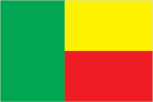
- two equal horizontal bands of yellow (top) and red (bottom) with a vertical green band on the hoist side; green symbolizes hope and revival, yellow wealth, and red courage uses the popular Pan-African colors of Ethiopia
- note
- uses the popular Pan-African colors of Ethiopia
Government type
presidential republic
Independence
1 August 1960 (from France)
International law organization participation
has not submitted an ICJ jurisdiction declaration; accepts ICCt jurisdiction
International organization participation
ACP, AfDB, AU, CD, ECOWAS, Entente, FAO, FZ, G-77, IAEA, IBRD, ICAO, ICCt, ICRM, IDA, IDB, IFAD, IFC, IFRCS, ILO, IMF, IMO, Interpol, IOC, IOM, IPU, ISO, ITSO, ITU, ITUC (NGOs), MIGA, MINUSMA, MONUSCO, NAM, OAS (observer), OIC, OIF, OPCW, PCA, UN, UNAMID, UNCTAD, UNESCO, UNHCR, UNIDO, UNMIL, UNMISS, UNOCI, UNWTO, UPU, WADB (regional), WAEMU, WCO, WFTU (NGOs), WHO, WIPO, WMO, WTO
Judicial branch
- Supreme Court or Cour Supreme (consists of the court president and 3 chamber presidents organized into an administrative division, judicial chamber, and chamber of accounts); Constitutional Court or Cour Constitutionnelle (consists of 7 members including the court president); High Court of Justice (consists of the Constitutional Court members, 6 members appointed by the National Assembly, and the Supreme Court president); note - jurisdiction of the High Court of Justice is limited to cases of high treason by the national president or members of the government while in office Supreme Court president and judges appointed by the national president upon the advice of the National Assembly; judges appointed for single renewable 5-year terms; Constitutional Court members - 4 appointed by the National Assembly and 3 by the national president; members appointed for single renewable 5-year terms; High Court of Justice "other" members elected by the National Assembly; member tenure NA Court of Appeal or Cour d'Appel; district courts; village courts; Assize courts
- highest court(s)
- Supreme Court or Cour Supreme (consists of the court president and 3 chamber presidents organized into an administrative division, judicial chamber, and chamber of accounts); Constitutional Court or Cour Constitutionnelle (consists of 7 members including the court president); High Court of Justice (consists of the Constitutional Court members, 6 members appointed by the National Assembly, and the Supreme Court president); note - jurisdiction of the High Court of Justice is limited to cases of high treason by the national president or members of the government while in office
- judge selection and term of office
- Supreme Court president and judges appointed by the national president upon the advice of the National Assembly; judges appointed for single renewable 5-year terms; Constitutional Court members - 4 appointed by the National Assembly and 3 by the national president; members appointed for single renewable 5-year terms; High Court of Justice "other" members elected by the National Assembly; member tenure NA
- subordinate courts
- Court of Appeal or Cour d'Appel; district courts; village courts; Assize courts
Legal system
civil law system modeled largely on the French system and some customary law
Legislative branch
- unicameral National Assembly or Assemblee Nationale (83 seats; members directly elected in multi-seat constituencies by proportional representation vote; members serve 4-year terms) last held on 26 April 2015 (next to be held in April 2019) percent of vote by party - FCBE 30.2%, UN 14.4%, PRD 10.6%, AND 7.6%, RB-RP 7.1%, other 30.1%; seats by party - FCBE 33, UN 13, PRD 10, AND 5, RB-RP 7, other 15
- description
- unicameral National Assembly or Assemblee Nationale (83 seats; members directly elected in multi-seat constituencies by proportional representation vote; members serve 4-year terms)
- election results
- percent of vote by party - FCBE 30.2%, UN 14.4%, PRD 10.6%, AND 7.6%, RB-RP 7.1%, other 30.1%; seats by party - FCBE 33, UN 13, PRD 10, AND 5, RB-RP 7, other 15
- elections
- last held on 26 April 2015 (next to be held in April 2019)
National anthem
- "L'Aube Nouvelle" (The Dawn of a New Day) Gilbert Jean DAGNON adopted 1960
- lyrics/music
- Gilbert Jean DAGNON
- name
- "L'Aube Nouvelle" (The Dawn of a New Day)
- note
- adopted 1960
National holiday
National Day, 1 August (1960)
National symbol(s)
- leopard; national colors: green, yellow, red
- leopard; national colors
- green, yellow, red
Political parties and leaders
- Alliance for a Triumphant Benin or ABT [Abdoulaye BIO TCHANE] African Movement for Development and Progress or MADEP [Sefou FAGBOHOUN] Benin Renaissance or RB [Lehady SOGLO] Cowrie Force for an Emerging Benin or FCBE [Yayi BONI] Democratic Renewal Party or PRD [Adrien HOUNGBEDJI] New Consciousness Rally or NC [Pascal KOUPAKI] Patriotic Awakening or RP [Janvier YAHOUEDEOU] Social Democrat Party or PSD [Emmanuel GOLOU] Sun Alliance or AS [Sacca LAFIA] Union Makes the Nation or UN [Adrien HOUNGBEDJI] (alliance superceded Alliance for Dynamic Democracy or ADD) United Democratic Forces or FDU [Mathurin NAGO] approximately 20 additional minor parties
- note
- approximately 20 additional minor parties
Political pressure groups and leaders
- economic groups; environmentalists; political groups; teachers' unions and other educational groups
- other
- economic groups; environmentalists; political groups; teachers' unions and other educational groups
Suffrage
18 years of age; universal
Economy
Agriculture - products
cotton, corn, cassava (manioc, tapioca), yams, beans, palm oil, peanuts, cashews; livestock
Budget
- $1.476 billion $2.02 billion (2015 est.)
- expenditures
- $2.02 billion (2015 est.)
- revenues
- $1.476 billion
Budget surplus (+) or deficit (-)
-6.4% of GDP (2015 est.)
Central bank discount rate
4.25% (31 December 2010) 4.25% (31 December 2009)
Commercial bank prime lending rate
NA%
Current account balance
-$937 million (2015 est.) -$896 million (2014 est.)
Debt - external
$2.115 billion (31 December 2015 est.) $1.984 billion (31 December 2014 est.)
Distribution of family income - Gini index
36.5 (2003)
Economy - overview
The free market economy of Benin remains underdeveloped and dependent on subsistence agriculture, cotton production, and regional trade. Cotton is a key export commodity; high prices supported export earnings. Growth in real output has averaged 6.5% since 2014. Inflation has subsided and remained 1% over the past several years. An insufficient electrical supply continues to hamper Benin's economic growth though the government recently has taken steps to increase domestic power production. Private foreign direct investment is small, and foreign aid accounts for the majority of investment in infrastructure projects. Benin’s 2001 privatization policy continues in telecommunications, water, electricity, and agriculture. Benin has appealed for international assistance to mitigate piracy against commercial shipping in its territory. Though security remains a problem, the Port of Cotonou has made progress towards implementing the International Ship and Port Facility Security (ISPS) Code in an effort to remain competitive. Projects included in Benin's $307 million Millennium Challenge Corporation (MCC) compact (2006-2011) were designed to increase investment and private sector activity by improving key institutional and physical infrastructure. The four projects focused on access to land, access to financial services, access to justice, and access to markets (including modernization of the port). The Port of Cotonou is the largest component of Benin’s economy with revenues projected to account for more than 40% of Benin’s national budget. Realizing its economic potential requires further efforts to infrastructure upgrades, stemming corruption, and expanding access to foreign markets in Nigeria and neighboring landlocked countries. In September 2015, Benin signed a MCC second Compact for $375 million that is designed to strengthen the national utility service provider, attract private sector investment, fund infrastructure investments in electricity generation and distribution, and develop off-grid electrification for poor and unserved households. In order to raise growth, Benin plans to attract more foreign investment, place more emphasis on tourism, facilitate the development of new food processing systems and agricultural products, encourage new information and communication technology, and establish Independent Power Producers (IPP).
Exchange rates
Communaute Financiere Africaine francs (XOF) per US dollar - 591.45 (2015 est.) 494.42 (2014 est.) 494.42 (2013 est.) 510.53 (2012 est.) 471.87 (2011 est.)
Exports
$1.841 billion (2015 est.) $2.562 billion (2014 est.)
Exports - commodities
cotton, cashews, shea butter, textiles, palm products, seafood
Exports - partners
India 24.2%, Gabon 14.6%, China 7.2%, Niger 6%, Bangladesh 5%, Nigeria 4.9%, Vietnam 4.2% (2015)
Fiscal year
calendar year
GDP - composition, by end use
- 67.3% 15.1% 26% 0.6% 26.9% -35.9% (2015 est.)
- exports of goods and services
- 26.9%
- government consumption
- 15.1%
- household consumption
- 67.3%
- imports of goods and services
- -35.9% (2015 est.)
- investment in fixed capital
- 26%
- investment in inventories
- 0.6%
GDP - composition, by sector of origin
- 23.2% 24.9% 51.9% (2015 est.)
- agriculture
- 23.2%
- industry
- 24.9%
- services
- 51.9% (2015 est.)
GDP - per capita (PPP)
- $2,100 (2015 est.) $2,100 (2014 est.) $2,000 (2013 est.) data are in 2015 US dollars
- note
- data are in 2015 US dollars
GDP - real growth rate
5.2% (2015 est.) 6.5% (2014 est.) 6.9% (2013 est.)
GDP (official exchange rate)
$8.471 billion (2015 est.)
GDP (purchasing power parity)
- $22.95 billion (2015 est.) $21.81 billion (2014 est.) $20.47 billion (2013 est.) data are in 2015 US dollars
- note
- data are in 2015 US dollars
Gross national saving
15.3% of GDP (2015 est.) 15.7% of GDP (2014 est.) 21.1% of GDP (2013 est.)
Household income or consumption by percentage share
- 3.1% 29% (2003)
- highest 10%
- 29% (2003)
- lowest 10%
- 3.1%
Imports
$2.727 billion (2015 est.) $3.273 billion (2014 est.)
Imports - commodities
foodstuffs, capital goods, petroleum products
Imports - partners
China 42.1%, US 8.9%, India 5.7%, Malaysia 4.8%, Thailand 4.3%, France 4% (2015)
Industrial production growth rate
6.8% (2015 est.)
Industries
textiles, food processing, construction materials, cement
Inflation rate (consumer prices)
0.3% (2015 est.) -1.1% (2014 est.)
Labor force
3.662 million (2007 est.)
Market value of publicly traded shares
$NA
Population below poverty line
37.4% (2007 est.)
Public debt
37.4% of GDP (2015 est.) 30.9% of GDP (2014 est.)
Reserves of foreign exchange and gold
$731.6 million (31 December 2015 est.) $726 million (31 December 2014 est.)
Stock of broad money
$4.165 billion (31 December 2014 est.) $3.61 billion (31 December 2013 est.)
Stock of domestic credit
$1.631 billion (31 December 2015 est.) $1.792 billion (31 December 2014 est.)
Stock of narrow money
$2.172 billion (31 December 2015 est.) $2.336 billion (31 December 2014 est.)
Taxes and other revenues
17.4% of GDP (2015 est.)
Unemployment rate
NA%
Energy
Carbon dioxide emissions from consumption of energy
5 million Mt (2013 est.)
Crude oil - exports
0 bbl/day (2013 est.)
Crude oil - imports
0 bbl/day (2013 est.)
Crude oil - production
0 bbl/day (2015 est.)
Crude oil - proved reserves
8 million bbl (1 January 2016 es)
Electricity - consumption
1 billion kWh (2014 est.)
Electricity - exports
0 kWh (2013 est.)
Electricity - from fossil fuels
99.4% of total installed capacity (2012 est.)
Electricity - from hydroelectric plants
0.6% of total installed capacity (2012 est.)
Electricity - from nuclear fuels
0% of total installed capacity (2012 est.)
Electricity - from other renewable sources
0% of total installed capacity (2012 est.)
Electricity - imports
1.1 billion kWh (2014 est.)
Electricity - installed generating capacity
163,000 kW (2015 est.)
Electricity - production
200 million kWh (2014 est.)
Electricity access
- 7,300,000 29% 57% 9% (2013)
- electrification - rural areas
- 9% (2013)
- electrification - total population
- 29%
- electrification - urban areas
- 57%
- population without electricity
- 7,300,000
Natural gas - consumption
0 cu m (2013 est.)
Natural gas - exports
0 cu m (2013 est.)
Natural gas - imports
0 cu m (2013 est.)
Natural gas - production
0 cu m (2013 est.)
Natural gas - proved reserves
1.133 billion cu m (1 January 2016 es)
Refined petroleum products - consumption
41,000 bbl/day (2014 est.)
Refined petroleum products - exports
4,914 bbl/day (2013 est.)
Refined petroleum products - imports
44,950 bbl/day (2013 est.)
Refined petroleum products - production
0 bbl/day (2013 est.)
Communications
Broadcast media
state-run Office de Radiodiffusion et de Television du Benin (ORTB) operates a TV station with multiple channels providing a wide broadcast reach; several privately owned TV stations broadcast from Cotonou; satellite TV subscription service is available; state-owned radio, under ORTB control, includes a national station supplemented by a number of regional stations; substantial number of privately owned radio broadcast stations; transmissions of a few international broadcasters are available on FM in Cotonou (2007)
Internet country code
.bj
Internet users
- 709,000 6.8% (July 2015 est.)
- percent of population
- 6.8% (July 2015 est.)
- total
- 709,000
Telephone system
- inadequate system of open-wire, microwave radio relay, and cellular connections; fixed-line network characterized by aging, deteriorating equipment fixed-line teledensity only about 2 per 100 persons; spurred by the presence of multiple mobile-cellular providers, cellular telephone subscribership has been increasing rapidly country code - 229; landing point for the SAT-3/WASC fiber-optic submarine cable that provides connectivity to Europe and Asia; long distance fiber-optic links with Togo, Burkina Faso, Niger, and Nigeria; satellite earth stations - 7 (Intelsat-Atlantic Ocean) (2015)
- domestic
- fixed-line teledensity only about 2 per 100 persons; spurred by the presence of multiple mobile-cellular providers, cellular telephone subscribership has been increasing rapidly
- general assessment
- inadequate system of open-wire, microwave radio relay, and cellular connections; fixed-line network characterized by aging, deteriorating equipment
- international
- country code - 229; landing point for the SAT-3/WASC fiber-optic submarine cable that provides connectivity to Europe and Asia; long distance fiber-optic links with Togo, Burkina Faso, Niger, and Nigeria; satellite earth stations - 7 (Intelsat-Atlantic Ocean) (2015)
Telephones - fixed lines
- 194,666 2 (July 2015 est.)
- subscriptions per 100 inhabitants
- 2 (July 2015 est.)
- total subscriptions
- 194,666
Telephones - mobile cellular
- 9.318 million 89 (July 2015 est.)
- subscriptions per 100 inhabitants
- 89 (July 2015 est.)
- total
- 9.318 million
Transportation
Airports
6 (2013)
Airports - with paved runways
- 1 (2013)
- 1,524 to 2,437 m
- 1 (2013)
- total
- 1
Airports - with unpaved runways
- 2 (2013)
- 1,524 to 2,437 m
- 1
- 2,438 to 3,047 m
- 2
- 914 to 1,523 m
- 2 (2013)
- total
- 5
Civil aircraft registration country code prefix
TY (2016)
National air transport system
- 112,392 805,347 mt-km (2015)
- annual freight traffic on registered air carriers
- 805,347 mt-km (2015)
- annual passenger traffic on registered air carriers
- 112,392
- inventory of registered aircraft operated by air carriers
- 1
- number of registered air carriers
- 1
Ports and terminals
- Cotonou Cotonou
- LNG terminal(s) (import)
- Cotonou
- major seaport(s)
- Cotonou
Railways
- 438 km 438 km 1.000-m gauge (2014)
- narrow gauge
- 438 km 1.000-m gauge (2014)
- total
- 438 km
Roadways
- 16,000 km 1,400 km 14,600 km (2006)
- paved
- 1,400 km
- total
- 16,000 km
- unpaved
- 14,600 km (2006)
Waterways
150 km (seasonal navigation on River Niger along northern border) (2011)
Military and Security
Military branches
- Benin Armed Forces (Forces Armees Beninoises, FAB): Army (l'Arme de Terre), Benin Navy (Forces Navales Beninois, FNB), Benin Air Force (Force Aerienne du Benin, FAB) (2013)
- Benin Armed Forces (Forces Armees Beninoises, FAB)
- Army (l'Arme de Terre), Benin Navy (Forces Navales Beninois, FNB), Benin Air Force (Force Aerienne du Benin, FAB) (2013)
Military expenditures
1.03% of GDP (2012) NA% (2011) 1.03% of GDP (2010)
Military service age and obligation
18-35 years of age for selective compulsory and voluntary military service; a higher education diploma is required; both sexes are eligible for military service; conscript tour of duty - 18 months (2013)
Transnational Issues
Disputes - international
talks continue between Benin and Togo on funding the Adjrala hydroelectric dam on the Mona River; Benin retains a border dispute with Burkina Faso near the town of Koualou; location of Benin-Niger-Nigeria tripoint is unresolved
Illicit drugs
transshipment point used by traffickers for cocaine destined for Western Europe; vulnerable to money laundering due to poorly enforced financial regulations (2008)