2008 Edition
CIA World Factbook 2008 (Project Gutenberg)
Introduction
Background
Present day Benin was the site of Dahomey, a prominent West African kingdom that rose in the 15th century. The territory became a French Colony in 1872 and achieved independence on 1 August 1960, as the Republic of Benin. A succession of military governments ended in 1972 with the rise to power of Mathieu KEREKOU and the establishment of a government based on Marxist-Leninist principles. A move to representative government began in 1989. Two years later, free elections ushered in former Prime Minister Nicephore SOGLO as president, marking the first successful transfer of power in Africa from a dictatorship to a democracy. KEREKOU was returned to power by elections held in 1996 and 2001, though some irregularities were alleged. KEREKOU stepped down at the end of his second term in 2006 and was succeeded by Thomas YAYI Boni, a political outsider and independent. YAYI has begun a high profile fight against corruption and has strongly promoted accelerating Benin's economic growth.
Geography
Area
total: 112,620 sq km land: 110,620 sq km water: 2,000 sq km
Area - comparative
slightly smaller than Pennsylvania
Climate
tropical; hot, humid in south; semiarid in north
Coastline
121 km
Elevation extremes
lowest point: Atlantic Ocean 0 m highest point: Mont Sokbaro 658 m
Environment - current issues
inadequate supplies of potable water; poaching threatens wildlife populations; deforestation; desertification
Environment - international agreements
party to: Biodiversity, Climate Change, Climate Change-Kyoto Protocol, Desertification, Endangered Species, Environmental Modification, Hazardous Wastes, Law of the Sea, Ozone Layer Protection, Ship Pollution, Wetlands, Whaling signed, but not ratified: none of the selected agreements
Freshwater withdrawal (domestic/industrial/agricultural)
total: 0.13 cu km/yr (32%/23%/45%) per capita: 15 cu m/yr (2001)
Geographic coordinates
9 30 N, 2 15 E
Geography - note
sandbanks create difficult access to a coast with no natural harbors, river mouths, or islands
Irrigated land
120 sq km (2003)
Land boundaries
total: 1,989 km border countries: Burkina Faso 306 km, Niger 266 km, Nigeria 773 km, Togo 644 km
Land use
arable land: 23.53% permanent crops: 2.37% other: 74.1% (2005)
Location
Western Africa, bordering the Bight of Benin, between Nigeria and Togo
Map references
Africa
Maritime claims
territorial sea: 200 nm
Natural hazards
hot, dry, dusty harmattan wind may affect north from December to March
Natural resources
small offshore oil deposits, limestone, marble, timber
Terrain
mostly flat to undulating plain; some hills and low mountains
Total renewable water resources
25.8 cu km (2001)
People and Society
Age structure
0-14 years: 45.5% (male 1,978,897/female 1,901,005) 15-64 years: 51.9% (male 2,195,667/female 2,236,458) 65 years and over: 2.6% (male 91,213/female 129,307) (2008 est.)
Birth rate
39.8 births/1,000 population (2008 est.)
Death rate
9.69 deaths/1,000 population (2008 est.)
Education expenditures
4.4% of GDP (2004)
Ethnic groups
Fon and related 39.2%, Adja and related 15.2%, Yoruba and related 12.3%, Bariba and related 9.2%, Peulh and related 7%, Ottamari and related 6.1%, Yoa-Lokpa and related 4%, Dendi and related 2.5%, other 1.6% (includes Europeans), unspecified 2.9% (2002 census)
HIV/AIDS - adult prevalence rate
1.9% (2003 est.)
HIV/AIDS - deaths
5,800 (2003 est.)
HIV/AIDS - people living with HIV/AIDS
68,000 (2003 est.)
Infant mortality rate
total: 66.2 deaths/1,000 live births male: 69.68 deaths/1,000 live births female: 62.55 deaths/1,000 live births (2008 est.)
Languages
French (official), Fon and Yoruba (most common vernaculars in south), tribal languages (at least six major ones in north)
Life expectancy at birth
total population: 58.56 years male: 57.42 years female: 59.76 years (2008 est.)
Literacy
definition: age 15 and over can read and write total population: 34.7% male: 47.9% female: 23.3% (2002 census)
Major infectious diseases
degree of risk: very high food or waterborne diseases: bacterial and protozoal diarrhea, hepatitis A, and typhoid fever vectorborne diseases: malaria and yellow fever respiratory disease: meningococcal meningitis (2008)
Median age
total: 17.1 years male: 16.7 years female: 17.6 years (2008 est.)
Nationality
noun: Beninese (singular and plural) adjective: Beninese
Net migration rate
0 migrant(s)/1,000 population (2008 est.)
Population
8,532,547 note: estimates for this country explicitly take into account the effects of excess mortality due to AIDS; this can result in lower life expectancy, higher infant mortality, higher death rates, lower population growth rates, and changes in the distribution of population by age and sex than would otherwise be expected (July 2008 est.)
Population growth rate
3.01% (2008 est.)
Religions
Christian 42.8% (Catholic 27.1%, Celestial 5%, Methodist 3.2%, other Protestant 2.2%, other 5.3%), Muslim 24.4%, Vodoun 17.3%, other 15.5% (2002 census)
School life expectancy (primary to tertiary education)
total: 7 years male: 9 years female: 6 years (2001)
Sex ratio
at birth: 1.03 male(s)/female under 15 years: 1.04 male(s)/female 15-64 years: 0.98 male(s)/female 65 years and over: 0.7 male(s)/female total population: 1 male(s)/female (2008 est.)
Total fertility rate
5.58 children born/woman (2008 est.)
Government
Administrative divisions
12 departments; Alibori, Atakora, Atlantique, Borgou, Collines, Kouffo, Donga, Littoral, Mono, Oueme, Plateau, Zou
Capital
name: Porto-Novo (official capital) geographic coordinates: 6 29 N, 2 37 E time difference: UTC+1 (6 hours ahead of Washington, DC during Standard Time) note: Cotonou (seat of government)
Constitution
adopted by referendum 2 December 1990
Country name
conventional long form: Republic of Benin conventional short form: Benin local long form: Republique du Benin local short form: Benin former: Dahomey
Diplomatic representation from the US
chief of mission: Ambassador Gayleatha B. BROWN embassy: Rue Caporal Bernard Anani, Cotonou mailing address: 01 B. P. 2012, Cotonou telephone: [229] 21-30-06-50
Diplomatic representation in the US
chief of mission: Ambassador Cyrille Segbe OGUIN chancery: 2124 Kalorama Road NW, Washington, DC 20008 telephone: [1] (202) 232-6656
Executive branch
chief of state: President Thomas YAYI Boni (since 6 April 2006); note - the president is both the chief of state and head of
FAX
- [1] (202) 265-1996
- [229] 21-30-03-84
Flag description
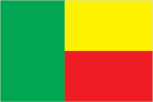
two equal horizontal bands of yellow (top) and red (bottom) with a vertical green band on the hoist side
Government type
republic
Independence
1 August 1960 (from France)
International organization participation
ACCT, ACP, AfDB, AU, ECOWAS, Entente, FAO, FZ, G-77, IAEA, IBRD, ICAO, ICCt, ICRM, IDA, IDB, IFAD, IFC, IFRCS, ILO, IMF, IMO, Interpol, IOC, IOM, IPU, ISO (correspondent), ITSO, ITU, ITUC, MIGA, MONUC, NAM, OAS (observer), OIC, OIF, OPCW, PCA, UN, UNCTAD, UNESCO, UNHCR, UNIDO, UNMIL, UNMIS, UNOCI, UNWTO, UPU, WADB (regional), WAEMU, WCL, WCO, WFTU, WHO, WIPO, WMO, WTO
Judicial branch
Constitutional Court or Cour Constitutionnelle; Supreme Court or Cour Supreme; High Court of Justice
Legal system
based on French civil law and customary law; has not accepted compulsory ICJ jurisdiction
Legislative branch
unicameral National Assembly or Assemblee Nationale (83 seats; members are elected by direct popular vote to serve four-year terms) elections: last held 31 March 2007 (next to be held by March 2011) election results: percent of vote by party - NA; seats by party - FCBE 35, ADD 20, PRD 10, other and independents 18
National holiday
National Day, 1 August (1960)
Political parties and leaders
Alliance for Dynamic Democracy or ADD; Alliance of Progress Forces or AFP; African Movement for Democracy and Progress or MADEP [Sefou FAGBOHOUN]; Benin Renaissance or RB [Rosine SOGLO]; Democratic Renewal Party or PRD [Adrien HOUNGBEDJI]; Force Cowrie for an Emerging Benin or FCBE; Impulse for Progress and Democracy or IPD [Theophile NATA]; Key Force or FC [Lazare SÈHOUÉTO]; Movement for the People's Alternative or MAP [Olivier CAPO-CHICHI]; Rally for Democracy and Progress or RDP [Dominique HOUNGNINOU]; Social Democrat Party or PSD [Bruno AMOUSSOU]; Union for the Relief or UPR [Issa SALIFOU]; Union for Democracy and National Solidarity or UDS [Sacca LAFIA] note: approximately 20 additional minor parties
Political pressure groups and leaders
other: economic groups; environmentalists; political groups; teachers' unions and other educational groups
Suffrage
18 years of age; universal
Economy
Agriculture - products
cotton, corn, cassava (tapioca), yams, beans, palm oil, peanuts, cashews; livestock
Budget
revenues: $959.2 million expenditures: $1.211 billion (2007 est.)
Central bank discount rate
4.25% (31 December 2007)
Commercial bank prime lending rate
NA
Currency (code)
Communaute Financiere Africaine franc (XOF); note - responsible authority is the Central Bank of the West African States
Currency code
XOF
Current account balance
-$441 million (2007 est.)
Debt - external
$1.2 billion (2007)
Distribution of family income - Gini index
36.5 (2003)
Economic aid - recipient
$374.7 million (2006)
Economy - overview
The economy of Benin remains underdeveloped and dependent on subsistence agriculture, cotton production, and regional trade. Growth in real output has averaged around 5% in the past seven years, but rapid population growth has offset much of this increase. Inflation has subsided over the past several years. In order to raise growth still further, Benin plans to attract more foreign investment, place more emphasis on tourism, facilitate the development of new food processing systems and agricultural products, and encourage new information and communication technology. Specific projects to improve the business climate by reforms to the land tenure system, the commercial justice system, and the financial sector were included in Benin's $307 million Millennium Challenge Account grant signed in February 2006. The 2001 privatization policy continues in telecommunications, water, electricity, and agriculture though the government annulled the privatization of Benin's state cotton company in November 2007 after the discovery of irregularities in the bidding process. The Paris Club and bilateral creditors have eased the external debt situation, with Benin benefiting from a G8 debt reduction announced in July 2005, while pressing for more rapid structural reforms. An insufficient electrical supply continues to adversely affect Benin's economic growth though the government recently has taken steps to increase domestic power production.
Electricity - consumption
595 million kWh (2006 est.)
Electricity - exports
0 kWh (2007 est.)
Electricity - imports
590 million kWh (2006 est.)
Electricity - production
120 million kWh (2006 est.)
Electricity - production by source
fossil fuel: 14.2% hydro: 85.8% nuclear: 0% other: 0% (2001)
Exchange rates
Communaute Financiere Africaine francs (XOF) per US dollar - 493.51 (2007), 522.59 (2006), 527.47 (2005), 528.29 (2004), 581.2 (2003) note: since 1 January 1999, the XOF franc has been pegged to the euro at a rate of 655.957 XOF francs per euro
Exports
$586 million f.o.b. (2007 est.)
Exports - commodities
cotton, cashews, shea butter, textiles, palm products, seafood
Exports - partners
China 24.7%, India 8.2%, Niger 6.6%, Togo 5.4%, Nigeria 5.3%, Belgium 4.6% (2007)
Fiscal year
calendar year
GDP - composition by sector
agriculture: 33.2% industry: 14.5% services: 52.3% (2007 est.)
GDP - per capita (PPP)
$1,400 (2007 est.)
GDP - real growth rate
4.5% (2007 est.)
GDP (official exchange rate)
$5.433 billion (2007 est.)
GDP (purchasing power parity)
$12 billion (2007 est.)
Household income or consumption by percentage share
lowest 10%: 3.1% highest 10%: 29% (2003)
Imports
$1.085 billion f.o.b. (2007 est.)
Imports - commodities
foodstuffs, capital goods, petroleum products
Imports - partners
China 44.5%, France 8.2%, US 6.5%, Thailand 6.3%, Malaysia 4.8% (2007)
Industrial production growth rate
4.5% (2007 est.)
Industries
textiles, food processing, construction materials, cement
Inflation rate (consumer prices)
1.3% (2007 est.)
Investment (gross fixed)
19.3% of GDP (2007 est.)
Labor force
5.38 million (2007 est.)
Market value of publicly traded shares
$NA
Natural gas - consumption
0 cu m (2007 est.)
Natural gas - exports
0 cu m (2007 est.)
Natural gas - imports
0 cu m (2007 est.)
Natural gas - production
0 cu m (2007 est.)
Natural gas - proved reserves
1.133 billion cu m (1 January 2008 est.)
Oil - consumption
9,232 bbl/day (2007 est.)
Oil - exports
6,484 bbl/day (2005)
Oil - imports
16,830 bbl/day (2007 est.)
Oil - production
0 bbl/day (2007 est.)
Oil - proved reserves
8 million bbl (1 January 2008 est.)
Population below poverty line
37.4% (2007 est.)
Reserves of foreign exchange and gold
$1.209 billion (31 December 2007 est.)
Stock of domestic credit
$520.6 million (31 December 2007)
Stock of money
$1.324 billion (31 December 2007)
Stock of quasi money
$627.2 million (31 December 2007)
Unemployment rate
NA%
Communications
Internet country code
.bj
Internet hosts
848 (2008)
Internet Service Providers (ISPs)
4 (2002)
Internet users
150,000 (2007)
Radio broadcast stations
AM 1, FM 34, shortwave 1 (2007)
Radios
660,000 (2000)
Telephone system
general assessment: inadequate; fixed-line network characterized by aging, deteriorating equipment with fixed-line teledensity stuck at 1 per 100 persons; mobile-cellular telephone subscribership is increasing domestic: system of open-wire, microwave radio relay, and cellular connections; multiple mobile-cellular providers international: country code - 229; landing point for the SAT-3/WASC fiber-optic submarine cable that provides connectivity to Europe and Asia; satellite earth stations - 7 (Intelsat-Atlantic Ocean) (2007)
Telephones - main lines in use
110,300 (2007)
Telephones - mobile cellular
1.895 million (2007)
Television broadcast stations
6 (2007)
Televisions
66,000 (2000)
Transportation
Airports
5 (2007)
Airports - with paved runways
total: 1 1,524 to 2,437 m: 1 (2007)
Airports - with unpaved runways
total: 4 2,438 to 3,047 m: 1 1,524 to 2,437 m: 1 914 to 1,523 m: 2 (2007)
Ports and terminals
Cotonou
Railways
total: 758 km narrow gauge: 758 km 1.000-m gauge (2006)
Roadways
total: 16,000 km paved: 1,400 km unpaved: 14,600 km (2006)
Waterways
150 km (on River Niger along northern border) (2005)
Military and Security
Benin Armed Forces (FAB)
Army (l'Arme de Terre), Benin Navy (Forces Navales Beninois, FNB), Benin People's Air Force (Force Aerienne Populaire de Benin, FAPB) (2008)
Manpower available for military service
males age 16-49: 1,908,457 females age 16-49: 1,882,421 (2008 est.)
Manpower fit for military service
males age 16-49: 1,173,742 females age 16-49: 1,162,113 (2008 est.)
Manpower reaching militarily significant age annually
male: 97,543 female: 94,008 (2008 est.)
Military expenditures
1.7% of GDP (2006)
Military service age and obligation
21 years of age for compulsory and voluntary military service; in practice, volunteers may be taken at the age of 18; both sexes are eligible for military service; conscript tour of duty - 18 months (2006)
Transnational Issues
Disputes - international
in September 2007, Economic Community of West African States (ECOWAS) intervened to attempt to resolve the dispute over two villages along the Benin-Burkina Faso border that remain from 2005 ICJ decision; much of Benin-Niger boundary, including tripoint with Nigeria, remains undemarcated; in 2005, Nigeria ceded thirteen villages to Benin, but border relations remain strained by rival cross-border gang clashes; talks continue between Benin and Togo on funding the Adjrala hydroelectric dam on the Mona River
Illicit drugs
transshipment point used by Nigerian traffickers for narcotics destined for Western Europe; vulnerable to money laundering due to poorly enforced financial regulations This page was last updated on 18 December, 2008
Refugees and internally displaced persons
refugees (country of origin): 9,444 (Togo) (2007)