1998 Edition
CIA World Factbook 1998 (Internet Archive)
Geography
Area
total: 112,620 sq km land: 110,620 sq km water: 2,000 sq km
Area-comparative
slightly smaller than Pennsylvania
Climate
tropical; hot, humid in south; semiarid in north
Coastline
121 km
Elevation extremes
lowest point: Atlantic Ocean 0 m highest point: Mount Tanekas 641 m
Environment-current issues
recent droughts have severely affected marginal agriculture in north; inadequate supplies of potable water; poaching threatens wildlife populations; deforestation; desertification
Environment-international agreements
party to: Biodiversity, Climate Change, Desertification, Endangered Species, Environmental Modification, Hazardous Wastes, Law of the Sea, Nuclear Test Ban, Ozone Layer Protection signed, but not ratified: none of the selected agreements
Geographic coordinates
9 30 N, 2 15 E
Geography-note
no natural harbors
Irrigated land
100 sq km (1993 est.)
Land boundaries
total: 1,989 km border countries: Burkina Faso 306 km, Niger 266 km, Nigeria 773 km, Togo 644 km
Land use
arable land: 13% permanent crops: 4% permanent pastures: 4% forests and woodland: 31% other: 48% (1993 est.)
Location
Western Africa, bordering the North Atlantic Ocean, between Nigeria and Togo
Map references
Africa
Maritime claims
territorial sea: 200 nm
Natural hazards
hot, dry, dusty harmattan wind may affect north in winter
Natural resources
small offshore oil deposits, limestone, marble, timber
Terrain
mostly flat to undulating plain; some hills and low mountains
People and Society
Age structure
0-14 years: 48% (male 1,465,067; female 1,455,852) 15-64 years: 50% (male 1,455,224; female 1,582,880) 65 years and over: 2% (male 61,523; female 80,253) (July 1998 est.)
Birth rate
45.82 births/1,000 population (1998 est.)
Death rate
12.77 deaths/1,000 population (1998 est.)
Ethnic groups
African 99% (42 ethnic groups, most important being Fon, Adja, Yoruba, Bariba), Europeans 5,500
Infant mortality rate
100.22 deaths/1,000 live births (1998 est.)
Languages
French (official), Fon and Yoruba (most common vernaculars in south), tribal languages (at least six major ones in north)
Life expectancy at birth
total population: 53.61 years male: 51.56 years female: 55.72 years (1998 est.)
Literacy
definition: age 15 and over can read and write total population: 37% male: 48.7% female: 25.8% (1995 est.)
Nationality
noun: Beninese (singular and plural) adjective: Beninese
Net migration rate
0 migrant(s)/1,000 population (1998 est.)
Population
6,100,799 (July 1998 est.)
Population growth rate
3.31% (1998 est.)
Religions
indigenous beliefs 70%, Muslim 15%, Christian 15%
Sex ratio
at birth: 1.03 male(s)/female under 15 years: 1 male(s)/female 15-64 years: 0.91 male(s)/female 65 years and over: 0.76 male(s)/female (1998 est.)
Total fertility rate
6.48 children born/woman (1998 est.)
Government
Administrative divisions
6 departments; Atakora, Atlantique, Borgou, Mono, Oueme, Zou
Constitution
2 December 1990
Country name
conventional long form: Republic of Benin conventional short form: Benin local long form: Republique du Benin local short form: Benin former: Dahomey
Data code
BN
Executive branch
chief of state: President Mathieu KEREKOU (since 4 April 1996); note-the president is both the chief of state and head of government head of government: President Mathieu KEREKOU (since 4 April 1996); note-the president is both the chief of state and head of government; Prime Minister Adrien HOUNGBEDJI (since 9 April 1996) acts as assistant to the president; a prime minister is not provided for in the constitution but was appointed by President KEREKOU with the permission of the constitutional court cabinet: Council of Ministers headed by the prime minister; all are appointed by the president elections: president elected by popular vote for a five-year term; election last held 18 March 1996 (next to be held March 2001) election results: Mathieu KEREKOU elected president; percent of vote-Mathieu KEREKOU 52.49%, Nicephore SOGLO 47.51%
FAX
- [1] (202) 265-1996 Diplomatic representation from the US: chief of mission: Ambassador John M. YATES embassy: Rue Caporal Bernard Anani, Cotonou mailing address: B. P. 2012, Cotonou telephone: [229] 30-06-50, 30-05-13, 30-17-92
- [229] 30-14-39, 30-19-74
Flag description
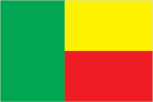
two equal horizontal bands of yellow (top) and red with a vertical green band on the hoist side
Government type
republic under multiparty democratic rule; dropped Marxism-Leninism December 1989; democratic reforms adopted February 1990; transition to multiparty system completed 4 April 1991
Independence
1 August 1960 (from France)
International organization participation
ACCT, ACP, AfDB, ECA, ECOWAS, Entente, FAO, FZ, G-77, IBRD, ICAO, ICFTU, ICRM, IDA, IDB, IFAD, IFC, IFRCS, ILO, IMF, IMO, Intelsat, Interpol, IOC, ITU, MIPONUH, NAM, OAU, OIC, UN, UNCTAD, UNESCO, UNIDO, UPU, WADB, WAEMU, WCL, WFTU, WHO, WIPO, WMO, WToO, WTrO Diplomatic representation in the US: chief of mission: Ambassador Lucien Edgar TONOUKOUIN chancery: 2737 Cathedral Avenue NW, Washington, DC 20008 telephone: [1] (202) 232-6656, 6657, 6658
Judicial branch
Constitutional Court or Cour Constitutionnelle, Supreme Court or Cour Supreme, High Court of Justice Political parties and leaders: Alliance of the National Party for Democracy and Development or PNDD and the Democratic Renewal Party or PRD [Pascal Chabi KAO]; Action for Renewal and Development or FARD-ALAFIA [Mathieu KEREKOU]; Alliance of the Social Democratic Party or PSD and the National Union for Solidarity and Progress or UNSP [Bruno AMOUSSOU]; Alliance Chameleon or AC; Alliance for Democracy and Progress or ADP [Adekpedjon AKINDES]; Alliance for Social Democracy or ASD [Robert DOSSOU]; Liberal Democrats' Rally for National Reconstruction-Vivoten or RDL-Vivoten [Severin ADJOVI]; Communist Party of Benin or PCB [Pascal TODJINOU, first secretary]; Our Common Cause or NCC [Albert TEVOEDJRE]; Rally for Democracy and Progress or RDP; The Renaissance Party of Benin or RB [Nicephore SOGLO] note: as of February 1996, more than 80 political parties were officially recognized
Legal system
based on French civil law and customary law; has not accepted compulsory ICJ jurisdiction
Legislative branch
unicameral National Assembly or Assemblee Nationale (83 seats; members are elected by direct popular vote to serve four-year terms) elections: last held 28 March 1995 (next to be held NA 1999) election results: percent of vote by party-NA; seats by party-RB 20, PRD 19, FARD-ALAFIA 10, PSD 7, NCC 3, RDL-VIVOTEN 3, PCB 2, AC 1, RDP 1, other 17
National capital
Porto-Novo is the official capital; Cotonou is the seat of government
National holiday
National Day, 1 August (1990)
Suffrage
18 years of age; universal
Economy
Agriculture-products
corn, sorghum, cassava (tapioca), yams, beans, rice, cotton, palm oil, peanuts; poultry, livestock
Budget
revenues: $299 million expenditures: $445 million, including capital expenditures of $14 million (1995 est.)
Currency
1 Communaute Financiere Africaine franc (CFAF) = 100 centimes
Debt-external
$1.7 billion (1995 est.)
Economic aid
recipient: ODA, $NA
Economy-overview
The economy of Benin remains underdeveloped and dependent on subsistence agriculture, cotton production, and regional trade. Growth in real output, which had averaged a sound 4% during 1990-95, rose to 5.5% in 1996 and was targeted at 4.8% for 1997. Rapid population growth offset much of this growth in output. Inflation jumped to 55% in 1994 (compared to 3% in 1993) following the 50% currency devaluation in January 1994, but has subsided over the past three years, with a target of 3.5% inflation in 1997. Commercial and transport activities, which make up a large part of GDP, are extremely vulnerable to developments in Nigeria, particularly fuel shortages. Support by the Paris Club and official bilateral creditors has eased the external debt situation in recent years. The government, still burdened with money-losing state enterprises and a bloated civil service, has been gradually implementing a World Bank supported structural adjustment program since 1991.
Electricity-capacity
15,000 kW (1995)
Electricity-consumption per capita
45 kWh (1995)
Electricity-production
6 million kWh (1995)
Exchange rates
CFA francs (CFAF) per US$1-608.36 (January 1998), 583.67 (1997), 511.55 (1996), 499.15 (1995), 555.20 (1994), 283.16 (1993) note: beginning 12 January 1994 the CFA franc was devalued to CFAF 100 per French franc from CFAF 50 at which it had been fixed since 1948
Exports
total value: $192 million (f.o.b., 1995) commodities: cotton, crude oil, palm products, cocoa partners: Brazil 18%, Portugal 14%, Morocco, Libya, France
Fiscal year
calendar year Communications
GDP
purchasing power parity-$11.3 billion (1997 est.)
GDP-composition by sector
agriculture: 34% industry: 14% services: 52% (1995)
GDP-per capita
purchasing power parity-$1,900 (1997 est.)
GDP-real growth rate
5.8% (1997 est.)
Imports
total value: $693 million (c.i.f., 1995) commodities: foodstuffs, beverages, tobacco, petroleum products, intermediate goods, capital goods, light consumer goods partners: France 27%, Thailand 9%, China, Hong Kong
Industrial production growth rate
NA%
Industries
textiles, cigarettes; beverages, food; construction materials, petroleum
Inflation rate-consumer price index
3.5% (1997 est.)
Labor force
NA
Radio broadcast stations
AM 2, FM 2, shortwave 0
Radios
NA
Telephone system
domestic: fair system of open wire and microwave radio relay international: satellite earth station-1 Intelsat (Atlantic Ocean); submarine cable
Telephones
16,200 (1986 est.)
Television broadcast stations
2
Televisions
20,000 (1993 est.)
Unemployment rate
NA%
Transportation
Airports
6 (1997 est.) Airports-with paved runways: total: 2 2,438 to 3,047 m: 1 1,524 to 2,437 m: 1 (1997 est.) Airports-with unpaved runways: total: 4 1,524 to 2,437 m: 1 914 to 1,523 m: 3 (1997 est.)
Highways
total: 6,787 km paved: 1,357 km (including 10 km of expressways) unpaved: 5,430 km (1996 est.)
Merchant marine
none
Railways
total: 578 km (single track) narrow gauge: 578 km 1.000-m gauge (1995 est.)
Waterways
navigable along small sections, important only locally Ports and harbors: Cotonou, Porto-Novo
Military and Security
Military branches
Armed Forces (includes Army, Navy, Air Force), National Gendarmerie
Military expenditures-dollar figure
$33 million (1994)
Military expenditures-percent of GDP
3.2% (1994)
Military manpower-availability
males age 15-49: 1,311,490 females age 15-49: 1,378,979 (1998 est.) note: both sexes are liable for military service Military manpower-fit for military service: males: 671,230 females: 698,290 (1998 est.)
Military manpower-military age
18 years of age
Military manpower-reaching military age annually
males: 65,498 females: 65,112 (1998 est.)
Transnational Issues
Disputes-international
none
Illicit drugs
transshipment point for narcotics associated with Nigerian trafficking organizations and most commonly destined for Western Europe and the US (dependent territory of the UK)