1993 Edition
CIA World Factbook 1993 (Project Gutenberg)
Geography
Area
total area: 112,620 km2 land area: 110,620 km2 comparative area: slightly smaller than Pennsylvania
Climate
tropical; hot, humid in south; semiarid in north
Coastline
121 km
Environment
hot, dry, dusty harmattan wind may affect north in winter; deforestation; desertification
International disputes
none
Irrigated land
60 km2 (1989 est.)
Land boundaries
total 1,989 km, Burkina 306 km, Niger 266 km, Nigeria 773 km, Togo 644 km
Land use
arable land: 12% permanent crops: 4% meadows and pastures: 4% forest and woodland: 35% other: 45%
Location
Western Africa, bordering the North Atlantic Ocean between Nigeria and Togo
Map references
Africa, Standard Time Zones of the World
Maritime claims
territorial sea: 200 nm
Natural resources
small offshore oil deposits, limestone, marble, timber
Note
recent droughts have severely affected marginal agriculture in north; no natural harbors
Terrain
mostly flat to undulating plain; some hills and low mountains
People and Society
Birth rate
48.09 births/1,000 population (1993 est.)
Death rate
14.8 deaths/1,000 population (1993 est.)
Ethnic divisions
African 99% (42 ethnic groups, most important being Fon, Adja, Yoruba, Bariba), Europeans 5,500
Infant mortality rate
112.7 deaths/1,000 live births (1993 est.)
Labor force
1.9 million (1987) by occupation: agriculture 60%, transport, commerce, and public services 38%, industry less than 2% note: 49% of population of working age (1985)
Languages
French (official), Fon and Yoruba (most common vernaculars in south), tribal languages (at least six major ones in north)
Life expectancy at birth
total population: 51.31 years male: 49.51 years female: 53.16 years (1993 est.)
Literacy
age 15 and over can read and write (1990) total population: 23% male: 32% female: 16%
Nationality
noun: Beninese (singular and plural) adjective: Beninese
Net migration rate
0 migrant(s)/1,000 population (1993 est.)
Population
5,166,735 (July 1993 est.)
Population growth rate
3.33% (1993 est.)
Religions
indigenous beliefs 70%, Muslim 15%, Christian 15%
Total fertility rate
6.86 children born/woman (1993 est.)
Government
Administrative divisions
6 provinces; Atakora, Atlantique, Borgou, Mono, Oueme, Zou
Capital
Porto-Novo
Chief of State and Head of Government
President Nicephore SOGLO (since 4 April 1991)
Constitution
2 December 1990
Digraph
BN
Diplomatic representation in US
chief of mission: Ambassador Candide AHOUANSOU chancery: 2737 Cathedral Avenue NW, Washington, DC 20008 telephone: (202) 232-6656
Executive branch
president, cabinet
FAX
[229] 30-14-39 and 30-19-74
Flag
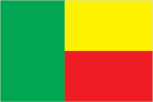
two equal horizontal bands of yellow (top) and red with a vertical green band on the hoist side
Independence
1 August 1960 (from France)
Judicial branch
Supreme Court (Cour Supreme)
Legal system
based on French civil law and customary law; has not accepted compulsory ICJ jurisdiction
Legislative branch
unicameral National Assembly (Assemblee Nationale)
Member of
ACCT, ACP, AfDB, CEAO, ECA, ECOWAS, Entente, FAO, FZ, G-77, GATT, IBRD, ICAO, IDA, IDB, IFAD, IFC, ILO, IMF, IMO, INTELSAT, INTERPOL, IOC, ITU, LORCS, NAM, OAU, OIC, UN, UNCTAD, UNESCO, UNIDO, UPU, WADB, WCL, WHO, WIPO, WMO, WTO
Names
conventional long form: Republic of Benin conventional short form: Benin local long form: Republique Populaire du Benin local short form: Benin former: Dahomey
National Assembly
last held 10 and 24 March 1991; results - percent of vote by party NA; seats - (64 total) UDFP-MDPS-ULD 12, PNDD/PRD 9, PSD/UNSP 8, NCC 7, RND 7, MNDD/MSUP/UDRN 6, UDS 5, RDL 4, ASD/BSD 3, ADP/UDRS 2, UNDP 1
National holiday
National Day, 1 August (1990)
Political parties and leaders
Alliance of the Democratic Union for the Forces of Progress (UDFP), Timothee ADANLIN; Movement for Democracy and Social Progress (MDPS), Jean-Roger AHOYO; Union for Liberty and Development (ULD), Marcellin DEGBE; Alliance of the National Party for Democracy and Development (PNDD) and the Democratic Renewal Party (PRD), Pascal Chabi KAO; Alliance of the Social Democratic Party (PSD) and the National Union for Solidarity and Progress (UNSP), Bruno AMOUSSOU; Our Common Cause (NCC), Albert TEVOEDJRE; National Rally for Democracy (RND), Joseph KEKE; Alliance of the National Movement for Democracy and Development (MNDD), leader NA; Movement for Solidarity, Union, and Progress (MSUP), Adebo ADENIYI; Union for Democracy and National Reconstruction (UDRN), Azaria FAKOREDE; Union for Democracy and National Solidarity (UDS), Mama Amadou N'DIAYE; Assembly of Liberal Democrats for National Reconstruction (RDL), Severin ADJOVI; Alliance of the Alliance for Social Democracy (ASD), Robert DOSSOU; Bloc for Social Democracy (BSD), Michel MAGNIDE; Alliance of the Alliance for Democracy and Progress (ADP), Akindes ADEKPEDJOU; Democratic Union for Social Renewal (UDRS), Bio Gado Seko N'GOYE; National Union for Democracy and Progress (UNDP), Robert TAGNON; Party for Progress and Democracy, Theophile NATA; numerous other small parties
President
last held 10 and 24 March 1991; results - Nicephore SOGLO 68%, Mathieu KEREKOU 32%
Suffrage
18 years of age; universal
Type
republic under multiparty democratic rule dropped Marxism-Leninism December 1989; democratic reforms adopted February 1990; transition to multiparty system completed 4 April 1991
US diplomatic representation
chief of mission: Ambassador Ruth A. DAVIS embassy: Rue Caporal Anani Bernard, Cotonou mailing address: B. P. 2012, Cotonou telephone: [229] 30-06-50, 30-05-13, 30-17-92
Economy
Agriculture
accounts for 35% of GDP; small farms produce 90% of agricultural output; production is dominated by food crops - corn, sorghum, cassava, beans, rice; cash crops include cotton, palm oil, peanuts; poultry and livestock output has not kept up with consumption
Budget
revenues $194 million; expenditures $390 million, including capital expenditures of $104 million (1990 est.)
Currency
1 CFA franc (CFAF) = 100 centimes
Economic aid
US commitments, including Ex-Im (FY70-89), $46 million; Western (non-US) countries, ODA and OOF bilateral commitments (1970-89), $1,300 million; OPEC bilateral aid (1979-89), $19 million; Communist countries (1970-89), $101 million
Electricity
30,000 kW capacity; 25 million kWh produced, 5 kWh per capita (1991)
Exchange rates
Communaute Financiere Africaine francs (CFAF) per US$1 - 274.06 (January 1993), 264.69 (1992), 282.11 (1991), 272.26 (1990), 319.01 (1989), 297.85 (1988)
Exports
$263.3 million (f.o.b., 1990 est.) commodities: crude oil, cotton, palm products, cocoa partners: FRG 36%, France 16%, Spain 14%, Italy 8%, UK 4%
External debt
$1 billion (December 1990 est.)
Fiscal year
calendar year
Imports
$428 million (f.o.b., 1990 est.) commodities: foodstuffs, beverages, tobacco, petroleum products, intermediate goods, capital goods, light consumer goods partners: France 34%, Netherlands 10%, Japan 7%, Italy 6%, US 4%
Industrial production
growth rate -0.7% (1988); accounts for 15% of GDP
Industries
textiles, cigarettes, construction materials, beverages, food production, petroleum
Inflation rate (consumer prices)
3.4% (1990)
National product
GDP - exchange rate conversion - $2 billion (1991)
National product per capita
$410 (1991)
National product real growth rate
3% (1991)
Overview
Benin is one of the least developed countries in the world because of limited natural resources and a poorly developed infrastructure. Agriculture accounts for about 35% of GDP, employs about 60% of the labor force, and generates a major share of foreign exchange earnings. The industrial sector contributes only about 15% to GDP and employs 2% of the work force. Low prices in recent years have kept down hard currency earnings from Benin's major exports of agricultural products and crude oil.
Unemployment rate
NA%
Communications
Airports
total: 7 usable: 5 with permanent-surface runways: 1 with runways over 3,659 m: with runways 2,439-3,659 m: 1 with runways 1,220-2,439 m: 2
Highways
5,050 km total; 920 km paved, 2,600 laterite, 1,530 km improved earth
Inland waterways
navigable along small sections, important only locally
Ports
Cotonou
Railroads
578 km, all 1.000-meter gauge, single track
Telecommunications
fair system of open wire, submarine cable, and radio relay microwave; broadcast stations - 2 AM, 2 FM, 2 TV; 1 Atlantic Ocean INTELSAT earth station
Military and Security
Branches
Armed Forces (including Army, Navy, Air Force), National Gendarmerie
Defense expenditures
exchange rate conversion - $29 million, 1.7% of GDP (1988 est.)
Manpower availability
males age 15-49 1,075,053; females age 15-49 1,170,693; males fit for military service 550,645; females fit for military service 591,506; males reach military age (18) annually 56,872; females reach military age (18) annually 55,141 (1993 est.); both sexes are liable for military service