1990 Edition
CIA World Factbook 1990 (Project Gutenberg)
Geography
Climate
tropical; hot, humid in south; semiarid in north
Coastline
121 km
Comparative area
slightly smaller than Pennsylvania
Environment
hot, dry, dusty harmattan wind may affect north in winter; deforestation; desertification
Land boundaries
1,989 km total; Burkina 306 km, Niger 266 km, Nigeria 773 km, Togo 644 km
Land use
12% arable land; 4% permanent crops; 4% meadows and pastures; 35% forest and woodland; 45% other; includes NEGL% irrigated
Natural resources
small offshore oil deposits, limestone, marble, timber
Note
recent droughts have severely affected marginal agriculture in north; no natural harbors
Terrain
mostly flat to undulating plain; some hills and low mountains
Territorial sea
200 nm
Total area
112,620 km2; land area: 110,620 km2
People and Society
Birth rate
50 births/1,000 population (1990)
Death rate
16 deaths/1,000 population (1990)
Ethnic divisions
99% African (42 ethnic groups, most important being Fon, Adja, Yoruba, Bariba); 5,500 Europeans
Infant mortality rate
121 deaths/1,000 live births (1990)
Labor force
1,900,000 (1987); 60% agriculture, 38% transport, commerce, and public services, less than 2% industry; 49% of population of working age
Language
French (official); Fon and Yoruba most common vernaculars in south; at least six major tribal languages in north
Life expectancy at birth
48 years male, 52 years female (1990)
Literacy
25.9%
Nationality
noun--Beninese (sing., pl.); adjective--Beninese
Net migration rate
NEGL migrants/1,000 population (1990)
Organized labor
about 75% of wage earners
Population
4,673,964 (July 1990), growth rate 3.3% (1990)
Religion
70% indigenous beliefs, 15% Muslim, 15% Christian
Total fertility rate
7.1 children born/woman (1990)
Government
Administrative divisions
6 provinces; Atakora, Atlantique, Borgou, Mono, Oueme, Zou
Capital
Porto-Novo (official), Cotonou (de facto)
Communists
dropped Marxism-Leninism December 1989
Constitution
23 May 1977 (nullified 1 March 1990); new constitution to be drafted by April 1990
Diplomatic representation
Ambassador Theophile NATA; Chancery at 2737 Cathedral Avenue NW, Washington DC 20008; telephone (202) 232-6656; US--Ambassador Harriet ISOM; Embassy at Rue Caporal Anani Bernard, Cotonou (mailing address is B. P. 2012, Cotonou); telephone [229] 30-06-50
Elections
President--last held July 1989 (next to be held July 1994); results--President Mathieu Kerekou was reelected by the National Revolutionary Assembly; National Revolutionary Assembly--dissolved 1 March 1990 and replaced by a 24-member interim High Council of the Republic with legislative elections for new institutions planned for February 1991
Executive branch
president, prime minister, cabinet
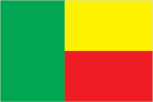
Flag
green with a red five-pointed star in the upper hoist-side corner
Independence
1 August 1960 (from France; formerly Dahomey)
Judicial branch
Central People's Court (Cour Central Populaire)
Leaders
Chief of State and Head of Government--President Mathieu KEREKOU
Legal system
based on French civil law and customary law; has not accepted compulsory ICJ jurisdiction
Legislative branch
unicameral National Revolutionary Assembly (Assemblee Nationale Revolutionnaire) dissolved 1 March 1990 and replaced by a 24-member interim High Council of the Republic during the transition period
Long-form name
Republic of Benin
Member of
ACP, AfDB, CEAO, EAMA, ECA, ECOWAS, Entente, FAO, G-77, GATT, IBRD, ICAO, ICO, IDA, IFAD, ILO, IMF, IMO, INTELSAT, INTERPOL, ITU, NAM, Niger River Commission, OAU, OCAM, UN, UNESCO, UPU, WFTU, WHO, WIPO, WMO, WTO
National holiday
National Day, 30 November (1975)
Political parties and leaders
only party--People's Revolutionary Party of Benin (PRPB), President Mathieu Kerekou, chairman of the Central Committee
Suffrage
universal at age 18
Type
dropped Marxism-Leninism December 1989; democratic reforms adopted February 1990; transition to multiparty system by 1991 planned
Economy
Agriculture
small farms produce 90% of agricultural output; production is dominated by food crops--corn, sorghum, cassava, beans, and rice; cash crops include cotton, palm oil, and peanuts; poultry and livestock output has not kept up with consumption
Aid
US commitments, including Ex-Im (FY70-88), $41 million; Western (non-US) countries, ODA and OOF bilateral commitments (1970-87), $1.0 billion; OPEC bilateral aid (1979-89), $19 million; Communist countries (1970-88), $101 million
Budget
revenues $168 million; expenditures $317 million, including capital expenditures of $97 million (1989)
Currency
Communaute Financiere Africaine franc (plural--francs); 1 CFA franc (CFAF) = 100 centimes
Electricity
28,000 kW capacity; 24 million kWh produced, 5 kWh per capita (1989)
Exchange rates
Communaute Financiere Africaine francs (CFAF) per US$1--287.99 (January 1990), 319.01 (1989), 297.85 (1988), 300.54 (1987), 346.30 (1986), 449.26 (1985)
Exports
$226 million (f.o.b., 1988); commodities--crude oil, cotton, palm products, cocoa; partners--FRG 36%, France 16%, Spain 14%, Italy 8%, UK 7%
External debt
$1.0 billion (December 1989 est.)
Fiscal year
calendar year
GDP
$1.7 billion, per capita $335; real growth rate 1.8% (1988)
Imports
$413 million (f.o.b., 1988); commodities--foodstuffs, beverages, tobacco, petroleum products, intermediate goods, capital goods, light consumer goods; partners--France 34%, Netherlands 10%, Japan 7%, Italy 6%, US 5%
Industrial production
growth rate - 0.7% (1988)
Industries
palm oil and palm kernel oil processing, textiles, beverages, petroleum
Inflation rate (consumer prices)
4.3% (1988)
Overview
Benin is one of the least developed countries in the world because of limited natural resources and a poorly developed infrastructure. Agriculture accounts for almost 45% of GDP, employs about 60% of the labor force, and generates a major share of foreign exchange earnings. The industrial sector contributes only about 15% to GDP and employs 2% of the work force. Persistently low prices in recent years have limited hard currency earnings from Benin's major exports of agricultural products and crude oil.
Unemployment
NA
Communications
Airports
6 total, 5 usable; 1 with permanent-surface runways; none with runways over 2,439 m; 4 with runways 1,220-2,439 m
Civil air
3 major transport aircraft
Highways
5,050 km total; 920 km paved, 2,600 laterite, 1,530 km improved earth
Inland waterways
navigable along small sections, important only locally
Merchant marine
1 cargo ship (1,000 GRT or over) of 2,999 GRT/4,407 DWT
Ports
Cotonou
Railroads
578 km, all 1.000-meter gauge, single track
Telecommunications
fair system of open wire, submarine cable, and radio relay; 16,200 telephones; stations--2 AM, 2 FM, 1 TV; 1 Atlantic Ocean INTELSAT satellite earth station
Military and Security
Branches
Army, Navy, Air Force
Defense expenditures
1.7% of GDP, or $28.9 million (1988 est.)
Military manpower
eligible 15-49, 2,015,206; of the 950,921 males 15-49, 486,620 are fit for military service; of the 1,064,285 females 15-49, 537,049 are fit for military service; about 55,550 males and 53,663 females reach military age (18) annually; both sexes are liable for military service