2017 Edition
CIA World Factbook 2017 Archive (HTML)
Introduction
Background
Belize was the site of several Mayan city states until their decline at the end of the first millennium A.D. The British and Spanish disputed the region in the 17th and 18th centuries; it formally became the colony of British Honduras in 1862. Territorial disputes between the UK and Guatemala delayed the independence of Belize until 1981. Guatemala refused to recognize the new nation until 1992 and the two countries are involved in an ongoing border dispute. Tourism has become the mainstay of the economy. Current concerns include the country's heavy foreign debt burden, high unemployment, growing involvement in the Mexican and South American drug trade, high crime rates, and one of the highest HIV/AIDS prevalence rates in Central America.
Geography
Area
- 22,966 sq km 22,806 sq km 160 sq km
- land
- 22,806 sq km
- total
- 22,966 sq km
- water
- 160 sq km
Area - comparative
slightly smaller than Massachusetts
Climate
tropical; very hot and humid; rainy season (May to November); dry season (February to May)
Coastline
386 km
Elevation
- 173 m lowest point: Caribbean Sea 0 m highest point: Doyle's Delight 1,124 m
- elevation extremes
- lowest point: Caribbean Sea 0 m
- highest point
- Doyle's Delight 1,124 m
- mean elevation
- 173 m
Environment - current issues
deforestation; water pollution from sewage, industrial effluents, agricultural runoff; solid and sewage waste disposal
Environment - international agreements
- Biodiversity, Climate Change, Climate Change-Kyoto Protocol, Desertification, Endangered Species, Hazardous Wastes, Law of the Sea, Ozone Layer Protection, Ship Pollution, Wetlands, Whaling none of the selected agreements
- party to
- Biodiversity, Climate Change, Climate Change-Kyoto Protocol, Desertification, Endangered Species, Hazardous Wastes, Law of the Sea, Ozone Layer Protection, Ship Pollution, Wetlands, Whaling
- signed, but not ratified
- none of the selected agreements
Geographic coordinates
17 15 N, 88 45 W
Geography - note
only country in Central America without a coastline on the North Pacific Ocean
Irrigated land
35 sq km (2012)
Land boundaries
- 542 km Guatemala 266 km, Mexico 276 km
- border countries (2)
- Guatemala 266 km, Mexico 276 km
- total
- 542 km
Land use
- 6.9% arable land 3.3%; permanent crops 1.4%; permanent pasture 2.2% 60.6% 32.5% (2011 est.)
- agricultural land
- 6.9%
- forest
- 60.6%
- other
- 32.5% (2011 est.)
Location
Central America, bordering the Caribbean Sea, between Guatemala and Mexico
Map references
Central America and the Caribbean
Maritime claims
- 12 nm in the north, 3 nm in the south; note - from the mouth of the Sarstoon River to Ranguana Cay, Belize's territorial sea is 3 nm; according to Belize's Maritime Areas Act, 1992, the purpose of this limitation is to provide a framework for negotiating a definitive agreement on territorial differences with Guatemala 200 nm
- exclusive economic zone
- 200 nm
- territorial sea
- 12 nm in the north, 3 nm in the south; note - from the mouth of the Sarstoon River to Ranguana Cay, Belize's territorial sea is 3 nm; according to Belize's Maritime Areas Act, 1992, the purpose of this limitation is to provide a framework for negotiating a definitive agreement on territorial differences with Guatemala
Natural hazards
frequent, devastating hurricanes (June to November) and coastal flooding (especially in south)
Natural resources
arable land potential, timber, fish, hydropower
Population - distribution
approximately 25% to 30% of the population lives in the former capital, Belize City; over half of the overall population is rural; population density is slightly higher in the north and east
Terrain
flat, swampy coastal plain; low mountains in south
People and Society
Age structure
- 33.95% (male 62,454/female 59,896) 20.55% (male 37,730/female 36,339) 36.62% (male 66,880/female 65,082) 4.99% (male 8,834/female 9,130) 3.89% (male 6,562/female 7,439) (2017 est.)
- 0-14 years
- 33.95% (male 62,454/female 59,896)
- 15-24 years
- 20.55% (male 37,730/female 36,339)
- 25-54 years
- 36.62% (male 66,880/female 65,082)
- 55-64 years
- 4.99% (male 8,834/female 9,130)
- 65 years and over
- 3.89% (male 6,562/female 7,439) (2017 est.)
Birth rate
24 births/1,000 population (2017 est.)
Children under the age of 5 years underweight
4.6% (2015)
Contraceptive prevalence rate
51.4% (2015)
Death rate
6 deaths/1,000 population (2017 est.)
Demographic profile
Migration continues to transform Belize's population. About 16% of Belizeans live abroad, while immigrants constitute approximately 15% of Belize's population. Belizeans seeking job and educational opportunities have preferred to emigrate to the United States rather than former colonizer Great Britain because of the United States' closer proximity and stronger trade ties with Belize. Belizeans also emigrate to Canada, Mexico, and English-speaking Caribbean countries. The emigration of a large share of Creoles (Afro-Belizeans) and the influx of Central American immigrants, mainly Guatemalans, Salvadorans, and Hondurans, has changed Belize's ethnic composition. Mestizos have become the largest ethnic group, and Belize now has more native Spanish speakers than English or Creole speakers, despite English being the official language. In addition, Central American immigrants are establishing new communities in rural areas, which contrasts with the urbanization trend seen in neighboring countries. Recently, Chinese, European, and North American immigrants have become more frequent. Immigration accounts for an increasing share of Belize's population growth rate, which is steadily falling due to fertility decline. Belize's declining birth rate and its increased life expectancy are creating an aging population. As the elderly population grows and nuclear families replace extended households, Belize's government will be challenged to balance a rising demand for pensions, social services, and healthcare for its senior citizens with the need to reduce poverty and social inequality and to improve sanitation.
Dependency ratios
- 56.8 50.9 5.9 17 (2015 est.)
- elderly dependency ratio
- 5.9
- potential support ratio
- 17 (2015 est.)
- total dependency ratio
- 56.8
- youth dependency ratio
- 50.9
Drinking water source
- urban: 98.9% of population rural: 100% of population total: 99.5% of population urban: 1.1% of population rural: 0% of population total: 0.5% of population (2015 est.)
- rural
- 0% of population
- total
- 0.5% of population (2015 est.)
- urban
- 1.1% of population
Education expenditures
6.2% of GDP (2013)
Ethnic groups
- mestizo 52.9%, Creole 25.9%, Maya 11.3%, Garifuna 6.1%, East Indian 3.9%, Mennonite 3.6%, white 1.2%, Asian 1%, other 1.2%, unknown 0.3% percentages add up to more than 100% because respondents were able to identify more than one ethnic origin (2010 est.)
- note
- percentages add up to more than 100% because respondents were able to identify more than one ethnic origin (2010 est.)
Health expenditures
5.8% of GDP (2014)
HIV/AIDS - adult prevalence rate
1.8% (2016 est.)
HIV/AIDS - people living with HIV/AIDS
4,300 (2016 est.)
Hospital bed density
1.1 beds/1,000 population (2012)
Infant mortality rate
- 18.9 deaths/1,000 live births 21.3 deaths/1,000 live births 16.4 deaths/1,000 live births (2017 est.)
- female
- 16.4 deaths/1,000 live births (2017 est.)
- male
- 21.3 deaths/1,000 live births
- total
- 18.9 deaths/1,000 live births
Languages
- English 62.9% (official), Spanish 56.6%, Creole 44.6%, Maya 10.5%, German 3.2%, Garifuna 2.9%, other 1.8%, unknown 0.3%, none 0.2% (cannot speak) shares sum to more than 100% because some respondents gave more than one answer on the census (2010 est.)
- note
- shares sum to more than 100% because some respondents gave more than one answer on the census (2010 est.)
Life expectancy at birth
- 68.9 years 67.3 years 70.6 years (2017 est.)
- female
- 70.6 years (2017 est.)
- male
- 67.3 years
- total population
- 68.9 years
Major infectious diseases
- high bacterial diarrhea, hepatitis A, and typhoid fever dengue fever and malaria active local transmission of Zika virus by Aedes species mosquitoes has been identified in this country (as of August 2016); it poses an important risk (a large number of cases possible) among US citizens if bitten by an infective mosquito; other less common ways to get Zika are through sex, via blood transfusion, or during pregnancy, in which the pregnant woman passes Zika virus to her fetus (2016)
- degree of risk
- high
- food or waterborne diseases
- bacterial diarrhea, hepatitis A, and typhoid fever
- note
- active local transmission of Zika virus by Aedes species mosquitoes has been identified in this country (as of August 2016); it poses an important risk (a large number of cases possible) among US citizens if bitten by an infective mosquito; other less common ways to get Zika are through sex, via blood transfusion, or during pregnancy, in which the pregnant woman passes Zika virus to her fetus (2016)
- vectorborne diseases
- dengue fever and malaria
Major urban areas - population
BELMOPAN (capital) 17,000 (2014)
Maternal mortality rate
28 deaths/100,000 live births (2015 est.)
Median age
- 22.7 years 22.5 years 22.9 years (2017 est.)
- female
- 22.9 years (2017 est.)
- male
- 22.5 years
- total
- 22.7 years
Nationality
- Belizean(s) Belizean
- adjective
- Belizean
- noun
- Belizean(s)
Net migration rate
0 migrant(s)/1,000 population (2017 est.)
Obesity - adult prevalence rate
24.1% (2016)
Physicians density
0.77 physicians/1,000 population (2009)
Population
360,346 (July 2017 est.)
Population distribution
approximately 25% to 30% of the population lives in the former capital, Belize City; over half of the overall population is rural; population density is slightly higher in the north and east
Population growth rate
1.8% (2017 est.)
Religions
Roman Catholic 40.1%, Protestant 31.5% (includes Pentecostal 8.4%, Seventh Day Adventist 5.4%, Anglican 4.7%, Mennonite 3.7%, Baptist 3.6%, Methodist 2.9%, Nazarene 2.8%), Jehovah's Witness 1.7%, other 10.5% (includes Baha'i, Buddhist, Hindu, Mormon, Muslim, Rastafarian, Salvation Army), unspecified 0.6%, none 15.5% (2010 est.)
Sanitation facility access
- urban: 93.5% of population rural: 88.2% of population total: 90.5% of population urban: 6.5% of population rural: 11.8% of population total: 9.5% of population (2015 est.)
- rural
- 11.8% of population
- total
- 9.5% of population (2015 est.)
- urban
- 6.5% of population
School life expectancy (primary to tertiary education)
- 13 years 13 years 13 years (2015)
- female
- 13 years (2015)
- male
- 13 years
- total
- 13 years
Sex ratio
- 1.05 male(s)/female 1.04 male(s)/female 1.04 male(s)/female 1.03 male(s)/female 0.97 male(s)/female 0.89 male(s)/female 1.03 male(s)/female (2016 est.)
- 0-14 years
- 1.04 male(s)/female
- 15-24 years
- 1.04 male(s)/female
- 25-54 years
- 1.03 male(s)/female
- 55-64 years
- 0.97 male(s)/female
- 65 years and over
- 0.89 male(s)/female
- at birth
- 1.05 male(s)/female
- total population
- 1.03 male(s)/female (2016 est.)
Total fertility rate
2.85 children born/woman (2017 est.)
Unemployment, youth ages 15-24
- 18.9% 12.1% 29.6% (2015 est.)
- female
- 29.6% (2015 est.)
- male
- 12.1%
- total
- 18.9%
Urbanization
- 43.7% of total population (2017) 1.93% annual rate of change (2015-20 est.)
- rate of urbanization
- 1.93% annual rate of change (2015-20 est.)
- urban population
- 43.7% of total population (2017)
Government
Administrative divisions
6 districts; Belize, Cayo, Corozal, Orange Walk, Stann Creek, Toledo
Capital
- Belmopan 17 15 N, 88 46 W UTC-6 (1 hour behind Washington, DC, during Standard Time)
- geographic coordinates
- 17 15 N, 88 46 W
- name
- Belmopan
- time difference
- UTC-6 (1 hour behind Washington, DC, during Standard Time)
Citizenship
- yes yes yes 5 years
- citizenship by birth
- yes
- citizenship by descent
- yes
- dual citizenship recognized
- yes
- residency requirement for naturalization
- 5 years
Constitution
previous 1954, 1963 (preindependence); latest signed and entered into force 21 September 1981; amended several times, last in 2012 (2016)
Country name
- none Belize British Honduras may be named for the Belize River, whose name possibly derives from the Maya word "belix," meaning "muddy-watered"
- conventional long form
- none
- conventional short form
- Belize
- etymology
- may be named for the Belize River, whose name possibly derives from the Maya word "belix," meaning "muddy-watered"
- former
- British Honduras
Diplomatic representation from the US
- Ambassador (vacant); Charge d’Affaires Adrienne GALANEK (since 20 January 2017) Floral Park Road, Belmopan City, Cayo District P.O. Box 497, Belmopan City, Cayo District, Belize [011] (501) 822-4011 [011] (501) 822-4012
- chief of mission
- Ambassador (vacant); Charge d’Affaires Adrienne GALANEK (since 20 January 2017)
- embassy
- Floral Park Road, Belmopan City, Cayo District
- FAX
- [011] (501) 822-4012
- mailing address
- P.O. Box 497, Belmopan City, Cayo District, Belize
- telephone
- [011] (501) 822-4011
Diplomatic representation in the US
- Ambassador Francisco Daniel GUTIERREZ (since 21 July 2017) 2535 Massachusetts Avenue NW, Washington, DC 20008 [1] (202) 332-9636 [1] (202) 332-6888 Los Angeles
- chancery
- 2535 Massachusetts Avenue NW, Washington, DC 20008
- chief of mission
- Ambassador Francisco Daniel GUTIERREZ (since 21 July 2017)
- consulate(s) general
- Los Angeles
- FAX
- [1] (202) 332-6888
- telephone
- [1] (202) 332-9636
Executive branch
- Queen ELIZABETH II (since 6 February 1952); represented by Governor General Sir Colville Norbert YOUNG, Sr. (since 17 November 1993) Prime Minister Dean Oliver BARROW (since 8 February 2008); Deputy Prime Minister Patrick FABER (since 7 June 2016) Cabinet appointed by the governor general on the advice of the prime minister from among members of the National Assembly the monarchy is hereditary; governor general appointed by the monarch; following legislative elections, the leader of the majority party or majority coalition usually appointed prime minister by the governor general; prime minister recommends the deputy prime minister
- cabinet
- Cabinet appointed by the governor general on the advice of the prime minister from among members of the National Assembly
- chief of state
- Queen ELIZABETH II (since 6 February 1952); represented by Governor General Sir Colville Norbert YOUNG, Sr. (since 17 November 1993)
- elections/appointments
- the monarchy is hereditary; governor general appointed by the monarch; following legislative elections, the leader of the majority party or majority coalition usually appointed prime minister by the governor general; prime minister recommends the deputy prime minister
- head of government
- Prime Minister Dean Oliver BARROW (since 8 February 2008); Deputy Prime Minister Patrick FABER (since 7 June 2016)
Flag description
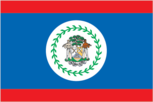
- royal blue with a narrow red stripe along the top and the bottom edges; centered is a large white disk bearing the coat of arms; the coat of arms features a shield flanked by two workers in front of a mahogany tree with the related motto SUB UMBRA FLOREO (I Flourish in the Shade) on a scroll at the bottom, all encircled by a green garland of 50 mahogany leaves; the colors are those of the two main political parties: blue for the PUP and red for the UDP; various elements of the coat of arms - the figures, the tools, the mahogany tree, and the garland of leaves - recall the logging industry that led to British settlement of Belize Belize's flag is the only national flag that depicts human beings; two British overseas territories, Montserrat and the British Virgin Islands, also depict humans
- note
- Belize's flag is the only national flag that depicts human beings; two British overseas territories, Montserrat and the British Virgin Islands, also depict humans
- royal blue with a narrow red stripe along the top and the bottom edges; centered is a large white disk bearing the coat of arms; the coat of arms features a shield flanked by two workers in front of a mahogany tree with the related motto SUB UMBRA FLOREO
- blue for the PUP and red for the UDP; various elements of the coat of arms - the figures, the tools, the mahogany tree, and the garland of leaves - recall the logging industry that led to British settlement of Belize
Government type
parliamentary democracy (National Assembly) under a constitutional monarchy; a Commonwealth realm
Independence
21 September 1981 (from the UK)
International law organization participation
has not submitted an ICJ jurisdiction declaration; accepts ICCt jurisdiction
International organization participation
ACP, AOSIS, C, Caricom, CD, CDB, CELAC, FAO, G-77, IADB, IAEA, IBRD, ICAO, ICC (NGOs), ICRM, IDA, IFAD, IFC, IFRCS, ILO, IMF, IMO, Interpol, IOC, IOM, ITU, LAES, MIGA, NAM, OAS, OPANAL, OPCW, PCA, Petrocaribe, SICA, UN, UNCTAD, UNESCO, UNIDO, UPU, WCO, WHO, WIPO, WMO, WTO
Judicial branch
- Supreme Court of Judicature (consists of the Court of Appeal with the court president and 3 justices, and the Supreme Court with the chief justice and 2 judges); note - in 2010, Belize ceased final appeals in civil and criminal cases to the Judicial Committee of the Privy Council (in London) and acceded to the Caribbean Court of Justice Court of Appeal president and justices appointed by the governor general upon advice of the prime minister after consultation with the National Assembly opposition leader; justices' tenures vary by terms of appointment; Supreme Court chief justice appointed by the governor-general upon the advice of the prime minister and the National Assembly opposition leader; other judges appointed by the governor-general upon the advice of the Judicial and Legal Services Section of the Public Services Commission and with the concurrence of the prime minister after consultation with the National Assembly opposition leader; judges can be appointed beyond age 65 but must retire by age 75; in 2013, the Supreme Court chief justice overturned a constitutional amendment that had restricted Court of Appeal judge appointments to as short as 1 year Magistrate Courts; Family Court
- highest court(s)
- Supreme Court of Judicature (consists of the Court of Appeal with the court president and 3 justices, and the Supreme Court with the chief justice and 2 judges); note - in 2010, Belize ceased final appeals in civil and criminal cases to the Judicial Committee of the Privy Council (in London) and acceded to the Caribbean Court of Justice
- judge selection and term of office
- Court of Appeal president and justices appointed by the governor general upon advice of the prime minister after consultation with the National Assembly opposition leader; justices' tenures vary by terms of appointment; Supreme Court chief justice appointed by the governor-general upon the advice of the prime minister and the National Assembly opposition leader; other judges appointed by the governor-general upon the advice of the Judicial and Legal Services Section of the Public Services Commission and with the concurrence of the prime minister after consultation with the National Assembly opposition leader; judges can be appointed beyond age 65 but must retire by age 75; in 2013, the Supreme Court chief justice overturned a constitutional amendment that had restricted Court of Appeal judge appointments to as short as 1 year
- subordinate courts
- Magistrate Courts; Family Court
Legal system
English common law
Legislative branch
- bicameral National Assembly consists of the Senate (12 seats; members appointed by the governor general - 6 on the advice of the prime minister, 3 on the advice of the leader of the opposition, and 1 each on the advice of the Belize Council of Churches and Evangelical Association of Churches, the Belize Chamber of Commerce and Industry and the Belize Better Business Bureau, and the National Trade Union Congress and the Civil Society Steering Committee; members serve 5-year terms) and the House of Representatives (31 seats; members directly elected in single-seat constituencies by simple majority vote to serve 5-year terms) House of Representatives - last held on 4 November 2015 (next to be held in November 2020) percent of vote by party - UDP 50%, PUP 47.3%, other 2.7%; seats by party - UDP 19, PUP 12
- description
- bicameral National Assembly consists of the Senate (12 seats; members appointed by the governor general - 6 on the advice of the prime minister, 3 on the advice of the leader of the opposition, and 1 each on the advice of the Belize Council of Churches and Evangelical Association of Churches, the Belize Chamber of Commerce and Industry and the Belize Better Business Bureau, and the National Trade Union Congress and the Civil Society Steering Committee; members serve 5-year terms) and the House of Representatives (31 seats; members directly elected in single-seat constituencies by simple majority vote to serve 5-year terms)
- election results
- percent of vote by party - UDP 50%, PUP 47.3%, other 2.7%; seats by party - UDP 19, PUP 12
- elections
- House of Representatives - last held on 4 November 2015 (next to be held in November 2020)
National anthem
- "Land of the Free" Samuel Alfred HAYNES/Selwyn Walford YOUNG adopted 1981; as a Commonwealth country, in addition to the national anthem, "God Save the Queen" serves as the royal anthem (see United Kingdom)
- lyrics/music
- Samuel Alfred HAYNES/Selwyn Walford YOUNG
- name
- "Land of the Free"
- note
- adopted 1981; as a Commonwealth country, in addition to the national anthem, "God Save the Queen" serves as the royal anthem (see United Kingdom)
National holiday
Battle of St. George's Caye Day (National Day), 10 September (1798); Independence Day, 21 September (1981)
National symbol(s)
- Baird's tapir (a large, browsing, forest-dwelling mammal), keel-billed toucan, Black Orchid; national colors: red, blue
- Baird's tapir (a large, browsing, forest-dwelling mammal), keel-billed toucan, Black Orchid; national colors
- red, blue
Political parties and leaders
Belize Progressive Party or BPP [Patrick ROGERS] (formed in 2015 from a merger of the People's National Party, elements of the Vision Inspired by the People, and other smaller political groups) People's United Party or PUP [Johnny BRICENO] United Democratic Party or UDP [Dean Oliver BARROW]
Political pressure groups and leaders
National Trade Union Congress of Belize or NTUCB [Floyd NEAL]
Suffrage
18 years of age; universal
Economy
Agriculture - products
bananas, cacao, citrus, sugar; fish, cultured shrimp; lumber
Budget
- $550 million $600 million (2016 est.)
- expenditures
- $600 million (2016 est.)
- revenues
- $550 million
Budget surplus (+) or deficit (-)
-2.9% of GDP (2016 est.)
Central bank discount rate
9.86% (1 September 2016) 10.01% (31 December 2015)
Commercial bank prime lending rate
9.84% (31 December 2016 est.) 10.32% (31 December 2015 est.)
Current account balance
$-163 million (2016 est.) $-174.7 million (2015 est.)
Debt - external
$1.338 billion (31 December 2016 est.) $1.33 billion (31 December 2015 est.)
Economy - overview
Tourism is the number one foreign exchange earner in this small economy, followed by exports of sugar, bananas, citrus, marine products, and crude oil. The government's expansionary monetary and fiscal policies, initiated in September 1998, led to GDP growth averaging nearly 4% in 1999-2007, however GDP growth slowed to 1% in 2015, and 0% in 2016. Oil discoveries in 2006 bolstered this growth and oil exploration continues, but production has fallen in recent years and future oil revenues remain uncertain and are offset by Belize’s growing imports of refined oil. Although Belize has the third highest per capita income in Central America, the average income figure masks a huge income disparity between rich and poor, and a key government objective remains reducing poverty and inequality with the help of international donors. High unemployment, a growing trade deficit and heavy foreign debt burden continue to be major concerns. Belize faces continued pressure from rising sovereign debt, and a growing trade imbalance.
Exchange rates
Belizean dollars (BZD) per US dollar - 2 (2016 est.) 2 (2015 est.) 2 (2014 est.) 2 (2013 est.) 2 (2012 est.)
Exports
$442.7 million (2016 est.) $537.9 million (2015 est.)
Exports - commodities
sugar, bananas, citrus, clothing, fish products, molasses, wood, crude oil
Exports - partners
Burma 30.7%, US 22.6%, UK 19.3% (2016)
Fiscal year
1 April - 31 March
GDP - composition, by end use
- 72.4% 14.9% 22.1% 0.9% 56.6% -66.9% (2016 est.)
- exports of goods and services
- 56.6%
- government consumption
- 14.9%
- household consumption
- 72.4%
- imports of goods and services
- -66.9% (2016 est.)
- investment in fixed capital
- 22.1%
- investment in inventories
- 0.9%
GDP - composition, by sector of origin
- 9.7% 14.3% 61.8% (2016 est.)
- agriculture
- 9.7%
- industry
- 14.3%
- services
- 61.8% (2016 est.)
GDP - per capita (PPP)
- $8,200 (2016 est.) $8,500 (2015 est.) $8,500 (2014 est.) data are in 2016 dollars
- note
- data are in 2016 dollars
GDP - real growth rate
-0.8% (2016 est.) 2.9% (2015 est.) 4.1% (2014 est.)
GDP (official exchange rate)
$1.74 billion (2016 est.)
GDP (purchasing power parity)
- $3.097 billion (2016 est.) $3.082 billion (2015 est.) $2.963 billion (2014 est.) data are in 2016 dollars
- note
- data are in 2016 dollars
Gross national saving
11.3% of GDP (2016 est.) 12.1% of GDP (2015 est.) 11.3% of GDP (2014 est.)
Household income or consumption by percentage share
- NA% NA%
- highest 10%
- NA%
- lowest 10%
- NA%
Imports
$916.2 million (2016 est.) $961.3 million (2015 est.)
Imports - commodities
machinery and transport equipment, manufactured goods; fuels, chemicals, pharmaceuticals; food, beverages, tobacco
Imports - partners
US 37.2%, China 11.6%, Mexico 10.8%, Guatemala 7% (2016)
Industrial production growth rate
0.1% (2016 est.)
Industries
garment production, food processing, tourism, construction, oil
Inflation rate (consumer prices)
0.6% (2016 est.) -0.9% (2015 est.)
Labor force
- 120,500 shortage of skilled labor and all types of technical personnel (2008 est.)
- note
- shortage of skilled labor and all types of technical personnel (2008 est.)
Labor force - by occupation
- 10.2% 18.1% 71.7% (2007)
- agriculture
- 10.2%
- industry
- 18.1%
- services
- 71.7% (2007)
Market value of publicly traded shares
$NA
Population below poverty line
41% (2013 est.)
Public debt
91.4% of GDP (2016 est.) 81.7% of GDP (2015 est.)
Reserves of foreign exchange and gold
$376.7 million (31 December 2016 est.) $437.2 million (31 December 2015 est.)
Stock of broad money
$1.475 billion (31 December 2016 est.) $1.437 billion (31 December 2015 est.)
Stock of domestic credit
$1.278 billion (31 December 2016 est.) $1.174 billion (31 December 2015 est.)
Stock of narrow money
$735.9 million (31 December 2016 est.) $764.3 million (31 December 2015 est.)
Taxes and other revenues
31.6% of GDP (2016 est.)
Unemployment rate
11.1% (2016 est.) 14.1% (2013 est.)
Energy
Carbon dioxide emissions from consumption of energy
700,000 Mt (2013 est.)
Crude oil - exports
3,000 bbl/day (2014 est.)
Crude oil - imports
0 bbl/day (2014 est.)
Crude oil - production
2,000 bbl/day (2016 est.)
Crude oil - proved reserves
6.7 million bbl (1 January 2017 es)
Electricity - consumption
413 million kWh (2015 est.)
Electricity - exports
0 kWh (2016 est.)
Electricity - from fossil fuels
52.4% of total installed capacity (2015 est.)
Electricity - from hydroelectric plants
28.3% of total installed capacity (2015 est.)
Electricity - from nuclear fuels
0% of total installed capacity (2015 est.)
Electricity - from other renewable sources
19.4% of total installed capacity (2015 est.)
Electricity - imports
230 million kWh (2015 est.)
Electricity - installed generating capacity
191,000 kW (2015 est.)
Electricity - production
248 million kWh (2015 est.)
Electricity access
- 100% (2016)
- electrification - total population
- 100% (2016)
Natural gas - consumption
0 cu m (2013 est.)
Natural gas - exports
0 cu m (2013 est.)
Natural gas - imports
0 cu m (2013 est.)
Natural gas - production
0 cu m (2013 est.)
Natural gas - proved reserves
0 cu m (1 January 2014 es)
Refined petroleum products - consumption
3,700 bbl/day (2015 est.)
Refined petroleum products - exports
0 bbl/day (2014 est.)
Refined petroleum products - imports
3,638 bbl/day (2014 est.)
Refined petroleum products - production
33.05 bbl/day (2014 est.)
Communications
Broadcast media
8 privately owned TV stations; multi-channel cable TV provides access to foreign stations; about 25 radio stations broadcasting on roughly 50 different frequencies; state-run radio was privatized in 1998 (2009)
Internet country code
.bz
Internet users
- 157,735 44.6% (July 2016 est.)
- percent of population
- 44.6% (July 2016 est.)
- total
- 157,735
Telephone system
- above-average system; trunk network depends primarily on microwave radio relay fixed-line teledensity of only about 6 per 100 persons; mobile-cellular teledensity approaching 65 per 100 persons country code - 501; landing point for the Americas Region Caribbean Ring System (ARCOS-1) fiber-optic telecommunications submarine cable that provides links to South and Central America, parts of the Caribbean, and the US; satellite earth station - 8 (Intelsat - 2, unknown - 6) (2016)
- domestic
- fixed-line teledensity of only about 6 per 100 persons; mobile-cellular teledensity approaching 65 per 100 persons
- general assessment
- above-average system; trunk network depends primarily on microwave radio relay
- international
- country code - 501; landing point for the Americas Region Caribbean Ring System (ARCOS-1) fiber-optic telecommunications submarine cable that provides links to South and Central America, parts of the Caribbean, and the US; satellite earth station - 8 (Intelsat - 2, unknown - 6) (2016)
Telephones - fixed lines
- 23,000 6 (July 2016 est.)
- subscriptions per 100 inhabitants
- 6 (July 2016 est.)
- total subscriptions
- 23,000
Telephones - mobile cellular
- 227,000 64 (July 2016 est.)
- subscriptions per 100 inhabitants
- 64 (July 2016 est.)
- total
- 227,000
Transportation
Airports
47 (2013)
Airports - with paved runways
- 3 (2017)
- 2,438 to 3,047 m
- 1
- 914 to 1,523 m
- 2
- total
- 6
- under 914 m
- 3 (2017)
Airports - with unpaved runways
- 29 (2013)
- 2,438 to 3,047 m
- 1
- 914 to 1,523 m
- 11
- total
- 41
- under 914 m
- 29 (2013)
Civil aircraft registration country code prefix
V3 (2016)
Merchant marine
- barge carrier 1, bulk carrier 33, cargo 156, chemical tanker 2, liquefied gas 1, passenger/cargo 4, petroleum tanker 9, refrigerated cargo 30, roll on/roll off 10, specialized tanker 1 152 (Bulgaria 1, China 61, Croatia 1, Estonia 1, Greece 2, Iceland 1, Italy 3, Latvia 9, Lithuania 1, Netherlands 1, Norway 2, Russia 30, Singapore 4, Switzerland 1, Syria 4, Thailand 1, Turkey 16, UAE 3, UK 4, Ukraine 6) (2010)
- by type
- barge carrier 1, bulk carrier 33, cargo 156, chemical tanker 2, liquefied gas 1, passenger/cargo 4, petroleum tanker 9, refrigerated cargo 30, roll on/roll off 10, specialized tanker 1
- foreign-owned
- 152 (Bulgaria 1, China 61, Croatia 1, Estonia 1, Greece 2, Iceland 1, Italy 3, Latvia 9, Lithuania 1, Netherlands 1, Norway 2, Russia 30, Singapore 4, Switzerland 1, Syria 4, Thailand 1, Turkey 16, UAE 3, UK 4, Ukraine 6) (2010)
- total
- 247
National air transport system
- 935,603 2,463,420 mt-km (2015)
- annual freight traffic on registered air carriers
- 2,463,420 mt-km (2015)
- annual passenger traffic on registered air carriers
- 935,603
- inventory of registered aircraft operated by air carriers
- 28
- number of registered air carriers
- 2
Ports and terminals
- Belize City, Big Creek
- major seaport(s)
- Belize City, Big Creek
Roadways
- 2,870 km 488 km 2,382 km (2011)
- paved
- 488 km
- total
- 2,870 km
- unpaved
- 2,382 km (2011)
Waterways
825 km (navigable only by small craft) (2011)
Military and Security
Military branches
- Belize Defense Force (BDF): Army, BDF Air Wing; Belize Coast Guard; Belize Police Department (2017)
- Belize Defense Force (BDF)
- Army, BDF Air Wing; Belize Coast Guard; Belize Police Department (2017)
Military expenditures
1.17% of GDP (2016) 1.09% of GDP (2015) 1.06% of GDP (2014) 1.1% of GDP (2013) 0.97% of GDP (2012)
Military service age and obligation
- 18 years of age for voluntary military service; laws allow for conscription only if volunteers are insufficient; conscription has never been implemented; volunteers typically outnumber available positions by 3:1; initial service obligation 12 years (2012)
- 18 years of age for voluntary military service; laws allow for conscription only if volunteers are insufficient; conscription has never been implemented; volunteers typically outnumber available positions by 3
- 1; initial service obligation 12 years (2012)
Transnational Issues
Disputes - international
Guatemala persists in its territorial claim to approximately half of Belize, but agrees to the Line of Adjacency to keep Guatemalan squatters out of Belize's forested interior; both countries agreed in April 2012 to hold simultaneous referenda, scheduled for 6 October 2013, to decide whether to refer the dispute to the ICJ for binding resolution, but this vote was suspended indefinitely; Belize and Mexico are working to solve minor border demarcation discrepancies arising from inaccuracies in the 1898 border treaty
Illicit drugs
major transshipment point for cocaine; small-scale illicit producer of cannabis, primarily for local consumption; offshore sector money-laundering activity related to narcotics trafficking and other crimes
Trafficking in persons
- Belize is a source, destination, and transit country for men, women, and children subjected to forced labor and sex trafficking; the coerced prostitution of women and children by family members has not led to arrests; child sex tourism, involving primarily US citizens, is on the rise; sex trafficking and forced labor of Belizean and foreign women and LGBT individuals occurs in bars, nightclubs, brothels, and domestic service; workers from Central America, Mexico, and Asia may fall victim to forced labor in restaurants, shops, agriculture, and fishing Tier 3 – Belize does not comply fully with the minimum standards for the elimination of human trafficking and is not making significant efforts to do so; authorities did not initiate any new trafficking investigations of prosecutions, and cases from previous years remain pending; law enforcement efforts to use informal means to identify and refer victims were ineffective and draft procedures for referring victims to services are still not finalized; trafficking victims were more commonly arrested, detained, or deported based on immigration violations than provided with assistance; the government did not make progress in implementing the 2012-14 anti-trafficking national strategic plan (2015)
- current situation
- Belize is a source, destination, and transit country for men, women, and children subjected to forced labor and sex trafficking; the coerced prostitution of women and children by family members has not led to arrests; child sex tourism, involving primarily US citizens, is on the rise; sex trafficking and forced labor of Belizean and foreign women and LGBT individuals occurs in bars, nightclubs, brothels, and domestic service; workers from Central America, Mexico, and Asia may fall victim to forced labor in restaurants, shops, agriculture, and fishing
- tier rating
- Tier 3 – Belize does not comply fully with the minimum standards for the elimination of human trafficking and is not making significant efforts to do so; authorities did not initiate any new trafficking investigations of prosecutions, and cases from previous years remain pending; law enforcement efforts to use informal means to identify and refer victims were ineffective and draft procedures for referring victims to services are still not finalized; trafficking victims were more commonly arrested, detained, or deported based on immigration violations than provided with assistance; the government did not make progress in implementing the 2012-14 anti-trafficking national strategic plan (2015)