2010 Edition
CIA World Factbook 2010 (Project Gutenberg)
Introduction
Background
Belize was the site of several Mayan city states until their decline at the end of the first millennium A.D. The British and Spanish disputed the region in the 17th and 18th centuries; it formally became the colony of British Honduras in 1854. Territorial disputes between the UK and Guatemala delayed the independence of Belize until 1981. Guatemala refused to recognize the new nation until 1992 and the two countries are involved in an ongoing border dispute. Guatemala and Belize plan to hold a simultaneous referendum to determine if this dispute will go before the International Court of Justice at The Hague, though they have not yet set a date. Tourism has become the mainstay of the economy. Current concerns include the country's heavy foreign debt burden, high unemployment, growing involvement in the South American drug trade, high crime rates, and increasing incidences of HIV/AIDS.
Geography
Area
- land
- 22,806 sq km
- total
- 22,966 sq km
- water
- 160 sq km
Area - comparative
slightly smaller than Massachusetts
Climate
tropical; very hot and humid; rainy season (May to November); dry season (February to May)
Coastline
386 km
Elevation extremes
- highest point
- Doyle's Delight 1,160 m
- lowest point
- Caribbean Sea 0 m
Environment - current issues
deforestation; water pollution from sewage, industrial effluents, agricultural runoff; solid and sewage waste disposal
Environment - international agreements
- party to
- Biodiversity, Climate Change, Climate Change-Kyoto Protocol, Desertification, Endangered Species, Hazardous Wastes, Law of the Sea, Ozone Layer Protection, Ship Pollution, Wetlands, Whaling signed, but not ratified: none of the selected agreements
Freshwater withdrawal (domestic/industrial/agricultural)
- per capita
- 556 cu m/yr (2000)
- total
- 0.15 cu km/yr (7%/73%/20%)
Geographic coordinates
17 15 N, 88 45 W
Geography - note
only country in Central America without a coastline on the North Pacific Ocean
Irrigated land
30 sq km (2003)
Land boundaries
- border countries
- Guatemala 266 km, Mexico 250 km
- total
- 516 km
Land use
- arable land
- 3.05%
- other
- 95.56% (2005)
- permanent crops
- 1.39%
Location
Central America, bordering the Caribbean Sea, between Guatemala and Mexico
Map references
Central America and the Caribbean
Maritime claims
- exclusive economic zone
- 200 nm
- territorial sea
- 12 nm in the north, 3 nm in the south; note - from the mouth of the Sarstoon River to Ranguana Cay, Belize's territorial sea is 3 nm; according to Belize's Maritime Areas Act, 1992, the purpose of this limitation is to provide a framework for negotiating a definitive agreement on territorial differences with Guatemala
Natural hazards
frequent, devastating hurricanes (June to November) and coastal flooding (especially in south)
Natural resources
arable land potential, timber, fish, hydropower
Terrain
flat, swampy coastal plain; low mountains in south
Total renewable water resources
18.6 cu km (2000)
People and Society
Age structure
0-14 years: 37.9% (male 59,462/female 57,117) 15-64 years: 58.6% (male 91,298/female 89,170) 65 years and over: 3.5% (male 5,185/female 5,667) (2010 est.)
Birth rate
26.84 births/1,000 population (2010 est.)
Death rate
5.82 deaths/1,000 population (July 2010 est.)
Education expenditures
5.1% of GDP (2007)
Ethnic groups
mestizo 48.7%, Creole 24.9%, Maya 10.6%, Garifuna 6.1%, other 9.7% (2000 census)
HIV/AIDS - adult prevalence rate
2.1% (2007 est.)
HIV/AIDS - deaths
fewer than 200 (2007 est.)
HIV/AIDS - people living with HIV/AIDS
3,600 (2007 est.)
Infant mortality rate
- female
- 19.68 deaths/1,000 live births (2010 est.)
- male
- 25.22 deaths/1,000 live births
- total
- 22.52 deaths/1,000 live births
Languages
Spanish 46%, Creole 32.9%, Mayan dialects 8.9%, English 3.9% (official), Garifuna 3.4% (Carib), German 3.3%, other 1.4%, unknown 0.2% (2000 census)
Life expectancy at birth
- female
- 70 years (2010 est.)
- male
- 66.54 years
- total population
- 68.23 years
Literacy
- definition: age 15 and over can read and write
- female
- 77.1% (2000 census)
- male
- 76.7%
- total population
- 76.9%
Major infectious diseases
- degree of risk
- high
- food or waterborne diseases
- bacterial diarrhea, hepatitis A, and typhoid fever
- vectorborne diseases
- dengue fever and malaria
- water contact disease
- leptospirosis (2009)
Median age
- female
- 20.9 years (2010 est.)
- male
- 20.5 years
- total
- 20.7 years
Nationality
- adjective
- Belizean
- noun
- Belizean(s)
Net migration rate
0 migrant(s)/1,000 population
Population
314,522 (July 2010 est.)
Population growth rate
2.102% (2010 est.)
Religions
Roman Catholic 49.6%, Protestant 27% (Pentecostal 7.4%, Anglican 5.3%, Seventh-Day Adventist 5.2%, Mennonite 4.1%, Methodist 3.5%, Jehovah's Witnesses 1.5%), other 14%, none 9.4% (2000)
School life expectancy (primary to tertiary education)
- female
- 12 years (2004)
- male
- 13 years
- total
- 12 years
Sex ratio
- at birth
- 1.05 male(s)/female under 15 years: 1.04 male(s)/female 15-64 years: 1.02 male(s)/female 65 years and over: 0.91 male(s)/female
- total population
- 1.03 male(s)/female (2010 est.)
Total fertility rate
3.28 children born/woman (2010 est.)
Urbanization
- rate of urbanization
- 3.1% annual rate of change (2005-10 est.)
- urban population
- 52% of total population (2008)
Government
Administrative divisions
6 districts; Belize, Cayo, Corozal, Orange Walk, Stann Creek, Toledo
Capital
- geographic coordinates
- 17 15 N, 88 46 W
- name
- Belmopan
- time difference
- UTC-6 (1 hour behind Washington, DC during Standard Time)
Constitution
21 September 1981
Country name
- conventional long form
- none
- conventional short form
- Belize
- former
- British Honduras
Diplomatic representation from the US
- chief of mission
- Ambassador Vinai THUMMALAPALLY
- embassy
- Floral Park Road, Belmopan City, Cayo District
- FAX
- [501] 822-4012
- mailing address
- P.O. Box 497, Belmopan City, Cayo District, Belize
- telephone
- [501] 822-4011
Diplomatic representation in the US
- chancery
- 2535 Massachusetts Avenue NW, Washington, DC 20008
- chief of mission
- Ambassador Nestor MENDEZ
- consulate(s) general
- Los Angeles
- FAX
- [1] (202) 332-6888
- telephone
- [1] (202) 332-9636
Executive branch
- cabinet
- Cabinet appointed by the governor general on the advice of the prime minister (For more information visit the World Leaders website )
- chief of state
- Queen ELIZABETH II (since 6 February 1952); represented by Governor General Sir Colville YOUNG, Sr. (since 17 November 1993)
- elections
- the monarchy is hereditary; governor general appointed by the monarch; following legislative elections, the leader of the majority party or the leader of the majority coalition usually appointed prime minister by the governor general; prime minister recommends the deputy prime minister
- head of government
- Prime Minister Dean Oliver BARROW (since 8 February 2008); Deputy Prime Minister Gaspar VEGA (since 12 February 2008)
Flag description
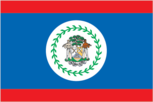
- blue with a narrow red stripe along the top and the bottom edges; centered is a large white disk bearing the coat of arms; the coat of arms features a shield flanked by two workers in front of a mahogany tree with the related motto SUB UMBRA FLOREO (I Flourish in the Shade) on a scroll at the bottom, all encircled by a green garland of 50 mahogany leaves; the colors are those of the two main
- political parties
- blue for the PUP and red for the UDP; various elements of the coat of arms - the figures, the tools, the mahogany tree, and the garland of leaves - recall the logging industry that led to British settlement of Belize note: Belize's flag is the only national flag that depicts human beings; two British overseas territories, Montserrat and the British Virgin Islands, also depict humans
Government type
parliamentary democracy and a Commonwealth realm
Independence
21 September 1981 (from the UK)
International organization participation
ACP, AOSIS, C, Caricom, CDB, FAO, G-77, IADB, IAEA, IBRD, ICAO, ICCt, ICRM, IDA, IFAD, IFC, IFRCS, ILO, IMF, IMO, Interpol, IOC, IOM, ITU, ITUC, LAES, MIGA, NAM, OAS, OPANAL, OPCW, PCA, PetroCaribe, RG, SICA, UN, UNCTAD, UNESCO, UNIDO, UPU, WCO, WHO, WIPO, WMO, WTO
Judicial branch
Summary Jurisdiction Courts (criminal) and District Courts (civil jurisdiction); Supreme Court (the chief justice is appointed by the governor general on the advice of the prime minister); Court of Appeal; Privy Council in the UK; member of the Caribbean Court of Justice (CCJ)
Legal system
English law; has not accepted compulsory ICJ jurisdiction
Legislative branch
- bicameral National Assembly consists of the Senate (12 seats; members appointed by the governor general - 6 on the advice of the prime minister, 3 on the advice of the leader of the opposition, and 1 each on the advice of the Belize Council of Churches and Evangelical Association of Churches, the Belize Chamber of Commerce and Industry and the Belize Better Business Bureau, and the National Trade Union Congress and the Civil Society Steering Committee; to serve five-year terms) and the House of Representatives (31 seats; members are elected by direct popular vote to serve five-year terms)
- election results
- percent of vote by party - UDP 56.3%, PUP 40.9%; seats by party - UDP 25, PUP 6
- elections
- House of Representatives - last held on 6 February 2008 (next to be held in 2013)
National anthem
- lyrics/music
- Samuel Alfred HAYNES/Selwyn Walford YOUNG note: adopted 1981; as a Commonwealth country, in addition to the national anthem, "God Save the Queen" serves as the royal anthem (see United Kingdom)
- name
- "Land of the Free"
National holiday
Independence Day, 21 September (1981)
Political parties and leaders
National Alliance for Belizean Rights or NABR; National Reform Party or NRP [Cornelius DUECK]; People's National Party or PNP [Wil MAHEIA]; People's United Party or PUP [John BRICENO]; United Democratic Party or UDP [Dean BARROW]; Vision Inspired by the People or VIP [Paul MORGAN]; We the People Reform Movement or WTP [Hipolito BAUTISTA]
Political pressure groups and leaders
Society for the Promotion of Education and Research or SPEAR [Nicole HAYLOCK]; Association of Concerned Belizeans or ACB [David VASQUEZ]; National Trade Union Congress of Belize or NTUC/B [Rene GOMEZ]
Suffrage
18 years of age; universal
Economy
Agriculture - products
bananas, cacao, citrus, sugar; fish, cultured shrimp; lumber
Central bank discount rate
12% (31 December 2009) 12% (31 December 2008)
Commercial bank prime lending rate
14.08% (31 December 2009 est.) 14.14% (31 December 2008 est.)
Current account balance
-$151 million (2010 est.) -$93.3 million (2009 est.)
Debt - external
$1.01 billion (2009 est.) $954.1 million (2008 est.)
Economy - overview
In this small, essentially private-enterprise economy, tourism is the number one foreign exchange earner followed by exports of marine products, citrus, cane sugar, bananas, and garments. The government's expansionary monetary and fiscal policies, initiated in September 1998, led to sturdy GDP growth averaging nearly 4% in 1999-2007, though growth slipped to 3.8% in 2008, 0% in 2009, and 1.5% in 2010 as a result of the global slowdown, natural disasters, and the drop in the price of oil. Oil discoveries in 2006 bolstered economic growth. Exploration efforts continue and production increased a small amount in 2009. Major concerns continue to be the sizable trade deficit and heavy foreign debt burden. In February 2007, the government restructured nearly all of its public external commercial debt, which helped reduce interest payments and relieved some of the country's liquidity concerns. A key objective remains the reduction of poverty and inequality with the help of international donors.
Electricity - consumption
198.5 million kWh (2007 est.)
Electricity - exports
0 kWh (2008 est.)
Electricity - imports
248.4 million kWh (2005)
Electricity - production
213.5 million kWh (2007 est.)
Exchange rates
Belizean dollars (BZD) per US dollar - 2 (2010), 2 (2009), 2 (2008), 2 (2007), 2 (2006)
Exports
$404 million (2010 est.) $381.9 million (2009 est.)
Exports - commodities
sugar, bananas, citrus, clothing, fish products, molasses, wood, crude oil
Exports - partners
US 30.7%, UK 29.77%, Nigeria 4.9%, Cote d'Ivoire 4.45% (2009)
GDP - composition by sector
- agriculture
- 29%
- industry
- 16.9%
- services
- 54.1% (2008 est.)
GDP - per capita (PPP)
$8,400 (2010 est.) $8,500 (2009 est.) $8,700 (2008 est.) note: data are in 2010 US dollars
GDP - real growth rate
1.5% (2010 est.) 0% (2009 est.) 3.6% (2008 est.)
GDP (official exchange rate)
$1.431 billion (2010 est.)
GDP (purchasing power parity)
$2.652 billion (2010 est.) $2.613 billion (2009 est.) $2.613 billion (2008 est.) note: data are in 2010 US dollars
Household income or consumption by percentage share
lowest 10%: NA% highest 10%: NA%
Imports
$740 million (2010 est.) $620.5 million (2009 est.)
Imports - commodities
machinery and transport equipment, manufactured goods; fuels, chemicals, pharmaceuticals; food, beverages, tobacco
Imports - partners
US 33.65%, Mexico 14.17%, Cuba 8.51%, Guatemala 6.75%, Spain 6.07%, China 4.12% (2009)
Industrial production growth rate
1.4% (2010 est.)
Industries
garment production, food processing, tourism, construction, oil
Inflation rate (consumer prices)
4.1% (2010 est.) -1.1% (2009 est.)
Investment (gross fixed)
26.2% of GDP (2010 est.)
Labor force
120,500 note: shortage of skilled labor and all types of technical personnel (2008 est.)
Labor force - by occupation
- agriculture
- 10.2%
- industry
- 18.1%
- services
- 71.7% (2007 est.)
Market value of publicly traded shares
$NA
Natural gas - consumption
0 cu m (2008 est.)
Natural gas - exports
0 cu m (2008 est.)
Natural gas - imports
0 cu m (2008 est.)
Natural gas - production
0 cu m (2008 est.)
Natural gas - proved reserves
0 cu m (1 January 2010 est.)
Oil - consumption
7,000 bbl/day (2009 est.)
Oil - exports
2,260 bbl/day (2007 est.)
Oil - imports
7,204 bbl/day (2007 est.)
Oil - production
3,990 bbl/day (2009 est.)
Oil - proved reserves
6.7 million bbl (1 January 2010 est.)
Population below poverty line
33.5% (2002 est.)
Reserves of foreign exchange and gold
$219 million (31 December 2010 est.) $213.7 million (31 December 2009 est.)
Stock of broad money
$1.351 billion (31 December 2010 est.) $1.084 billion (31 December 2009 est.)
Stock of domestic credit
$1.291 billion (31 December 2010 est.) $1.036 billion (31 December 2009 est.)
Stock of narrow money
$389.5 million (31 December 2010 est) $336.5 million (31 December 2009 est)
Unemployment rate
13.1% (2009) 8.2% (2008)
Communications
Broadcast media
8 privately-owned TV stations; multi-channel cable TV provides access to foreign stations; about 25 radio stations broadcasting on roughly 50 different frequencies; state-run radio was privatized in 1998 (2007)
Internet country code
.bz
Internet hosts
2,880 (2010)
Internet users
36,000 (2009)
Telephone system
- domestic
- fixed-line teledensity of 10 per 100 persons; mobile-cellular teledensity roughly 55 per 100 persons
- general assessment
- above-average system; trunk network depends primarily on microwave radio relay
- international
- country code - 501; landing point for the Americas Region Caribbean Ring System (ARCOS-1) fiber-optic telecommunications submarine cable that provides links to South and Central America, parts of the Caribbean, and the US; satellite earth station - 8 (Intelsat - 2, unknown - 6) (2008)
Telephones - main lines in use
31,200 (2009)
Telephones - mobile cellular
161,800 (2009)
Transportation
Airports
45 (2010)
Airports - with paved runways
- total
- 4 2,438 to 3,047 m: 1 914 to 1,523 m: 1 under 914 m: 2 (2010)
Airports - with unpaved runways
- total
- 41 2,438 to 3,047 m: 1 914 to 1,523 m: 13 under 914 m: 27 (2010)
Merchant marine
- by type
- barge carrier 1, bulk carrier 37, cargo 146, chemical tanker 1, passenger 1, passenger/cargo 1, petroleum tanker 7, refrigerated cargo 27, roll on/roll off 10
- foreign-owned
- 171 (Chile 1, China 64, Croatia 1, Cyprus 1, Estonia 1, Germany 1, Greece 2, Iceland 2, Italy 3, Japan 1, Latvia 10, Lithuania 2, Netherlands 1, Nigeria 2, Norway 3, Peru 1, Russia 32, Singapore 7, Spain 1, Syria 2, Turkey 18, UAE 5, UK 4, Ukraine 6) (2010)
- total
- 231
Ports and terminals
Belize City, Big Creek
Roadways
- paved
- 575 km
- total
- 3,007 km
- unpaved
- 2,432 km (2006)
Waterways
825 km (navigable only by small craft) (2010)
Military and Security
Manpower available for military service
males age 16-49: 79,088 females age 16-49: 77,147 (2010 est.)
Manpower fit for military service
males age 16-49: 57,759 females age 16-49: 55,903 (2010 est.)
Manpower reaching militarily significant age annually
- female
- 3,543 (2010 est.)
- male
- 3,678
Military branches
- Belize Defense Force (BDF)
- Army, BDF Air Wing (includes Special Boat Unit), BDF Volunteer Guard (2010)
Military expenditures
1.4% of GDP (2009)
Military service age and obligation
18 years of age for voluntary military service; laws allow for conscription only if volunteers are insufficient; conscription has never been implemented; volunteers typically outnumber available positions by 3:1 (2008)
Transnational Issues
Disputes - international
OAS-initiated Agreement on the Framework for Negotiations and Confidence Building Measures saw cooperation in repatriation of Guatemalan squatters and other areas, but Guatemalan land and maritime claims in Belize and the Caribbean Sea remain unresolved; the Line of Adjacency created under the 2002 Differendum serves in lieu of the contiguous international boundary to control squatting in the sparsely inhabited rain forests of Belize's border region; Honduras claims Belizean-administered Sapodilla Cays in its constitution but agreed to a joint ecological park under the Differendum
Illicit drugs
transshipment point for cocaine; small-scale illicit producer of cannabis, primarily for local consumption; offshore sector money-laundering activity related to narcotics trafficking and other crimes (2008) page last updated on January 12, 2011 ======================================================================
Trafficking in persons
- current situation
- Belize is a source, transit, and destination country for men, women, and children trafficked for the purposes of commercial sexual exploitation and forced labor; the most common form of trafficking in Belize is the internal sex trafficking of minors; some Central American men, women, and children, particularly from Guatemala, Honduras, and El Salvador, migrate voluntarily to Belize in search of work but are subsequently subjected to conditions of forced labor or forced prostitution
- tier rating
- Belize is placed on Tier 2 Watch List because it does not fully comply with the minimum standards for the elimination of trafficking; however, it is making significant efforts to do so; despite efforts to raise public awareness of human trafficking and provide protection services for trafficking victims, the government did not show evidence of progress in convicting and sentencing trafficking offenders last year (2009)