1993 Edition
CIA World Factbook 1993 (Project Gutenberg)
Geography
Area
total area: 22,960 km2 land area: 22,800 km2 comparative area: slightly larger than Massachusetts
Climate
tropical; very hot and humid; rainy season (May to February)
Coastline
386 km
Environment
frequent devastating hurricanes (September to December) and coastal flooding (especially in south); deforestation
International disputes
border with Guatemala in dispute; negotiations to resolve the dispute have begun
Irrigated land
20 km2 (1989 est.)
Land boundaries
total 516 km, Guatemala 266 km, Mexico 250 km
Land use
arable land: 2% permanent crops: 0% meadows and pastures: 2% forest and woodland: 44% other: 52%
Location
Central America, bordering the Caribbean Sea between Guatemala and Mexico
Map references
Central America and the Caribbean, North America, Standard Time Zones of the World
Maritime claims
territorial sea: 12 nm in the north, 3 nm in the south note: from the mouth of the Sarstoon River to Ranguana Caye, Belize's territorial sea is 3 miles; according to Belize's Maritime Areas Act, 1992, the purpose of this limitation is to provide a framework for the negotiation of a definitive agreement on territorial differences with Guatemala
Natural resources
arable land potential, timber, fish
Note
national capital moved 80 km inland from Belize City to Belmopan because of hurricanes; only country in Central America without a coastline on the North Pacific Ocean
Terrain
flat, swampy coastal plain; low mountains in south
People and Society
Birth rate
35.75 births/1,000 population (1993 est.)
Death rate
6.15 deaths/1,000 population (1993 est.)
Ethnic divisions
Mestizo 44%, Creole 30%, Maya 11%, Garifuna 7%, other 8%
Infant mortality rate
36.5 deaths/1,000 live births (1993 est.)
Labor force
51,500 by occupation: agriculture 30%, services 16%, government 15.4%, commerce 11.2%, manufacturing 10.3% note: shortage of skilled labor and all types of technical personnel (1985)
Languages
English (official), Spanish, Maya, Garifuna (Carib)
Life expectancy at birth
total population: 67.85 years male: 65.91 years female: 69.88 years (1993 est.)
Literacy
age 15 and over having ever attended school (1970) total population: 91% male: 91% female: 91%
Nationality
noun: Belizean(s) adjective: Belizean
Net migration rate
-5.44 migrant(s)/1,000 population (1993 est.)
Population
203,957 (July 1993 est.)
Population growth rate
2.42% (1993 est.)
Religions
Roman Catholic 62%, Protestant 30% (Anglican 12%, Methodist 6%, Mennonite 4%, Seventh-Day Adventist 3%, Pentecostal 2%, Jehovah's Witnesses 1%, other 2%), none 2%, other 6% (1980)
Total fertility rate
4.53 children born/woman (1993 est.)
Government
Administrative divisions
6 districts; Belize, Cayo, Corozal, Orange Walk, Stann Creek, Toledo
Capital
Belmopan
Chief of State
Queen ELIZABETH II (since 6 February 1952), represented by Governor General Dame Minita Elmira GORDON (since 21 September 1981)
Constitution
21 September 1981
Digraph
BH
Diplomatic representation in US
chief of mission: Ambassador James V. HYDE
Executive branch
British monarch, governor general, prime minister, deputy prime minister, Cabinet
FAX
[501] (2) 30802
Flag
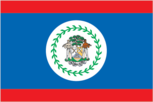
blue with a narrow red stripe along the top and the bottom edges; centered is a large white disk bearing the coat of arms; the coat of arms features a shield flanked by two workers in front of a mahogany tree with the related motto SUB UMBRA FLOREO (I Flourish in the Shade) on a scroll at the bottom, all encircled by a green garland
Head of Government
Prime Minister George Cadle PRICE (since 4 September 1989)
Independence
21 September 1981 (from UK)
Judicial branch
Supreme Court
Legal system
English law
Legislative branch
bicameral National Assembly consists of an upper house or Senate and a lower house or House of Representatives
Member of
ACP, C, CARICOM, CDB, ECLAC, FAO, G-77, GATT, IBRD, ICAO, IDA, IFAD, IFC, ILO, IMF, IMO, INTERPOL, IOC, IOM (observer), ITU, LORCS, NAM, OAS, UN, UNCTAD, UNESCO, UNIDO, UPU, WCL, WHO, WMO
Names
conventional long form: none conventional short form: Belize former: British Honduras
National Assembly
last held 4 September 1989 (next to be held September 1994); results - percent of vote by party NA; seats - (28 total) PUP 15, UDP 13; note - in January 1990 one member expelled from UDP joined PUP, making the seat count PUP 16, UDP 12
National holiday
Independence Day, 21 September
Other political or pressure groups
Society for the Promotion of Education and Research (SPEAR), Assad SHOMAN; United Workers Front, leader NA
Political parties and leaders
People's United Party (PUP), George PRICE, Florencio MARIN, Said MUSA; United Democratic Party (UDP), Manuel ESQUIVEL, Dean LINDO, Dean BARROW; National Alliance for Belizean Rights, leader NA
Suffrage
18 years of age; universal
Type
parliamentary democracy
US diplomatic representation
chief of mission: Ambassador Eugene L. SCASSA embassy: Gabourel Lane and Hutson Street, Belize City mailing address: P. O. Box 286, Belize City telephone: [501] (2) 77161 through 77163
Economy
Agriculture
accounts for 22% of GDP (including fish and forestry); commercial crops include sugarcane, bananas, coca, citrus fruits; expanding output of lumber and cultured shrimp; net importer of basic foods
Budget
revenues $126.8 million; expenditures $123.1 million, including capital expenditures of $44.8 million (FY91 est.)
Currency
1 Belizean dollar (Bz$) = 100 cents
Economic aid
US commitments, including Ex-Im (FY70-89), $104 million; Western (non-US) countries, ODA and OOF bilateral commitments (1970-89), $215 million
Electricity
34,532 kW capacity; 90 million kWh produced, 393 kWh per capita (1992)
Exchange rates
Belizean dollars (Bz$) per US$1 - 2.00 (fixed rate)
Exports
$95.6 million (f.o.b., 1991) commodities: sugar, citrus, clothing, bananas, fish products, molasses partners: US 49%, UK, EC, Mexico (1991)
External debt
$143.7 million (1991)
Fiscal year
1 April - 31 March
Illicit drugs
an illicit producer of cannabis for the international drug trade; eradication program cut marijuana production from 200 metric tons in 1987 to about 50 metric tons in 1991; transshipment point for cocaine
Imports
$194 million (c.i.f., 1991 est.) commodities: machinery and transportation equipment, food, manufactured goods, fuels, chemicals, pharmaceuticals partners: US 60%, UK, EC, Mexico (1991)
Industrial production
growth rate 3.7% (1990); accounts for 12% of GDP
Industries
garment production, citrus concentrates, sugar refining, rum, beverages, tourism
Inflation rate (consumer prices)
5.5% (1991)
National product
GDP - exchange rate conversion - $373 million (1990 est.)
National product per capita
$1,635 (1990 est.)
National product real growth rate
10% (1990)
Overview
The economy is based primarily on agriculture, agro-based industry, and merchandising, with tourism and construction assuming increasing importance. Agriculture accounts for about 30% of GDP and provides 75% of export earnings, while sugar, the chief crop, accounts for almost 40% of hard currency earnings. The US, Belize's main trading partner, is assisting in efforts to reduce dependency on sugar with an agricultural diversification program.
Unemployment rate
12% (1991 est.)
Communications
Airports
total: 42 usable: 32 with permanent-surface runways: 3 with runways over 3,659 m: with runways 2,440-3,659 m: 1 with runways 1,229-2,439 mr: 2
Highways
2,710 km total; 500 km paved, 1,600 km gravel, 300 km improved earth, and 310 km unimproved earth
Inland waterways
825 km river network used by shallow-draft craft; seasonally navigable
Merchant marine
4 ships (1,000 GRT or over) totaling 9,768 GRT/12,721 DWT; includes 3 cargo, 1 roll-on/roll-off
Ports
Belize City; additional ports for shallow draught craft include Corozol, Punta Gorda, Big Creek
Telecommunications
8,650 telephones; above-average system based on microwave radio relay; broadcast stations - 6 AM, 5 FM, 1 TV, 1 shortwave; 1 Atlantic Ocean INTELSAT earth station
Military and Security
Branches
British Forces Belize, Belize Defense Force (including Army, Navy, Air Force, and Volunteer Guard), Belize National Police
Defense expenditures
exchange rate conversion - $5.4 million, 2% of GDP (1992)
Manpower availability
males age 15-49 47,135; fit for military service 28,070; reach military age (18) annually 2,066 (1993 est.)