2023 Edition
CIA World Factbook 2023 (factbook.json @ 0d4fa4984ecb)
Introduction
Background
After seven decades as a constituent republic of the USSR, Belarus attained its independence in 1991. It has retained closer political and economic ties to Russia than have any of the other former Soviet republics, and since 2022 Belarus has facilitated Russia's war in Ukraine, which was launched in part from Belarusian territory. Belarus and Russia signed a treaty on a two-state union on 8 December 1999 envisioning greater political and economic integration. Although Belarus agreed to a framework to carry out the accord, serious implementation has yet to take place and negotiations on further integration have been contentious. Since his election in July 1994 as the country's first and only directly elected president, Alyaksandr LUKASHENKA has steadily consolidated his power through authoritarian means and a centralized economic system. Government restrictions on political and civil freedoms, freedom of speech and the press, peaceful assembly, and religion have remained in place. Restrictions on political freedoms have grown increasingly strained following the disputed presidential election in August 2020. The election results sparked largescale protests as members of the opposition and civil society criticized the election’s validity. Alyaksandr LUKASHENKA has remained in power as the disputed winner of the presidential election after quelling protests in late 2020.
Geography
Area
- land
- 202,900 sq km
- total
- 207,600 sq km
- water
- 4,700 sq km
Area - comparative
slightly less than twice the size of Kentucky; slightly smaller than Kansas
Climate
cold winters, cool and moist summers; transitional between continental and maritime
Coastline
0 km (landlocked)
Elevation
- highest point
- Dzyarzhynskaya Hara 346 m
- lowest point
- Nyoman River 90 m
- mean elevation
- 160 m
Geographic coordinates
53 00 N, 28 00 E
Geography - note
landlocked; glacial scouring accounts for the flatness of Belarusian terrain and for its 11,000 lakes
Irrigated land
303 sq km (2020)
Land boundaries
- border countries
- Latvia 161 km; Lithuania 640 km; Poland 375 km; Russia 1,312 km; Ukraine 1,111 km
- total
- 3,599 km
Land use
- agricultural land
- 43.7% (2018 est.)
- agricultural land: arable land
- arable land: 27.2% (2018 est.)
- agricultural land: permanent crops
- permanent crops: 0.6% (2018 est.)
- agricultural land: permanent pasture
- permanent pasture: 15.9% (2018 est.)
- forest
- 42.7% (2018 est.)
- other
- 13.6% (2018 est.)
Location
Eastern Europe, east of Poland
Major rivers (by length in km)
Dnyapro (Dnieper) (shared with Russia [s] and Ukraine [m]) - 2,287 kmnote – [s] after country name indicates river source; [m] after country name indicates river mouth
Major watersheds (area sq km)
Atlantic Ocean drainage: (Black Sea) Dnieper (533,966 sq km)
Map references
Europe
Maritime claims
none (landlocked)
Natural hazards
large tracts of marshy land
Natural resources
timber, peat deposits, small quantities of oil and natural gas, granite, dolomitic limestone, marl, chalk, sand, gravel, clay
Population distribution
a fairly even distribution throughout most of the country, with urban areas attracting larger and denser populations
Terrain
generally flat with much marshland
People and Society
Age structure
- 0-14 years
- 15.83% (male 764,281/female 721,632)
- 15-64 years
- 66.81% (male 3,055,606/female 3,213,751)
- 65 years and over
- 17.36% (2023 est.) (male 544,270/female 1,084,313)
Alcohol consumption per capita
- beer
- 2.26 liters of pure alcohol (2019 est.)
- other alcohols
- 2.66 liters of pure alcohol (2019 est.)
- spirits
- 4.67 liters of pure alcohol (2019 est.)
- total
- 10.57 liters of pure alcohol (2019 est.)
- wine
- 0.98 liters of pure alcohol (2019 est.)
Birth rate
8.6 births/1,000 population (2023 est.)
Child marriage
- men married by age 18
- 1.6% (2019 est.)
- women married by age 15
- 0.1%
- women married by age 18
- 4.7%
Children under the age of 5 years underweight
NA
Contraceptive prevalence rate
52.6% (2019)
Current health expenditure
6.4% of GDP (2020)
Currently married women (ages 15-49)
66.6% (2023 est.)
Death rate
13.3 deaths/1,000 population (2023 est.)
Dependency ratios
- elderly dependency ratio
- 25.4
- potential support ratio
- 3.9 (2021 est.)
- total dependency ratio
- 50.8
- youth dependency ratio
- 25.4
Drinking water source
- improved: rural
- rural: 99.6% of population
- improved: total
- total: 99.9% of population
- improved: urban
- urban: 100% of population
- unimproved: rural
- rural: 0.4% of population
- unimproved: total
- total: 0.1% of population (2020 est.)
- unimproved: urban
- urban: 0% of population
Education expenditures
4.7% of GDP (2021 est.)
Ethnic groups
Belarusian 83.7%, Russian 8.3%, Polish 3.1%, Ukrainian 1.7%, other 2.4%, unspecified 0.9% (2009 est.)
Gross reproduction rate
0.7 (2023 est.)
Hospital bed density
10.8 beds/1,000 population (2014)
Infant mortality rate
- female
- 1.8 deaths/1,000 live births
- male
- 2.5 deaths/1,000 live births
- total
- 2.1 deaths/1,000 live births (2023 est.)
Languages
- Languages
- Russian (official) 71.4%, Belarusian (official) 26%, other 0.3% (includes small Polish- and Ukrainian-speaking minorities), unspecified 2.3% (2009 est.)
- major-language sample(s)
- Книга фактов о мире – незаменимый источник базовой информации. (Russian)The World Factbook, the indispensable source for basic information.
Life expectancy at birth
- female
- 79.9 years
- male
- 69.6 years
- total population
- 74.6 years (2023 est.)
Literacy
- definition
- age 15 and over can read and write
- female
- 99.9% (2019)
- male
- 99.9%
- total population
- 99.9%
Major urban areas - population
2.057 million MINSK (capital) (2023)
Maternal mortality ratio
1 deaths/100,000 live births (2020 est.)
Median age
- female
- 44.6 years
- male
- 39.1 years
- total
- 41.7 years (2023 est.)
Mother's mean age at first birth
26.8 years (2019 est.)
Nationality
- adjective
- Belarusian
- noun
- Belarusian(s)
Net migration rate
0.9 migrant(s)/1,000 population (2023 est.)
Obesity - adult prevalence rate
24.5% (2016)
Physicians density
4.54 physicians/1,000 population (2019)
Population
9,383,853 (2023 est.)
Population distribution
a fairly even distribution throughout most of the country, with urban areas attracting larger and denser populations
Population growth rate
-0.39% (2023 est.)
Religions
Orthodox 48.3%, Catholic 7.1%, other 3.5%, non-believers 41.1% (2011 est.)
Sanitation facility access
- improved: rural
- rural: 98.3% of population
- improved: total
- total: 99.5% of population
- improved: urban
- urban: 99.9% of population
- unimproved: rural
- rural: 1.7% of population
- unimproved: total
- total: 0.5% of population (2020 est.)
- unimproved: urban
- urban: 0.1% of population
School life expectancy (primary to tertiary education)
- female
- 15 years (2021)
- male
- 15 years
- total
- 15 years
Sex ratio
- 0-14 years
- 1.06 male(s)/female
- 15-64 years
- 0.95 male(s)/female
- 65 years and over
- 0.5 male(s)/female
- at birth
- 1.06 male(s)/female
- total population
- 0.88 male(s)/female (2023 est.)
Tobacco use
- female
- 13.5% (2020 est.)
- male
- 47.4% (2020 est.)
- total
- 30.5% (2020 est.)
Total fertility rate
1.45 children born/woman (2023 est.)
Urbanization
- rate of urbanization
- 0.28% annual rate of change (2020-25 est.)
- urban population
- 80.7% of total population (2023)
Youth unemployment rate (ages 15-24)
- female
- 8.4%
- male
- 14%
- total
- 11.3% (2021 est.)
Government
Administrative divisions
- 6 regions (voblastsi, singular - voblasts') and 1 municipality* (horad); Brest, Homyel' (Gomel'), Horad Minsk* (Minsk City), Hrodna (Grodno), Mahilyow (Mogilev), Minsk, Vitsyebsk (Vitebsk)
- note
- note: administrative divisions have the same names as their administrative centers; Russian spelling provided for reference when different from Belarusian
Capital
- etymology
- the origin of the name is disputed; Minsk may originally have been located 16 km to the southwest, on the banks of Menka River; remnants of a 10th-century settlement on the banks of the Menka have been found
- geographic coordinates
- 53 54 N, 27 34 E
- name
- Minsk
- time difference
- UTC+2 (7 hours ahead of Washington, DC, during Standard Time)
Citizenship
- citizenship by birth
- no
- citizenship by descent only
- at least one parent must be a citizen of Belarus
- dual citizenship recognized
- no
- residency requirement for naturalization
- 7 years
Constitution
- amendments
- proposed by the president of the republic through petition to the National Assembly or by petition of least 150,000 eligible voters; approval required by at least two-thirds majority vote in both chambers or by simple majority of votes cast in a referendum; amended 1996, 2004
- history
- several previous; latest drafted between late 1991 and early 1994, signed 15 March 1994
Country name
- conventional long form
- Republic of Belarus
- conventional short form
- Belarus
- etymology
- the name is a compound of the Belarusian words "bel" (white) and "Rus" (the Old East Slavic ethnic designation) to form the meaning White Rusian or White Ruthenian
- former
- Belorussian (Byelorussian) Soviet Socialist Republic
- local long form
- Respublika Byelarus' (Belarusian)/ Respublika Belarus' (Russian)
- local short form
- Byelarus' (Belarusian)/ Belarus' (Russian)
Diplomatic representation from the US
- chief of mission
- Ambassador (vacant); Chargé d’Affaires Peter KAUFMAN (since June 2023)
- email address and website
- ConsularMinsk@state.govhttps://by.usembassy.gov/
- embassy
- 46 Starovilenskaya Street, Minsk 220002
- FAX
- [375] (17) 334-78-53
- mailing address
- 7010 Minsk Place, Washington DC 20521-7010
- telephone
- [375] (17) 210-12-83/217-73-47/217-73-48
Diplomatic representation in the US
- chancery
- 1619 New Hampshire Avenue NW, Washington, DC 20009
- chief of mission
- Ambassador (vacant; recalled by Belarus in 2008); Chargé d'Affaires Pavel SHIDLOWSKI (since 9 August 2022)
- email address and website
- usa@mfa.gov.byhttps://usa.mfa.gov.by/en/
- FAX
- [1] (202) 986-1805
- telephone
- [1] (202) 986-1606
Executive branch
- cabinet
- Council of Ministers appointed by the president
- chief of state
- President Alyaksandr LUKASHENKA (since 20 July 1994)
- election results
- 2020: Alyaksandr LUKASHENKA reelected president (); percent of vote - Alyaksandr LUKASHENKA (independent) 80.1%, Svyatlana TSIKHANOWSKAYA (independent) 10.1%, other 9.8%; note - widespread street protests erupted following announcement of the election results amid allegations of voter fraud2015: Alyaksandr LUKASHENKA president (); percent of vote - Alyaksandr LUKASHENKA (independent) 84.1%, Tatsyana KARATKEVICH 4.4%, Sergey GAYDUKEVICH 3.3%, other 8.2%.
- elections/appointments
- president directly elected by absolute majority popular vote in 2 rounds if needed for a 5-year term (no term limits); first election held on 23 June and 10 July 1994; according to the 1994 constitution, the next election should have been held in 1999; however, Alyaksandr LUKASHENKA extended his term to 2001 via a November 1996 referendum; subsequent election held on 9 September 2001; an October 2004 referendum ended presidential term limits and allowed the President LUKASHENKA to run and win a third term (19 March 2006); a fourth term (19 December 2010); a fifth term (11 October 2015); a sixth term (9 August 2020); next election to be held in 2025; prime minister and deputy prime ministers appointed by the president and approved by the National Assembly
- head of government
- Prime Minister Roman GOLOVCHENKO (since 4 June 2020); First Deputy Prime Minister Mikalay SNAPKOW (since 4 June 2020); Deputy Prime Ministers Ihar PETRYSHENKA (since 18 August 2018), Anatol SIVAK (since 1 September 2020), Leanid ZAYATS (since 21 March 2022), Petr PARKHOMCHYK (since 16 August 2022)
Flag description
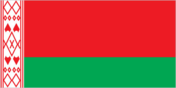
red horizontal band (top) and green horizontal band one-half the width of the red band; a white vertical stripe on the hoist side bears Belarusian national ornamentation in red; the red band color recalls past struggles from oppression, the green band represents hope and the many forests of the country
Government type
presidential republic in name, although in fact a dictatorship
Independence
25 August 1991 (from the Soviet Union)
International law organization participation
has not submitted an ICJ jurisdiction declaration; non-party state to the ICCt
International organization participation
BSEC (observer), CBSS (observer), CEI, CIS, CSTO, EAEC, EAEU, EAPC, EBRD, FAO, GCTU, IAEA, IBRD, ICAO, ICC (NGOs), ICRM, IDA, IFC, IFRCS, ILO, IMF, IMSO, Interpol, IOC, IOM, IPU, ISO, ITU, ITUC (NGOs), MIGA, NAM, NSG, OPCW, OSCE, PCA, PFP, SCO (dialogue member), UN, UNCTAD, UNESCO, UNIDO, UNIFIL, UNOOSA, UNWTO, UPU, WCO, WFTU (NGOs), WHO, WIPO, WMO, WTO (observer), ZC
Judicial branch
- highest court(s)
- Supreme Court (consists of the chairman and deputy chairman and organized into several specialized panels, including economic and military; number of judges set by the president of the republic and the court chairman); Constitutional Court (consists of 12 judges, including a chairman and deputy chairman)
- judge selection and term of office
- Supreme Court judges appointed by the president with the consent of the Council of the Republic; judges initially appointed for 5 years and evaluated for life appointment; Constitutional Court judges - 6 appointed by the president and 6 elected by the Council of the Republic; the presiding judge directly elected by the president and approved by the Council of the Republic; judges can serve for 11 years with an age limit of 70
- subordinate courts
- oblast courts; Minsk City Court; town courts; Minsk city and oblast economic courts
Legal system
civil law system; note - nearly all major codes (civil, civil procedure, criminal, criminal procedure, family, and labor) were revised and came into force in 1999 and 2000
Legislative branch
- description
- bicameral National Assembly or Natsyyalny Skhod consists of:Council of the Republic or Savet Respubliki (64 seats statutory, current 60; 56 members indirectly elected by regional and Minsk city councils and 8 members appointed by the president; members serve 4-year terms)House of Representatives or Palata Pradstawnikow (110 seats; members directly elected in single-seat constituencies by absolute majority vote in 2 rounds if needed; members serve 4-year terms)
- election results
- Council of the Republic - percent of vote by party - NA; seats by party - NA; composition - as of August 2023 - men 45, women 15, percent of women 25%House of Representatives - percent of vote by party - NA; seats by party - KPB 11, Republican Party of Labor and Justice 6, BPP 2, LDP 1, BAP 1, independent 89; composition as of August 2023 - men 66, women 44, percent of women 40%; note - total National Assembly percent of women 34.7%
- elections
- Council of the Republic - indirect election last held on 7 November 2019House of Representatives - last held on 17 November 2019 (next to be held on 25 February 2024); OSCE observers determined that the election was neither free nor impartial and that vote counting was problematic in a number of polling stations; pro-LUKASHENKA candidates won every seat; international observers determined that the previous elections - on 28 September 2008, 23 September 2012, and 11 September 2016 - also fell short of democratic standards, with pro-LUKASHENKA candidates winning every, or virtually every seat
- note
- note: the US does not recognize the legitimacy of the National Assembly
National anthem
- lyrics/music
- Mikhas KLIMKOVICH and Uladzimir KARYZNA/Nester SAKALOUSKI
- name
- "My, Bielarusy" (We Belarusians)
- note
- note: music adopted 1955, lyrics adopted 2002; after the fall of the Soviet Union, Belarus kept the music of its Soviet-era anthem but adopted new lyrics; also known as "Dziarzauny himn Respubliki Bielarus" (State Anthem of the Republic of Belarus)
National heritage
- selected World Heritage Site locales
- Białowieża Forest (n); Mir Castle Complex (c); Architectural, Residential, and Cultural Complex of the Radziwill Family at Nesvizh (c)
- total World Heritage Sites
- 4 (3 cultural, 1 natural)
National holiday
Independence Day, 3 July (1944); note - 3 July 1944 was the date Minsk was liberated from German troops, 25 August 1991 was the date of independence from the Soviet Union
National symbol(s)
no clearly defined current national symbol, the mounted knight known as Pahonia (the Chaser) is the traditional Belarusian symbol; national colors: green, red, white
Political parties and leaders
pro-government parties:Belarusian Agrarian Party or BAP [Mikhail RUSY]Belarusian Patriotic Party or BPP [Mikalay ULAKHOVICH]Belarusian Social Sport Party or BSSP [Uladzimir ALEKSANDROVICH]Belaya Rus [Henadz DAVYDKA]Communist Party of Belarus or KPB [Alyaksey SOKOL]Liberal Democratic Party or LDP [Aleh GAYDUKEVICH]Republican Party [Uladzimir BELAZOR]Republican Party of Labor and Justice [Alyaksandr STSYAPANAW]Social Democratic Party of Popular Accord [Syarhey YERMAK]opposition parties: Belarusian Christian Democracy Party [Paval SEVYARYNETS, Volha KAVALKOVA, Vital RYMASHEWSKI] (unregistered)Belarusian Party of the Green [Dzimtry KUCHUK]Belarusian Party of the Left "Just World" [Syarhey KALYAKIN]Belarusian Social-Democratic Assembly of BSDH [Syarhey CHERACHEN]Belarusian Social Democratic Party ("Assembly") or BSDPH [Ihar BARYSAW]Belarusian Social Democratic Party (People's Assembly) or BSDP [Mikalay STATKEVICH] (unregistered)BPF Party [Ryhor KASTUSYOW]Christian Conservative Party-BPF [Zyanon PAZNYAK]United Civic Party or UCP [Mikalay KAZLOW]
Suffrage
18 years of age; universal
Economy
Agricultural products
milk, potatoes, sugar beets, wheat, triticale, barley, maize, rye, rapeseed, poultry
Average household expenditures
- on alcohol and tobacco
- 7.2% of household expenditures (2018 est.)
- on food
- 32.3% of household expenditures (2018 est.)
Budget
- expenditures
- $24.239 billion (2019 est.)
- revenues
- $24.743 billion (2019 est.)
Budget surplus (+) or deficit (-)
2.9% (of GDP) (2017 est.)
Credit ratings
- Fitch rating
- B (2018)
- Moody's rating
- B3 (2018)
- note
- note: The year refers to the year in which the current credit rating was first obtained.
- Standard & Poors rating
- B (2017)
Current account balance
- Current account balance 2019
- -$1.246 billion (2019 est.)
- Current account balance 2020
- -$178.4 million (2020 est.)
- Current account balance 2021
- $2.153 billion (2021 est.)
Debt - external
- Debt - external 2018
- $39.297 billion (2018 est.)
- Debt - external 2019
- $39.847 billion (2019 est.)
Economic overview
declining Russian energy subsidies will end in 2024; growing public debt; strong currency pressures have led to higher inflation; recent price controls on basic food and drugs; public sector wage increases and fragile private sector threaten household income gains and economic growth
Exchange rates
- Currency
- Belarusian rubles (BYB/BYR) per US dollar -
- Exchange rates 2017
- 1.932 (2017 est.)
- Exchange rates 2018
- 2.038 (2018 est.)
- Exchange rates 2019
- 2.092 (2019 est.)
- Exchange rates 2020
- 2.44 (2020 est.)
- Exchange rates 2021
- 2.539 (2021 est.)
Exports
- Exports 2019
- $41.975 billion (2019 est.)
- Exports 2020
- $37.183 billion (2020 est.)
- Exports 2021
- $49.425 billion (2021 est.)
- note
- note: Data are in current year dollars and do not include illicit exports or re-exports.
Exports - commodities
fertilizers, refined petroleum, cheese, delivery trucks, lumber (2021)
Exports - partners
Russia 42%, Ukraine 13%, United Kingdom 7% (2019)
Fiscal year
calendar year
GDP - composition, by end use
- exports of goods and services
- 67% (2017 est.)
- government consumption
- 14.6% (2017 est.)
- household consumption
- 54.8% (2017 est.)
- imports of goods and services
- -67% (2017 est.)
- investment in fixed capital
- 24.9% (2017 est.)
- investment in inventories
- 5.7% (2017 est.)
GDP - composition, by sector of origin
- agriculture
- 8.1% (2017 est.)
- industry
- 40.8% (2017 est.)
- services
- 51.1% (2017 est.)
GDP (official exchange rate)
$63.168 billion (2019 est.)
Gini Index coefficient - distribution of family income
- Gini Index coefficient - distribution of family income 2020
- 24.4 (2020 est.)
Household income or consumption by percentage share
- highest 10%
- 21.9% (2008)
- lowest 10%
- 3.8%
Imports
- Imports 2019
- $42.378 billion (2019 est.) note: data are in current year dollars
- Imports 2020
- $35.236 billion (2020 est.) note: data are in current year dollars
- Imports 2021
- $45.459 billion (2021 est.) note: data are in current year dollars
Imports - commodities
crude petroleum, natural gas, cars and vehicle parts, packaged medicines, broadcasting equipment (2019)
Imports - partners
Russia 57%, China 7%, Poland 5%, Germany 5%, Ukraine 5% (2019)
Industrial production growth rate
6.7% (2021 est.)
Industries
metal-cutting machine tools, tractors, trucks, earthmovers, motorcycles, synthetic fibers, fertilizer, textiles, refrigerators, washing machines and other household appliances
Inflation rate (consumer prices)
- Inflation rate (consumer prices) 2019
- 5.6% (2019 est.)
- Inflation rate (consumer prices) 2020
- 5.55% (2020 est.)
- Inflation rate (consumer prices) 2021
- 9.46% (2021 est.)
Labor force
4.95 million (2021 est.)
Labor force - by occupation
- agriculture
- 9.7%
- industry
- 23.4%
- services
- 66.8% (2015 est.)
Population below poverty line
5% (2019 est.)
Public debt
- Public debt 2017
- 39.88% of GDP (2017 est.)
- Public debt 2018
- 37.1% of GDP (2018 est.)
- Public debt 2019
- 33.24% of GDP (2019 est.)
Real GDP (purchasing power parity)
- note
- note: data are in 2017 dollars
- Real GDP (purchasing power parity) 2019
- $181.605 billion (2019 est.)
- Real GDP (purchasing power parity) 2020
- $180.335 billion (2020 est.)
- Real GDP (purchasing power parity) 2021
- $184.482 billion (2021 est.)
Real GDP growth rate
- Real GDP growth rate 2019
- 1.4% (2019 est.)
- Real GDP growth rate 2020
- -0.7% (2020 est.)
- Real GDP growth rate 2021
- 2.3% (2021 est.)
Real GDP per capita
- note
- note: data are in 2017 dollars
- Real GDP per capita 2019
- $19,300 (2019 est.)
- Real GDP per capita 2020
- $19,200 (2020 est.)
- Real GDP per capita 2021
- $19,800 (2021 est.)
Reserves of foreign exchange and gold
- Reserves of foreign exchange and gold 31 December 2019
- $9.394 billion (31 December 2019 est.)
- Reserves of foreign exchange and gold 31 December 2020
- $7.468 billion (31 December 2020 est.)
- Reserves of foreign exchange and gold 31 December 2021
- $8.425 billion (31 December 2021 est.)
Taxes and other revenues
12.02% (of GDP) (2020 est.)
Unemployment rate
- note
- note: official registered unemployed; large number of underemployed workers
- Unemployment rate 2019
- 4.16% (2019 est.)
- Unemployment rate 2020
- 4.77% (2020 est.)
- Unemployment rate 2021
- 4.74% (2021 est.)
Youth unemployment rate (ages 15-24)
- female
- 8.4%
- male
- 14%
- total
- 11.3% (2021 est.)
Energy
Carbon dioxide emissions
- from coal and metallurgical coke
- 1.623 million metric tonnes of CO2 (2019 est.)
- from consumed natural gas
- 36.217 million metric tonnes of CO2 (2019 est.)
- from petroleum and other liquids
- 16.856 million metric tonnes of CO2 (2019 est.)
- total emissions
- 54.695 million metric tonnes of CO2 (2019 est.)
Coal
- consumption
- 621,000 metric tons (2020 est.)
- exports
- 1.574 million metric tons (2020 est.)
- imports
- 2.117 million metric tons (2020 est.)
- production
- 0 metric tons (2020 est.)
- proven reserves
- 0 metric tons (2019 est.)
Electricity
- consumption
- 32,665,500,000 kWh (2019 est.)
- exports
- 4.777 billion kWh (2020 est.)
- imports
- 4.277 billion kWh (2020 est.)
- installed generating capacity
- 11.36 million kW (2020 est.)
- transmission/distribution losses
- 2.711 billion kWh (2019 est.)
Electricity access
- electrification - total population
- 100% (2021)
Electricity generation sources
- biomass and waste
- 1.2% of total installed capacity (2020 est.)
- fossil fuels
- 95.8% of total installed capacity (2020 est.)
- geothermal
- 0% of total installed capacity (2020 est.)
- hydroelectricity
- 1.1% of total installed capacity (2020 est.)
- nuclear
- 0.9% of total installed capacity (2020 est.)
- solar
- 0.5% of total installed capacity (2020 est.)
- tide and wave
- 0% of total installed capacity (2020 est.)
- wind
- 0.5% of total installed capacity (2020 est.)
Energy consumption per capita
- Total energy consumption per capita 2019
- 102.558 million Btu/person (2019 est.)
Natural gas
- consumption
- 18,639,590,000 cubic meters (2019 est.)
- exports
- 0 cubic meters (2021 est.)
- imports
- 18,673,429,000 cubic meters (2019 est.)
- production
- 68.951 million cubic meters (2019 est.)
- proven reserves
- 2.832 billion cubic meters (2021 est.)
Nuclear energy
- Net capacity of operational nuclear reactors
- 2.22GW (2023)
- Number of operational nuclear reactors
- 2 (2023)
- Percent of total electricity production
- 14.1% (2021)
- Percent of total energy produced
- 40.8% (2021)
Petroleum
- crude oil and lease condensate exports
- 32,200 bbl/day (2018 est.)
- crude oil and lease condensate imports
- 383,200 bbl/day (2018 est.)
- crude oil estimated reserves
- 198 million barrels (2021 est.)
- refined petroleum consumption
- 134,600 bbl/day (2019 est.)
- total petroleum production
- 34,300 bbl/day (2021 est.)
Refined petroleum products - exports
351,200 bbl/day (2015 est.)
Refined petroleum products - imports
14,630 bbl/day (2015 est.)
Refined petroleum products - production
477,200 bbl/day (2015 est.)
Communications
Broadband - fixed subscriptions
- subscriptions per 100 inhabitants
- 35 (2020 est.)
- total
- 3,255,552 (2020 est.)
Broadcast media
7 state-controlled national TV channels; Polish and Russian TV broadcasts are available in some areas; state-run Belarusian Radio operates 5 national networks and an external service; Russian and Polish radio broadcasts are available (2019)
Internet country code
.by
Internet users
- percent of population
- 87% (2021 est.)
- total
- 8.352 million (2021 est.)
Telecommunication systems
- domestic
- fixed-line teledensity is improving although rural areas continue to be underserved, approximately 45 per 100 fixed-line; mobile-cellular teledensity now roughly 123 telephones per 100 persons (2021)
- general assessment
- the Government of Belarus has successfully promoted the migration to an all-IP platform as part of a wider effort towards a digital transformation for the economy; the state-supported infrastructure operator beCloud has built an extensive fiber network, which reaches all but the smallest settlements in the country; Belarus has the second-highest fiber subscription rate in Europe, behind only Iceland; LTE coverage is almost universal, while considerable progress has also been made in developing 5G services (2021)
- international
- country code - 375; Belarus is landlocked and therefore a member of the Trans-European Line (TEL), Trans-Asia-Europe (TAE) fiber-optic line, and has access to the Trans-Siberia Line (TSL); 3 fiber-optic segments provide connectivity to Latvia, Poland, Russia, and Ukraine; worldwide service is available to Belarus through this infrastructure; additional analog lines to Russia; Intelsat, Eutelsat, and Intersputnik earth stations; almost 31,000 base stations in service in 2019 (2020)
Telephones - fixed lines
- subscriptions per 100 inhabitants
- 45 (2021 est.)
- total subscriptions
- 4,332,754 (2021 est.)
Telephones - mobile cellular
- subscriptions per 100 inhabitants
- 123 (2021 est.)
- total subscriptions
- 11,760,087 (2021 est.)
Transportation
Airports
65 (2021)
Airports - with paved runways
- 33
- note
- note: paved runways have a concrete or asphalt surface but not all have facilities for refueling, maintenance, or air traffic control; the length of a runway required for aircraft to safely operate depends on a number of factors including the type of aircraft, the takeoff weight (including passengers, cargo, and fuel), engine types, flap settings, landing speed, elevation of the airport, and average maximum daily air temperature; paved runways can reach a length of 5,000 m (16,000 ft.), but the “typical” length of a commercial airline runway is between 2,500-4,000 m (8,000-13,000 ft.)
Airports - with unpaved runways
- 32
- note
- note: unpaved runways have a surface composition such as grass or packed earth and are most suited to the operation of light aircraft; unpaved runways are usually short, often less than 1,000 m (3,280 ft.) in length; airports with unpaved runways often lack facilities for refueling, maintenance, or air traffic control
Civil aircraft registration country code prefix
EW
Heliports
1 (2021)
Merchant marine
- by type
- other 4
- total
- 4 (2022)
National air transport system
- annual freight traffic on registered air carriers
- 1.9 million (2018) mt-km
- annual passenger traffic on registered air carriers
- 2,760,168 (2018)
- inventory of registered aircraft operated by air carriers
- 30
- number of registered air carriers
- 2 (2020)
Pipelines
5,386 km gas, 1,589 km oil, 1,730 km refined products (2013)
Ports and terminals
- river port(s)
- Mazyr (Prypyats')
Railways
- broad gauge
- 5,503 km (2014) 1.520-m gauge (874 km electrified)
- standard gauge
- 25 km (2014) 1.435-m gauge
- total
- 5,528 km (2014)
Roadways
- total
- 86,600 km (2017)
Waterways
2,500 km (2011) (major rivers are the west-flowing Western Dvina and Neman Rivers and the south-flowing Dnepr River and its tributaries, the Berezina, Sozh, and Pripyat Rivers)
Military and Security
Military - note
the military of Belarus is responsible for territorial defense; it is a mixed force of conscripts and professionals that is equipped with Russian or Soviet-era weapons; the Army’s principal combat forces are divided into two geographically based commands, each with two mechanized brigades and an artillery brigade; there are also separate artillery and surface-to-surface missile brigades; the Special Operations Forces have three airborne, air assault, and special forces (spetsnaz) brigades, which serve as the military’s high-readiness units; the Air and Air Defense inventory includes about 100 combat aircraft and attack helicopters, as well as air defense brigades and regiments with surface-to-air missilesRussia is the country’s closest security partner, a relationship that includes an integrated air and missile defense system and joint military training centers and exercises; Russia leases from Belarus a strategic ballistic missile defense site operated by Russian Aerospace Forces and a global communications facility for the Russian Navy; in 2020, the countries signed an agreement allowing for close security cooperation between the Belarusian Ministry of Interior and the Russian National Guard, including protecting public order and key government facilities and combating extremism and terrorism; in 2022, Belarus allowed Russian military forces to stage on its territory for their invasion of Ukraine and continues to supply arms and other aid to the Russian military, including logistical support, supply lines, medical care, and airfields for Russian combat aircraft; in 2023, Belarus agreed to permit Russia to deploy nuclear weapons on its soilBelarus has been a member of the Collective Security Treaty Organization (CSTO) since 1994 and has committed an airborne brigade to CSTO's rapid reaction force; the military trains regularly with other CSTO members (2023)
Military and security forces
- Belarus Armed Forces: Army, Air and Air Defense Force, Special Operations Force, Special Troops (electronic warfare, signals, engineers, biological/chemical/nuclear protection troops, etc)Ministry of Interior: State Border Troops, Militia, Internal Troops (2023)
- note
- note: in early 2023, President LUKASHENKO ordered the formation of a new volunteer paramilitary territorial defense force to supplement the Army
Military and security service personnel strengths
approximately 45-50,000 active-duty troops; information on the individual services varies, but reportedly includes about 25-30,000 Army, 15,000 Air/Air Defense, and 5,000 Special Operations forces (2023)
Military equipment inventories and acquisitions
the military's inventory is comprised mostly of Russian/Soviet-origin equipment, and in recent years Russia has continued to be the leading provider of arms; Belarus's defense industry manufactures some equipment (mostly modernized Soviet designs), including vehicles, guided weapons, and electronic warfare systems (2023)
Military expenditures
- Military Expenditures 2018
- 1.5% of GDP (2018 est.) (approximately $2.05 billion)
- Military Expenditures 2019
- 1.5% of GDP (2019 est.) (approximately $2.11 billion)
- Military Expenditures 2020
- 1.5% of GDP (2020 est.)
- Military Expenditures 2021
- 1.2% of GDP (2021 est.)
- Military Expenditures 2022
- 1.1% of GDP (2022 est.)
Military service age and obligation
- 18-27 years of age for compulsory military or alternative service; conscript service obligation is 12-18 months, depending on academic qualifications, and 24-36 months for alternative service, also depending on academic qualifications; 17-year-olds are eligible to become cadets at military higher education institutes, where they are classified as military personnel (2023)
- note
- note: conscripts can be assigned to the military, to the Ministry of Interior as internal or border troops, or to the Ministry of Labor and Social Protection (alternative service); as of 2020, conscripts comprised an estimated 40% of the military
Transnational Issues
Disputes - international
Belarus-Latvia: boundary demarcated with LatviaBelarus-Lithuania: boundary demarcated with Lithuania.Belarus-Poland: as a member state that forms part of the EU's external border, Poland has implemented strict Schengen border rules to restrict illegal immigration and trade along its border with Belarus.
Illicit drugs
limited cultivation of opium poppy and cannabis, mostly for the domestic market; transshipment point for illicit drugs to and via Russia, and to the Baltics and Western Europe; a small and lightly regulated financial center; anti-money-laundering legislation does not meet international standards and was weakened further when know-your-customer requirements were curtailed in 2008; few investigations or prosecutions of money-laundering activities
Refugees and internally displaced persons
- refugees (country of origin)
- 32,435 (Ukraine) (as of 1 August 2023)
- stateless persons
- 5,626 (2022)
Trafficking in persons
- tier rating
- Tier 3 — Belarus does not fully meet the minimum standards for the elimination of trafficking and is not making significant efforts to do so, therefore Belarus was downgraded to Tier 3; nonetheless, the government took some steps to address trafficking, including conducting investigations and prosecutions and identifying and referring victims to services; however, the government did not report investigating, prosecuting, or convicting traffickers under its trafficking statute nor provide adequate protection to victims; officials reportedly returned many migrants and asylum seekers to their countries of origin without comprehensively screening them for trafficking; the government did not report conducting awareness activities, and its efforts to prevent labor trafficking remained inadequate; for the 5th consecutive year, Belarus did not report investigating or filing charges related to illegal recruitment of migrant workers (2022)
- trafficking profile
- human traffickers exploit domestic and foreign victims and exploit Belarusians abroad; the majority of trafficking victims are men subjected to forced labor, primarily in Russia; most Belarusian victims are trafficked in Belarus and Russia, but also in Poland, Turkey, and other European, Eurasian and Middle Eastern countries; some Belarusian women traveling for foreign employment in the adult entertainment and hotel industries are subjected to sex trafficking; most traffickers are Belarusian citizens, and traffickers increasingly use online methods to coerce victims into forced labor and sex trafficking (2022)
Space
Space agency/agencies
Belarus Space Agency (aka National Agency for Space Research; established 2009) (2023)
Space program overview
- has a modest national space program focused on developing remote sensing (RS) satellites; jointly builds satellites with foreign partners; develops some space technologies and components for space equipment, including satellite payloads and associated technology, such as optics and imaging equipment; has cooperated with a variety of foreign space agencies and commercial entities, including those of Azerbaijan, China, Kazakhstan, Russia, and Ukraine; has a state-owned satellite company (2023)
- note
- note: further details about the key activities, programs, and milestones of the country’s space program, as well as government spending estimates on the space sector, appear in Appendix S
Environment
Air pollutants
- carbon dioxide emissions
- 58.28 megatons (2016 est.)
- methane emissions
- 17.19 megatons (2020 est.)
- particulate matter emissions
- 15.48 micrograms per cubic meter (2019 est.)
Climate
cold winters, cool and moist summers; transitional between continental and maritime
Environment - current issues
soil pollution from pesticide use; southern part of the country contaminated with fallout from 1986 nuclear reactor accident at Chornobyl' in northern Ukraine
Environment - international agreements
- party to
- Air Pollution, Air Pollution-Nitrogen Oxides, Air Pollution-Sulphur 85, Antarctic-Environmental Protection, Antarctic Treaty, Biodiversity, Climate Change, Climate Change-Kyoto Protocol, Climate Change-Paris Agreement, Comprehensive Nuclear Test Ban, Desertification, Endangered Species, Environmental Modification, Hazardous Wastes, Law of the Sea, Marine Dumping-London Convention, Nuclear Test Ban, Ozone Layer Protection, Ship Pollution, Wetlands
- signed, but not ratified
- none of the selected agreements
Land use
- agricultural land
- 43.7% (2018 est.)
- agricultural land: arable land
- arable land: 27.2% (2018 est.)
- agricultural land: permanent crops
- permanent crops: 0.6% (2018 est.)
- agricultural land: permanent pasture
- permanent pasture: 15.9% (2018 est.)
- forest
- 42.7% (2018 est.)
- other
- 13.6% (2018 est.)
Major rivers (by length in km)
Dnyapro (Dnieper) (shared with Russia [s] and Ukraine [m]) - 2,287 kmnote – [s] after country name indicates river source; [m] after country name indicates river mouth
Major watersheds (area sq km)
Atlantic Ocean drainage: (Black Sea) Dnieper (533,966 sq km)
Revenue from coal
0% of GDP (2018 est.)
Revenue from forest resources
1.02% of GDP (2018 est.)
Total renewable water resources
57.9 billion cubic meters (2020 est.)
Total water withdrawal
- agricultural
- 370 million cubic meters (2020 est.)
- industrial
- 410 million cubic meters (2020 est.)
- municipal
- 550 million cubic meters (2020 est.)
Urbanization
- rate of urbanization
- 0.28% annual rate of change (2020-25 est.)
- urban population
- 80.7% of total population (2023)
Waste and recycling
- municipal solid waste generated annually
- 4.28 million tons (2015 est.)
- municipal solid waste recycled annually
- 684,800 tons (2016 est.)
- percent of municipal solid waste recycled
- 16% (2016 est.)