2019 Edition
CIA World Factbook 2019 Archive (Wayback Machine)
Introduction
Background
After seven decades as a constituent republic of the USSR, Belarus attained its independence in 1991. It has retained closer political and economic ties to Russia than have any of the other former Soviet republics. Belarus and Russia signed a treaty on a two-state union on 8 December 1999 envisioning greater political and economic integration. Although Belarus agreed to a framework to carry out the accord, serious implementation has yet to take place and current negotiations on further integration have been contentious. Since his election in July 1994 as the country's first and only directly elected president, Aleksandr LUKASHENKO has steadily consolidated his power through authoritarian means and a centralized economic system. Government restrictions on political and civil freedoms, freedom of speech and the press, peaceful assembly, and religion have remained in place.
Geography
Area
- Land
- 202,900 sq km
- Total
- 207,600 sq km
- Water
- 4,700 sq km
Area Comparative
slightly less than twice the size of Kentucky; slightly smaller than Kansas
Climate
cold winters, cool and moist summers; transitional between continental and maritime
Coastline
0 km (landlocked)
Elevation
- Highest Point
- Dzyarzhynskaya Hara 346 m
- Lowest Point
- Nyoman River 90 m
- Mean Elevation
- 160 m
Environment Current Issues
soil pollution from pesticide use; southern part of the country contaminated with fallout from 1986 nuclear reactor accident at Chornobyl' in northern Ukraine
Environment International Agreements
- Party To
- Air Pollution, Air Pollution-Nitrogen Oxides, Air Pollution-Sulfur 85, Biodiversity, Climate Change, Climate Change-Kyoto Protocol, Desertification, Endangered Species, Environmental Modification, Hazardous Wastes, Law of the Sea, Marine Dumping, Ozone Layer Protection, Ship Pollution, Wetlands
- Signed But Not Ratified
- none of the selected agreements
Geographic Coordinates
53 00 N, 28 00 E
Geography Note
landlocked; glacial scouring accounts for the flatness of Belarusian terrain and for its 11,000 lakes
Irrigated Land
1,140 sq km (2012)
Land Boundaries
- Border Countries
- Latvia 161 km, Lithuania 640 km, Poland 418 km, Russia 1312 km, Ukraine 1111 km
- Total
- 3,642 km
Land Use
- Agricultural Land
- 43.7% (2016 est.)
- Agricultural Land Arable Land
- 27.2% (2016 est.)
- Agricultural Land Permanent Crops
- 0.6% (2016 est.)
- Agricultural Land Permanent Pasture
- 15.9% (2016 est.)
- Forest
- 42.7% (2016 est.)
- Other
- 13.6% (2016 est.)
Location
Eastern Europe, east of Poland
Map References
Europe
Maritime Claims
none (landlocked)
Natural Hazards
large tracts of marshy land
Natural Resources
timber, peat deposits, small quantities of oil and natural gas, granite, dolomitic limestone, marl, chalk, sand, gravel, clay
Population Distribution
a fairly even distribution throughout most of the country, with urban areas attracting larger and denser populations
Terrain
generally flat with much marshland
People and Society
Age Structure
- 0 14 Years
- 15.91% (male 779,577 /female 736,481)
- 15 24 Years
- 9.96% (male 488,240 /female 460,673)
- 25 54 Years
- 44.49% (male 2,089,202 /female 2,149,486)
- 55 64 Years
- 14.42% (male 607,368 /female 766,238)
- 65 Years And Over
- 15.22% (male 467,299 /female 982,979) (2018 est.)
Birth Rate
10 births/1,000 population (2018 est.)
Contraceptive Prevalence Rate
72.1% (2017)
Current Health Expenditure
6.3% (2016)
Death Rate
13.2 deaths/1,000 population (2018 est.)
Dependency Ratios
- Elderly Dependency Ratio
- 20.6 (2015 est.)
- Potential Support Ratio
- 4.9 (2015 est.)
- Total Dependency Ratio
- 43.8 (2015 est.)
- Youth Dependency Ratio
- 23.2 (2015 est.)
Drinking Water Source
- Improved Rural
- 99.1% of population
- Improved Total
- 99.7% of population
- Improved Urban
- 99.9% of population
- Unimproved Rural
- 0.9% of population
- Unimproved Total
- 0.3% of population (2015 est.)
- Unimproved Urban
- 0.1% of population
Education Expenditures
4.8% of GDP (2017)
Ethnic Groups
Belarusian 83.7%, Russian 8.3%, Polish 3.1%, Ukrainian 1.7%, other 2.4%, unspecified 0.9% (2009 est.)
HIV/AIDS Adult Prevalence Rate
0.5% (2018 est.)
HIV/AIDS Deaths
<500 (2018 est.)
HIV/AIDS People Living With HIV/AIDS
27,000 (2018 est.)
Hospital Bed Density
11 beds/1,000 population (2013)
Infant Mortality Rate
- Female
- 3.1 deaths/1,000 live births
- Male
- 4 deaths/1,000 live births
- Total
- 3.6 deaths/1,000 live births (2018 est.)
Languages
Russian (official) 70.2%, Belarusian (official) 23.4%, other 3.1% (includes small Polish- and Ukrainian-speaking minorities), unspecified 3.3% (2009 est.)
Life Expectancy at Birth
- Female
- 79 years
- Male
- 67.8 years
- Total Population
- 73.2 years (2018 est.)
Literacy
- Definition
- age 15 and over can read and write
- Female
- 99.7% (2015)
- Male
- 99.8%
- Total Population
- 99.7%
Major Urban Areas Population
2.017 million MINSK (capital) (2019)
Maternal Mortality Rate
2 deaths/100,000 live births (2017 est.)
Median Age
- Female
- 43.3 years
- Male
- 37.4 years
- Total
- 40.3 years (2018 est.)
Mother's Mean Age at First Birth
25.7 years (2014 est.)
Nationality
- Adjective
- Belarusian
- Noun
- Belarusian(s)
Net Migration Rate
0.7 migrant(s)/1,000 population (2018 est.)
Obesity Adult Prevalence Rate
24.5% (2016)
Physicians Density
4.08 physicians/1,000 population (2014)
Population
9,527,543 (July 2018 est.)
Population Growth Rate
-0.24% (2018 est.)
Religions
Orthodox 48.3%, Catholic 7.1%, other 3.5%, non-believers 41.1% (2011 est.)
Sanitation Facility Access
- Improved Rural
- 95.2% of population (2015 est.)
- Improved Total
- 94.3% of population (2015 est.)
- Improved Urban
- 94.1% of population (2015 est.)
- Unimproved Rural
- 4.8% of population (2015 est.)
- Unimproved Total
- 5.7% of population (2015 est.)
- Unimproved Urban
- 5.9% of population (2015 est.)
School Life Expectancy Primary To Tertiary Education
- Female
- 16 years (2017)
- Male
- 15 years
- Total
- 15 years
Sex Ratio
- 0 14 Years
- 1.06 male(s)/female
- 15 24 Years
- 1.06 male(s)/female
- 25 54 Years
- 0.97 male(s)/female
- 55 64 Years
- 0.79 male(s)/female
- 65 Years And Over
- 0.48 male(s)/female
- At Birth
- 1.06 male(s)/female
- Total Population
- 0.87 male(s)/female (2018 est.)
Total Fertility Rate
1.49 children born/woman (2018 est.)
Unemployment Youth Ages 15 24
- Female
- 7.2% (2017 est.)
- Male
- 11.2%
- Total
- 9.3%
Urbanization
- Rate Of Urbanization
- 0.44% annual rate of change (2015-20 est.)
- Urban Population
- 79% of total population (2019)
Government
Administrative Divisions
6 provinces (voblastsi, singular - voblasts') and 1 municipality* (horad); Brest, Homyel' (Gomel'), Horad Minsk* (Minsk City), Hrodna (Grodno), Mahilyow (Mogilev), Minsk, Vitsyebsk (Vitebsk)
Capital
- Geographic Coordinates
- 53 54 N, 27 34 E
- Name
- Minsk
- Time Difference
- UTC+2 (7 hours ahead of Washington, DC, during Standard Time)
Citizenship
- Citizenship By Birth
- no
- Citizenship By Descent Only
- at least one parent must be a citizen of Belarus
- Dual Citizenship Recognized
- no
- Residency Requirement For Naturalization
- 7 years
Constitution
- Amendments
- proposed by the president of the republic through petition to the National Assembly or by petition of least 150,000 eligible voters; approval required by at least two-thirds majority vote in both chambers or by simple majority of votes cast in a referendum (2016)
- History
- several previous; latest drafted between late 1991 and early 1994, signed 15 March 1994
Country Name
- Conventional Long Form
- Republic of Belarus
- Conventional Short Form
- Belarus
- Etymology
- the name is a compound of the Belarusian words "bel" (white) and "Rus" (the Old East Slavic ethnic designation) to form the meaning White Rusian or White Ruthenian
- Former
- Belorussian (Byelorussian) Soviet Socialist Republic
- Local Long Form
- Respublika Byelarus'/Respublika Belarus'
- Local Short Form
- Byelarus'/Belarus'
Diplomatic Representation From The Us
- Chief Of Mission
- Ambassador (vacant; left in 2008 upon insistence of Belarusian Government); Charge d'Affaires Jenifer MOORE (since August 2018)
- Embassy
- 46 Starovilenskaya Street, Minsk 220002
- Fax
- [375] (17) 234-7853
- Mailing Address
- Unit 7010 Box 100, DPO AE 09769
- Telephone
- [375] (17) 210-1283
Diplomatic Representation In The Us
- Chancery
- 1619 New Hampshire Avenue NW, Washington, DC 20009
- Chief Of Mission
- Ambassador (vacant; recalled by Belarus in 2008); Charge d'Affaires Dmitriy BASIK (since July 2019)
- Consulate's General
- New York
- Fax
- [1] (202) 986-1805
- Telephone
- [1] (202) 986-1606
Executive Branch
- Cabinet
- Council of Ministers appointed by the president
- Chief Of State
- President Aleksandr LUKASHENKO (since 20 July 1994)
- Election Results
- Aleksandr LUKASHENKO reelected president; percent of vote - Aleksandr LUKASHENKO (independent) 83.5%, Tatstyana KARATKEVICH (Tell the Truth) 4.4%, Sergey GAYDUKEVICH (LDP) 3.3%, other 8.8%; note - election marred by electoral fraud
- Elections Appointments
- president directly elected by absolute majority popular vote in 2 rounds if needed for a 5-year term (no term limits); first election took place on 23 June and 10 July 1994; according to the 1994 constitution, the next election should have been held in 1999; however, Aleksandr LUKASHENKO extended his term to 2001 via a November 1996 referendum; subsequent election held on 9 September 2001; an October 2004 referendum ended presidential term limits and allowed the president to run and win in a third (19 March 2006), fourth (19 December 2010), and fifth election (11 October 2015); next election in 2020; prime minister and deputy prime ministers appointed by the president and approved by the National Assembly
- Head Of Government
- Prime Minister Sergey RUMAS (since 18 August 2018); First Deputy Prime Minister Dmitriy KRUTOY (since 29 November 2019); Deputy Prime Ministers Vladimir DVORNIK (since 28 March 2018), Igor LYASHENKO, Vladimir KUKHAREV, Igor PETRISHENKO (since 18 August 2018)
Flag Description
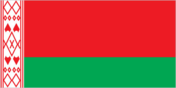
red horizontal band (top) and green horizontal band one-half the width of the red band; a white vertical stripe on the hoist side bears Belarusian national ornamentation in red; the red band color recalls past struggles from oppression, the green band represents hope and the many forests of the country
Government Type
presidential republic in name, although in fact a dictatorship
Independence
25 August 1991 (from the Soviet Union)
International Law Organization Participation
has not submitted an ICJ jurisdiction declaration; non-party state to the ICCt
International Organization Participation
BSEC (observer), CBSS (observer), CEI, CIS, CSTO, EAEC, EAEU, EAPC, EBRD, FAO, GCTU, IAEA, IBRD, ICAO, ICC (NGOs), ICRM, IDA, IFC, IFRCS, ILO, IMF, IMSO, Interpol, IOC, IOM, IPU, ISO, ITU, ITUC (NGOs), MIGA, NAM, NSG, OPCW, OSCE, PCA, PFP, SCO (dialogue member), UN, UNCTAD, UNESCO, UNIDO, UNIFIL, UNWTO, UPU, WCO, WFTU (NGOs), WHO, WIPO, WMO, WTO (observer), ZC
Judicial Branch
- Highest Courts
- Supreme Court (consists of the chairman and deputy chairman and organized into several specialized panels, including economic and military; number of judges set by the president of the republic and the court chairman); Constitutional Court (consists of 12 judges, including a chairman and deputy chairman)
- Judge Selection And Term Of Office
- Supreme Court judges appointed by the president with the consent of the Council of the Republic; judges initially appointed for 5 years and evaluated for life appointment; Constitutional Court judges - 6 appointed by the president and 6 elected by the Council of the Republic; the presiding judge directly elected by the president and approved by the Council of the Republic; judges can serve for 11 years with an age limit of 70
- Subordinate Courts
- oblast courts; Minsk City Court; town courts; Minsk city and oblast economic courts
Legal System
civil law system; note - nearly all major codes (civil, civil procedure, criminal, criminal procedure, family, and labor) were revised and came into force in 1999 and 2000
Legislative Branch
- Description
- bicameral National Assembly or Natsionalnoye Sobraniye consists of: Council of the Republic or Sovet Respubliki (64 seats; 56 members indirectly elected by regional and Minsk city councils and 8 members appointed by the president; members serve 4-year terms) House of Representatives or Palata Predstaviteley (110 seats; members directly elected in single-seat constituencies by absolute majority vote in 2 rounds if needed; members serve 4-year terms)
- Election Results
- Council of the Republic - percent of vote by party - NA; seats by party - NA; composition - NA House of Representatives - percent of vote by party - NA; seats by party - KPB 11, Republican Party of Labor and Justice 6, Belarusian Patriotic Party 2, LDP 1, AP 1, independent 89; composition - men 66, women 44, percent of women 40%; note - total National Assembly percent of women - NA
- Elections
- Council of the Republic - (indirect) election last held on 7 November 2019 House of Representatives - last held on 17 November 2019 (next to be held in 2023); OSCE observers determined that the election was neither free nor impartial and that vote counting was problematic in a number of polling stations; pro-LUKASHENKO candidates won every seat; international observers determined that the previous elections, on 28 September 2008, 23 September 2012, and 11 September 2016 also fell short of democratic standards, with pro-LUKASHENKO candidates winning every, or virtually every, seat
National Anthem
- Lyrics Music
- Mikhas KLIMKOVICH and Uladzimir KARYZNA/Nester SAKALOUSKI
- Name
- "My, Bielarusy" (We Belarusians)
National Holiday
Independence Day, 3 July (1944); note - 3 July 1944 was the date Minsk was liberated from German troops, 25 August 1991 was the date of independence from the Soviet Union
National Symbol S
no clearly defined current national symbol, the mounted knight known as Pahonia (the Chaser) is the traditional Belarusian symbol; national colors: green, red, white
Political Parties And Leaders
pro-government parties: Belarusian Agrarian Party or AP [Mikhail SHIMANSKY] Belarusian Patriotic Party [Nikolai ULAKHOVICH] Belarusian Social Sport Party [Vladimir ALEKSANDROVICH] Communist Party of Belarus or KPB [Aleksei SOKOL] Liberal Democratic Party or LDP [Sergey GAYDUKEVICH] Republican Party [Vladimir BELOZOR] Republican Party of Labor and Justice [Vasiliy ZADNEPRYANIY] Social Democratic Party of Popular Accord [Sergei YERMAK] opposition parties: Belarusian Christian Democracy Party [Paval SEVIARYNETS, Volha KAVALKOVA, Vital RYMASHEWSKI] (unregistered) Belarusian Party of the Green [Anastasiya DOROFEYEVA] Belarusian Party of the Left "Just World" [Sergey KALYAKIN] Belarusian Popular Front or BPF [Ryhor KASTUSEU] Belarusian Social-Democratic Assembly [Sergei CHERECHEN] Belarusian Social Democratic Party ("Assembly") or BSDPH [Ihar BARYSAU] Belarusian Social Democratic Party (People's Assembly) [Mikalay STATKEVICH] (unregistered) Christian Conservative Party or BPF [Zyanon PAZNYAK] United Civic Party or UCP [Nikolay KOZLOV]
Suffrage
18 years of age; universal
Economy
Agriculture Products
grain, potatoes, vegetables, sugar beets, flax; beef, milk
Budget
- Expenditures
- 20.57 billion (2017 est.)
- Revenues
- 22.15 billion (2017 est.)
Budget Surplus Or Deficit
2.9% (of GDP) (2017 est.)
Central Bank Discount Rate
- 15 March 2017
- 15%
- 19 April 2017
- 14%
Commercial Bank Prime Lending Rate
- 31 December 2016
- 14.4%
- 31 December 2017
- 9.66%
Current Account Balance
- 2016
- -$1.669 billion
- 2017
- -$931 million
Debt External
- 31 December 2016
- $37.74 billion
- 31 December 2017
- $39.92 billion
Distribution Of Family Income Gini Index
- 1998
- 21.7
- 2011
- 26.5
Economy Overview
As part of the former Soviet Union, Belarus had a relatively well-developed industrial base, but it is now outdated, inefficient, and dependent on subsidized Russian energy and preferential access to Russian markets. The country’s agricultural base is largely dependent on government subsidies. Following the collapse of the Soviet Union, an initial burst of economic reforms included privatization of state enterprises, creation of private property rights, and the acceptance of private entrepreneurship, but by 1994 the reform effort dissipated. About 80% of industry remains in state hands, and foreign investment has virtually disappeared. Several businesses have been renationalized. State-owned entities account for 70-75% of GDP, and state banks make up 75% of the banking sector.Economic output declined for several years following the break-up of the Soviet Union, but revived in the mid-2000s. Belarus has only small reserves of crude oil and imports crude oil and natural gas from Russia at subsidized, below market, prices. Belarus derives export revenue by refining Russian crude and selling it at market prices. Russia and Belarus have had serious disagreements over prices and quantities for Russian energy. Beginning in early 2016, Russia claimed Belarus began accumulating debt – reaching $740 million by April 2017 – for paying below the agreed price for Russian natural gas and Russia cut back its export of crude oil as a result of the debt. In April 2017, Belarus agreed to pay its gas debt and Russia restored the flow of crude.New non-Russian foreign investment has been limited in recent years, largely because of an unfavorable financial climate. In 2011, a financial crisis lead to a nearly three-fold devaluation of the Belarusian ruble. The Belarusian economy has continued to struggle under the weight of high external debt servicing payments and a trade deficit. In mid-December 2014, the devaluation of the Russian ruble triggered a near 40% devaluation of the Belarusian ruble.Belarus’s economy stagnated between 2012 and 2016, widening productivity and income gaps between Belarus and neighboring countries. Budget revenues dropped because of falling global prices on key Belarusian export commodities. Since 2015, the Belarusian government has tightened its macro-economic policies, allowed more flexibility to its exchange rate, taken some steps towards price liberalization, and reduced subsidized government lending to state-owned enterprises. Belarus returned to modest growth in 2017, largely driven by improvement of external conditions and Belarus issued sovereign debt for the first time since 2011, which provided the country with badly-needed liquidity, and issued $600 million worth of Eurobonds in February 2018, predominantly to US and British investors.
Exchange Rates
- 2013
- 10,224.1
- 2014
- 15,926
- 2015
- 2
- 2016
- 2
- 2017
- 1.9
- Currency
- Belarusian rubles (BYB/BYR) per US dollar -
Exports
- 2016
- $22.98 billion
- 2017
- $28.65 billion
Exports Commodities
machinery and equipment, mineral products, chemicals, metals, textiles, foodstuffs
Exports Partners
Russia 43.9%, Ukraine 11.5%, UK 8.2% (2017)
Fiscal Year
calendar year
GDP Composition By End Use
- Exports Of Goods And Services
- 67% (2017 est.)
- Government Consumption
- 14.6% (2017 est.)
- Household Consumption
- 54.8% (2017 est.)
- Imports Of Goods And Services
- -67% (2017 est.)
- Investment In Fixed Capital
- 24.9% (2017 est.)
- Investment In Inventories
- 5.7% (2017 est.)
GDP Composition By Sector Of Origin
- Agriculture
- 8.1% (2017 est.)
- Industry
- 40.8% (2017 est.)
- Services
- 51.1% (2017 est.)
GDP Official Exchange Rate
$54.44 billion (2017 est.)
GDP Per Capita Ppp
- 2015
- $19,000
- 2016
- $18,400
- 2017
- $18,900
GDP Purchasing Power Parity
- 2015
- $179.7 billion
- 2016
- $175.1 billion
- 2017
- $179.4 billion
GDP Real Growth Rate
- 2015
- -3.8%
- 2016
- -2.5%
- 2017
- 2.4%
Gross National Saving
- 2015
- 25.8% of GDP
- 2016
- 23% of GDP
- 2017
- 24.5% of GDP
Household Income Or Consumption By Percentage Share
- Highest 10
- 21.9% (2008)
- Lowest 10
- 3.8%
Imports
- 2016
- $25.61 billion
- 2017
- $31.58 billion
Imports Commodities
mineral products, machinery and equipment, chemicals, foodstuffs, metals
Imports Partners
Russia 57.2%, China 8%, Germany 5.1% (2017)
Industrial Production Growth Rate
5.6% (2017 est.)
Industries
metal-cutting machine tools, tractors, trucks, earthmovers, motorcycles, synthetic fibers, fertilizer, textiles, refrigerators, washing machines and other household appliances
Inflation Rate Consumer Prices
- 2016
- 11.8%
- 2017
- 6%
Labor Force
4.381 million (2016 est.)
Labor Force By Occupation
- Agriculture
- 9.7%
- Industry
- 23.4%
- Services
- 66.8% (2015 est.)
Market Value Of Publicly Traded Shares
NA
Population Below Poverty Line
5.7% (2016 est.)
Public Debt
- 2016
- 53.5% of GDP
- 2017
- 53.4% of GDP
Reserves Of Foreign Exchange And Gold
- 31 December 2016
- $4.927 billion
- 31 December 2017
- $7.315 billion
Stock Of Broad Money
- 31 December 2016
- $2.719 billion
- 31 December 2017
- $3.702 billion
Stock Of Direct Foreign Investment Abroad
- 31 December 2015
- $4.649 billion
- 31 December 2016
- $3.547 billion
Stock Of Direct Foreign Investment at Home
- 31 December 2015
- $7.241 billion
- 31 December 2016
- $6.929 billion
Stock Of Domestic Credit
- 31 December 2016
- $20.65 billion
- 31 December 2017
- $19.81 billion
Stock Of Narrow Money
- 31 December 2016
- $2.719 billion
- 31 December 2017
- $3.702 billion
Taxes And Other Revenues
40.7% (of GDP) (2017 est.)
Unemployment Rate
- 2016
- 1%
- 2017
- 0.8%
Energy
Carbon Dioxide Emissions From Consumption Of Energy
56.07 million Mt (2017 est.)
Crude Oil Exports
31,730 bbl/day (2015 est.)
Crude Oil Imports
468,400 bbl/day (2015 est.)
Crude Oil Production
31,000 bbl/day (2018 est.)
Crude Oil Proved Reserves
198 million bbl (1 January 2018 est.)
Electricity Access
100% (2016)
Electricity Consumption
31.72 billion kWh (2016 est.)
Electricity Exports
3.482 billion kWh (2015 est.)
Electricity From Fossil Fuels
96% of total installed capacity (2016 est.)
Electricity From Hydroelectric Plants
1% of total installed capacity (2017 est.)
Electricity From Nuclear Fuels
0% of total installed capacity (2017 est.)
Electricity From Other Renewable Sources
3% of total installed capacity (2017 est.)
Electricity Imports
6.319 billion kWh (2016 est.)
Electricity Installed Generating Capacity
10.04 million kW (2016 est.)
Electricity Production
31.58 billion kWh (2016 est.)
Natural Gas Consumption
17.7 billion cu m (2017 est.)
Natural Gas Exports
0 cu m (2017 est.)
Natural Gas Imports
17.53 billion cu m (2017 est.)
Natural Gas Production
59.46 million cu m (2017 est.)
Natural Gas Proved Reserves
2.832 billion cu m (1 January 2018 est.)
Refined Petroleum Products Consumption
141,000 bbl/day (2016 est.)
Refined Petroleum Products Exports
351,200 bbl/day (2015 est.)
Refined Petroleum Products Imports
14,630 bbl/day (2015 est.)
Refined Petroleum Products Production
477,200 bbl/day (2015 est.)
Communications
Broadband Fixed Subscriptions
- Subscriptions Per 100 Inhabitants
- 33 (2017 est.)
- Total
- 3,163,286
Broadcast Media
7 state-controlled national TV channels; Polish and Russian TV broadcasts are available in some areas; state-run Belarusian Radio operates 5 national networks and an external service; Russian and Polish radio broadcasts are available (2019)
Internet Country Code
.by
Internet Users
- Percent Of Population
- 71.1% (July 2016 est.)
- Total
- 6,805,786
Telephone System
- Domestic
- fixed-line teledensity is improving although rural areas continue to be underserved, 47 per 100 fixed-line; mobile-cellular teledensity now approaches 120 telephones per 100 persons (2018)
- General Assessment
- fiber network reaches two million establishments; trial 5G services during the first half of 2019; 10,000km of fiber cabling laid; August 2018 almost two million GPON connections (Gigabit Passive Optical Network, point-to-multi point access mechanism); 5 year plan is on track; Belarus launched its first telecoms satellite in 2016; LTE use reaches 75% of mobile subscribers (2018)
- International
- country code - 375; Belarus is landlocked and therefore a member of the Trans-European Line (TEL), Trans-Asia-Europe (TAE) fiber-optic line, and has access to the Trans-Siberia Line (TSL); 3 fiber-optic segments provide connectivity to Latvia, Poland, Russia, and Ukraine; worldwide service is available to Belarus through this infrastructure; additional analog lines to Russia; Intelsat, Eutelsat, and Intersputnik earth stations
Telephones Fixed Lines
- Subscriptions Per 100 Inhabitants
- 47 (2017 est.)
- Total Subscriptions
- 4,499,821
Telephones Mobile Cellular
- Subscriptions Per 100 Inhabitants
- 115 (2017 est.)
- Total Subscriptions
- 10,963,224
Transportation
Airports
65 (2013)
Airports With Paved Runways
- 1 524 To 2 437 M
- 4 (2017)
- 2 438 To 3 047 M
- 20 (2017)
- 914 To 1 523 M
- 1 (2017)
- Over 3 047 M
- 1 (2017)
- Total
- 33 (2017)
- Under 914 M
- 7 (2017)
Airports With Unpaved Runways
- 1 524 To 2 437 M
- 1 (2013)
- 914 To 1 523 M
- 2 (2013)
- Over 3 047 M
- 1 (2013)
- Total
- 32 (2013)
- Under 914 M
- 28 (2013)
Civil Aircraft Registration Country Code Prefix
EW (2016)
Heliports
1 (2013)
Merchant Marine
- By Type
- oil tanker 1, other 4 (2018)
- Total
- 5
National Air Transport System
- Annual Freight Traffic On Registered Air Carriers
- 1.807 million mt-km (2015)
- Annual Passenger Traffic On Registered Air Carriers
- 1,489,035 (2015)
- Inventory Of Registered Aircraft Operated By Air Carriers
- 30 (2015)
- Number Of Registered Air Carriers
- 2 (2015)
Pipelines
5386 km gas, 1589 km oil, 1730 km refined products (2013)
Ports And Terminals
Mazyr (Prypyats')
Railways
- Broad Gauge
- 5,503 km 1.520-m gauge (874 km electrified) (2014)
- Standard Gauge
- 25 km 1.435-m gauge (2014)
- Total
- 5,528 km (2014)
Roadways
86,600 km (2017)
Waterways
2,500 km (major rivers are the west-flowing Western Dvina and Neman Rivers and the south-flowing Dnepr River and its tributaries, the Berezina, Sozh, and Pripyat Rivers) (2011)
Military and Security
Military And Security Forces
Belarus Armed Forces: Army, Air and Air Defense Force, Special Operations Force (2019)
Military Expenditures
- 2014
- 1.33% of GDP
- 2015
- 1.33% of GDP
- 2016
- 1.2% of GDP
- 2017
- 0.93% of GDP
- 2018
- 1.27% of GDP
Military Service Age And Obligation
18-27 years of age for compulsory military or alternative service; conscript service obligation is 12-18 months, depending on academic qualifications, and 24-36 months for alternative service, depending on academic qualifications; 17 year olds are eligible to become cadets at military higher education institutes, where they are classified as military personnel (2016)
Transnational Issues
Disputes International
boundary demarcated with Latvia and Lithuania; as a member state that forms part of the EU's external border, Poland has implemented strict Schengen border rules to restrict illegal immigration and trade along its border with Belarus
Illicit Drugs
limited cultivation of opium poppy and cannabis, mostly for the domestic market; transshipment point for illicit drugs to and via Russia, and to the Baltics and Western Europe; a small and lightly regulated financial center; anti-money-laundering legislation does not meet international standards and was weakened further when know-your-customer requirements were curtailed in 2008; few investigations or prosecutions of money-laundering activities
Refugees And Internally Displaced Persons
6,025 (2018)
Trafficking In Persons
- Current Situation
- Belarus is a source, transit, and destination country for women, men, and children subjected to sex trafficking and forced labor; more victims are exploited within Belarus than abroad; Belarusians exploited abroad are primarily trafficked to Germany, Poland, Russian, and Turkey but also other European countries, the Middle East, Japan, Kazakhstan, and Mexico; Moldovans, Russians, Ukrainians, and Vietnamese are exploited in Belarus; state-sponsored forced labor is a continuing problem; students are forced to do farm labor without pay and military conscripts are forced to perform unpaid non-military work; the government has retained a decree forbidding workers in state-owned wood processing factories from leaving their jobs without their employers’ permission
- Tier Rating
- Tier 3 – Belarus does not fully comply with the minimum standards for the elimination of trafficking and was placed on Tier 3 after being on the Tier 2 Watch List for two consecutive years without making progress; government efforts to repeal state-sponsored forced labor policies and domestic trafficking were inadequate; no trafficking offenders were convicted in 2014, and the number of investigations progressively declined from 2005-14; efforts to protect trafficking victims remain insufficient, with no identification and referral mechanism in place; care facilities were not trafficking-specific and were poorly equipped, leading most victims to seek assistance from private shelters (2015)