2011 Edition
CIA World Factbook 2011 Archive (HTML)
Introduction
Background
After seven decades as a constituent republic of the USSR, Belarus attained its independence in 1991. It has retained closer political and economic ties to Russia than any of the other former Soviet republics. Belarus and Russia signed a treaty on a two-state union on 8 December 1999 envisioning greater political and economic integration. Although Belarus agreed to a framework to carry out the accord, serious implementation has yet to take place. Since his election in July 1994 as the country's first president, Aleksandr LUKASHENKO has steadily consolidated his power through authoritarian means. Government restrictions on freedom of speech and the press, peaceful assembly, and religion remain in place.
Geography
Area
- 207,600 sq km 202,900 sq km 4,700 sq km
- total
- 207,600 sq km
- water
- 4,700 sq km
Area - comparative
slightly smaller than Kansas
Climate
cold winters, cool and moist summers; transitional between continental and maritime
Coastline
0 km (landlocked)
Elevation extremes
- Nyoman River 90 m Dzyarzhynskaya Hara 346 m
- highest point
- Dzyarzhynskaya Hara 346 m
- lowest point
- Nyoman River 90 m
Environment - current issues
soil pollution from pesticide use; southern part of the country contaminated with fallout from 1986 nuclear reactor accident at Chornobyl' in northern Ukraine
Environment - international agreements
- Air Pollution, Air Pollution-Nitrogen Oxides, Air Pollution-Sulfur 85, Biodiversity, Climate Change, Climate Change-Kyoto Protocol, Desertification, Endangered Species, Environmental Modification, Hazardous Wastes, Law of the Sea, Marine Dumping, Ozone Layer Protection, Ship Pollution, Wetlands none of the selected agreements
- party to
- Air Pollution, Air Pollution-Nitrogen Oxides, Air Pollution-Sulfur 85, Biodiversity, Climate Change, Climate Change-Kyoto Protocol, Desertification, Endangered Species, Environmental Modification, Hazardous Wastes, Law of the Sea, Marine Dumping, Ozone Layer Protection, Ship Pollution, Wetlands
- signed, but not ratified
- none of the selected agreements
Freshwater withdrawal (domestic/industrial/agricultural)
- 2.79 cu km/yr (23%/47%/30%) 286 cu m/yr (2000)
- per capita
- 286 cu m/yr (2000)
- total
- 2.79 cu km/yr (23%/47%/30%)
Geographic coordinates
53 00 N, 28 00 E
Geography - note
landlocked; glacial scouring accounts for the flatness of Belarusian terrain and for its 11,000 lakes
Irrigated land
1,310 sq km (2008)
Land boundaries
- 3,306 km Latvia 171 km, Lithuania 680 km, Poland 605 km, Russia 959 km, Ukraine 891 km
- border countries
- Latvia 171 km, Lithuania 680 km, Poland 605 km, Russia 959 km, Ukraine 891 km
- total
- 3,306 km
Land use
- 26.77% 0.6% 72.63% (2005)
- arable land
- 26.77%
- other
- 72.63% (2005)
- permanent crops
- 0.6%
Location
Eastern Europe, east of Poland
Map references
Europe
Maritime claims
none (landlocked)
Natural hazards
NA
Natural resources
timber, peat deposits, small quantities of oil and natural gas, granite, dolomitic limestone, marl, chalk, sand, gravel, clay
Terrain
generally flat and contains much marshland
Total renewable water resources
58 cu km (1997)
People and Society
Age structure
- 14.2% (male 699,048/female 660,130) 71.7% (male 3,328,548/female 3,542,359) 14.1% (male 427,086/female 920,381) (2011 est.)
- 0-14 years
- 14.2% (male 699,048/female 660,130)
- 15-64 years
- 71.7% (male 3,328,548/female 3,542,359)
- 65 years and over
- 14.1% (male 427,086/female 920,381) (2011 est.)
Birth rate
9.76 births/1,000 population (2011 est.)
Children under the age of 5 years underweight
1.3% (2005)
Death rate
13.77 deaths/1,000 population (July 2011 est.)
Drinking water source
- urban: 100% of population rural: 100% of population total: 100% of population (2008)
- rural
- 100% of population
- total
- 100% of population (2008)
- urban
- 100% of population
Education expenditures
4.5% of GDP (2009)
Ethnic groups
Belarusian 81.2%, Russian 11.4%, Polish 3.9%, Ukrainian 2.4%, other 1.1% (1999 census)
Health expenditures
5.8% of GDP (2009)
HIV/AIDS - adult prevalence rate
0.3% (2009 est.)
HIV/AIDS - deaths
fewer than 1,000 (2009 est.)
HIV/AIDS - people living with HIV/AIDS
17,000 (2009 est.)
Hospital bed density
11.23 beds/1,000 population (2007)
Infant mortality rate
- 6.25 deaths/1,000 live births 7.24 deaths/1,000 live births 5.19 deaths/1,000 live births (2011 est.)
- female
- 5.19 deaths/1,000 live births (2011 est.)
- total
- 6.25 deaths/1,000 live births
Languages
Belarusian (official) 36.7%, Russian (official) 62.8%, other 0.5% (includes small Polish- and Ukrainian-speaking minorities) (1999 census)
Life expectancy at birth
- 71.2 years 65.57 years 77.18 years (2011 est.)
- female
- 77.18 years (2011 est.)
- total population
- 71.2 years
Literacy
- age 15 and over can read and write 99.6% 99.8% 99.4% (1999 census)
- definition
- age 15 and over can read and write
- female
- 99.4% (1999 census)
- male
- 99.8%
- total population
- 99.6%
Major cities - population
MINSK (capital) 1.837 million (2009)
Maternal mortality rate
15 deaths/100,000 live births (2008)
Median age
- 39 years 36.1 years 42.1 years (2011 est.)
- female
- 42.1 years (2011 est.)
- male
- 36.1 years
- total
- 39 years
Nationality
- Belarusian(s) Belarusian
- adjective
- Belarusian
- noun
- Belarusian(s)
Net migration rate
0.38 migrant(s)/1,000 population (2011 est.)
Physicians density
4.869 physicians/1,000 population (2007)
Population
9,577,552 (July 2011 est.)
Population growth rate
-0.363% (2011 est.)
Religions
Eastern Orthodox 80%, other (including Roman Catholic, Protestant, Jewish, and Muslim) 20% (1997 est.)
Sanitation facility access
- urban: 91% of population rural: 97% of population total: 93% of population urban: 9% of population rural: 3% of population total: 7% of population (2008)
- rural
- 3% of population
- total
- 7% of population (2008)
- urban
- 9% of population
School life expectancy (primary to tertiary education)
- 15 years 14 years 15 years (2007)
- female
- 15 years (2007)
- male
- 14 years
- total
- 15 years
Sex ratio
- 1.062 male(s)/female 1.06 male(s)/female 0.94 male(s)/female 0.47 male(s)/female 0.87 male(s)/female (2011 est.)
- 15-64 years
- 0.94 male(s)/female
- 65 years and over
- 0.47 male(s)/female
- at birth
- 1.062 male(s)/female
- total population
- 0.87 male(s)/female (2011 est.)
- under 15 years
- 1.06 male(s)/female
Total fertility rate
1.26 children born/woman (2011 est.)
Urbanization
- 75% of total population (2010) 0.1% annual rate of change (2010-15 est.)
- rate of urbanization
- 0.1% annual rate of change (2010-15 est.)
- urban population
- 75% of total population (2010)
Government
Administrative divisions
6 provinces (voblastsi, singular - voblasts') and 1 municipality* (horad); Brest, Homyel' (Gomel), Horad Minsk* (Minsk City), Hrodna (Grodno), Mahilyow (Mogilev), Minsk, Vitsyebsk (Vitebsk) administrative divisions have the same names as their administrative centers; Russian spelling provided for reference when different from Belarusian
Capital
- Minsk 53 54 N, 27 34 E UTC+2 (7 hours ahead of Washington, DC during Standard Time) +1hr, begins last Sunday in March and will continue throughout 2011
- daylight saving time
- +1hr, begins last Sunday in March and will continue throughout 2011
- geographic coordinates
- 53 54 N, 27 34 E
- name
- Minsk
- time difference
- UTC+2 (7 hours ahead of Washington, DC during Standard Time)
Constitution
15 March 1994; revised by national referendum 24 November 1996 giving the presidency greatly expanded powers; became effective 27 November 1996; revised again 17 October 2004 removing presidential term limits
Country name
- Republic of Belarus Belarus Respublika Byelarus' Byelarus' Belorussian (Byelorussian) Soviet Socialist Republic
- conventional long form
- Republic of Belarus
- conventional short form
- Belarus
- former
- Belorussian (Byelorussian) Soviet Socialist Republic
- local long form
- Respublika Byelarus'
- local short form
- Byelarus'
Diplomatic representation from the US
- Ambassador (vacant); Charge d'Affaires Michael SCANLAN 46 Starovilenskaya Street, Minsk 220002 PSC 78, Box B Minsk, APO 09723 [375] (17) 210-12-83, 217-7347 through 7348 [375] (17) 334-7853
- chief of mission
- Ambassador (vacant); Charge d'Affaires Michael SCANLAN
- embassy
- 46 Starovilenskaya Street, Minsk 220002
- FAX
- [375] (17) 334-7853
- mailing address
- PSC 78, Box B Minsk, APO 09723
- telephone
- [375] (17) 210-12-83, 217-7347 through 7348
Diplomatic representation in the US
- Ambassador (vacant); Charge d'Affaires Oleg KRAVCHENKO 1619 New Hampshire Avenue NW, Washington, DC 20009 [1] (202) 986-1604 [1] (202) 986-1805 New York
- chancery
- 1619 New Hampshire Avenue NW, Washington, DC 20009
- chief of mission
- Ambassador (vacant); Charge d'Affaires Oleg KRAVCHENKO
- consulate(s) general
- New York
- FAX
- [1] (202) 986-1805
- telephone
- [1] (202) 986-1604
Executive branch
- President Aleksandr LUKASHENKO (since 20 July 1994) Prime Minister Mikhail MYASNIKOVICH (since 28 December 2010); First Deputy Prime Minister Vladimir SEMASHKO (since December 2003) Council of Ministers president elected by popular vote for a five-year term; first election took place on 23 June and 10 July 1994; according to the 1994 constitution, the next election should have been held in 1999, however, Aleksandr LUKASHENKO extended his term to 2001 via a November 1996 referendum; subsequent election held on 9 September 2001; an October 2004 referendum ended presidential term limits and allowed the president to run in a third (19 March 2006) and fourth election (19 December 2010); prime minister and deputy prime ministers appointed by the president Aleksandr LUKASHENKO reelected president; percent of vote - Aleksandr LUKASHENKO 79.7%, Andrey SANNIKAU 2.6%, other candidates 17.7%; note - election marred by electoral fraud
- cabinet
- Council of Ministers
- chief of state
- President Aleksandr LUKASHENKO (since 20 July 1994)
- election results
- Aleksandr LUKASHENKO reelected president; percent of vote - Aleksandr LUKASHENKO 79.7%, Andrey SANNIKAU 2.6%, other candidates 17.7%; note - election marred by electoral fraud
- elections
- president elected by popular vote for a five-year term; first election took place on 23 June and 10 July 1994; according to the 1994 constitution, the next election should have been held in 1999, however, Aleksandr LUKASHENKO extended his term to 2001 via a November 1996 referendum; subsequent election held on 9 September 2001; an October 2004 referendum ended presidential term limits and allowed the president to run in a third (19 March 2006) and fourth election (19 December 2010); prime minister and deputy prime ministers appointed by the president
- head of government
- Prime Minister Mikhail MYASNIKOVICH (since 28 December 2010); First Deputy Prime Minister Vladimir SEMASHKO (since December 2003)
Flag description
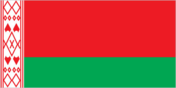
red horizontal band (top) and green horizontal band one-half the width of the red band; a white vertical stripe on the hoist side bears Belarusian national ornamentation in red; the red band color recalls past struggles from oppression, the green band represents hope and the many forests of the country
Government type
republic in name, although in fact a dictatorship
Independence
25 August 1991 (from the Soviet Union)
International law organization participation
has not submitted an ICJ jurisdiction declaration; non-party state to the ICCt
International organization participation
BSEC (observer), CBSS (observer), CEI, CIS, CSTO, EAEC, EAPC, EBRD, FAO, GCTU, IAEA, IBRD, ICAO, ICRM, IDA, IFC, IFRCS, ILO, IMF, IMSO, Interpol, IOC, IOM, IPU, ISO, ITU, ITUC, MIGA, NAM, NSG, OPCW, OSCE, PCA, PFP, SCO (dialogue member), UN, UNCTAD, UNESCO, UNIDO, UNWTO, UPU, WCO, WFTU, WHO, WIPO, WMO, WTO (observer), ZC
Judicial branch
Supreme Court (judges are appointed by the president); Constitutional Court (half of the judges appointed by the president and half appointed by the Chamber of Representatives)
Legal system
civil law system; note - nearly all major codes (civil, civil procedure, criminal, criminal procedure, family and labor) have been revised and came into force in 1999 or 2000
Legislative branch
- bicameral National Assembly or Natsionalnoye Sobraniye consists of the Council of the Republic or Sovet Respubliki (64 seats; 56 members elected by regional and Minsk city councils and 8 members appointed by the president, to serve four-year terms) and the Chamber of Representatives or Palata Predstaviteley (110 seats; members elected by popular vote to serve four-year terms) Palata Predstaviteley - last held on 28 September 2008 (next to be held in the spring of 2012); international observers determined that despite minor improvements the election ultimately fell short of democratic standards; pro-LUKASHENKO candidates won every seat Sovet Respubliki - percent of vote by party - NA; seats by party - NA; Palata Predstaviteley - percent of vote by party - NA; seats by party - KPB 6, AP 1, no affiliation 103
- election results
- Sovet Respubliki - percent of vote by party - NA; seats by party - NA; Palata Predstaviteley - percent of vote by party - NA; seats by party - KPB 6, AP 1, no affiliation 103
- elections
- Palata Predstaviteley - last held on 28 September 2008 (next to be held in the spring of 2012); international observers determined that despite minor improvements the election ultimately fell short of democratic standards; pro-LUKASHENKO candidates won every seat
National anthem
- "My, Bielarusy" (We Belarusians) Mikhas KLIMKOVICH and Uladzimir KARYZNA/Nester SAKALOUSKI music adopted 1955, lyrics adopted 2002; after the fall of the Soviet Union, Belarus kept the music of its Soviet-era anthem but adopted new lyrics; also known as "Dziarzauny himn Respubliki Bielarus" (State Anthem of the Republic of Belarus)
- lyrics/music
- Mikhas KLIMKOVICH and Uladzimir KARYZNA/Nester SAKALOUSKI
- name
- "My, Bielarusy" (We Belarusians)
National holiday
Independence Day, 3 July (1944); note - 3 July 1944 was the date Minsk was liberated from German troops, 25 August 1991 was the date of independence from the Soviet Union
National symbol(s)
mounted knight known as Pahonia (the Chaser)
Political parties and leaders
- Belarusian Agrarian Party or AP [Mikhail SHIMANSKY]; Belarusian Patriotic Movement (Belarusian Patriotic Party) or BPR [Nikolay ULAKHOVICH, chairman]; Communist Party of Belarus or KPB [Tatsyana HOLUBEVA]; Liberal Democratic Party or LDP [Sergey GAYDUKEVICH]; Republican Party of Labor and Justice [Vasiliy ZADNEPRYANYY] Belarusian Christian Democracy Party [Pavel SEVERINETS] (unregistered); Belarusian Party of Communists or PKB [Sergey KALYAKIN]; Belarusian Party of Labor [Aleksandr BUKHVOSTOV] (unregistered); Belarusian Popular Front or BPF [Aleksey YANUKEVICH]; Belarusian Social-Democratic Hramada [Stanislav SHUSHKEVICH]; Belarusian Social Democratic Party Hramada ("Assembly") or BSDPH [Anatoliy LEVKOVICH]; Belarusian Social Democratic Party People's Assembly ("Narodnaya Hramada") [Nikolay STATKEVICH] (unregistered); Belarusian Women's Party Nadzeya ("Hope") [Yelena YESKOVA, chairperson]; Christian Conservative Party or BPF [Zyanon PAZNIAK]; European Belarus Campaign [Andrey SANNIKOV]; Party of Freedom and Progress [Vladimir NOVOSYAD] (unregistered); "Tell the Truth" Campaign [Vladimir NEKLYAYEV]; United Civic Party or UCP [Anatoliy LEBEDKO]
- opposition parties
- Belarusian Christian Democracy Party [Pavel SEVERINETS] (unregistered); Belarusian Party of Communists or PKB [Sergey KALYAKIN]; Belarusian Party of Labor [Aleksandr BUKHVOSTOV] (unregistered); Belarusian Popular Front or BPF [Aleksey YANUKEVICH]; Belarusian Social-Democratic Hramada [Stanislav SHUSHKEVICH]; Belarusian Social Democratic Party Hramada ("Assembly") or BSDPH [Anatoliy LEVKOVICH]; Belarusian Social Democratic Party People's Assembly ("Narodnaya Hramada") [Nikolay STATKEVICH] (unregistered); Belarusian Women's Party Nadzeya ("Hope") [Yelena YESKOVA, chairperson]; Christian Conservative Party or BPF [Zyanon PAZNIAK]; European Belarus Campaign [Andrey SANNIKOV]; Party of Freedom and Progress [Vladimir NOVOSYAD] (unregistered); "Tell the Truth" Campaign [Vladimir NEKLYAYEV]; United Civic Party or UCP [Anatoliy LEBEDKO]
- pro-government parties
- Belarusian Agrarian Party or AP [Mikhail SHIMANSKY]; Belarusian Patriotic Movement (Belarusian Patriotic Party) or BPR [Nikolay ULAKHOVICH, chairman]; Communist Party of Belarus or KPB [Tatsyana HOLUBEVA]; Liberal Democratic Party or LDP [Sergey GAYDUKEVICH]; Republican Party of Labor and Justice [Vasiliy ZADNEPRYANYY]
Political pressure groups and leaders
Assembly of Pro-Democratic NGOs (unregistered) [Sergey MATSKEVICH]; Belarusian Congress of Democratic Trade Unions [Aleksandr YAROSHUK]; Belarusian Association of Journalists [Zhana LITVINA]; Belarusian Helsinki Committee [Aleh HULAK]; Belarusian Independence Bloc (unregistered) and For Freedom movement [Aleksandr MILINKEVICH]; Belarusian Organization of Working Women [Irina ZHIKHAR]; BPF-Youth [Andrus KRECHKA]; Charter 97 (unregistered) [Andrey SANNIKOV]; Perspektiva small business association [Anatol SHUMCHENKO]; Nasha Vyasna (unregistered) ("Our Spring") human rights center; "Tell the Truth" Movement [Vladimir NEKLYAYEV]; Women's Independent Democratic Movement [Ludmila PETINA]; Young Belarus (Malady Belarus) [Zmitser KASPYAROVICH]; Youth Front (Malady Front) [Zmitser DASHKEVICH]
Suffrage
18 years of age; universal
Economy
Agriculture - products
grain, potatoes, vegetables, sugar beets, flax; beef, milk
Budget
- $23.59 billion $24.7 billion (2010 est.)
- expenditures
- $24.7 billion (2010 est.)
- revenues
- $23.59 billion
Budget surplus (+) or deficit (-)
-2% of GDP (2010 est.)
Central bank discount rate
10.5% (31 December 2010 est.) 13.5% (31 December 2009 est.)
Commercial bank prime lending rate
9.217% (31 December 2010 est.) 11.675% (31 December 2009 est.)
Current account balance
-$8.5 billion (2010 est.) -$6.39 billion (2009 est.)
Debt - external
$33.1 billion (30 June 2011 est.) $22.13 billion (31 December 2010 est.)
Distribution of family income - Gini index
27.2 (2008) 21.7 (1998)
Economy - overview
Belarus has seen limited structural reform since 1995, when President LUKASHENKO launched the country on the path of "market socialism." In keeping with this policy, LUKASHENKO reimposed administrative controls over prices and currency exchange rates and expanded the state's right to intervene in the management of private enterprises. Since 2005, the government has re-nationalized a number of private companies. In addition, businesses have been subjected to pressure by central and local governments, including arbitrary changes in regulations, numerous rigorous inspections, retroactive application of new business regulations, and arrests of "disruptive" businessmen and factory owners. Continued state control over economic operations hampers market entry for businesses, both domestic and foreign. Government statistics indicate GDP growth was strong, surpassing 10% in 2008, despite the roadblocks of a tough, centrally directed economy with a high rate of inflation and a low rate of unemployment. However, the global crisis pushed the country into recession in 2009, and GDP grew only 0.2% for the year. Slumping foreign demand hit the industrial sector hard. Minsk has depended on a standby-agreement with the IMF to assist with balance of payments shortfalls. In line with IMF conditions, in 2009, Belarus devalued the ruble more than 40% and tightened some fiscal and monetary policies. On 1 January 2010, Russia, Kazakhstan and Belarus launched a customs union, with unified trade regulations and customs codes still under negotiation. In late January, Russia and Belarus amended their 2007 oil supply agreement. The new terms raised prices for above quota purchases, increasing Belarus' current account deficit. GDP grew 4.8% in 2010, in part, on the strength of renewed export growth. In December 2010, Belarus, Russia and Kazakhstan signed an agreement to form a Common Economic Space and Russia removed all Belarusian oil duties.
Electricity - consumption
31.07 billion kWh (2008 est.)
Electricity - exports
5.245 billion kWh (2008 est.)
Electricity - imports
1.84 billion kWh (2008 est.)
Electricity - production
32.95 billion kWh (2008 est.)
Exchange rates
Belarusian rubles (BYB/BYR) per US dollar - 3,019.9 (2010) 2,789.49 (2009) 2,130 (2008) 2,145 (2007) 2,144.6 (2006)
Exports
$25.35 billion (2010 est.) $21.36 billion (2009 est.)
Exports - commodities
machinery and equipment, mineral products, chemicals, metals, textiles, foodstuffs
Exports - partners
Russia 38.9%, Netherlands 11%, Ukraine 10.2% (2010)
GDP - composition by sector
- 9.5% 44.8% 45.8% (2010 est.)
- agriculture
- 9.5%
- industry
- 44.8%
- services
- 45.8% (2010 est.)
GDP - per capita (PPP)
$13,600 (2010 est.) $12,600 (2009 est.) $12,600 (2008 est.) data are in 2010 US dollars
GDP - real growth rate
7.6% (2010 est.) 0.2% (2009 est.) 10.2% (2008 est.)
GDP (official exchange rate)
$54.71 billion (2010 est.)
GDP (purchasing power parity)
$131.2 billion (2010 est.) $121.9 billion (2009 est.) $121.7 billion (2008 est.) data are in 2010 US dollars
Household income or consumption by percentage share
- 3.8% 21.9% (2008)
- highest 10%
- 21.9% (2008)
- lowest 10%
- 3.8%
Imports
$34.47 billion (2010 est.) $28.32 billion (2009 est.)
Imports - commodities
mineral products, machinery and equipment, chemicals, foodstuffs, metals
Imports - partners
Russia 51.8%, Germany 6.8%, Ukraine 5.4%, China 4.8% (2010)
Industrial production growth rate
10.5% (2010 est.)
Industries
metal-cutting machine tools, tractors, trucks, earthmovers, motorcycles, televisions, synthetic fibers, fertilizer, textiles, radios, refrigerators
Inflation rate (consumer prices)
7.8% (2010 est.) 12.9% (2009 est.)
Investment (gross fixed)
36.6% of GDP (2010 est.)
Labor force
5 million (2009)
Labor force - by occupation
- 14% 34.7% 51.3% (2003 est.)
- agriculture
- 14%
- industry
- 34.7%
- services
- 51.3% (2003 est.)
Market value of publicly traded shares
$NA
Natural gas - consumption
17.75 billion cu m (2009 est.)
Natural gas - exports
0 cu m (2009 est.)
Natural gas - imports
17.6 billion cu m (2009 est.)
Natural gas - production
150 million cu m (2009 est.)
Natural gas - proved reserves
2.832 billion cu m (1 January 2011 est.)
Oil - consumption
163,000 bbl/day (2010 est.)
Oil - exports
310,500 bbl/day (2009 est.)
Oil - imports
471,400 bbl/day (2009 est.)
Oil - production
31,010 bbl/day (2010 est.)
Oil - proved reserves
198 million bbl (1 January 2011 est.)
Population below poverty line
27.1% (2003 est.)
Reserves of foreign exchange and gold
$3.431 billion (31 December 2010 est.) $4.831 billion (31 December 2009 est.)
Stock of broad money
$16.75 billion (31 December 2010 est.) $13.31 billion (31 December 2009 est.)
Stock of domestic credit
$25.25 billion (31 December 2010 est.) $16.55 billion (31 December 2009 est.)
Stock of narrow money
$4.554 billion (31 December 2010 est.) $3.949 billion (31 December 2009 est.)
Taxes and other revenues
43.1% of GDP (2010 est.)
Unemployment rate
1% (2009 est.) 1.6% (2005) official registered unemployed; large number of underemployed workers
Communications
Broadcast media
4 state-controlled national TV channels; Polish and Russian TV broadcasts are available in some areas; state-run Belarusian Radio operates 3 national networks and an external service; Russian and Polish radio broadcasts are available (2007)
Internet country code
.by
Internet hosts
147,311 (2010)
Internet users
2.643 million (2009)
Telephone system
- Belarus lags behind its neighbors in upgrading telecommunications infrastructure; modernization of the network progressing with roughly two-thirds of switching equipment now digital state-owned Beltelcom is the sole provider of fixed-line local and long distance service; fixed-line teledensity is improving although rural areas continue to be underserved; multiple GSM mobile-cellular networks are experiencing rapid growth; mobile-cellular teledensity now exceeds 100 telephones per 100 persons country code - 375; Belarus is a member of the Trans-European Line (TEL), Trans-Asia-Europe (TAE) fiber-optic line, and has access to the Trans-Siberia Line (TSL); 3 fiber-optic segments provide connectivity to Latvia, Poland, Russia, and Ukraine; worldwide service is available to Belarus through this infrastructure; additional analog lines to Russia; Intelsat, Eutelsat, and Intersputnik earth stations (2008)
- domestic
- state-owned Beltelcom is the sole provider of fixed-line local and long distance service; fixed-line teledensity is improving although rural areas continue to be underserved; multiple GSM mobile-cellular networks are experiencing rapid growth; mobile-cellular teledensity now exceeds 100 telephones per 100 persons
- general assessment
- Belarus lags behind its neighbors in upgrading telecommunications infrastructure; modernization of the network progressing with roughly two-thirds of switching equipment now digital
- international
- country code - 375; Belarus is a member of the Trans-European Line (TEL), Trans-Asia-Europe (TAE) fiber-optic line, and has access to the Trans-Siberia Line (TSL); 3 fiber-optic segments provide connectivity to Latvia, Poland, Russia, and Ukraine; worldwide service is available to Belarus through this infrastructure; additional analog lines to Russia; Intelsat, Eutelsat, and Intersputnik earth stations (2008)
Telephones - main lines in use
4.139 million (2010)
Telephones - mobile cellular
10.333 million (2010)
Transportation
Airports
67 (2010)
Airports - with paved runways
- 7 (2010)
- 1,524 to 2,437 m
- 3
- 2,438 to 3,047 m
- 22
- 914 to 1,523 m
- 1
- over 3,047 m
- 2
- total
- 35
- under 914 m
- 7 (2010)
Airports - with unpaved runways
- 27 (2010)
- 1,524 to 2,437 m
- 1
- 2,438 to 3,047 m
- 2
- 914 to 1,523 m
- 2
- total
- 32
- under 914 m
- 27 (2010)
Heliports
1 (2010)
Pipelines
gas 5,250 km; oil 1,528 km; refined products 1,730 km (2010)
Ports and terminals
Mazyr
Railways
- 5,537 km 5,512 km 1.520-m gauge (874 km electrified) 25 km 1.435-m gauge (2010)
- standard gauge
- 25 km 1.435-m gauge (2010)
- total
- 5,537 km
Roadways
- 94,797 km 84,028 km 10,769 km (2005)
- total
- 94,797 km
- unpaved
- 10,769 km (2005)
Waterways
2,500 km (use limited by its location on the perimeter of the country and by its shallowness) (2003)
Military and Security
Manpower available for military service
- 2,401,785 2,429,653 (2010 est.)
- females age 16-49
- 2,429,653 (2010 est.)
- males age 16-49
- 2,401,785
Manpower fit for military service
- 1,693,626 2,012,401 (2010 est.)
- females age 16-49
- 2,012,401 (2010 est.)
- males age 16-49
- 1,693,626
Manpower reaching militarily significant age annually
- 51,855 48,760 (2010 est.)
- female
- 48,760 (2010 est.)
- male
- 51,855
Military branches
- Belarus Armed Forces: Land Force, Air and Air Defense Force, Special Operations Force (2011)
- Belarus Armed Forces
- Land Force, Air and Air Defense Force, Special Operations Force (2011)
Military expenditures
1.4% of GDP (2005 est.)
Military service age and obligation
18-27 years of age for compulsory military service; conscript service obligation - 12-18 months, depending on academic qualifications (2010)
Transnational Issues
Disputes - international
boundary demarcated with Latvia and Lithuania; Poland seeks enhanced demarcation and security along this Schengen hard border with financial assistance from the EU
Illicit drugs
limited cultivation of opium poppy and cannabis, mostly for the domestic market; transshipment point for illicit drugs to and via Russia, and to the Baltics and Western Europe; a small and lightly regulated financial center; anti-money-laundering legislation does not meet international standards and was weakened further when know-your-customer requirements were curtailed in 2008; few investigations or prosecutions of money-laundering activities (2008)
Trafficking in persons
- Belarus is a source, destination, and transit country for women, men, and children subjected to sex trafficking and forced labor; women and children are subjected to sex trafficking in Russia, Germany, Poland, the Czech Republic, Lithuania, Spain, Greece, Belgium, Turkey, Israel, Lebanon, Egypt, the United Arab Emirates, and within Belarus; Belarusian men, women, and children are found in forced begging, as well as in forced labor in the construction industry and other sectors in Russia and Belarus Tier 2 Watch List - the government did not demonstrate evidence of increasing anti-trafficking efforts; instead, it weakened victim protection efforts and prosecuted and convicted fewer trafficking offenders than in previous years; however, the government did conduct anti-trafficking prevention campaigns jointly with NGOs, identifying a number of victims of trafficking, and providing limited in-kind assistance to anti-trafficking NGOs (2011)
- current situation
- Belarus is a source, destination, and transit country for women, men, and children subjected to sex trafficking and forced labor; women and children are subjected to sex trafficking in Russia, Germany, Poland, the Czech Republic, Lithuania, Spain, Greece, Belgium, Turkey, Israel, Lebanon, Egypt, the United Arab Emirates, and within Belarus; Belarusian men, women, and children are found in forced begging, as well as in forced labor in the construction industry and other sectors in Russia and Belarus
- tier rating
- Tier 2 Watch List - the government did not demonstrate evidence of increasing anti-trafficking efforts; instead, it weakened victim protection efforts and prosecuted and convicted fewer trafficking offenders than in previous years; however, the government did conduct anti-trafficking prevention campaigns jointly with NGOs, identifying a number of victims of trafficking, and providing limited in-kind assistance to anti-trafficking NGOs (2011)