2009 Edition
CIA World Factbook 2009 (Project Gutenberg)
Introduction
Background
After seven decades as a constituent republic of the USSR, Belarus attained its independence in 1991. It has retained closer political and economic ties to Russia than any of the other former Soviet republics. Belarus and Russia signed a treaty on a two-state union on 8 December 1999 envisioning greater political and economic integration. Although Belarus agreed to a framework to carry out the accord, serious implementation has yet to take place. Since his election in July 1994 as the country's first president, Aleksandr LUKASHENKO has steadily consolidated his power through authoritarian means. Government restrictions on freedom of speech and the press, peaceful assembly, and religion remain in place.
Geography
Area
total: 207,600 sq km country comparison to the world: 85 land: 202,900 sq km water: 4,700 sq km
Area - comparative
slightly smaller than Kansas
Climate
cold winters, cool and moist summers; transitional between continental and maritime
Coastline
0 km (landlocked)
Elevation extremes
lowest point: Nyoman River 90 m highest point: Dzyarzhynskaya Hara 346 m
Environment - current issues
soil pollution from pesticide use; southern part of the country contaminated with fallout from 1986 nuclear reactor accident at Chornobyl' in northern Ukraine
Environment - international agreements
party to: Air Pollution, Air Pollution-Nitrogen Oxides, Air Pollution-Sulfur 85, Biodiversity, Climate Change, Climate Change-Kyoto Protocol, Desertification, Endangered Species, Environmental Modification, Hazardous Wastes, Law of the Sea, Marine Dumping, Ozone Layer Protection, Ship Pollution, Wetlands signed, but not ratified: none of the selected agreements
Freshwater withdrawal (domestic/industrial/agricultural)
total: 2.79 cu km/yr (23%/47%/30%) per capita: 286 cu m/yr (2000)
Geographic coordinates
53 00 N, 28 00 E
Geography - note
landlocked; glacial scouring accounts for the flatness of Belarusian terrain and for its 11,000 lakes
Irrigated land
1,310 sq km (2003)
Land boundaries
total: 3,306 km border countries: Latvia 171 km, Lithuania 680 km, Poland 605 km, Russia 959 km, Ukraine 891 km
Land use
arable land: 26.77% permanent crops: 0.6% other: 72.63% (2005)
Location
Eastern Europe, east of Poland
Map references
Europe
Maritime claims
none (landlocked)
Natural hazards
NA
Natural resources
forests, peat deposits, small quantities of oil and natural gas, granite, dolomitic limestone, marl, chalk, sand, gravel, clay
Terrain
generally flat and contains much marshland
Total renewable water resources
58 cu km (1997)
People and Society
Age structure
0-14 years: 14.3% (male 707,550/female 667,560) 15-64 years: 71.3% (male 3,337,253/female 3,540,916) 65 years and over: 14.5% (male 446,746/female 948,508) (2009 est.)
Birth rate
9.71 births/1,000 population (2009 est.) country comparison to the world: 199
Death rate
13.86 deaths/1,000 population (July 2009 est.) country comparison to the world: 24
Education expenditures
6.1% of GDP (2006) country comparison to the world: 39
Ethnic groups
Belarusian 81.2%, Russian 11.4%, Polish 3.9%, Ukrainian 2.4%, other 1.1% (1999 census)
HIV/AIDS - adult prevalence rate
0.2% (2007 est.) country comparison to the world: 104
HIV/AIDS - deaths
1,100 (2007 est.) country comparison to the world: 69
HIV/AIDS - people living with HIV/AIDS
13,000 (2007 est.) country comparison to the world: 91
Infant mortality rate
total: 6.43 deaths/1,000 live births country comparison to the world: 177 male: 7.45 deaths/1,000 live births female: 5.36 deaths/1,000 live births (2009 est.)
Languages
Belarusian, Russian, other
Life expectancy at birth
total population: 70.63 years country comparison to the world: 141 male: 64.95 years female: 76.67 years (2009 est.)
Literacy
definition: age 15 and over can read and write total population: 99.6% male: 99.8% female: 99.4% (1999 census)
Median age
total: 38.6 years male: 35.6 years female: 41.6 years (2009 est.)
Nationality
noun: Belarusian(s) adjective: Belarusian
Net migration rate
0.38 migrant(s)/1,000 population (2009 est.) country comparison to the world: 67
Population
9,648,533 (July 2009 est.) country comparison to the world: 86
Population growth rate
-0.378% (2009 est.) country comparison to the world: 224
Religions
Eastern Orthodox 80%, other (including Roman Catholic, Protestant, Jewish, and Muslim) 20% (1997 est.)
School life expectancy (primary to tertiary education)
total: 15 years male: 14 years female: 15 years (2006)
Sex ratio
at birth: 1.06 male(s)/female under 15 years: 1.06 male(s)/female 15-64 years: 0.94 male(s)/female 65 years and over: 0.47 male(s)/female total population: 0.87 male(s)/female (2009 est.)
Total fertility rate
1.24 children born/woman (2009 est.) country comparison to the world: 213
Urbanization
urban population: 73% of total population (2008) rate of urbanization: 0% annual rate of change (2005-10 est.)
Government
Administrative divisions
6 provinces (voblastsi, singular - voblasts') and 1 municipality* (horad); Brest, Homyel', Horad Minsk*, Hrodna, Mahilyow, Minsk, Vitsyebsk note: administrative divisions have the same names as their administrative centers
Capital
name: Minsk geographic coordinates: 53 54 N, 27 34 E time difference: UTC+2 (7 hours ahead of Washington, DC during Standard Time) daylight saving time: +1hr, begins last Sunday in March; ends last Sunday in October
Constitution
15 March 1994; revised by national referendum of 24 November 1996 giving the presidency greatly expanded powers and became effective 27 November 1996; revised again 17 October 2004 removing presidential term limits
Country name
conventional long form: Republic of Belarus conventional short form: Belarus local long form: Respublika Byelarus' local short form: Byelarus' former: Belorussian (Byelorussian) Soviet Socialist Republic
Diplomatic representation from the US
chief of mission: Ambassador (vacant); Charge d'Affaires Jonathan MOORE embassy: 46 Starovilenskaya Street, Minsk 220002 mailing address: PSC 78, Box B Minsk, APO 09723 telephone: [375] (17) 210-12-83, 217-7347 through 7348
Diplomatic representation in the US
chief of mission: Ambassador (vacant); Charge D'Affaires Oleg KRAVCHENKO chancery: 1619 New Hampshire Avenue NW, Washington, DC 20009 telephone: [1] (202) 986-1604
Executive branch
chief of state: President Aleksandr LUKASHENKO (since 20 July 1994) head of government: Prime Minister Sergey SIDORSKIY (since 19 December 2003); First Deputy Prime Minister Vladimir SEMASHKO (since December 2003) cabinet: Council of Ministers elections: president elected by popular vote for a five-year term; first election took place 23 June and 10 July 1994; according to the 1994 constitution, the next election should have been held in 1999, however, Aleksandr LUKASHENKO extended his term to 2001 via a November 1996 referendum; subsequent election held 9 September 2001; an October 2004 referendum ended presidential term limits and allowed the president to run in a third election, which was held on 19 March 2006; prime minister and deputy prime ministers appointed by the president election results: Aleksandr LUKASHENKO reelected president; percent of vote - Aleksandr LUKASHENKO 82.6%, Aleksandr MILINKEVICH 6%, Aleksandr KOZULIN 2.3%; note - election marred by electoral fraud
FAX
- [1] (202) 986-1805 consulate(s) general: New York
- [375] (17) 234-7853
Flag description
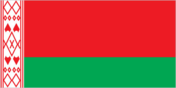
red horizontal band (top) and green horizontal band one-half the width of the red band; a white vertical stripe on the hoist side bears Belarusian national ornamentation in red; the red band color recalls past struggles from oppression, the green band represents hope and the many forests of the country
Government type
republic in name, although in fact a dictatorship
Independence
25 August 1991 (from the Soviet Union)
International organization participation
BSEC (observer), CEI, CIS, CSTO, EAEC, EAPC, EBRD, FAO, GCTU, IAEA, IBRD, ICAO, ICRM, IDA, IFC, IFRCS, ILO, IMF, IMSO, Interpol, IOC, IOM, IPU, ISO, ITU, ITUC, MIGA, NAM, NSG, OPCW, OSCE, PCA, PFP, UN, UNCTAD, UNESCO, UNIDO, UNWTO, UPU, WCO, WFTU, WHO, WIPO, WMO, WTO (observer)
Judicial branch
Supreme Court (judges are appointed by the president); Constitutional Court (half of the judges appointed by the president and half appointed by the Chamber of Representatives)
Legal system
based on civil law system; has not accepted compulsory ICJ jurisdiction
Legislative branch
bicameral National Assembly or Natsionalnoye Sobranie consists of the Council of the Republic or Soviet Respubliki (64 seats; 56 members elected by regional councils and eight members appointed by the president, to serve four-year terms) and the Chamber of Representatives or Palata Predstaviteley (110 seats; members elected by popular vote to serve four-year terms) elections: Palata Predstaviteley - last held 28 September and 3 October 2008 (next to be held fall of 2012); international observers determined that despite minor improvements the election ultimately fell short of democratic standards; pro-LUKASHENKO candidates won every seat election results: Soviet Respubliki - percent of vote by party - NA; seats by party - NA; Palata Predstaviteley - percent of vote by party - NA; seats by party - NA
National holiday
Independence Day, 3 July (1944); note - 3 July 1944 was the date Minsk was liberated from German troops, 25 August 1991 was the date of independence from the Soviet Union
Political parties and leaders
pro-government parties: Agrarian Party or AP [Mikhail SHIMANSKY]; Communist Party of Belarus or KPB; Belarusian Patriotic Movement (Belarusian Patriotic Party) or BPR [Nikolay ULAKHOVICH, chairman]; Liberal Democratic Party [Sergey GAYDUKEVICH]; Republican Party of Labor and Justice [Viktor SOKOLOV]; Social-Sports Party [Vladimir ALEXANDROVICH] opposition parties: Belarusian Christian Democracy Party (unregistered) [Pavel SEVERINETS]; Belarusian Party of Communists or PKB [Sergey KALYAKIN]; Belarusian Party of Labor (unregistered) [Aleksandr BUKHVOSTOV, Leonid LEMESHONAK]; Belarusian Popular Front or BPF [Levon BARSHCHEVSKIY]; Belarusian Social-Democratic Gramada [Stanislav SHUSHKEVICH]; Belarusian Social Democratic Party Hramada (People's Assembly) or BSDPH [Anatoliy LEVKOVICH]; European Coalition [Nikolay STATKEVICH]; Green Party [Oleg GROMYKO]; Party of Freedom and Progress (unregistered) [Vladimir NOVOSYAD]; United Civic Party or UCP [Anatoliy LEBEDKO]; Women's Party Hope (Nadezhda) [Valentina MATUSEVICH, chairperson] other opposition includes: Christian Conservative BPF [Zyanon PAZNIAK]; Ecological Party of Greens [Mikhail KARTASH]; Party of Popular Accord [Sergey YERMAKK]; Republican Party [Vladimir BELAZOR]
Political pressure groups and leaders
Assembly of Pro-Democratic NGOs [Sergey MATSKEVICH]; Belarusian Congress of Democratic Trade Unions [Aleksandr YAROSHUK]; Belarusian Helsinki Committee [Tatiana PROTKO]; Belarusian Organization of Working Women [Irina ZHIKHAR]; BPF-Youth [Franak VYACHORKA]; Charter 97 [Andrey SANNIKOV]; For Freedom [Aleksandr MILINKEVICH]; Lenin Communist Union of Youth (youth wing of the Belarusian Party of Communists or PKB); National Strike Committee of Entrepreneurs [Aleksandr VASILYEV, Valery LEVONEVSKY]; Partnership NGO [Nikolay ASTREYKA]; Perspektiva kiosk watchdog NGO [Anatol SHUMCHENKO]; Vyasna [Ales BYALATSKY]; Women's Independent Democratic Movement [Ludmila PETINA]; Young Belarus (Malady Belarus) [Artur FINKEVICH]; Youth Front (Malady Front) [Dmitriy DASHKEVICH]; Zubr youth group [Vladimir KOBETS]
Suffrage
18 years of age; universal
Economy
Agriculture - products
grain, potatoes, vegetables, sugar beets, flax; beef, milk
Budget
revenues: $25.15 billion expenditures: $25.97 billion (2008 est.)
Central bank discount rate
12% (31 December 2008) country comparison to the world: 37 10% (31 December 2007)
Commercial bank prime lending rate
8.55% (31 December 2008) country comparison to the world: 99 8.58% (31 December 2007)
Current account balance
-$5.063 billion (2008 est.) country comparison to the world: 158 -$3.042 billion (2007 est.)
Debt - external
$15.15 billion (31 December 2008) country comparison to the world: 77 $12.49 billion (31 December 2007)
Distribution of family income - Gini index
27.9 (2005) country comparison to the world: 122 21.7 (1998)
Economy - overview
Belarus has seen little structural reform since 1995, when President LUKASHENKO launched the country on the path of "market socialism." In keeping with this policy, LUKASHENKO reimposed administrative controls over prices and currency exchange rates and expanded the state's right to intervene in the management of private enterprises. Since 2005, the government has re-nationalized a number of private companies. In addition, businesses have been subject to pressure by central and local governments, e.g., arbitrary changes in regulations, numerous rigorous inspections, retroactive application of new business regulations, and arrests of "disruptive" businessmen and factory owners. A wide range of redistributive policies has helped those at the bottom of the ladder; the Gini coefficient is among the lowest in the world. Because of these restrictive economic policies, Belarus has had trouble attracting foreign investment. Nevertheless, government statistics indicate GDP growth has been strong in recent years, reaching 10% in 2008, despite the roadblocks of a tough, centrally directed economy with a high rate of inflation. Belarus receives discounted oil and natural gas from Russia and much of Belarus' growth can be attributed to the re-export of Russian oil at market prices. Trade with Russia - by far its largest single trade partner - decreased in 2007-08, largely as a result of a change in the way the Value Added Tax (VAT) on trade was collected. Russia has introduced an export duty on oil shipped to Belarus, which will increase gradually through 2009, and a requirement that Belarusian duties on re-exported Russian oil be shared with Russia - 80% was slated to go to Russia in 2008, and 85% in 2009. Russia also increased Belarusian natural gas prices from $47 per thousand cubic meters (tcm)in 2006 to $100 per tcm in 2007, and to $128 per tcm in 2008, and plans to increase prices gradually to world levels by 2011. Russia's recent policy of bringing energy prices for Belarus to world market levels may result in a slowdown in economic growth in Belarus over the next few years. Some policy measures, including improving energy efficiency and diversifying exports, have been introduced, but external borrowing has been the main mechanism used to manage the growing pressures on the economy. Belarus felt the effects of the global financial crisis in late 2008 and reached agreement with Russia in November for a $2 billion stabilization loan and with the IMF for a $2.5 billion stand-by agreement in January 2009. In line with IMF conditionality, Belarus devalued the ruble approximately 20% in January 2009 and has tightened some fiscal and monetary policies. Belarus's economic growth is likely to slow in 2009 as it faces decreasing demand for its exports, and will find it difficult to increase external borrowing if the credit markets continue to tighten.
Electricity - consumption
30.54 billion kWh (2007 est.) country comparison to the world: 58
Electricity - exports
5.062 billion kWh (2007 est.)
Electricity - imports
9.406 billion kWh (2007 est.)
Electricity - production
29.92 billion kWh (2007 est.) country comparison to the world: 63
Exchange rates
Belarusian rubles (BYB/BYR) per US dollar - 2,130 (2008 est.), 2,145 (2007), 2,144.6 (2006), 2,150 (2005), 2,160.26 (2004)
Exports
$33.04 billion (2008 est.) country comparison to the world: 61 $24.33 billion (2007 est.)
Exports - commodities
machinery and equipment, mineral products, chemicals, metals, textiles, foodstuffs
Exports - partners
Russia 32.2%, Netherlands 16.9%, Ukraine 8.5%, Latvia 6.6%, Poland 5.5%, UK 4.4% (2008)
GDP - composition by sector
agriculture: 8.5% industry: 41.2% services: 50.3% (2008 est.)
GDP - per capita (PPP)
$11,800 (2008 est.) country comparison to the world: 93 $10,700 (2007 est.) $9,800 (2006 est.) note: data are in 2008 US dollars
GDP - real growth rate
10% (2008 est.) country comparison to the world: 11 8.2% (2007 est.) 9.9% (2006 est.)
GDP (official exchange rate)
$60.3 billion (2008 est.)
GDP (purchasing power parity)
$114.3 billion (2008 est.) country comparison to the world: 62 $103.9 billion (2007 est.) $96.06 billion (2006 est.) note: data are in 2008 US dollars
Household income or consumption by percentage share
lowest 10%: 3.6% highest 10%: 22% (2005)
Imports
$39.16 billion (2008 est.) country comparison to the world: 55 $28.4 billion (2007 est.)
Imports - commodities
mineral products, machinery and equipment, chemicals, foodstuffs, metals
Imports - partners
Russia 59.8%, Germany 7.1%, Ukraine 5.4% (2008)
Industrial production growth rate
12% (2008 est.) country comparison to the world: 5
Industries
metal-cutting machine tools, tractors, trucks, earthmovers, motorcycles, televisions, synthetic fibers, fertilizer, textiles, radios, refrigerators
Inflation rate (consumer prices)
14.8% (2008 est.) country comparison to the world: 188 8.4% (2007 est.)
Investment (gross fixed)
31.9% of GDP (2008 est.) country comparison to the world: 19
Labor force
4.869 million (2007) country comparison to the world: 77
Labor force - by occupation
agriculture: 14% industry: 34.7% services: 51.3% (2003 est.)
Market value of publicly traded shares
$NA
Natural gas - consumption
21.75 billion cu m (2008 est.) country comparison to the world: 34
Natural gas - exports
0 cu m (2008) country comparison to the world: 48
Natural gas - imports
21.6 billion cu m (2008 est.) country comparison to the world: 13
Natural gas - production
152 million cu m (2008 est.) country comparison to the world: 77
Natural gas - proved reserves
2.832 billion cu m (1 January 2009 est.) country comparison to the world: 94
Oil - consumption
184,000 bbl/day (2008 est.) country comparison to the world: 60
Oil - exports
303,900 bbl/day (2007 est.) country comparison to the world: 39
Oil - imports
444,800 bbl/day (2007 est.) country comparison to the world: 28
Oil - production
32,950 bbl/day (2008 est.) country comparison to the world: 68
Oil - proved reserves
198 million bbl (1 January 2009 est.) country comparison to the world: 58
Population below poverty line
27.1% (2003 est.)
Reserves of foreign exchange and gold
$2.687 billion (31 December 2008 est.) country comparison to the world: 98 $3.952 billion (31 December 2007 est.)
Stock of domestic credit
$18.42 billion (31 December 2008) country comparison to the world: 60 $12.16 billion (31 December 2007)
Stock of money
$4.872 billion (31 December 2008) country comparison to the world: 55 $4.065 billion (31 December 2007)
Stock of quasi money
$8.784 billion (31 December 2008) country comparison to the world: 55 $6.823 billion (31 December 2007)
Unemployment rate
1.6% (2005) country comparison to the world: 12 note: officially registered unemployed; large number of underemployed workers
Communications
Internet country code
.by
Internet hosts
113,115 (2009) country comparison to the world: 70
Internet users
3.107 million (2008) country comparison to the world: 57
Radio broadcast stations
AM 28, FM 37, shortwave 11 (1998)
Telephone system
general assessment: Belarus lags behind its neighbors in upgrading telecommunications infrastructure; state-owned Beltelcom is the sole provider of fixed-line local and long distance service; fixed-line teledensity of roughly 35 per 100 persons; mobile-cellular telephone density of about 90 per 100 persons; modernization of the network progressing with roughly two-thirds of switching equipment now digital domestic: fixed-line penetration is improving although rural areas continue to be underserved; 3 GSM wireless networks are experiencing rapid growth; strict government controls on telecommunications technologies international: country code - 375; Belarus is a member of the Trans-European Line (TEL), Trans-Asia-Europe (TAE) fiber-optic line, and has access to the Trans-Siberia Line (TSL); 3 fiber-optic segments provide connectivity to Latvia, Poland, Russia, and Ukraine; worldwide service is available to Belarus through this infrastructure; additional analog lines to Russia; Intelsat, Eutelsat, and Intersputnik earth stations (2008)
Telephones - main lines in use
3.718 million (2008) country comparison to the world: 41
Telephones - mobile cellular
8.693 million (2008) country comparison to the world: 66
Television broadcast stations
47 (plus 27 repeaters) (1995)
Transportation
Airports
65 (2009) country comparison to the world: 75
Airports - with paved runways
total: 35 over 3,047 m: 2 2,438 to 3,047 m: 22 1,524 to 2,437 m: 3 914 to 1,523 m: 1 under 914 m: 7 (2009)
Airports - with unpaved runways
total: 30 2,438 to 3,047 m: 2 1,524 to 2,437 m: 1 914 to 1,523 m: 2 under 914 m: 25 (2009)
Heliports
1 (2009)
Pipelines
gas 5,250 km; oil 1,528 km; refined products 1,730 km (2008)
Ports and terminals
Mazyr
Railways
total: 5,538 km country comparison to the world: 32 broad gauge: 5,512 km 1.520-m gauge (874 km electrified) standard gauge: 25 km 1.435-m gauge (2008)
Roadways
total: 94,797 km country comparison to the world: 48 paved: 84,028 km unpaved: 10,769 km (2005)
Waterways
2,500 km (use limited by location on perimeter of country and by shallowness) (2003) country comparison to the world: 36
Military and Security
Belarus Armed Forces
Land Force, Air and Air Defense Force (2009)
Manpower available for military service
males age 16-49: 2,491,643 females age 16-49: 2,528,779 (2008 est.)
Manpower fit for military service
males age 16-49: 1,720,049 females age 16-49: 2,069,898 (2009 est.)
Manpower reaching militarily significant age annually
male: 60,009 female: 56,834 (2009 est.)
Military expenditures
1.4% of GDP (2005 est.) country comparison to the world: 117
Military service age and obligation
18-27 years of age for compulsory military service; conscript service obligation - 18 months (2005)
Transnational Issues
Disputes - international
Boundary demarcated with Latvia and Lithuania in 2006; 1997 boundary delimitation treaty with Ukraine remains unratified over unresolved financial claims, preventing demarcation and diminishing border security
Illicit drugs
limited cultivation of opium poppy and cannabis, mostly for the domestic market; transshipment point for illicit drugs to and via Russia, and to the Baltics and Western Europe; a small and lightly regulated financial center; anti-money-laundering legislation does not meet international standards and was weakened further when know-your-customer requirements were curtailed in 2008; few investigations or prosecutions of money-laundering activities (2008) page last updated on November 11, 2009