2004 Edition
CIA World Factbook 2004 (Project Gutenberg)
Introduction
Background
After seven decades as a constituent republic of the USSR, Belarus attained its independence in 1991. It has retained closer political and economic ties to Russia than any of the other former Soviet republics. Belarus and Russia signed a treaty on a two-state union on 8 December 1999 envisioning greater political and economic integration. Although Belarus agreed to a framework to carry out the accord, serious implementation has yet to take place.
Geography
Area
- land
- 207,600 sq km
- total
- 207,600 sq km
- water
- 0 sq km
Area - comparative
slightly smaller than Kansas
Climate
cold winters, cool and moist summers; transitional between continental and maritime
Coastline
0 km (landlocked)
Elevation extremes
- highest point
- Dzyarzhynskaya Hara 346 m
- lowest point
- Nyoman River 90 m
Environment - current issues
soil pollution from pesticide use; southern part of the country contaminated with fallout from 1986 nuclear reactor accident at Chornobyl' in northern Ukraine
Environment - international agreements
- Pollution-Sulfur 85, Biodiversity, Climate Change, Desertification, Endangered Species, Environmental Modification, Hazardous Wastes, Marine Dumping, Ozone Layer Protection, Ship Pollution, Wetlands
- party to
- Air Pollution, Air Pollution-Nitrogen Oxides, Air
- signed, but not ratified
- Law of the Sea
Geographic coordinates
53 00 N, 28 00 E
Geography - note
landlocked; glacial scouring accounts for the flatness of Belarusian terrain and for its 11,000 lakes; the country is geologically well endowed with extensive deposits of granite, dolomitic limestone, marl, chalk, sand, gravel, and clay
Irrigated land
1,150 sq km (1998 est.)
Land boundaries
- Russia 959 km, Ukraine 891 km
- border countries
- Latvia 141 km, Lithuania 502 km, Poland 407 km,
- total
- 2,900 km
Land use
- arable land
- 29.55%
- other
- 69.85% (2001)
- permanent crops
- 0.6%
Location
Eastern Europe, east of Poland
Map references
Europe
Maritime claims
none (landlocked)
Natural hazards
NA
Natural resources
forests, peat deposits, small quantities of oil and natural gas, granite, dolomitic limestone, marl, chalk, sand, gravel, clay
Terrain
generally flat and contains much marshland
People and Society
Age structure
0-14 years: 16.3% (male 859,219; female 823,839) 15-64 years: 69.2% (male 3,469,926; female 3,662,203) 65 years and over: 14.5% (male 496,204; female 999,129) (2004 est.)
Birth rate
10.52 births/1,000 population (2004 est.)
Death rate
14.1 deaths/1,000 population (2004 est.)
Ethnic groups
Belarusian 81.2%, Russian 11.4%, Polish, Ukrainian, and other 7.4%
HIV/AIDS - adult prevalence rate
0.3% (2001 est.)
HIV/AIDS - deaths
1,000 (2001 est.)
HIV/AIDS - people living with HIV/AIDS
15,000 (2001 est.)
Infant mortality rate
- female
- 12.47 deaths/1,000 live births (2004 est.)
- male
- 14.71 deaths/1,000 live births
- total
- 13.62 deaths/1,000 live births
Languages
Belarusian, Russian, other
Life expectancy at birth
- female
- 74.65 years (2004 est.)
- male
- 62.79 years
- total population
- 68.57 years
Literacy
- definition
- age 15 and over can read and write
- female
- 99.5% (2003 est.)
- male
- 99.8%
- total population
- 99.6%
Median age
- female
- 39.5 years (2004 est.)
- male
- 34.2 years
- total
- 36.9 years
Nationality
- adjective
- Belarusian
- noun
- Belarusian(s)
Net migration rate
2.54 migrant(s)/1,000 population (2004 est.)
Population
10,310,520 (July 2004 est.)
Population growth rate
-0.11% (2004 est.)
Religions
Eastern Orthodox 80%, other (including Roman Catholic, Protestant, Jewish, and Muslim) 20% (1997 est.)
Sex ratio
- 15-64 years: 0.95 male(s)/female 65 years and over: 0.5 male(s)/female
- at birth
- 1.05 male(s)/female
- total population
- 0.88 male(s)/female (2004 est.)
- under 15 years
- 1.04 male(s)/female
Total fertility rate
1.36 children born/woman (2004 est.)
Government
Administrative divisions
- 6 provinces (voblastsi, singular - voblasts') and 1 municipality* (horad); Brest, Homyel', Horad Minsk*, Hrodna, Mahilyow, Minsk, Vitsyebsk
- administrative centers
- note
- administrative divisions have the same names as their
Capital
Minsk
Constitution
30 March 1994; revised by national referendum of 24 November 1996 giving the presidency greatly expanded powers and became effective 27 November 1996; revised again 17 October 2004 removing presidential term limits
Country name
- conventional long form
- Republic of Belarus
- conventional short form
- Belarus
- former
- Belorussian (Byelorussian) Soviet Socialist Republic
- local long form
- Respublika Byelarus'
- local short form
- none
Diplomatic representation from the US
- FAX: [375] (17) 234-7853
- chief of mission
- Ambassador George A. KROL
- embassy
- 46 Starovilenskaya St., Minsk 220002
- mailing address
- PSC 78, Box B Minsk, APO 09723
- telephone
- [375] (17) 210-12-83, 217-7347, 217-7348
Diplomatic representation in the US
- FAX: [1] (202) 986-1805
- chancery
- 1619 New Hampshire Avenue NW, Washington, DC 20009
- chief of mission
- Ambassador Mikhail KHVOSTOV
- consulate(s) general
- New York
- telephone
- [1] (202) 986-1604
Executive branch
- December 2003); First Deputy Prime Minister Vladimir SEMASHKO (since December 2003); Deputy Prime Ministers Andrei KOBYAKOV (since December 2003), Vladimir DRAZHIN (since 24 September 2001), Ivan BAMBIZA (since 25 May 2004), Anatoly TYUTYUNOV (since July 2002)
- of vote - Aleksandr LUKASHENKO 75.6%, Vladimir GONCHARIK 15.4%
- first election took place 23 June and 10 July 1994; according to the 1994 constitution, the next election should have been held in 1999, however LUKASHENKO extended his term to 2001 via a November 1996 referendum; new election held 9 September 2001; October 2004 referendum ended presidential term limits allowing president to run for a third term in September 2006; prime minister and deputy prime ministers appointed by the president
- cabinet
- Council of Ministers
- chief of state
- President Aleksandr LUKASHENKO (since 20 July 1994)
- election results
- Aleksandr LUKASHENKO reelected president; percent
- elections
- president elected by popular vote for a five-year term;
- head of government
- Prime Minister Sergei SIDORSKY (since 19
Flag description
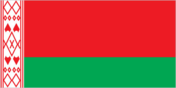
red horizontal band (top) and green horizontal band one-half the width of the red band; a white vertical stripe on the hoist side bears Belarusian national ornamention in red
Government type
republic in name, although in fact a dictatorship
Independence
25 August 1991 (from Soviet Union)
International organization participation
CEI, CIS, EAPC, EBRD, IAEA, IBRD, ICAO, ICFTU, ICRM, IFC, IFRCS, ILO, IMF, Interpol, IOC, IOM (observer), ISO, ITU, MIGA, NAM, NSG, OPCW, OSCE, PCA, PFP, UN, UNCTAD, UNESCO, UNIDO, UPU, WCO, WFTU, WHO, WIPO, WMO, WTrO (observer)
Judicial branch
Supreme Court (judges are appointed by the president); Constitutional Court (half of the judges appointed by the president and half appointed by the Chamber of Representatives)
Legal system
based on civil law system
Legislative branch
- bicameral Parliament or Natsionalnoye Sobranie consists of the Council of the Republic or Soviet Respubliki (64 seats; 56 members elected by regional councils and 8 members appointed by the president, all for 4-year terms) and the Chamber of Representatives or Palata Predstaviteliy (110 seats; members elected by universal adult suffrage to serve 4-year terms)
- NA%; seats by party - NA; Palata Pretsaviteley - percent of vote by party - NA%; seats by party - NA
- 2004 (bi-election will be held March 2005 to fill one unfilled seat in the Palata Predstaviteliy); international observers widely denounced the October 2004 elections as flawed and undemocratic, based on massive government falsification; pro-Lukashenko candidates won every seat, after many opposition candidates were disqualified for technical reasons
- election results
- Soviet Respubliki - percent of vote by party -
- elections
- last held 18 March and 1 April 2001 and 17 and 31 October
National holiday
Independence Day, 3 July (1944); note - 3 July 1944 was the date Minsk was liberated from German troops, 25 August 1991 was the date of independence from the Soviet Union
Political parties and leaders
- Pro-government parties: Agrarian Party or AP; Belarusian Communist Party or KPB; Belarusian Patriotic Movement (Belarusian Patriotic Party) or BPR [Anatoliy BARANKEVICH, chairman]; Liberal Democratic Party of Belarus [Sergei GAYDUKEVICH]; Social-Sports Party; Opposition parties: Belarusian Popular Front or BNF [Vintsuk VYACHORKA]; Belarusian Social-Democrat Party Narodnaya Gromada or BSDP NG [Nikolay STATKEVICH, chairman]; Belarusian Social-Democratic Party Hromada [Stanislav SHUSHKEVICH, chairman]; United Civic Party or UCP [Anatol LEBEDKO]; Party of Communists Belarusian or PKB [Sergei KALYAKIN, chairman]; Women's Party "Nadezhda" [Valentina MATUSEVICH, chairperson]
- BUKHVOSTOV] was liquidated in August 2004, but remains active
- note
- the opposition Belarusian Party of Labor [Aleksandr
Political pressure groups and leaders
NA
Suffrage
18 years of age; universal
Economy
Agriculture - products
grain, potatoes, vegetables, sugar beets, flax; beef, milk
Budget
- million (2003 est.)
- expenditures
- $3.211 billion, including capital expenditures of $180
- revenues
- $2.976 billion
Currency
Belarusian ruble (BYB/BYR)
Currency code
BYB/BYR
Current account balance
$-945 million (2003)
Debt - external
$851 million (2001 est.)
Distribution of family income - Gini index
21.7 (1998)
Economic aid - recipient
$194.3 million (1995)
Economy - overview
Belarus' economy in 2003 posted 6.1 percent growth and is likely to continue expanding through 2004, albeit at a slower growth rate. The Belarusian economy in 2004 is likely to be hampered by high inflation, persistent trade deficits, and ongoing rocky relations with Russia, Belarus' largest trading partner and energy supplier. Belarus has seen little structural reform since 1995, when President LUKASHENKO launched the country on the path of "market socialism." In keeping with this policy, LUKASHENKO reimposed administrative controls over prices and currency exchange rates and expanded the state's right to intervene in the management of private enterprises. In addition, businesses have been subject to pressure on the part of central and local governments, e.g., arbitrary changes in regulations, numerous rigorous inspections, retroactive application of new business regulations, and arrests of "disruptive" businessmen and factory owners. A wide range of redistributive policies has helped those at the bottom of the ladder. For the time being, Belarus remains self-isolated from the West and its open-market economies.
Electricity - consumption
26.69 billion kWh (2001)
Electricity - exports
300 million kWh (2001)
Electricity - imports
4.3 billion kWh (2001)
Electricity - production
24.4 billion kWh (2001)
Exchange rates
Belarusian rubles per US dollar - 1,790.92 (2003), 1,920 (2002), 1,390 (2001), 876.75 (2000), 248.795 (1999)
Exports
$9.413 billion f.o.b. (2003 est.)
Exports - commodities
machinery and equipment, mineral products, chemicals, metals; textiles, foodstuffs
Exports - partners
Russia 49.1%, UK 9.4%, Poland 4.4%, Germany 4.2%, Netherlands 4.2% (2003)
Fiscal year
calendar year
GDP
purchasing power parity - $62.56 billion (2003 est.)
GDP - composition by sector
- agriculture
- 11.1%
- industry
- 36.4%
- services
- 52.5% (2003 est.)
GDP - per capita
purchasing power parity - $6,100 (2003 est.)
GDP - real growth rate
6.8% (2003 est.)
Household income or consumption by percentage share
- highest 10%
- 20% (1998)
- lowest 10%
- 5.1%
Imports
$11.09 billion f.o.b. (2003 est.)
Imports - commodities
mineral products, machinery and equipment, chemicals, foodstuffs, metals
Imports - partners
Russia 65.8%, Germany 7.1%, Ukraine 3.1% (2003) Reserves of foreign exchange & gold: $637 million (2003)
Industrial production growth rate
5% (2003 est.)
Industries
metal-cutting machine tools, tractors, trucks, earthmovers, motorcycles, television sets, chemical fibers, fertilizer, textiles, radios, refrigerators
Inflation rate (consumer prices)
28.2% (2003 est.)
Investment (gross fixed)
21.7% of GDP (2003)
Labor force
4.8 million (2000 est.)
Labor force - by occupation
NA
Natural gas - consumption
18 billion cu m (2001 est.)
Natural gas - exports
0 cu m (2001 est.)
Natural gas - imports
17.8 billion cu m (2001 est.)
Natural gas - production
200 million cu m (2001 est.)
Oil - consumption
230,000 bbl/day (2001 est.)
Oil - exports
NA (2001)
Oil - imports
NA (2001)
Oil - production
37,000 bbl/day (2001 est.)
Population below poverty line
22% (1995 est.)
Unemployment rate
2.1% officially registered unemployed (December 2000); large number of underemployed workers (2003 est.)
Communications
Internet country code
.by
Internet hosts
5,308 (2004)
Internet Service Providers (ISPs)
23 (2002)
Internet users
1,391,900 (2003)
Radio broadcast stations
AM 28, FM 37, shortwave 11 (1998)
Radios
3.02 million (1997)
Telephone system
- telecommunications through its carrier (a joint stock company) Beltelcom which is a monopoly
- cellular NMT-450 network; waiting lists for telephones are long; local service outside Minsk is neglected and poor; intercity - Belarus has a partly developed fiber-optic backbone system presently serving at least 13 major cities (1998); Belarus' fiber optics form synchronous digital hierarchy rings through other countries' systems; an inadequate analog system remains operational
- Trans-European Line (TEL), Trans-Asia-Europe (TAE) fiber-optic line, and has access to the Trans-Siberia Line (TSL); three fiber-optic segments provide connectivity to Latvia, Poland, Russia, and Ukraine; worldwide service is available to Belarus through this infrastructure; additional analog lines to Russia; Intelsat, Eutelsat, and Intersputnik earth stations
- domestic
- local - Minsk has a digital metropolitan network and a
- general assessment
- the Ministry of Telecommunications controls all
- international
- country code - 375; Belarus is a member of the
Telephones - main lines in use
3,071,300 (2003)
Telephones - mobile cellular
1.118 million (2003)
Television broadcast stations
47 (plus 27 repeaters) (1995)
Televisions
2.52 million (1997)
Transportation
Airports
135 (2003 est.)
Airports - with paved runways
- 2,438 to 3,047 m: 21
- 1,524 to 2,437 m: 6
- over 3,047 m
- 2
- total
- 50
- under 914 m
- 21 (2003 est.)
Airports - with unpaved runways
- 914 to 1,523 m: 11
- 2,438 to 3,047 m: 2 1,524 to 2,437 m: 5
- over 3,047 m
- 3
- total
- 85
- under 914 m
- 64 (2003 est.)
Heliports
1 (2003 est.)
Highways
- paved
- 66,203 km
- total
- 74,385 km
- unpaved
- 8,182 km (2000)
Pipelines
gas 5,223 km; oil 2,443 km; refined products 1,686 km (2004)
Ports and harbors
Mazyr
Railways
- broad gauge
- 5,523 km 1.520-m gauge (875 km electrified) (2003)
- total
- 5,523 km
Waterways
2,500 km (use limited by location on perimeter of country and by shallowness) (2003)
Military and Security
Military branches
Army, Air and Air Defense Force
Military expenditures - dollar figure
$176.1 million (FY02)
Military expenditures - percent of GDP
1.4% (FY02)
Military manpower - availability
- males age 15-49
- 2,764,856 (2004 est.)
Military manpower - fit for military service
- males age 15-49
- 2,164,923 (2004 est.)
Military manpower - military age and obligation
18-27 years of age for compulsory military service; conscript service obligation - 18 months (May 2004)
Military manpower - reaching military age annually
- males
- 86,716 (2004 est.)
Transnational Issues
Disputes - international
1997 boundary treaty with Ukraine remains unratified over unresolved financial claims, preventing demarcation and diminishing border security; boundaries with Latvia and Lithuania remain undemarcated despite European Union financial support
Illicit drugs
limited cultivation of opium poppy and cannabis, mostly for the domestic market; transshipment point for illicit drugs to and via Russia, and to the Baltics and Western Europe; a small and lightly regulated financial center; new anti-money-laundering legislation does not meet international standards; few investigations or prosecutions of money-laundering activities This page was last updated on 10 February, 2005 @Belgium