1997 Edition
CIA World Factbook 1997 (Project Gutenberg)
Geography
Area
total: 207,600 sq km land: 207,600 sq km water: 0 sq km
Area - comparative
slightly smaller than Kansas
Climate
cold winters, cool and moist summers; transitional between continental and maritime
Coastline
0 km (landlocked)
Elevation extremes
lowest point: Nyoman River 90 m highest point: Dzyarzhynskaya Hara 346 m
Environment - current issues
soil pollution from pesticide use; southern part of the country contaminated with fallout from 1986 nuclear reactor accident at Chornobyl' in northern Ukraine
Environment - international agreements
party to: Air Pollution, Air Pollution-Nitrogen Oxides, Air Pollution-Sulphur 85, Biodiversity, Environmental Modification, Marine Dumping, Nuclear Test Ban, Ozone Layer Protection signed, but not ratified: Climate Change, Law of the Sea
Geographic coordinates
53 00 N, 28 00 E
Geography - note
landlocked
Irrigated land
1,000 sq km (1993 est.)
Land boundaries
total: 3,098 km border countries: Latvia 141 km, Lithuania 502 km, Poland 605 km, Russia 959 km, Ukraine 891 km
Land use
arable land : 29% permanent crops: 1% permanent pastures: 15% forests and woodland: 34% other: 21% (1993 est.)
Location
Eastern Europe, east of Poland
Map references
Commonwealth of Independent States
Maritime claims
none (landlocked)
Natural hazards
NA
Natural resources
forests, peat deposits, small quantities of oil and natural gas
Terrain
generally flat and contains much marshland
People and Society
Age structure
0-14 years: 21% (male 1,092,760; female 1,047,992) 15-64 years : 66% (male 3,346,111; female 3,547,352) 65 years and over: 13% (male 452,267; female 925,737) (July 1997 est.)
Birth rate
9.75 births/1,000 population (1997 est.)
Death rate
13.23 deaths/1,000 population (1997 est.)
Ethnic groups
Byelorussian 77.9%, Russian 13.2%, Polish 4.1%, Ukrainian 2.9%, other 1.9%
Infant mortality rate
13.9 deaths/1,000 live births (1997 est.)
Languages
Byelorussian, Russian, other
Life expectancy at birth
total population: 68.4 years male: 62.48 years female: 74.61 years (1997 est.)
Literacy
definition: age 15 and over can read and write total population: 98% male : 99% female: 97% (1989 est.)
Nationality
noun: Belarusian(s) adjective: Belarusian
Net migration rate
3.38 migrant(s)/1,000 population (1997 est.)
Population
10,412,219 (July 1997 est.)
Population growth rate
-0.01% (1997 est.)
Religions
Eastern Orthodox 80%, other (including Roman Catholic, Protestant, Jewish, and Muslim) 20% (1997 est.)
Sex ratio
at birth: 1.05 male(s)/female under 15 years: 1.04 male(s)/female 15-64 years: 0.94 male(s)/female 65 years and over: 0.49 male(s)/female total population: 0.89 male(s)/female (1997 est.)
Total fertility rate
1.35 children born/woman (1997 est.)
Government
Administrative divisions
6 voblastsi (singular - voblasts') and one municipality* (harady, singular - horad); Brestskaya (Brest), Homyel'skaya (Homyel'), Horad Minsk*, Hrodzyenskaya (Hrodna), Mahilyowskaya (Mahilyow), Minskaya, Vitsyebskaya (Vitsyebsk) note: administrative divisions have the same names as their administrative centers (exceptions have the administrative center name following in parentheses)
Constitution
referendum of 27 November 1996 (declared illegitimate by the international community) adopted a new constitution massing power in the hands of the president; signed into law on 28 November 1996
Country name
conventional long form : Republic of Belarus conventional short form: Belarus local long form: Respublika Byelarus' local short form: none former: Belorussian (Byelorussian) Soviet Socialist Republic
Data code
BO
Diplomatic representation from the US
chief of mission : Ambassador Kenneth Spencer YALOWITZ embassy: Starovilenskaya #46-220002, Minsk mailing address: use embassy street address telephone: [375] (172) 31-50-00
Diplomatic representation in the US
chief of mission : Ambassador-designate Valeriy TSEPKALO chancery: 1619 New Hampshire Avenue NW, Washington, DC 20009 telephone: [1] (202) 986-1604
Executive branch
chief of state: President Aleksandr LUKASHENKO (since 20 July 1994) head of government: Prime Minister Sergey LING (acting since NA November 1996, confirmed NA February 1997); First Deputy Prime Minister Pyotr PROKOPOVICH (since NA); Deputy Prime Ministers Vladimir GARKUN (since NA), Valeriy KOKAREV (since NA), Vladimir RUSAKEVICH (since NA), Vasyl DALGALYOV (since NA) cabinet: Council of Ministers elections: president elected by popular vote for a five-year term; election last held 24 June and 10 July 1994 (next to be held NA 2001 because of the additional two years provided by the November 1996 referendum); prime minister appointed by the president election results: Aleksandr LUKASHENKO elected president; percent of vote - Aleksandr LUKASHENKO 85%, Vyacheslav KEBICH 15% note: first presidential elections took place in June-July 1994
FAX
- [1] (202) 986-1805 consulate(s) general: New York
- [375] (172) 34-78-53
Flag description
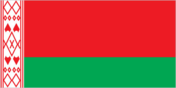
red horizontal band (top) and green horizontal band one-half the width of the red band; a white vertical stripe of white on the hoist side bears in red the Belarusian national ornament
Government type
republic
Independence
25 August 1991 (from Soviet Union); the Belarusian Supreme Soviet issued a proclamation of independence; on 17 July 1990 Belarus issued a declaration of sovereignty
International organization participation
BIS, CCC, CEI, CIS, EBRD, ECE, IAEA, IBRD, ICAO, IFC, IFRCS, ILO, IMF, Inmarsat, Intelsat (nonsignatory user), Interpol, IOC, IOM (observer), ISO, ITU, NACC, OSCE, PCA, PFP, UN, UNCTAD, UNESCO, UNIDO, UPU, WFTU, WHO, WIPO, WMO, WTrO (applicant)
Judicial branch
Supreme Court, judges are appointed by the president; Constitutional Court, half of the judges appointed by the president and half appointed by the Chamber of Representatives
Legal system
based on civil law system
Legislative branch
bicameral Parliament established by the 28 November Constitution consists of the Council of the Republic (64 seats; the president appoints 8 and each oblast plus the Minsk city government elect 8) and the Chamber of Representatives (110 seats; note - present members came from the defunct Supreme Soviet) elections: last held May and November-December 1995 (two rounds, each with a run-off; next to be held NA 2000) election results : percent of vote by party - NA; seats by party - KPB 42, Agrarian 33, CAB 9, Party of People's Concord 8, UPNAZ 2, SDPB 2, BPR 1, Green Party 1, Republican Party of Labor and Justice 1, BSP 1, NFB 1, Social and Sports Party 1, Ecological Party 1, independents 95, vacant 62; note - after the November 1996 referendum, seats for the Chamber of Representatives were filled by former Supreme Soviet members as follows: PKB 24, Agrarian 14, Party of Peoples Concord 5, LDPB 1, UPNAZ 1, Green World Party 1, Belarusian Social Sports Party 1, Ecological Party 1, Republican Party of Labor and Justice 1, independents 60; 58 of the 64 seats in the Council of the Republic have been appointed/elected
National capital
Minsk
National holiday
Independence Day, 3 July (1990); note - date set by referendum of November 1996
Political parties and leaders
Belarusian Communist Party or KPB [Yefrem SOKOLOV and Viktor CHIKIN, chairmen]; Agrarian Party [Aleksandr PAVLOV, chairman]; Civic Accord Bloc (United Civic Party) or CAB [Stanislav BOGDANKEVICH, chairman]; Party of People's Concord [Leonid SECHKO, chairman]; Party of All-Belarusian Unity and Concord or UPNAZ [Dmitriy BULAKOV, chairman]; Belarusian Social-Democrat Hramada or SDBP [Nikolai STATKEVICH, chairman]; Belarusian Patriotic Movement (Belarusian Patriotic Party) or BPR [Anatol BARANKEVICH]; Green Party of Belarus [Nikolai KARTASH, chairman]; Republican Party of Labor and Justice [Anatol NETYLKIN, chairman]; Belarus Peasants or BSP [Yevgeniy LUGIN, chairman]; Belarusian Popular Front or NFB [Levon BARSHEVSKIY, acting chairman]; Belarusian Social Sports Party [Aleksandr ALEKSANDROVICH, chairman]; Ecological Party [Liudmila YELIZAROVA, chairman]; National Democratic Party of Belarus or NDPB [Viktor NAUMENKO, chairman]; United Democratic Party of Belarus or ADPB [Aleksandr DOBROVOLSKIY]; Belarusian Socialist Party or SPB [Vyacheslav KUZNETSOV]; Slavic Assembly or SAB [Nikolai SYARECHEV]; Liberal-Democratic Party or LDPB [Sergei GAIDUKEVICH, chairman]; Belarusian Christian-Democratic Unity or BKDZ [Petr SILKO]; Polish Democratic Union or PDZ [Konstantin TARASEVICH]; Party of Beer Lovers [Yuriy GONCHAR]; Party of Communists Belarusian or PKB [Sergei KALYAKIN and Vasiliy NOVIKOV, chairmen]; Belarusian Labor Party or BPP [Aleksandr BUKHVOSTOV]
Suffrage
18 years of age; universal
Economy
Agriculture - products
grain, potatoes, vegetables; meat, milk
Budget
revenues : $NA expenditures: $NA, including capital expenditures of $NA
Currency
Belarusian ruble (BR)
Debt - external
$2 billion (September 1995 est.)
Economic aid
recipient: ODA, $186 million (1993) note : commitments, $3,930 million ($1,845 million disbursements), 1992-95
Economy - overview
At the time of independence in late 1991, Belarus was one of the most developed of the former Soviet states, inheriting a modern - by Soviet standards - machine building sector and robust agricultural sector. However, the breakup of the Soviet Union and its traditional trade ties in December 1991, as well as the government's failure to embrace market reforms, has resulted in a sharp economic decline. Privatization is virtually nonexistent and the system of state orders and distribution persists. Although President LUKASHENKO pronounces his 1995 macro stabilization policies a success - annual inflation dropped from 2,220% in 1994 to 244% in 1995 - the IMF has criticized his exchange rate policies and suspended Minsk's $300 million standby program in November 1995. The overvalued ruble has especially hurt Belarusian exporters, most of which now operate at a loss. In addition, the January 1995 Customs Union agreement with Russia - which required Minsk to adjust its foreign trade practices to mirror Moscow's - has resulted in higher import tariffs for Belarusian consumers; tariffs rose from 5%-20% to 20%-40%. In general, as of the beginning of 1997, Belarus has badly lagged in moving away from the old centrally planned policies of the former USSR.
Electricity - capacity
7.21 million kW (1994)
Electricity - consumption per capita
2,553 kWh (1995 est.)
Electricity - production
23.7 billion kWh (1996)
Exchange rates
Belarusian rubles per US$1 - 16,613 (September monthly average 1996),15,500 (yearend 1996), 11,500 (yearend 1995), 10,600 (yearend 1994), 699 (yearend 1993), 15 (yearend 1992)
Exports
total value: $5.2 billion (f.o.b., 1996) commodities: machinery and transport equipment, chemicals, foodstuffs partners: Russia, Ukraine, Poland, Germany
Fiscal year
calendar year
GDP
purchasing power parity - $51.9 billion (1996 estimate as extrapolated from World Bank estimate for 1994)
GDP - composition by sector
agriculture: 21% industry: 49% services: 30% (1991 est.)
GDP - per capita
purchasing power parity - $5,000 (1996 est.)
GDP - real growth rate
3% (1996 est.)
Imports
total value: $6.8 billion (c.i.f., 1996) commodities: fuel, natural gas, industrial raw materials, textiles, sugar partners: Russia, Ukraine, Poland, Germany
Industrial production growth rate
3.2% (1996 est.)
Industries
tractors, metal-cutting machine tools, off-highway dump trucks up to 110-metric-ton load capacity, wheel-type earth movers for construction and mining, eight-wheel-drive, high-flotation trucks with cargo capacity of 25 metric tons for use in tundra and roadless areas, equipment for animal husbandry and livestock feeding, motorcycles, television sets, chemical fibers, fertilizer, linen fabric, wool fabric, radios, refrigerators, other consumer goods
Inflation rate - consumer price index
33% (1996)
Labor force
total: 4.731 million by occupation: industry and construction 36%, agriculture and forestry 19%, services 45% (1995)
Unemployment rate
3.1% officially registered unemployed (December 1996); large numbers of underemployed workers
Communications
Radio broadcast stations
AM 35, FM 18, shortwave 0
Radios
3.17 million (1991 est.) (5,615,000 with multiple speaker systems for program diffusion)
Telephone system
telephone service inadequate for the purposes of either business or the population; about 70% of the telephones are in homes; over 750,000 applications from households for telephones remain unsatisfied (1992 est.); new investment centers on international connections and business needs domestic : the new NMT-450 analog cellular system is now operating in Minsk international: international traffic is carried by the Moscow international gateway switch and also by satellite; satellite earth stations - 1 Intelsat (through Canada) and 1 Eutelsat (through the UK)
Telephones
1.849 million (1991 est.)
Television broadcast stations
2 (one national and one private; the license of the private station was suspended during the parliamentary elections of 1994)
Televisions
3.5 million (1992 est.)
Transportation
Airports
118 (1996 est.)
Airports - with paved runways
total: 36 over 3,047 m : 2 2,438 to 3,047 m: 18 1,524 to 2,437 m: 5 under 914 m: 11 (1996 est.)
Airports - with unpaved runways
total: 82 over 3,047 m: 1 2,438 to 3,047 m : 6 1,524 to 2,437 m: 4 914 to 1,523 m: 9 under 914 m: 62 (1996 est.)
Highways
total: 51,547 km paved: 50,825 km unpaved: 722 km (1995 est.)
Merchant marine
note: claims 5% of former Soviet fleet (1995 est.)
Pipelines
crude oil 1,470 km; refined products 1,100 km; natural gas 1,980 km (1992)
Ports and harbors
Mazyr
Railways
total: 5,488 km broad gauge: 5,488 km 1.520-m gauge (873 km electrified) (1993)
Waterways
NA km; note - Belarus has extensive and widely used canal and river systems
Military and Security
Military branches
Army, Air Force, Air Defense Force, Interior Ministry Troops, Border Guards
Military expenditures - dollar figure
2.4 trillion rubles (1997); note - conversion of defense expenditures into US dollars using the current exchange rate could produce misleading results
Military expenditures - percent of GDP
NA%
Military manpower - availability
males age 15-49: 2,659,236 (1997 est.)
Military manpower - fit for military service
males: 2,083,696 (1997 est.)
Military manpower - military age
18 years of age
Military manpower - reaching military age annually
males: 77,496 (1997 est.)
Transnational Issues
Disputes - international
treaty with Lithuania defining the border awaits demarcation
Illicit drugs
limited cultivation of opium poppy and cannabis, mostly for the domestic market; transshipment point for illicit drugs to Russia and Western Europe ______________________________________________________________________ BELGIUM