1995 Edition
CIA World Factbook 1995 (Project Gutenberg)
Geography
Area
total area: 207,600 sq km land area: 207,600 sq km comparative area: slightly smaller than Kansas
Climate
cold winters, cool and moist summers; transitional between continental and maritime
Coastline
0 km (landlocked)
Environment
current issues: soil pollution from pesticide use; southern part of the country contaminated with fallout from 1986 nuclear reactor accident at Chornobyl' natural hazards: NA international agreements: party to - Air Pollution, Air Pollution-Nitrogen Oxides, Air Pollution-Sulphur 85, Biodiversity, Environmental Modification, Marine Dumping, Nuclear Test Ban, Ozone Layer Protection; signed, but not ratified - Climate Change, Law of the Sea
International disputes
none
Irrigated land
1,490 sq km (1990)
Land boundaries
total 3,098 km, Latvia 141 km, Lithuania 502 km, Poland 605 km, Russia 959 km, Ukraine 891 km
Land use
arable land: 29% permanent crops: 1% meadows and pastures: 15% forest and woodland: 0% other: 55%
Location
Eastern Europe, east of Poland
Map references
Commonwealth of Independent States - European States
Maritime claims
none; landlocked
Natural resources
forest land, peat deposits, small quantities of oil and natural gas
Note
landlocked
Terrain
generally flat and contains much marshland
People and Society
Age structure
0-14 years: 22% (female 1,126,062; male 1,166,439) 15-64 years: 65% (female 3,494,891; male 3,293,196) 65 years and over: 13% (female 913,508; male 443,322) (July 1995 est.)
Birth rate
12.98 births/1,000 population (1995 est.)
Death rate
11.23 deaths/1,000 population (1995 est.)
Ethnic divisions
Byelorussian 77.9%, Russian 13.2%, Polish 4.1%, Ukrainian 2.9%, other 1.9%
Infant mortality rate
18.6 deaths/1,000 live births (1995 est.)
Labor force
4.887 million by occupation: industry and construction 40%, agriculture and forestry 21%, other 39% (1992)
Languages
Byelorussian, Russian, other
Life expectancy at birth
total population: 71.03 years male: 66.36 years female: 75.93 years (1995 est.)
Literacy
age 15 and over can read and write (1989) total population: 97% male: 99% female: 96%
Nationality
noun: Belarusian(s) adjective: Belarusian
Net migration rate
1.27 migrant(s)/1,000 population (1995 est.)
Population
10,437,418 (July 1995 est.)
Population growth rate
0.3% (1995 est.)
Religions
Eastern Orthodox, other
Total fertility rate
1.87 children born/woman (1995 est.)
Government
Administrative divisions
6 voblastsi (singular - voblasts') and one municipality* (harady, singular - horad); Brestskaya (Brest), Homyel'skaya (Homyel'), Horad Minsk*, Hrodzyenskaya (Hrodna), Mahilyowskaya (Mahilyow), Minskaya, Vitsyebskaya (Vitsyebsk) note: the administrative centers of the voblastsi are included in parentheses
Capital
Minsk
Constitution
adopted 15 March 1994; replaces constitution of April 1978
Digraph
BO
Diplomatic representation in US
chief of mission: Ambassador Sergey Nikolayevich MARTYNOV chancery: 1619 New Hampshire Avenue NW, Washington, DC 20009 telephone: [1] (202) 986-1604
Executive branch
chief of state: President Aleksandr LUKASHENKO (since 20 July 1994); election held June 24 and 10 July 1994 (next to be held NA 1999); Aleksandr LUKASHENKO 80%, Vyacheslav KEBICH 14% head of government: Prime Minister Mikhail CHIGIR (since July 1994); Deputy Prime Ministers Vladimir GARKUN, Viktor GONCHAR, Sergey LING, Mikhail MYASNIKOVICH, Valeriy KOKAREV (since NA) cabinet: Council of Ministers note: first presidential elections took place in June-July 1994
FAX
[1] (202) 986-1805 consulate(s) general: New York
Flag
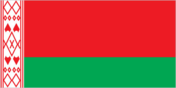
three horizontal bands of white (top), red, and white
Independence
25 August 1991 (from Soviet Union)
Judicial branch
Supreme Court
Legal system
based on civil law system
Legislative branch
unicameral
Member of
CCC, CE (guest), CEI (associate members), CIS, EBRD, ECE, IAEA, IBRD, ICAO, IFC, ILO, IMF, INMARSAT, INTELSAT (nonsignatory user), INTERPOL, IOC, ISO, ITU, NACC, OSCE, PCA, PFP, UN, UNCTAD, UNESCO, UNIDO, UPU, WHO, WIPO, WMO
Names
conventional long form: Republic of Belarus conventional short form: Belarus local long form: Respublika Byelarus' local short form: none former: Belorussian (Byelorussian) Soviet Socialist Republic
National holiday
Independence Day, 27 July (1990)
Political parties and leaders
Belarusian Popular Front (BPF), Zenon POZNYAK, chairman; Party of Popular Accord, Gennadiy KARPENKO; Union of Belarusian Entreprenuers, V. N. KARYAGIN; Belarusian Party of Communists, Vasiliy NOVIKOV, Viktor CHIKIN, chairmen; Belarus Peasant Party, Yevgeniy LUGIN, chairman; Belarusian Socialist Party, Vyacheslav KUZNETSOV, chairman; Belarusian Social Democrat Party (SDBP), Oleg TRUSOV, Stanislav SHUSHKEVICH, chairmen; Agrarian Party of Belarus, Aleksandr DUBKO; United Democratic Party of Belarus (UDPB), Aleksandr DOBROVOLSKIY, chairman; Independent Trade Unions, Sergey ANTONCHIK, chairman
Suffrage
18 years of age; universal
Supreme Soviet
elections last held 4 April 1990 (next to be held 14 May 1995); results - Communists 87%; seats - (360 total) number of seats by party NA; note - 50 seats are for public bodies; the Communist Party obtained an overwhelming majority
Type
republic
US diplomatic representation
chief of mission: Ambassador Kenneth Spencer YALOWITZ embassy: Starovilenskaya #46, Minsk mailing address: use embassy street address telephone: [7] (0172) 34-65-37
Economy
Agriculture
accounts for almost 25% of GDP and 5.7% of total agricultural output of former Soviet Union; employs 21% of the labor force; in 1988 produced the following (in percent of total Soviet production): grain (3.6%), potatoes (12.2%), vegetables (3.0%), meat (6.0%), milk (7.0%); net exporter of meat, milk, eggs, flour, potatoes
Budget
revenues: $NA expenditures: $NA, including capital expenditures of $NA
Currency
Belarusian rubel (BR)
Economic aid
$NA
Electricity
capacity: 7,010,000 kW production: 31.4 billion kWh consumption per capita: 3,010 kWh (1994)
Exchange rates
Belarusian rubels per US$1 - 10,600 (end December 1994)
Exports
$968 million to outside of the FSU countries (f.o.b., 1994) commodities: machinery and transport equipment, chemicals, foodstuffs partners: Russia, Ukraine, Poland, Bulgaria
External debt
$1.5 billion (July 1994 est.)
Fiscal year
calendar year
Illicit drugs
illicit cultivator of opium poppy and cannabis; mostly for the domestic market; transshipment point for illicit drugs to Western Europe
Imports
$534 million from outside the FSU countries (c.i.f., 1994) commodities: fuel, natural gas, industrial raw materials, textiles, sugar partners: Russia, Ukraine, Poland
Industrial production
growth rate -19% (1994); accounts for about 40% of GDP (1992)
Industries
employ about 40% of labor force and produced a wide variety of products including (in percent share of total output of former Soviet Union): tractors (12%); metal-cutting machine tools (11%); off-highway dump trucks up to 110-metric-ton load capacity (100%); wheel-type earthmovers for construction and mining (100%); eight-wheel-drive, high-flotation trucks with cargo capacity of 25 metric tons for use in tundra and roadless areas (100%); equipment for animal husbandry and livestock feeding (25%); motorcycles (21.3%); television sets (11%); chemical fibers (28%); fertilizer (18%); linen fabric (11%); wool fabric (7%); radios; refrigerators; and other consumer goods
Inflation rate (consumer prices)
29% per month (1994)
National product
GDP - purchasing power parity - $53.4 billion (1994 estimate as extrapolated from World Bank estimate for 1992)
National product per capita
$5,130 (1994 est.)
National product real growth rate
-20% (1994)
Overview
Belarus ranks among the most developed of the former Soviet states, with a relatively modern - by Soviet standards - and diverse machine building sector and a robust agriculture sector. It also serves as a transport link for Russian oil exports to the Baltic states and Eastern and Western Europe. The breakup of the Soviet Union and its command economy has resulted in a sharp economic contraction as traditional trade ties have collapsed. The Belarusian government has lagged behind the governments of most other former Soviet states in economic reform, with privatization almost nonexistent. The system of state orders and distribution persists. In mid-1994, the Belarusian government embarked on an austerity program with IMF support to slash state credits and consumer subsidies in order to bring down the budget deficit and reduce inflation. However, despite its promising start, the regime's drive to reinvigorate the economy has fallen short, and the IMF has criticized its failure to implement the reforms that the Fund had negotiated. As a result, the IMF has suspended talks on introducing a stand-by arrangement. Economic relations with Russia, which will have an important bearing on the future course of the economy, will be strengthened if Minsk adopts the necessary legislation to implement a customs union agreed to in January 1995.
Unemployment rate
1.4% officially registered unemployed (December 1993); large numbers of underemployed workers
Communications
Radio
broadcast stations: AM NA, FM NA, shortwave 0 radios: 3.14 million (5,615,000 with multiple speaker systems for program diffusion)
Telephone system
1,849,000 telephones (December 1991); 18 telephones/100 persons; telephone service inadequate for the purposes of either business or the population; about 70% of the telephones are in homes; over 750,000 applications from households for telephones remain unsatisfied (1992); new investment centers on international connections and business needs; the new BelCel NMT 450 cellular system (a joint venture) is now operating in Minsk local: NA intercity: NA international: international traffic is carried by the Moscow international gateway switch and also by 2 satellite earth stations near Minsk - INTELSAT (through Canada) and EUTELSAT (through the UK)
Television
broadcast stations: NA televisions: 3.538 million
Transportation
Airports
total: 118 with paved runways over 3,047 m: 2 with paved runways 2,438 to 3,047 m: 18 with paved runways 1,524 to 2,437 m: 5 with paved runways under 914 m: 11 with unpaved runways over 3,047 m: 1 with unpaved runways 2,438 to 3,047 m: 6 with unpaved runways 1,524 to 2,438 m: 4 with unpaved runways 914 to 1,523 m: 9 with unpaved runways under 914 m: 62
Highways
total: 98,200 km paved: 66,100 km unpaved: earth 32,100 km (1990)
Inland waterways
NA km
Merchant marine
note: claims 5% of former Soviet fleet
Pipelines
crude oil 1,470 km; refined products 1,100 km; natural gas 1,980 km (1992)
Ports
Mazyr
Railroads
total: 5,570 km in common carrier service; does not include industrial lines broad gauge: 5,570 km 1.520-m gauge (1990)
Military and Security
Branches
Army, Air Force, Air Defense Force, Republic Security Forces (internal and border troops)
Defense expenditures
56.5 billion rubles, NA% of GDP (1993 est.); note - conversion of the military budget into US dollars using the current exchange rate could produce misleading results ________________________________________________________________________ BELGIUM
Manpower availability
males age 15-49 2,550,500; males fit for military service 1,999,138; males reach military age (18) annually 71,808 (1995 est.)